


 Chat with AI
Exam 1: Medicine

Exam 1: Medicine2 k Questions
Exam 2: Pediatric723 Questions
Exam 3: Psychiatry336 Questions
Exam 4: Surgery563 Questions
Exam 5: Obstetrics & Gynecology469 Questions
Select questions type


A 72-year-old man comes to the office due to chest discomfort for the past 6 months. He describes a pressure-like sensation in the middle of his chest that is brought on by brisk walking. It lasts 2-3 minutes and subsides with rest. The patient has not had shortness of breath, palpitations, syncope, or lower extremity swelling. Medical history is significant for hypertension and hyperlipidemia. He is a former smoker with a 25-pack-year smoking history. Recent pulmonary function tests are consistent with mild chronic obstructive pulmonary disease. He does not drink alcohol. Blood pressure is 145/82 mm Hg and pulse is 77/min and regular. Echocardiogram shows left atrial dilation, mild concentric left ventricular hypertrophy, and an ejection fraction of 62%. The aortic valve is calcified with restricted opening. Estimated aortic valve area is 1.6 cm2. No other valvular abnormalities are noted. Which of the following conditions is most likely responsible for this patient's current symptoms?
(Multiple Choice)
4.9/5  (68)
(68) A 38-year-old man is being evaluated for shortness of breath, cough, and chest tightness. He reports that his breathing "gets noisy" sometimes. The symptoms appeared 3 months ago, last throughout most of the day, and have gradually become more severe. The patient started working as a research laboratory technician 2 years ago, spending most of his day maintaining rodent colonies. He is unsure if his respiratory symptoms are related to his arrival at or departure from the animal facility. The patient's breathing improved when he attended a weeklong conference in another city. He reports no fevers, night sweats, weight loss, or unusual fatigue. Vitals signs are within normal limits. Pulmonary examination reveals normal lung sounds. Chest x-ray is normal. Baseline spirometry demonstrates normal airflow rates. Which of the following diagnostic tests will be most useful for establishing the diagnosis?
(Multiple Choice)
4.9/5 (81)
(81) A 30-year-old man comes to the office for evaluation of 2 months of lower-extremity swelling and skin lesions. He has no shortness of breath, fever, night sweats, or abdominal pain. He has had some weight loss but is unable to quantify the exact amount. The patient is an ex-intravenous drug user and was hospitalized 3 years ago for upper-extremity cellulitis. Three months ago, he went to an urgent care clinic for white patches in his mouth. His temperature is 37.2 C (99 F), blood pressure is 132/78 mm Hg, and pulse is 92/min. His BMI is 22 kg/m2. Skin examination of the groin region is shown below. 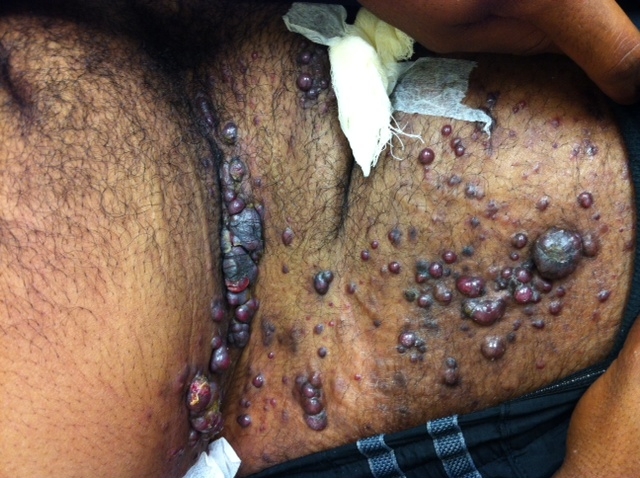 Which of the following is the most likely diagnosis?
 (Multiple Choice)
4.9/5 (79)
(79) A 54-year-old man comes to the emergency department due to progressive shortness of breath, lower extremity swelling, and decreased urine output for the past week. The patient has a history of nonischemic cardiomyopathy and heart failure with reduced ejection fraction. Medications include metoprolol succinate, lisinopril, spironolactone, and furosemide. He has been on stable doses of medication for the past 6 months but admits that he "misses some doses now and then." Temperature is 98.5 F (36.9 C), blood pressure is 112/64 mm Hg, pulse is 90/min, and respirations are 20/min. Oxygen saturation is 93% on room air. Physical examination shows jugular venous distension. S1 and S2 are normal and there are no murmurs. An S3 is heard. Crackles are heard at the bilateral lung bases. The abdomen is distended and there is 2+ pitting lower extremity edema bilaterally. Laboratory results (current and from 3 weeks ago) are as follows:  Urinalysis is unremarkable. Which of the following is the most likely cause of this patient's acute kidney injury?
 (Multiple Choice)
4.8/5 (81)
(81) A 26-year-old man comes to the office with his wife due to inability to conceive after a year of regular unprotected intercourse. His wife has a child from a previous marriage. The patient reports decreased libido but has no trouble achieving or maintaining erection. Temperature is 37 C (98.6 F), blood pressure is 116/70 mm Hg, and pulse is 60/min. His height is 185 cm (6 ft 1 in), weight is 70 kg (154 lb), and BMI is 20 kg/m2. Physical examination shows intact sense of smell and visual fields. He has bilateral gynecomastia and sparse facial and body hair. Genital examination shows normal penis morphology, but the testes are firm and about 6 mL in volume (normal: 18-25 mL). Which of the following is the most likely cause of this patient's infertility?
(Multiple Choice)
4.8/5 (68)
(68) A 55-year-old woman comes to the office due to persistent shortness of breath. Over the last year, she has had difficulty climbing the stairs to her bedroom and performing household chores. The patient also feels fatigued at the end of the day. She has no chest pain, cough, syncope, or lower extremity swelling. Medical history is significant for carpal tunnel syndrome and hypothyroidism, for which she takes levothyroxine. The patient is a lifetime nonsmoker. She has no family history of early coronary artery disease. Blood pressure is 133/75 mm Hg and pulse is 85/min and regular. Lungs are clear on auscultation. The apical impulse is displaced to the left, and there is a palpable systolic thrill. A 4/6 blowing and high-pitched holosystolic murmur is heard at the apex. Which of the following additional physical findings would most likely be present in this patient?
(Multiple Choice)
5.0/5 (82)
(82) A 24-year-old woman comes to the office due to 3 days of left eye redness and discharge, with crusting of the eyelid and difficulty opening it in the morning. Today, the patient's right eye also became red. She has had no pain, itching, photophobia, or visual difficulty. Her boyfriend has had similar symptoms. The patient has no chronic medical conditions and takes no medications. Physical examination shows bilateral conjunctival erythema. There is thick, yellowish discharge at the corner of the eyes that quickly reaccumulates after wiping. The cornea is normal, and no ocular tenderness is present. Which of the following pathogens is most likely responsible for this patient's condition?
(Multiple Choice)
4.9/5 (90)
(90) A 49-year-old man comes to the office for evaluation of a pruritic rash on his back. The rash has been present for a few months and has been unrelenting. The itching disturbs his sleep, and over-the-counter antihistamines have not helped. Medical history is significant for primary hypertension, for which he takes hydrochlorothiazide and lisinopril. Vital signs are normal. The patient's skin findings are shown in the image below: 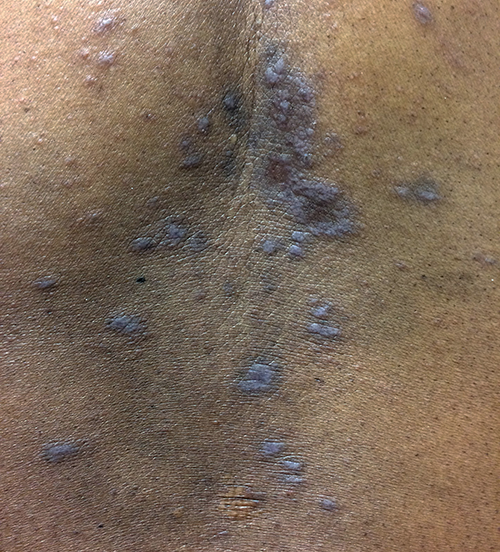 Which of the following is the most likely diagnosis?
 (Multiple Choice)
4.8/5 (71)
(71) A prospective cohort study was conducted to evaluate the long-term effects of a high-fat diet on the incidence of colon cancer. The study participants were randomly selected from the population of interest. Dietary patterns were assessed through the use of periodic self-completed questionnaires. The investigators reported a 5-year relative risk of 1.60 for people who consumed a high-fat diet compared to individuals who consumed a low-fat diet. The 95% confidence interval was 1.02 to 2.15. This study is most likely to have which of the following p values?
(Multiple Choice)
4.9/5 (72)
(72) A 37-year-old woman comes to the emergency department due to left-sided weakness that started several hours ago. She has had no fever, headache, or vision changes. Over the past 6 months, the patient has had progressive exertional dyspnea, nocturnal cough, and occasional hemoptysis. She also has had frequent episodes of palpitations and an irregular heartbeat. The patient emigrated from Cambodia 2 years ago. She has never used tobacco and does not use alcohol. On neurologic examination, left-sided hemiparesis is present. Which of the following is the most likely diagnosis?
(Multiple Choice)
4.9/5 (81)
(81) Walking for 6 minutes causes mild dyspnea, and oxygen saturation drops to 88%. Chest x-ray shows no infiltrates. Pulmonary function testing reveals FEV1 at 95% of predicted and a FEV1/FVC ratio of 84%. Pulmonary artery systolic pressure estimated by Doppler echocardiography is 65 mm Hg at rest (normal 15-30 mm Hg).
Lung biopsy will most likely demonstrate which of the following?
(Multiple Choice)
4.8/5 (77)
(77) A 9-year-old girl is brought to the office due to "ringing in her right ear" over the past week. She also has noticed a popping sensation in the ear when she swallows and difficulty hearing soft sounds. The patient has had nasal congestion during this time but is otherwise well. She and her family flew home from a ski trip in Colorado a few days before her symptoms began. Vital signs are normal. Otoscopic examination shows a retracted right tympanic membrane with surrounding dilated blood vessels; the left side is unremarkable. Pupils are equal, round, and reactive to light and accommodation. Coordination and balance are normal. Cranial nerve testing demonstrates a mild reduction in hearing on the right side. Which of the following is the most likely diagnosis in this patient?
(Multiple Choice)
4.9/5 (89)
(89) A 45-year-old woman comes to the office due to a 3-month history of progressive exertional dyspnea and nonproductive cough. She has had no chest pain or pedal edema but reports intermittent episodes of difficulty swallowing. The patient has a history of hypertension and severe gastroesophageal reflux and has had Raynaud phenomenon for 2 years. She does not use tobacco or alcohol. Blood pressure is 142/86 mm Hg and pulse is 80/min. Physical examination shows the skin over her face, hands, arms, and trunk to be thick and firm. Scattered crackles are heard on lung auscultation. Which of the following is the most likely cause of this patient's current symptoms?
(Multiple Choice)
4.9/5 (69)
(69) A 72-year-old man comes to the office due to palpitations for the past 1 week. The patient has had no fever, cough, chest pain, or dizziness. Medical history is significant for mild chronic obstructive pulmonary disease, long-standing hypertension, hyperlipidemia, and chronic stable angina. He uses an albuterol/ipratropium inhaler as needed. The patient is a former smoker; he does not use alcohol but drinks 2 or 3 cups of coffee daily. Temperature is 37.1 C (98.8 F), blood pressure is 136/78 mm Hg, pulse is 116/min, respirations are 16/min. Oxygen saturation is 97% on room air. On physical examination, the patient appears comfortable with normal work of breathing. Lung auscultation reveals mildly prolonged expiration with no wheezing or crackles. Cardiac examination shows irregular tachycardia. The remainder of the physical examination is unremarkable. ECG rhythm strip is shown in the exhibit.  Which of the following most likely increased the risk of development of this patient's arrhythmia?
 (Multiple Choice)
4.9/5 (72)
(72) A 44-year-old-man with HIV is being discharged from the hospital. He was admitted 2 weeks ago for fever and headache and was diagnosed with cryptococcal meningitis. The patient was treated with amphotericin B and flucytosine, and his symptoms are now resolved. Vital signs are normal. Physical examination shows no abnormalities. Which of the following medications should be prescribed for the patient to take following discharge?
(Multiple Choice)
5.0/5 (81)
(81) A 9-year-old boy is brought to the emergency department due to lower extremity weakness and pain. The patient first noticed soreness in his legs yesterday and had difficulty standing this morning. He has a tingling sensation in his toes and fingers as well as lower back pain. Temperature is 37.2 C (98.9 F), blood pressure is 105/70 mm Hg, and pulse is 40/min. The patient is alert and responds appropriately. Heart and lung examinations are normal aside from bradycardia. The lower back pain is nonreproducible with palpation of the spinous processes or paraspinal muscles. Neurologic examination shows decreased strength and diminished reflexes in both lower extremities. There is pain and mildly decreased sensation with pinprick testing. Which of the following is most associated with this patient's underlying diagnosis?
(Multiple Choice)
4.7/5 (88)
(88) A 36-year-old man is brought to the emergency department by his roommate with confusion and agitation for the last 2 days. While in the emergency department, he has generalized tonic-clonic seizures. The patient's other medical problems include alcohol abuse and illicit drug use. He was hospitalized 6 months ago for alcoholic pancreatitis. His temperature is 40.0 C (104.0 F), blood pressure is 120/80 mm Hg, and pulse is 105/min. He is confused and disoriented. Funduscopy is within normal limits, and there is no neck stiffness. Neurologic examination shows upgoing plantar reflexes bilaterally. CT scan of the head reveals no abnormalities. Lumbar puncture is performed, and cerebrospinal fluid analysis results are as follows: 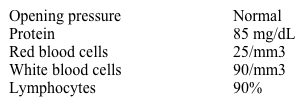 Gram stain shows no bacteria. Further cerebrospinal fluid studies are pending. Which of the following is the best next step in management of this patient?
 (Multiple Choice)
4.8/5 (83)
(83) A 70-year-old woman comes to the office due to worsening bilateral shoulder pain for 3 months that is not responsive to analgesics. The patient also reports tingling in her right hand and forearm for the past 3 weeks. Medical history is significant for diabetic nephropathy and end-stage renal disease. The patient has been receiving hemodialysis 3 times a week for 20 years. Temperature is 37 C (98.6 F), blood pressure is 130/78 mm Hg, pulse is 80/min, and respirations are 16/min. Examination shows bilateral hypertrophy of the shoulders. Range of motion of the shoulder joints is restricted in all directions. Weakness and atrophy of the muscles of the thenar eminence, as well as decreased sensation in the thumb and index, middle, and ring fingers, are noted. Heart sounds are normal. There is no hepatosplenomegaly. X-ray reveals radiolucent bone cysts in both shoulders. Ultrasound reveals increased rotator cuff thickness and deposits with increased echogenicity between the muscles and tendons of the rotator cuff. Serum calcium is 8.1 mg/dL. Which of the following is the most likely diagnosis?
(Multiple Choice)
4.8/5 (80)
(80) A 34-year-old sexually active female comes to your office because of urinary frequency and dysuria for two days. She has had two such episodes in the past, each treated with oral antibiotics. Physical examination reveals suprapubic tenderness and her urinalysis is positive for nitrite, leukocyte esterase, many WBC, and a moderate amount of bacteria. Which of the following is the most common reason for the higher incidence of urinary tract infections in females than in males?
(Multiple Choice)
4.8/5 (71)
(71) A 21-year-old college student is brought to the emergency department by ambulance. The patient's friends saw him swallow an unknown substance at a concert party. Soon afterward, he appeared to be interacting with others at the party. A few hours later, however, the patient seemed disoriented, appeared flushed, and was sweating profusely. When emergency responders arrived, they found him having a seizure. He was stabilized en route to the emergency department, where his seizure stopped. The patient has no active illnesses except for a history of depression, for which he takes a selective serotonin reuptake inhibitor. He takes no other medications. Temperature is 40 C (104 F), blood pressure is 170/96 mm Hg, pulse is 120/min, and respirations are 18/min. On examination, the patient is flushed, diaphoretic, and hyperreflexive with occasional myoclonus, and he continues to be disoriented. Laboratory results are unremarkable except for a serum sodium level of 121 mEq/L. Which of the following substances is the most likely cause of this patient's condition?
(Multiple Choice)
4.9/5 (94)
(94) Showing 181 - 200 of 1702
 Prev
- 1
- ...
- 2
- ...
- 3
- ...
- 4
- ...
- 5
- ...
- 6
- ...
- 7
- ...
- 8
- ...
- 9
- ...
- 10
- ...
- 11
- ...
- 12
- ...
- 13
- ...
- 14
- ...
- 15
- ...
- 16
- ...
- 17
- ...
- 18
- ...
- 19
- ...
- 20
- ...
- 21
- ...
- 22
- ...
- 23
- ...
- 24
- ...
- 25
- ...
- 26
- ...
- 27
- ...
- 28
- ...
- 29
- ...
- 30
- ...
- 31
- ...
- 32
- ...
- 33
- ...
- 34
- ...
- 35
- ...
- 36
- ...
- 37
- ...
- 38
- ...
- 39
- ...
- 40
- ...
- 41
- ...
- 42
- ...
- 43
- ...
- 44
- ...
- 45
- ...
- 46
- ...
- 47
- ...
- 48
- ...
- 49
- ...
- 50
- ...
- 51
- ...
- 52
- ...
- 53
- ...
- 54
- ...
- 55
- ...
- 56
- ...
- 57
- ...
- 58
- ...
- 59
- ...
- 60
- ...
- 61
- ...
- 62
- ...
- 63
- ...
- 64
- ...
- 65
- ...
- 66
- ...
- 67
- ...
- 68
- ...
- 69
- ...
- 70
- ...
- 71
- ...
- 72
- ...
- 73
- ...
- 74
- ...
- 75
- ...
- 76
- ...
- 77
- ...
- 78
- ...
- 79
- ...
- 80
- ...
- 81
- ...
- 82
- ...
- 83
- ...
- 84
- ...
- 85
- ...
- 86
- ...
- Next

Filters
- Essay(0)
- Multiple Choice(0)
- Short Answer(0)
- True False(0)
- Matching(0)