


 Chat with AI
Exam 1: Medicine

Exam 1: Medicine2 k Questions
Exam 2: Pediatric723 Questions
Exam 3: Psychiatry336 Questions
Exam 4: Surgery563 Questions
Exam 5: Obstetrics & Gynecology469 Questions
Select questions type


A 19-year-old woman comes to the office due to a persistent sore throat, fever, and mild lower abdominal discomfort for the past few days. She has no associated fatigue, chills, dysphagia, rhinorrhea, cough, or sick contacts. The patient has no changes in bowel or bladder function and no other medical conditions. She started college 4 months ago and lives with 3 roommates. The patient is sexually active and has 2 new sexual partners; she uses combination oral contraceptives. She does not use tobacco, alcohol, or illicit drugs. Temperature is 38.3 C (100.9 F), blood pressure is 120/70 mm Hg, and pulse is 68/min. The oral mucosa has no ulcerative lesions or petechiae. The pharyngeal arches are erythematous without exudate. Bilateral nontender cervical lymphadenopathy is present. The abdomen is tender to deep palpation in the lower quadrants; there is no splenomegaly. Urine pregnancy test is negative. Which of the following is the most likely pathogen responsible for this patient's symptoms?
(Multiple Choice)
4.8/5  (78)
(78) A 36-year-old man comes in for evaluation of 4 months of coughing. The cough is productive of white sputum and worsens at night. The patient has no hemoptysis, chest pain, dyspnea, weight loss, nasal congestion, or postnasal drip. He tried over-the-counter cough syrup that contains diphenhydramine. He says it "just makes me sleepy but doesn't help the cough." The patient's other medical problems include gastroesophageal reflux disease, for which he takes omeprazole daily. He smoked a pack of cigarettes a day for 10 years and quit 5 years ago. His BMI is 26.5 kg/m2. Chest examination indicates normal breath sounds bilaterally. Cardiac examination shows a split second heart sound with inspiration and no murmurs. Chest x-ray is normal. Which of the following is the best next step in management of this patient's cough?
(Multiple Choice)
4.8/5 (86)
(86) A 37-year-old previously healthy man comes to the emergency department due to worsening cough and dyspnea for the past several days. Evaluation shows tachycardia, tachypnea, labored breathing, and hypoxemia on room air. Chest x-ray reveals diffuse bilateral interstitial infiltrates. The patient states he has had unprotected sex with multiple partners. He is not married and does not have any children. Rapid HIV testing is positive. The diagnosis is discussed with the patient, and hospital admission for treatment of hypoxic respiratory failure due to suspected Pneumocystis pneumonia is recommended. The patient agrees but does not want any of his family members to know about the HIV diagnosis. Which of the following is the best course of action?
(Multiple Choice)
4.9/5 (75)
(75) A 24-year-old man comes to the office due to 3 days of urethral discharge and a burning sensation with urination. He had sexual intercourse with a new female partner a week ago and has had 4 female sexual partners over the past 6 years. The patient has no other medical conditions and takes no medication. He does not use tobacco, alcohol, or illicit drugs. Vital signs are within normal limits. Examination shows no skin lesions or rash. The abdomen is soft and nontender. Genital examination shows copious, purulent discharge from the urethral orifice. Nucleic acid amplification testing (NAAT) result from the urine specimen is positive for Neisseria gonorrhoeae. HIV testing is negative. Antibiotic therapy is prescribed. Which additional test is indicated in this patient?
(Multiple Choice)
4.9/5 (67)
(67) A 44-year-old man is brought to the emergency department of a large academic medical center by ambulance after being shot in the thigh during an altercation at a local bar. Blood pressure 113/66 mm Hg, pulse is 102/min, and respirations are 22/min. On examination, the patient appears intoxicated and in moderate distress. The left lower extremity has a gunshot entry wound on the anterolateral upper left thigh and an exit wound on the medial thigh. The patient repeatedly uses offensive and racially charged language toward the treating physician. Which best describes the physician's ethical duty to provide treatment for this patient?
(Multiple Choice)
4.7/5 (82)
(82) A 22-year-old man comes to the office due to a facial rash. The patient has a history of cold sores and says he developed a recurrent sore about a week ago after spending hours outside training for a bike race. He applied a new, over-the-counter lip balm to his lips and the affected area for comfort. Three days ago, the sore began to crust over as he expected; however, a new, nonvesicular, pruritic rash developed near the site of the sore and has now spread toward the chin. Examination findings of the rash is shown in the image below: 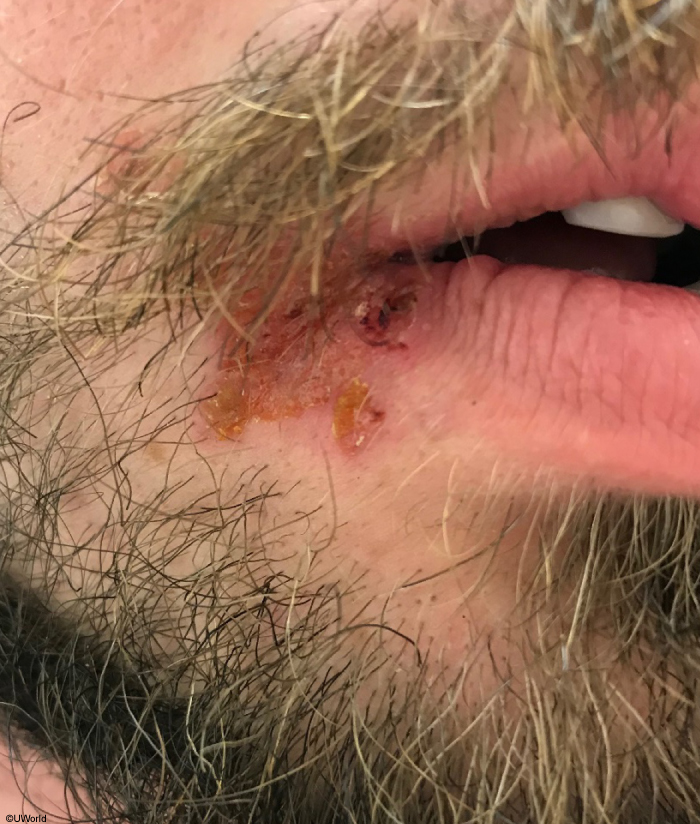 Which of the following is the most likely cause of this patient's current symptoms?
 (Multiple Choice)
4.9/5 (77)
(77) A 46-year-old man comes to the office for follow-up due to a blood pressure reading of 150/95 mm Hg during a preemployment examination. He has had no symptoms, and his medical history is unremarkable. The patient is an ex-smoker with a 10-pack-year history; he does not use alcohol or illicit drugs. He has a family history of hypertension, and his father died of a stroke at age 68. Blood pressure is 145/90 mm Hg (repeat: 144/92 mm Hg), and pulse is 75/min and regular. BMI is 29 kg/m2. Physical examination is unremarkable. This patient should be screened for which of the following conditions?
(Multiple Choice)
4.9/5 (76)
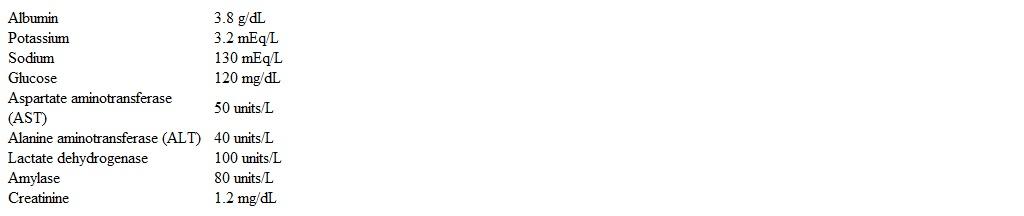
(76) A 37-year-old woman comes to the emergency department due to shortness of breath and left-sided chest pain that have been progressively worsening since beginning suddenly 2 days ago. The patient was diagnosed with multiple sclerosis 5 years ago. She uses a wheelchair due to spastic paraparesis and has scanning speech. Temperature is 36.7 C (98.1 F), blood pressure is 120/70 mm Hg, pulse is 110/min, and respirations are 20/min. Pulse oximetry is 94% on room air. Pulmonary examination is normal except for reduced breath sounds and dullness to percussion at the left lung base. The abdomen is soft and nontender. There is no peripheral edema. Laboratory results are as follows:  Chest x-ray reveals a small left-sided pleural effusion. No infiltrates are seen. Which of the following is the most likely cause of this patient's pleural effusion?
 (Multiple Choice)
4.8/5 (72)
(72) A 64-year-old nondiabetic man complains of cramping pain in his right thigh after walking 2 blocks. The pain goes away once he stops and rests for several minutes. He is an ex-smoker with 35-pack-year history. On physical examination, the distal pulses are diminished on the right leg. His ankle brachial index is 0.98 on the left and 0.75 on the right. Which of the following is this patient most likely to suffer over the next 5 years?
(Multiple Choice)
4.7/5 (76)
(76) A 44-year-old woman, gravida 2 para 2, comes to the office due to intermittent loss of urine over the last 3 months. Five years ago, she had midurethral sling surgery for stress incontinence that resolved her leakage of urine until recently. Prior to the midurethral sling, the patient's urinary leaking occurred during the day with laughing and jogging. Now, she is leaking unrelated to laughing or exercise and must get up to go to the bathroom throughout the night. The patient has tried Kegel exercises and having a regular bathroom schedule, but she is still leaking urine and often cannot make it to the bathroom in time. Her last menstrual period was 2 weeks ago. Physical examination shows a slight bulge at the anterior vaginal wall. Urinalysis is normal. Postvoid residual volume is 50 mL. Which of the following is the most appropriate therapy for this patient's urinary symptoms?
(Multiple Choice)
4.9/5 (89)
(89) A 52-year-old woman comes to the office due to an oral lesion. Medical history is significant for type 2 diabetes mellitus, vitiligo, and hypertension. Her last hemoglobin A1c 6 months ago was 8.3%. The patient works as a bus driver for a local public school. She has a 20-pack-year history. BMI is 32 kg/m2. On oral examination, a white patch is seen on the tongue, as shown in the exhibit. 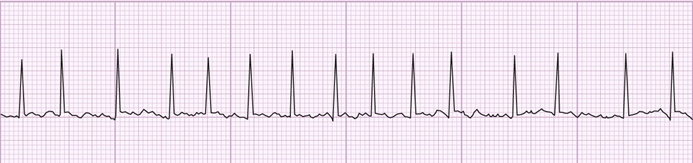 The lesion is not indurated and cannot be removed by scraping with a tongue depressor. There is no regional lymphadenopathy.
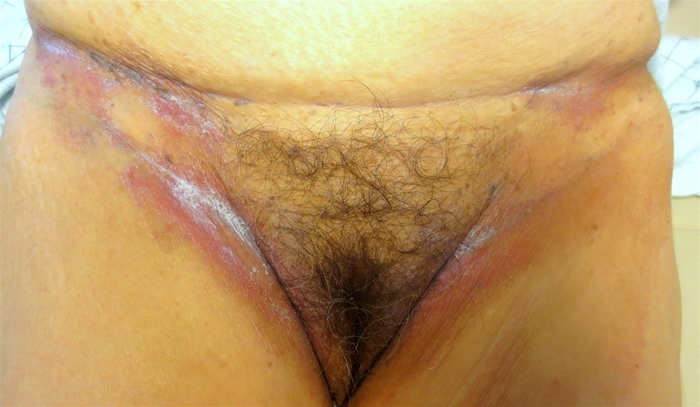 Which of the following is the greatest risk factor for this patient's oral lesion?
The lesion is not indurated and cannot be removed by scraping with a tongue depressor. There is no regional lymphadenopathy. Which of the following is the greatest risk factor for this patient's oral lesion? (Multiple Choice)
4.8/5 (88)
(88) A 62-year-old man comes to the office due to a year of progressive exertional dyspnea and dry cough. He lives by himself and has been having difficulty performing daily activities. The patient has a history of gastroesophageal reflux and osteoarthritis. He has smoked a pack of cigarettes daily for 40 years and occasionally drinks alcohol. The patient worked as a carpenter for 20 years, and before that, he repaired navy ships. He has no pets or recent travel history. Blood pressure is 140/80 mm Hg and pulse is 80/min and regular. Pulse oximetry is 92% on ambient air. BMI is 33.2 kg/m2. Chest x-ray reveals pleural calcifications. Pulmonary function studies are as follows.  Which of the following is the most likely cause of this patient's symptoms?
 (Multiple Choice)
4.8/5 (67)
(67) A 42-year-old woman comes to the emergency department due to 2 syncopal episodes in the last 3 days. The patient was well until approximately a month ago when she began to feel increasingly fatigued and weak. For the past 2 weeks, she has had anorexia, nausea, and abdominal pain. The patient's medical history is unremarkable, and she takes no medications. She drinks wine only on social occasions, and does not use tobacco or illicit drugs. Temperature is 36.7 C (98 F), blood pressure is 86/52 mm Hg, pulse is 90/min, and respirations are 18/min. Cardiopulmonary examination is normal. The abdomen is mildly tender with otherwise normal findings. The skin shows hyperpigmentation in the palmar creases. Which of the following additional findings is most likely present in this patient?
(Multiple Choice)
4.8/5 (73)
(73) A 9-year-old boy is brought to the emergency department for a worsening cough. Two weeks ago, he developed rhinorrhea, congestion, and a mild cough. Since then, the cough has worsened, particularly at night and during exertion, and he often vomits after a bout of coughing. The patient has no chronic medical conditions. Temperature is 37.2 C (99 F), blood pressure is 90/60 mm Hg, pulse is 98/min, and respirations are 20/min. Pulse oximetry shows an oxygen saturation of 98%. On physical examination, the child is alert and well-appearing. Bilateral subconjunctival hemorrhages and periorbital petechiae are noted. The lungs are clear to auscultation. Which of the following organisms is the most likely cause of this patient's illness?
(Multiple Choice)
4.7/5 (78)
(78) A 65-year-old woman comes to the office due to concerns about her risk for osteoporotic fractures. She reports that her sister takes medication for osteoporosis. Medical history is notable for hypothyroidism treated with levothyroxine and hypertension treated with hydrochlorothiazide. The patient underwent hysterectomy with salpingo-oophorectomy at age 51. She has a 10-pack-year history of cigarette smoking but quit at age 40, and she drinks 2 or 3 glasses of wine a week. Vital signs are normal. BMI is 23 kg/m2. Examination of the heart, lungs, and abdomen is normal. Pelvic examination shows vaginal atrophy. Laboratory evaluation is normal. DXA reveals a T-score of −2.5 at the lumbar spine and −1.9 at the femoral neck, which is consistent with osteoporosis. In addition to calcium and vitamin D supplementation, which of the following is the most appropriate treatment for this patient?
(Multiple Choice)
4.9/5 (59)
(59) A 44-year-old man comes to the emergency department for exertional dyspnea, abdominal distention, and abdominal discomfort. He has a history of alcohol abuse, peptic ulcer disease, and acute pancreatitis. Physical examination shows a distended abdomen with shifting dullness and 1+ ankle edema. A diagnostic paracentesis is performed and shows the following:  Blood studies show the following:
 Which of the following is the most likely cause of this patient's ascites?
Blood studies show the following: Which of the following is the most likely cause of this patient's ascites? (Multiple Choice)
4.8/5 (74)
(74) A 55-year-old business executive comes to the office due to worsening joint pains for the past several months. He says, "My hands and fingers feel tight on waking up in the morning, and they are painful to move. I can't hold my toothbrush or button up my shirts. It slowly gets better by the time I get to the office in the morning." The patient has also felt excessively tired and has lost 4.5 kg (10 lb) over the past 6 months, which he attributes to extra work for a new business venture. He has no prior medical problems and takes no medications. The patient occasionally drinks alcohol and does not use tobacco or illicit drugs. Temperature is 37.2 C (99 F), blood pressure is 132/86 mm Hg, and pulse is 72/min. Physical examination shows no scleral icterus or oral lesions. The lungs are clear to auscultation. Heart sounds are normal. The abdomen is soft and nontender with no organomegaly. Metacarpophalangeal and proximal interphalangeal joints of both hands show mild boggy swelling with tenderness on gentle squeezing. There is no increased joint warmth or erythema. No skin rashes are present. Laboratory results are as follows.  Which of the following is the most appropriate next step in evaluation of this patient?
 (Multiple Choice)
4.9/5 (69)
(69) A 39-year-old previously healthy man comes to the office due to 4 days of nausea, loss of appetite, malaise, and mild upper abdominal discomfort. He has had no vomiting or diarrhea. The patient returned from a trip to the Philippines with his wife 2 weeks ago, but she has had no symptoms. He did not receive any vaccinations or chemoprophylaxis prior to travel and reports that he did not consume bottled water consistently during the trip. The patient does not use tobacco, alcohol, or illicit drugs. Temperature is 37.9 C (100.2 F), blood pressure is 118/72 mm Hg, and pulse is 96/min. Physical examination reveals scleral icterus and tender hepatomegaly. Laboratory results are as follows:  Which of the following is the most likely sequela of this patient's condition?
 (Multiple Choice)
4.9/5 (87)
(87) A 48-year-old woman comes to the emergency department due to a 4-hour history of acute-onset shortness of breath and chest pain. She has no fever and no history of similar symptoms. The patient is being evaluated as an outpatient for excessive menstrual bleeding and is scheduled to undergo endometrial biopsy and ultrasound. Her other medical problems include carpal tunnel syndrome, hypertension, hypercholesterolemia, and hypothyroidism. She is afebrile. Blood pressure is 130/80 mm Hg, pulse is 112/min, and respirations are 24/min. BMI is 36 kg/m2. Heart sounds are normal. Bilateral wheezing is heard on auscultation. The patient's right leg is swollen. Which of the following is most likely present on further evaluation?
(Multiple Choice)
4.9/5 (80)
(80) A 53-year-old man comes to the emergency department of an academic medical center with back pain after lifting a heavy box a day earlier. The patient appears anxious and in pain. He says, "I'm worried I've twisted a nerve in my back, and I really hope you are going to do an MRI." A second-year resident obtains the patient's history and conducts an initial physical examination. Palpation of the lower back reveals paravertebral tenderness on the left side at the L4 level; there is no tenderness to palpation over the spine. Strength and sensation in both extremities are intact, and deep tendon reflexes are symmetric. The resident presents his findings to the attending physician, mentioning the patient's concerns and request for MRI. As the attending physician examines the patient, which of the following statements is most recommended to reduce patient requests for unnecessary imaging?
(Multiple Choice)
5.0/5 (68)
(68) Showing 1561 - 1580 of 1702
 Prev
- 1
- ...
- 2
- ...
- 3
- ...
- 4
- ...
- 5
- ...
- 6
- ...
- 7
- ...
- 8
- ...
- 9
- ...
- 10
- ...
- 11
- ...
- 12
- ...
- 13
- ...
- 14
- ...
- 15
- ...
- 16
- ...
- 17
- ...
- 18
- ...
- 19
- ...
- 20
- ...
- 21
- ...
- 22
- ...
- 23
- ...
- 24
- ...
- 25
- ...
- 26
- ...
- 27
- ...
- 28
- ...
- 29
- ...
- 30
- ...
- 31
- ...
- 32
- ...
- 33
- ...
- 34
- ...
- 35
- ...
- 36
- ...
- 37
- ...
- 38
- ...
- 39
- ...
- 40
- ...
- 41
- ...
- 42
- ...
- 43
- ...
- 44
- ...
- 45
- ...
- 46
- ...
- 47
- ...
- 48
- ...
- 49
- ...
- 50
- ...
- 51
- ...
- 52
- ...
- 53
- ...
- 54
- ...
- 55
- ...
- 56
- ...
- 57
- ...
- 58
- ...
- 59
- ...
- 60
- ...
- 61
- ...
- 62
- ...
- 63
- ...
- 64
- ...
- 65
- ...
- 66
- ...
- 67
- ...
- 68
- ...
- 69
- ...
- 70
- ...
- 71
- ...
- 72
- ...
- 73
- ...
- 74
- ...
- 75
- ...
- 76
- ...
- 77
- ...
- 78
- ...
- 79
- ...
- 80
- ...
- 81
- ...
- 82
- ...
- 83
- ...
- 84
- ...
- 85
- ...
- 86
- ...
- Next

Filters
- Essay(0)
- Multiple Choice(0)
- Short Answer(0)
- True False(0)
- Matching(0)