


 Chat with AI
Exam 1: Medicine

Exam 1: Medicine2 k Questions
Exam 2: Pediatric723 Questions
Exam 3: Psychiatry336 Questions
Exam 4: Surgery563 Questions
Exam 5: Obstetrics & Gynecology469 Questions
Select questions type


A 37-year-old man comes to the emergency department due to severe nausea and vomiting a day after receiving chemotherapy for oropharyngeal cancer. He has no other acute symptoms and is otherwise tolerating his treatments. The patient has a history of bipolar disorder that has been stable, as well as a remote history of alcohol abuse. Medications include lithium and lamotrigine. Temperature is 36.7 C (98 F), blood pressure is 140/86 mm Hg, pulse is 98/min, and respirations are 16/min. Physical examination shows mild erythema at the excision site of the primary lesion on the base of the tongue but is otherwise normal. Laboratory results indicate mild dehydration, lithium level of 0.6 mEq/L (normal: 0.6-1.2 mEq/L), and blood alcohol level of 0. The patient is treated with intravenous normal saline and multiple doses of an antiemetic to stop his vomiting. Several hours later, he has sudden neck pain, his neck muscles are stiff, and he has difficulty speaking. Which of the following medications best explains this patient's sudden symptoms?
(Multiple Choice)
4.9/5  (76)
(76) A 54-year-old man comes to the office due to morning facial puffiness and bilateral leg swelling. His other medical problems include recurrent pulmonary infections due to bronchiectasis and psoriasis. Blood pressure is 143/92 mm Hg and pulse is 92/min. BMI is 24 kg/m2. Examination shows a fourth heart sound. Hepatomegaly, palpable kidneys, and 2+ pitting edema of the lower extremities to the knees bilaterally are present on examination. Urinalysis shows 4+ proteinuria and normal urinary sediment. Which of the following is the most likely diagnosis in this patient?
(Multiple Choice)
4.9/5 (83)
(83) A 23-year-old woman comes to the emergency department due to 3 days of fever, chills, cough productive of clear sputum, and pain in her right lower chest with deep inspiration and cough. She has had no sore throat, nasal discharge, or sick contacts. The patient has a history of HIV and takes combination antiretroviral therapy as prescribed. CD4 count was 300/mm3 at routine office follow-up a month ago. She does not use tobacco, alcohol, or illicit drugs. Temperature is 39 C (102.2 F), blood pressure is 115/76 mm Hg, pulse is 104/min, and respirations are 22/min. Oropharyngeal mucosa is normal and there is no cervical lymphadenopathy. Cardiopulmonary auscultation reveals a soft midsystolic murmur at the upper left sternal border and crackles in the right lower posterior chest. Chest x-ray is shown below. 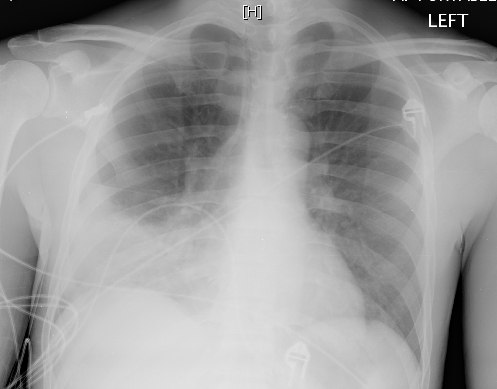 Which of the following is the most likely organism responsible for this patient's current symptoms?
 (Multiple Choice)
4.9/5 (92)
(92) A 60-year-old man comes to the office due to fatigue and muscle weakness in his extremities. The weakness has gotten progressively worse over the past few months. He has also lost 7 kg (15.4 lb) during the last 3 months. He has no other medical conditions. The patient smokes 2 packs of cigarettes daily and consumes alcohol occasionally. On examination, he has difficulty getting out of the chair to sit on the examining table. Muscle strength is 3/5 in the proximal muscle groups symmetrically and is not improved by repeated muscle contractions. Reflexes are 2+ bilaterally. No sensory abnormality is present. There are erythematous patches and violaceous papules involving the dorsum of his fingers. Chest x-ray reveals an ill-defined mass in the right lower lobe. The patient's muscle weakness is most likely due to a pathologic process at which of the following?
(Multiple Choice)
5.0/5 (71)
(71) A 32-year-old man comes to the emergency department due to worsening shortness of breath. The patient has a 20-year history of asthma. He developed low-grade fever, rhinorrhea, and generalized body aches 4 days ago, followed by increasing dyspnea and cough since yesterday. The patient's as-needed reliever inhaler provided little help. Temperature is 37 C (98.6 F), blood pressure is 155/88 mm Hg, pulse is 120/min, and respirations are 28/min. Pulse oximetry is 84% on room air and 92% on 3 L/min of oxygen. The patient speaks in clipped phrases and uses the accessory muscles of respiration. Examination shows diminished breath sounds bilaterally with scattered expiratory wheezes. Chest x-ray reveals hyperinflated lungs but no infiltrates. Complete blood count shows leukocytes at 11,000/mm3. The patient is started on continuous albuterol and ipratropium nebulizers, as well as intravenous magnesium and methylprednisolone. Repeat examination an hour later is notable for respirations at 36/min, persistently decreased breath sounds, and no wheezing. Results of an arterial blood gas test on 3 L/min of oxygen are as follows:  Which of the following is the best next step in management of this patient?
 (Multiple Choice)
4.9/5 (77)
(77) A 15-year-old girl is brought to the office for evaluation of her menstrual periods. The patient underwent menarche at age 12 and initially had irregular, heavy, nonpainful menses. Menses now occur monthly and consist of 4 days of light bleeding. For the past 3 months, the girl has developed malaise and dizziness 2 days prior to her menstrual period and has had associated, continuous lower abdominal pain that radiates to her thighs. Symptoms resolve on the second day of menses. She has no chronic medical conditions and takes no daily medications. The patient is not sexually active. Her last menstrual period was a week ago. Vital signs are normal. The abdomen is soft, nontender, and nondistended and has no palpable masses. Pelvic examination is deferred. Which of the following is the best next step in management of this patient?
(Multiple Choice)
4.9/5 (88)
(88) A 32-year-old man comes to the emergency department due to a persistent nosebleed lasting an hour. Over the past week, he has had several episodes of epistaxis that stopped after prolonged nose pinching. The patient has also noticed more fatigue and skin bruising than usual over the past month. He has not had any recent nasal trauma or upper respiratory tract infections and does not use any intranasal medications. The patient does not use tobacco or alcohol and maintains a vegan diet. Temperature is 37.2 C (99 F), blood pressure is 130/80 mm Hg, pulse is 96/min, and respirations are 18/min. Physical examination shows dried blood in the right nostril with no intranasal lesions. No enlarged lymph nodes are present. Lung fields are clear to auscultation and heart sounds are normal. The abdomen is soft and nontender with no hepatosplenomegaly. Scattered ecchymoses are present on the extremities. Laboratory results are as follows:  Which of the following is most likely associated with this patient's current condition?
 (Multiple Choice)
4.8/5 (79)
(79) A 22-year-old primigravida at 34 weeks gestation is brought to the emergency department by ambulance due to sudden loss of consciousness followed by generalized shaking. The paramedics initiated an intravenous magnesium sulfate bolus, which was infusing rapidly when the patient arrived at the hospital. She says she is very tired and has blurry vision and a headache. The patient also has muscle pain and sore joints and is unable to move her right arm. Blood pressure is 145/98 mm Hg, pulse is 112/min, and respirations are 16/min. She holds the right arm adducted and internally rotated. Examination shows loss of external rotation of the right arm but no sensory deficits. Deep tendon reflexes are 2+ bilaterally, and handgrip and wrist strength are preserved on both sides. Urinalysis shows 3+ protein. Which of the following is the most likely cause of this patient's right arm findings?
(Multiple Choice)
4.8/5 (74)
(74) A 65-year-old woman comes to the physician complaining of periodic headaches in the temporal region, visual disturbances, and neck stiffness. Appropriate empiric medical therapy is initiated, and biopsy of a scalp artery confirms giant cell arteritis. The patient is very compliant with treatment. She comes to the physician 6 months later with slowly progressive muscle weakness. Her headaches have resolved, but she has difficulty climbing stairs and getting up from a chair. Her blood pressure is 120/70 mm Hg, pulse is 82/min, and respirations are 12/min. Physical examination shows 4/5 muscle power in her proximal lower extremities bilaterally. Her serum creatine kinase level and erythrocyte sedimentation rate are normal. Which of the following is the most likely cause of this patient's current complaints?
(Multiple Choice)
4.8/5 (77)
(77) A 24-year-old man experiences syncope while shoveling snow. He regains consciousness within 1 minute. He has had some shortness of breath and chest pains recently, related primarily to exercise. He denies illicit drug use. His temperature is 37.2° C (98.9° F), blood pressure is 126/76 mm Hg, pulse is 76/min, and respirations are 14/min. Physical examination shows a well-built man in no apparent distress. Lungs are clear. A crescendo-decrescendo systolic murmur is heard along the left sternal border without carotid radiation. Chest x-ray is normal. Which of the following is the most likely cause of his syncopal episode?
(Multiple Choice)
4.8/5 (92)
(92) A 4-year-old boy is brought by his parents to the volunteer medical center of a large refugee camp in Egypt for evaluation of eye redness. For 10 days the boy has had mild rhinorrhea and cough that are now resolving. He began having mild eye redness 2 days ago with scant, watery discharge. He has not had ocular pain or itching. The patient's 6-year-old brother has similar symptoms. The family fled their home in Sudan due to regional conflict and arrived in the refugee camp approximately 2 months ago. The boy's grandfather and 2 dogs remained at their home. Vital signs are stable. Examination of the chest and abdomen is unremarkable. Examination of the eyes shows several pale follicles and inflammatory changes in the tarsal conjunctivae bilaterally. The conjunctivae appear mildly thickened. Visual acuity is 20/20 bilaterally. Which of the following is the most likely diagnosis for this patient?
(Multiple Choice)
4.9/5 (82)
(82) A 26-year-old woman comes to the emergency department due to 3 weeks of fever, watery diarrhea, nausea, abdominal cramps, and weight loss of 4.5 kg (10 lb). She has a history of AIDS and is noncompliant with therapy. The patient has been admitted to the hospital twice in the last 4 months due to Pneumocystis pneumonia. Temperature is 38.2 C (100.8 F), blood pressure is 102/62 mm Hg, and pulse is 102/min. BMI is 18 kg/m2. Scattered lymphadenopathy is present in the cervical, axillary, and inguinal chains. Abdominal examination reveals mild, diffuse tenderness and no organomegaly. CD4 count is 18/mm3 and alkaline phosphatase is 484 U/L. Blood cultures in specialized media grow nontuberculous mycobacteria. Which of the following is the most appropriate antibiotic therapy for this patient?
(Multiple Choice)
4.8/5 (71)
(71) A 75-year-old woman comes to the office after 2 months of heat intolerance, sweating, and palpitations. The patient has lost significant weight recently despite increasing her dietary intake. Medical history is notable only for hypertension, for which she takes amlodipine. Temperature is 37.2 C (99 F), blood pressure is 116/80 mm Hg, pulse is 120/min and regular, and respirations are 18/min. Physical examination shows a nontender, diffuse swelling in the front of her neck that moves upward with swallowing. There is no proptosis or pretibial myxedema. Fine hand tremors and hyperreflexia are noted on neurological examination. Laboratory results are as follows:  Radioactive iodine uptake at 24 hours is significantly increased and homogenously distributed throughout the thyroid gland. The patient is started on a beta blocker. Which of the following is the best next step in management of this patient?
 (Multiple Choice)
5.0/5 (82)
(82) A 35-year-old man comes to the office due to a week of pain with swallowing and a substernal burning sensation. The patient was diagnosed with HIV 2 years ago. He was previously noncompliant with treatment but recently started taking antiretroviral therapy and trimethoprim-sulfamethoxazole. CD4 count a month ago was 46/mm3. Temperature is 36.6 C (98 F), blood pressure is 133/89 mm Hg, and pulse is 72/min. Examination of the oral cavity shows white plaques on the buccal mucosa and palate that are easily removable with a tongue scraper. The lungs are clear to auscultation. The abdomen is soft and nontender. What is the most appropriate next step in management of this patient's substernal chest pain?
(Multiple Choice)
4.9/5 (76)
(76) A 38-year-old woman is brought to the emergency department due to an episode of syncope. The patient has felt weak and has not eaten well over the last 2 weeks. As a result, she believes she is "dehydrated." Temperature is 38.2 C (100.8 F), blood pressure is 112/58 mm Hg, and pulse is 49/min and regular. The oral mucosa is dry and dentition is poor. An early diastolic murmur is heard at the left sternal border at full expiration. The lungs are clear. The abdomen is soft and nontender. ECG reveals sinus rhythm with a 2:1 second-degree atrioventricular block. Laboratory results are as follows:  Which of the following is the most likely diagnosis in this patient?
 (Multiple Choice)
4.9/5 (74)
(74) A 27-year-old man comes to the office due to syncope. Two days ago, the patient was sitting at his computer at work and then suddenly awakened lying on the ground. His coworkers saw him collapse to the floor, jerk a few times, and become still. The patient was unconscious for 1-2 minutes. He was not lethargic or confused after the episode and did not experience chest pain or shortness of breath. The patient has had two similar episodes in the last year but did not seek medical attention. He has become concerned following this third episode. He has no medical history and takes no medications. Temperature is 36.7 C (98.1 F), blood pressure is 120/60 mm Hg, pulse is 72/min, and respirations are 16/min. Pulse oximetry is 100% on room air. The patient is awake, alert, and oriented, with normal speech. He has a small occipital hematoma. Oropharyngeal examination is normal. The pupils are equal and reactive to light. Heart and lung examinations are normal. Strength is 5/5 in the upper and lower extremities, and gait is normal. ECG is normal. What is the best next step in management of this patient?
(Multiple Choice)
4.7/5 (96)
(96) In clinical practice, the "CAGE" questionnaire is used to screen patients for alcohol use disorder (AUD). When a patient replies with 2 out of 4 positive responses to the "CAGE" questions, the test is considered to be positive for AUD. If this criterion is changed so that 3 out of 4 positive responses to the "CAGE" questions label the patient as having AUD, what is the effect on the sensitivity and specificity of this test?
(Multiple Choice)
4.9/5 (83)
(83) A 20-year-old woman comes to the office with intermittent chest pain for the past 3 weeks. She describes the pain as sharp, located to the left of the sternum, and lasting 5-10 seconds each episode. There is no associated fever, cough, breathlessness, palpitations, or syncope. The patient does not use tobacco, alcohol, or illicit drugs. Cardiac auscultation reveals a systolic murmur at the apex that shortens with squatting. Which of the following is the most likely diagnosis?
(Multiple Choice)
4.7/5 (76)
(76) A 16-year-old girl is brought to the emergency department after her parents found her attempting to cut her wrists. The parents say that she is often "moody" but has never done anything like this before. The patient has been very upset since her boyfriend broke up with her last week. Examination shows numerous superficial cuts on her forearms in various stages of healing and a fresh deep laceration that requires 5 sutures. The patient admits to attempting suicide by cutting her wrists. When asked why she did it, she says, "I don't know. I felt so alone and angry. I just didn't want to be here anymore." The patient avoids eye contact and looks at the ground during the entire interview. She refuses to answer many questions but admits to feeling depressed over the past few months. When asked if she would do something like this again, the patient looks down and does not answer. Her parents want to take the girl to her pediatrician, whom they trust and feel knows the patient very well. They refuse psychiatric hospitalization, and insist that they will watch their daughter at all times. The patient wants to go home as well. Which of the following is the most appropriate course of action?
(Multiple Choice)
4.8/5 (86)
(86) A 30-year-old man comes to the office with fatigue and lethargy that has worsened over the last 2 weeks. He has been forgetful lately and feels "exhausted" at the end of the day. The patient works as a contractor and is currently renovating old houses for sale. He describes feeling "clumsy" and dropping things at work, as well as tripping multiple times while climbing stairs. He also has abdominal pain that he attributes to constipation. The patient drinks 1 or 2 beers each weekend and does not use tobacco or illicit drugs. His mother was diagnosed with lupus and his older sister had thyroid surgery. Blood pressure is 120/80 mm Hg, and pulse is 76/min. Examination shows normal jugular venous pressure, no thyromegaly, clear lung fields, and normal first and second heart sounds. The abdomen is soft and nontender. There is no hepatomegaly or splenomegaly. There is weakness on dorsiflexion of bilateral wrists and feet. Upper and lower limb deep tendon reflexes are 1+. Laboratory results are as follows: 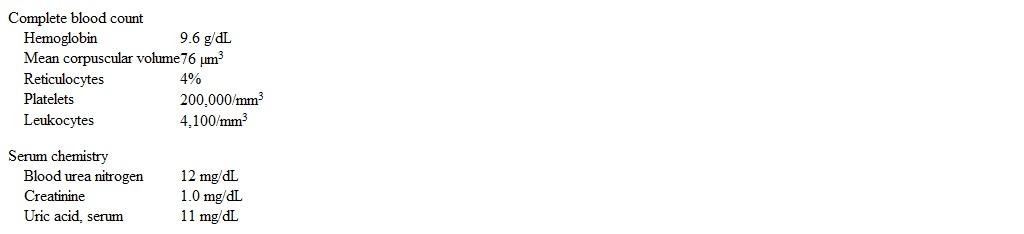 Creatine phosphokinase levels are normal. Which of the following is most likely to improve this patient's symptoms?
 (Multiple Choice)
4.9/5 (79)
(79) Showing 841 - 860 of 1702
 Prev
- 1
- ...
- 2
- ...
- 3
- ...
- 4
- ...
- 5
- ...
- 6
- ...
- 7
- ...
- 8
- ...
- 9
- ...
- 10
- ...
- 11
- ...
- 12
- ...
- 13
- ...
- 14
- ...
- 15
- ...
- 16
- ...
- 17
- ...
- 18
- ...
- 19
- ...
- 20
- ...
- 21
- ...
- 22
- ...
- 23
- ...
- 24
- ...
- 25
- ...
- 26
- ...
- 27
- ...
- 28
- ...
- 29
- ...
- 30
- ...
- 31
- ...
- 32
- ...
- 33
- ...
- 34
- ...
- 35
- ...
- 36
- ...
- 37
- ...
- 38
- ...
- 39
- ...
- 40
- ...
- 41
- ...
- 42
- ...
- 43
- ...
- 44
- ...
- 45
- ...
- 46
- ...
- 47
- ...
- 48
- ...
- 49
- ...
- 50
- ...
- 51
- ...
- 52
- ...
- 53
- ...
- 54
- ...
- 55
- ...
- 56
- ...
- 57
- ...
- 58
- ...
- 59
- ...
- 60
- ...
- 61
- ...
- 62
- ...
- 63
- ...
- 64
- ...
- 65
- ...
- 66
- ...
- 67
- ...
- 68
- ...
- 69
- ...
- 70
- ...
- 71
- ...
- 72
- ...
- 73
- ...
- 74
- ...
- 75
- ...
- 76
- ...
- 77
- ...
- 78
- ...
- 79
- ...
- 80
- ...
- 81
- ...
- 82
- ...
- 83
- ...
- 84
- ...
- 85
- ...
- 86
- ...
- Next

Filters
- Essay(0)
- Multiple Choice(0)
- Short Answer(0)
- True False(0)
- Matching(0)