


 Chat with AI
Exam 1: Medicine

Exam 1: Medicine2 k Questions
Exam 2: Pediatric723 Questions
Exam 3: Psychiatry336 Questions
Exam 4: Surgery563 Questions
Exam 5: Obstetrics & Gynecology469 Questions
Select questions type


A 27-year-old man comes to the office due to episodic abdominal pain. The pain is concentrated in the epigastrium and is gnawing in quality. It wakes him up during the night and is promptly relieved by a glass of water and a piece of bread. The patient has no associated vomiting or diarrhea but has experienced occasional "dark stools." He has no significant past medical history and takes no medications. Family history is significant for biliary disease in his mother. He smokes a pack of cigarettes daily and consumes a can of beer most days. Vital signs are within normal limits. Physical examination shows mild epigastric discomfort on deep palpation. After the diagnosis is confirmed, which of the following is the most appropriate intervention to provide relief of this patient's symptoms?
(Multiple Choice)
4.9/5  (82)
(82) A 19-year-old college student is brought to the emergency department by his friends due to severe retrosternal and upper abdominal pain. The patient was out with his friends drinking alcohol and celebrating the end of final exam week. An hour before arrival, he had several episodes of emesis, which is when he began experiencing the pain. He has had no medical issues other than ankle sprains while playing basketball. The patient has smoked cigarettes on several occasions and drinks alcohol on the weekends. His father died of a myocardial infarction at the age of 45. Temperature is 38.3 C (101 F), blood pressure is 95/56 mm Hg, pulse is 120/min, and respirations are 30/min. Pulse oximetry is 97% on room air. Height is 201 cm (6 ft 7 in), and weight is 90 kg (198.4 lb). On physical examination, the patient appears intoxicated and diaphoretic. Oral mucous membranes are dry, and there is no pharyngeal erythema. Cervical lymph nodes are not enlarged, but there is palpable crepitus in the suprasternal notch. Lung auscultation reveals bilateral symmetric breath sounds. Heart sounds are normal. There is mild epigastric tenderness without guarding or rebound. There is no extremity edema or cyanosis. Which of the following is the most likely cause of this patient's current condition?
(Multiple Choice)
4.8/5 (98)
(98) A 23-year-old woman comes to the office with a month of milky discharge from both nipples. The patient's menstrual cycles have also been erratic for the past 3 months, and her libido is poor. She has mild breast tenderness but does not report any other symptoms. The patient has no medical issues but says she had a "nervous breakdown" a year ago, felt depressed, and did not leave the house for almost 2 months. She thought a neighbor was plotting to burn down her house, so she sat up many nights at the door watching for unusual activity. The patient was eventually treated and remains on medication. She has a family history of breast cancer, bipolar disorder, and Graves disease. She occasionally drinks alcohol, and smokes a half-pack of cigarettes per day. Laboratory studies show a prolactin level of 70 ng/mL (normal, 3-30 ng/mL) and a TSH of 3.0 mU/L. Urine pregnancy test is negative. Which of the following is most likely responsible for this patient's current symptoms?
(Multiple Choice)
4.8/5 (96)
(96) A 35-year-old man comes to the office for follow-up of ulcerative colitis. The condition was diagnosed 8 years ago and, at that time, involved the entire colon. The patient started taking mesalamine and has been asymptomatic ever since. Medical history is otherwise unremarkable. Family history is negative for inflammatory bowel disease and cancer. Physical examination is normal. Which of the following is the most appropriate management at this time?
(Multiple Choice)
4.9/5 (86)
(86) A 31-year-old woman comes to the office due to a 6.8-kg (15-lb) weight gain over the last few months. She has been unable to lose weight despite rigorous dieting and regular exercise. The patient also has experienced weakness and cannot lift weights that she was able to lift before the onset of her symptoms. Her menstrual periods have been irregular for the last few months, and she has had increasing anxiety and insomnia for which she has started seeing a clinical psychologist. Medical history is unremarkable. She drinks wine only on rare occasions and quit smoking 7 years ago after a 5-pack-year history. On examination, blood pressure is 160/100 mm Hg and pulse is 88/min and regular. Neurologic examination shows proximal muscle weakness. Dark terminal hair is present on the lower abdomen. Fasting laboratory results are as follows: 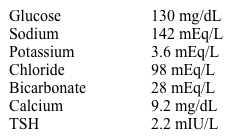 Which of the following is the most appropriate next step in evaluating this patient's condition?
 (Multiple Choice)
4.7/5 (82)
(82) A 29-year-old woman comes to the office for confirmation of pregnancy after a recent positive home pregnancy test. The patient has mild fatigue and nausea but no vomiting, vaginal bleeding, or pelvic pain. She has no chronic medical conditions, and her only medications are a daily probiotic and prenatal vitamin. The patient does not use tobacco, alcohol, or illicit drugs. She exercises daily, alternating between running and weight training. The patient avoids processed foods and red meat, preferring a diet rich in vegetables and fish. She drinks decaffeinated coffee with breakfast and has ginger tea throughout the day to help relieve nausea. BMI is 21 kg/m2. Vital signs are normal. Physical examination is unremarkable. Ultrasound shows a 7-week intrauterine fetal pole with cardiac motion. Which of the following part of this patient's history requires further evaluation?
(Multiple Choice)
4.8/5 (73)
(73) A 42-year-old man with HIV infection who is noncompliant with antiretroviral therapy comes to the emergency department due to 3 weeks of increasing headache, vomiting, and lethargy. Temperature is 38.5 C (101.3 F), blood pressure is 130/80 mm Hg, pulse is 80/min, and respirations are 15/min. On examination, the patient is lethargic. Neck stiffness is present. Cardiopulmonary examination is normal. CT scan of the head shows moderate hydrocephalus and basilar meningeal enhancement; no mass lesions are present. CD4 count is 400/mm3. What is the most likely diagnosis?
(Multiple Choice)
4.8/5 (77)
(77) A 40-year-old woman comes to the emergency department due to a 6-hour history of palpitations. She describes "fluttering in the chest" that has never happened before. In addition, over the last few months, the patient has experienced anxiety, fatigue, and a 7-kg (15-lb) weight loss. Her medical history is unremarkable, and she takes no medications. The patient does not use tobacco, alcohol, or illicit drugs. Her blood pressure is 110/80 mm Hg, and pulse is 125/min and irregular. Examination reveals lid lag and a fine tremor in the outstretched hands. No murmurs are audible, and the lungs are clear to auscultation. ECG shows atrial fibrillation with rapid ventricular response. Which of the following is the best next step in management of this patient?
(Multiple Choice)
4.9/5 (82)
(82) A 32-year-old Italian-American man comes to the office for a routine checkup. The patient is a business executive and has been under significant stress recently. He drinks alcohol occasionally and has a 10-pack-year smoking history. Laboratory results are as follows:  Serial fecal occult blood tests are negative. Peripheral blood smear is shown in the image below.
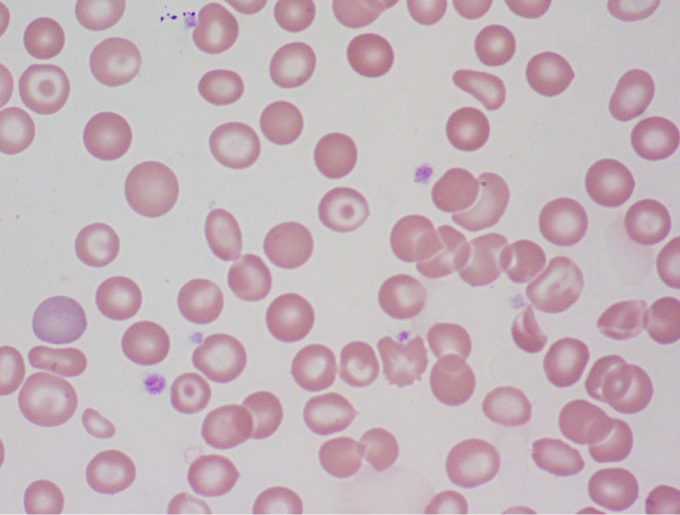 Which of the following is the best treatment for this patient?
Serial fecal occult blood tests are negative. Peripheral blood smear is shown in the image below.
Which of the following is the best treatment for this patient? (Multiple Choice)
4.8/5 (81)
(81) A 36-year-old man comes to the office for a routine preventive visit. The patient feels well, but for the past 2 days he has occasionally noticed blood on the tissue paper after defecation. Otherwise, his bowel movements have remained normal in consistency and frequency. He has no melena, vomiting, abdominal pain, or unexpected weight changes. Medical history is unremarkable, and the patient has no family history of malignancy. Vital signs are normal. The abdomen is soft and nontender with normal bowel sounds and no hepatosplenomegaly or masses. Digital rectal examination is unremarkable except for traces of red blood visible on the glove. Which of the following is the most appropriate next step in management?
(Multiple Choice)
5.0/5 (75)
(75) A 44-year-old woman comes to the office due to painful oral ulcers. She was initially evaluated 2 months ago for worsening pain, stiffness, and swelling in her hands; x-rays revealed periarticular osteopenia and bony erosions, and laboratory results at that time showed mild anemia with normal liver and renal function studies. Therapy with a disease-modifying drug was begun, and the patient's joint symptoms have gradually improved. However, she has developed painful ulcerations in her mouth, which make eating difficult. She has had no fever, chills, nausea, vomiting, or abdominal pain. Vital signs are within normal limits. Physical examination shows tender ulcerations of buccal mucosa and gingiva. There is no cervical lymphadenopathy. Laboratory studies reveal the following:  Which of the following is the most likely cause of this patient's current symptoms?
 (Multiple Choice)
4.9/5 (74)
(74) A 54-year-old man comes to the clinic complaining of bitter taste and substernal burning 30-40 minutes after meals. The burning is relieved with antacids and worsened by lying supine. He has also noticed that food gets stuck in his chest if he does not chew properly. He has had an unintentional weight loss of 4.5 kg (10 lb) over the past 3 months. The patient has a 40-pack-year smoking history. He has no family history of cancer. He is afebrile with stable vital signs. The physical examination is unremarkable. Chest x-ray and electrocardiogram show no abnormalities. The stool guaiac test is negative. Which of the following is the most appropriate next step in management of this patient?
(Multiple Choice)
4.8/5 (81)
(81) A 40-year-old man comes to the office due to anal discharge and pruritus. The patient had an episode of severe anal pain several months ago, which resolved spontaneously after 2 days. Since then, he has had an intermittent, foul-smelling discharge on his undergarments and occasional pain during defecation. The patient has had no abdominal pain, diarrhea, or blood in the stool. He has no prior medical conditions and takes no medications. Vital signs are within normal limits. Physical examination shows a soft and nontender abdomen. The perianal skin appears inflamed. There is an indurated pustule-like lesion close to the anal verge. Digital rectal examination reveals mild tenderness but no mass. Which of the following is the most appropriate next step in management of this patient?
(Multiple Choice)
4.9/5 (90)
(90) A 47-year-old man comes to the office in mid-January due to persistent high-grade fever, headache, and severe myalgias that began abruptly 4 days ago. The patient also has sore throat, nonproductive cough, and mild nasal congestion but no shortness of breath or chest pain. It has been >5 years since his last appointment, and he is not up to date on health maintenance or immunizations. The patient has no chronic medical problems, takes no medications, and has no known drug allergies. Temperature is 38.5 C (101.3 F), blood pressure is 135/80 mm Hg, pulse is 88/min, and respirations are 16/min. Oxygen saturation is 98% on room air. Physical examination shows a mildly erythematous oropharynx with normal tonsils. No significant cervical lymphadenopathy is present. Breath sounds are clear and equal bilaterally with no dullness to percussion or egophony. Heart sounds are normal. Which of the following is the most appropriate next step in management of this patient?
(Multiple Choice)
4.9/5 (76)
(76) A 78-year-old man with mild dementia is hospitalized due to chest discomfort, breathing difficulty, and agitation. He was initially diagnosed with an acute exacerbation of chronic obstructive pulmonary disease, but he was later found to have had an acute myocardial infarction. The patient gets confused in the evening and refuses medications. On the third day of hospitalization, he has sharp chest pain and does not want to lie down. A friction rub is heard along the left sternal border. Which of the following would have most likely prevented this patient's current condition?
(Multiple Choice)
4.9/5 (84)
(84) A 52-year-old woman comes to the office due to eye discomfort. For the past several months, the patient has had persistent irritation, grittiness, and a foreign-body sensation in her eyes, which are worse outdoors in windy conditions. Lately, she has also had difficulty reading or working on her computer for prolonged periods. The patient had her vision checked and was found to have mild presbyopia, but wearing corrective glasses has not improved the symptoms. She has no prior medical conditions and takes no medications. The patient does not use tobacco, alcohol, or illicit drugs. Vital signs are within normal limits. On ocular examination, the conjunctivae and corneas appear dull, but there is no conjunctival erythema, discharge, or corneal opacities. Pupillary reflexes are normal, and funduscopy shows no abnormalities. There are no skin rashes or joint tenderness, but the lips are cracked, and the oral mucosa is dry. Which of the following is the most likely potential complication associated with this patient's condition?
(Multiple Choice)
4.9/5 (84)
(84) The patient is started on furosemide and spironolactone. Esophagogastroduodenoscopy reveals several medium distal esophageal varices. Which of the following additional interventions is most appropriate at this time?
(Multiple Choice)
4.9/5 (73)
(73) A 25-year-old man comes to the office due to right hand pain and swelling. He injured the skin over his right knuckles when he punched a man in the teeth during a bar fight 3 days ago. The patient ignored the wound initially, but his hand became more painful and swollen yesterday. He has no medical history and takes no medications. The patient received a tetanus toxoid vaccination at age 18. Temperature is 37.3 C (99.1 F), blood pressure is 120/70 mm Hg, and pulse is 78/min. There are small lacerations over the right third and fourth metacarpophalangeal joints with surrounding erythema, swelling, and tenderness. No discharge or crepitus is present. Hand radiographs reveal no foreign body or bone/joint changes. Cultures are obtained. Which of the following empiric antibiotics is most appropriate for this patient?
(Multiple Choice)
4.9/5 (77)
(77) A 54-year-old man comes to the office due to fatigue, a productive cough with blood-tinged sputum, and a 7-kg (15.4-lb) weight loss over the past few months. He has no fever, chest pain, or night sweats. Ten years ago, the patient emigrated from Vietnam, where he received treatment for pulmonary tuberculosis. He has no other medical history. He does not use tobacco or illicit drugs but drinks alcohol occasionally. Temperature is 36.7 C (98 F), blood pressure is 120/80 mm Hg, and pulse is 82/min. Lung auscultation reveals right-sided rhonchi and crackles. Creatinine is 1.1 mg/dL and urinalysis is normal. CT scan of the chest is shown in the image below. 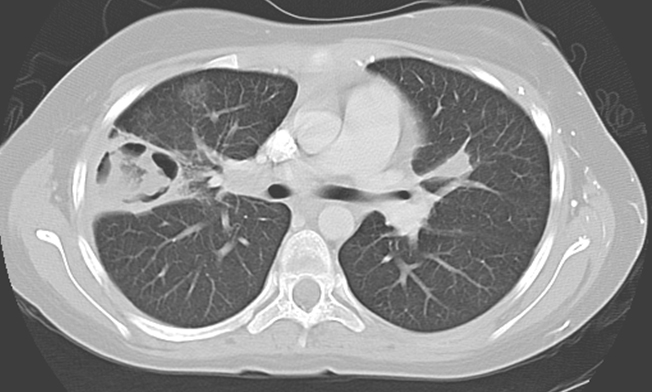 Which of the following is the most likely diagnosis for this patient?
 (Multiple Choice)
4.7/5 (78)
(78) A 34-year-old man comes to the office after several days of difficulty walking. He also has had some "funny" sensations in his feet. He has no recent skin rash, diarrhea, or joint pain. He has had lower back pain for the last week due to a lifting injury while he was moving. He visited friends in Connecticut 1 month ago and while there developed an upper respiratory infection that lasted 4 days. The patient smokes 1 pack of cigarettes a day and admits to occasional IV drug use. He has not been sexually active for 3 months. Temperature is 36.7 C (98 F), blood pressure is 120/80 mm Hg, pulse is 90/min, and respirations are 16/min. Chest examination is unremarkable. The abdomen is soft and nontender. The liver span is 8 cm and the spleen is not palpable. Cranial nerves II-XII are intact. Muscle strength is reduced in the lower extremities but well preserved in the upper extremities. Lower-extremity sensation is decreased. Mild hyperreflexia is noted bilaterally in the lower extremities. Stroking the soles of the feet elicits extension of the great toe. Which of the following is most likely to diagnose this patient's condition?
(Multiple Choice)
4.9/5 (87)
(87) Showing 801 - 820 of 1702
 Prev
- 1
- ...
- 2
- ...
- 3
- ...
- 4
- ...
- 5
- ...
- 6
- ...
- 7
- ...
- 8
- ...
- 9
- ...
- 10
- ...
- 11
- ...
- 12
- ...
- 13
- ...
- 14
- ...
- 15
- ...
- 16
- ...
- 17
- ...
- 18
- ...
- 19
- ...
- 20
- ...
- 21
- ...
- 22
- ...
- 23
- ...
- 24
- ...
- 25
- ...
- 26
- ...
- 27
- ...
- 28
- ...
- 29
- ...
- 30
- ...
- 31
- ...
- 32
- ...
- 33
- ...
- 34
- ...
- 35
- ...
- 36
- ...
- 37
- ...
- 38
- ...
- 39
- ...
- 40
- ...
- 41
- ...
- 42
- ...
- 43
- ...
- 44
- ...
- 45
- ...
- 46
- ...
- 47
- ...
- 48
- ...
- 49
- ...
- 50
- ...
- 51
- ...
- 52
- ...
- 53
- ...
- 54
- ...
- 55
- ...
- 56
- ...
- 57
- ...
- 58
- ...
- 59
- ...
- 60
- ...
- 61
- ...
- 62
- ...
- 63
- ...
- 64
- ...
- 65
- ...
- 66
- ...
- 67
- ...
- 68
- ...
- 69
- ...
- 70
- ...
- 71
- ...
- 72
- ...
- 73
- ...
- 74
- ...
- 75
- ...
- 76
- ...
- 77
- ...
- 78
- ...
- 79
- ...
- 80
- ...
- 81
- ...
- 82
- ...
- 83
- ...
- 84
- ...
- 85
- ...
- 86
- ...
- Next

Filters
- Essay(0)
- Multiple Choice(0)
- Short Answer(0)
- True False(0)
- Matching(0)