


 Chat with AI
Exam 1: Medicine

Exam 1: Medicine2 k Questions
Exam 2: Pediatric723 Questions
Exam 3: Psychiatry336 Questions
Exam 4: Surgery563 Questions
Exam 5: Obstetrics & Gynecology469 Questions
Select questions type


A 34-year-old male is recovering from head trauma sustained in a motor vehicle accident. He is currently in the intensive care unit on mechanical ventilation. His most recent arterial blood gas analysis shows:
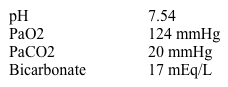 Which of the following additional findings do you most expect in this patient?
 (Multiple Choice)
4.8/5  (76)
(76) A 44-year-old man is brought to the emergency department after a motor vehicle collision. He was restrained in the driver's seat when a truck hit his car on the driver's side. The patient did not lose consciousness but was dazed for several minutes after the collision. Subsequently, he began to experience severe left leg pain. On arrival, blood pressure is 102/62 mm Hg and pulse is 118/min. Oxygen saturation is 96% on room air. The patient is conscious and answers questions appropriately. On physical examination, the pupils are equal and reactive to light. Multiple small facial lacerations are present. A cervical collar is in place. Breath sounds are symmetric and heart sounds are normal. The abdomen is diffusely tender. There is obvious deformity and tenderness of the left thigh. Portable chest x-ray reveals no pneumothorax or widened mediastinum. Rapid infusion of isotonic fluids is ongoing. Which of the following is the best immediate step in management of this patient?
(Multiple Choice)
4.8/5 (85)
(85) A 56-year-old man comes to the office due to an episode of transient right eye blindness that lasted an hour. He has had no weakness in his extremities or speech changes. He last saw a physician 3 years ago. The patient has smoked a pack of cigarettes daily for 30 years. Temperature is 37 C (98.6 F), blood pressure is 160/94 mm Hg, pulse is 78/min, and respirations are 14/min. Pulse oximetry is 98% on room air. BMI is 32 kg/m2. There is no carotid bruit. Facial plethora is present. Cardiopulmonary examination is normal. Abdominal examination reveals splenomegaly. There is no lower extremity edema, and peripheral pulses are intact. Laboratory results are as follows: 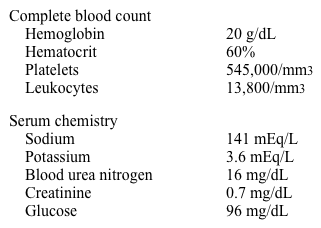 In addition to counseling about smoking cessation, which of the following is the best therapy for this patient?
 (Multiple Choice)
4.7/5 (87)
(87) A 32-year-old woman comes to the clinic due to progressively worsening dyspnea a month after returning from a vacation in Texas. The symptoms started with shortness of breath on exertion and have progressed to the point that she now wakes during the night with a choking sensation that improves only with sitting up. The patient has had a very active lifestyle for years, but currently she is markedly limited in her activities. She has no associated chest pain, skin rash, or joint pain. The patient has no significant medical history. Family history is significant for thyroid cancer in her aunt and lung cancer in her father. There is no family history of coronary artery disease, heart failure, or sudden cardiac death. She does not use illicit drugs. The patient currently lives in New York City. Temperature is 37.2 C (99 F), blood pressure is 110/70 mm Hg, pulse is 96/min, and respirations are 14/min. Bilateral pitting ankle edema is present. The liver is enlarged 2 cm below the right costal margin. Lung auscultation reveals decreased breath sounds at the bases bilaterally. Cardiac examination reveals the presence of a third heart sound. Chest x-ray reveals an enlarged cardiac silhouette and small bilateral pleural effusions. ECG shows nonspecific ST segment changes. Which of the following is the most likely cause of this patient's symptoms?
(Multiple Choice)
4.8/5 (73)
(73) A 72-year-old man comes to the office due to severe fatigue. He says that 5 months ago he was able to climb 4 flights of stairs without shortness of breath, but now he has to rest after 2 flights. His appetite has decreased, but he has not had any abdominal discomfort or black stool. Physical examination reveals firm, enlarged cervical, inguinal and supraclavicular lymph nodes. A soft II/VI grade systolic murmur is heard along the left sternal border. Abdomen is soft and nontender. His liver span is 10 cm and the spleen is palpated 4 cm below the left costal margin. His blood hemoglobin level is 7.1 mg/dL. Which of the following is the most likely cause of this patient's anemia?
(Multiple Choice)
4.8/5 (93)
(93) A 32-year-old woman, gravida 3 para 3, comes to the office due to abnormal uterine bleeding. Menarche was at age 13, and her menstrual cycles were monthly until a year ago. The patient then began to have irregular menses that occurred every 45-60 days with heavy bleeding and passage of clots but no cramping. She has not had a menstrual period for the last 4 months. The patient has no hot flushes, acne, or abnormal hair growth. She takes levothyroxine for hypothyroidism and her only surgery was a tubal ligation after her last delivery. Height is 160 cm (5 ft 3 in) and weight is 120.2 kg (265 lb). Speculum examination is normal and bimanual examination is limited by body habitus. Urine pregnancy test is negative. Laboratory results are as follows:  Which of the following is the most likely diagnosis in this patient?
 (Multiple Choice)
4.9/5 (81)
(81) A 42-year-old man with a history of AIDS comes to the office due to 2 weeks of painful swallowing. A week ago, the patient was prescribed oral fluconazole for these symptoms, but the pain has worsened despite taking the medication as indicated. Laboratory testing from a previous office visit shows a CD4 count of 42/mm3 and viral load of 300,000 copies/mL. Endoscopy reveals multiple large, linear ulcers in the distal esophagus. A biopsy of the abnormal mucosa shows tissue destruction and the presence of intranuclear and intracytoplasmic inclusions. Which of the following is the most appropriate pharmacotherapy for this patient?
(Multiple Choice)
4.7/5 (78)
(78) A 42-year-old man who recently emigrated from Northern Africa comes to the clinic due to a 1-month history of abdominal pain and watery diarrhea. He has also had a skin rash for the last 2 months that gets worse with sun exposure. In addition, the patient has felt depressed recently and has loss of appetite with mild weight loss. Medical history is notable for latent tuberculosis, for which he is currently taking isoniazid and pyridoxine. The patient takes no other medications and does not use tobacco, alcohol, or illicit drugs. He is vegetarian, and his diet consists mostly of corn and other cereal grains. On examination, there is a pigmented scaly skin rash in the malar distribution of his face, on his neck, and on the back of his hands. He also has mild, diffuse abdominal tenderness. Neurologic examination, including distal sensation and gait, is normal. Liver function tests are normal. Which of the following is the most likely diagnosis?
(Multiple Choice)
4.9/5 (68)
(68) A 68-year-old woman with a history of advanced chronic obstructive pulmonary disease comes to the emergency department due to increased shortness of breath and cough for 12 hours. She took 2 extra nebulizer treatments at home with no relief of symptoms. She has no fever, nausea, vomiting, or hemoptysis. The patient has been oxygen dependent for the last 2 years. She has a 45-pack-year smoking history and quit about 6 years ago. Medications include tiotropium daily, fluticasone/salmeterol twice daily, and albuterol by metered-dose inhaler or nebulizer as needed. Temperature is 36.7 C (98.1 F), blood pressure is 110/65 mm Hg, pulse is 110/min, and respirations are 28/min. The patient appears dyspneic and in moderate distress. She is given intravenous antibiotics, methylprednisolone, and 2 treatments of nebulized ipratropium with albuterol. Following these measures, the patient remains dyspneic and uses accessory muscles of respiration but is alert and follows commands. On 4 L/min O2, her pulse oximetry is 89%, and arterial blood gas shows pH of 7.30, PCO2 of 63 mm Hg, and PO2 of 54 mm Hg. Chest x-ray, shown in the image below, demonstrates hyperinflation: 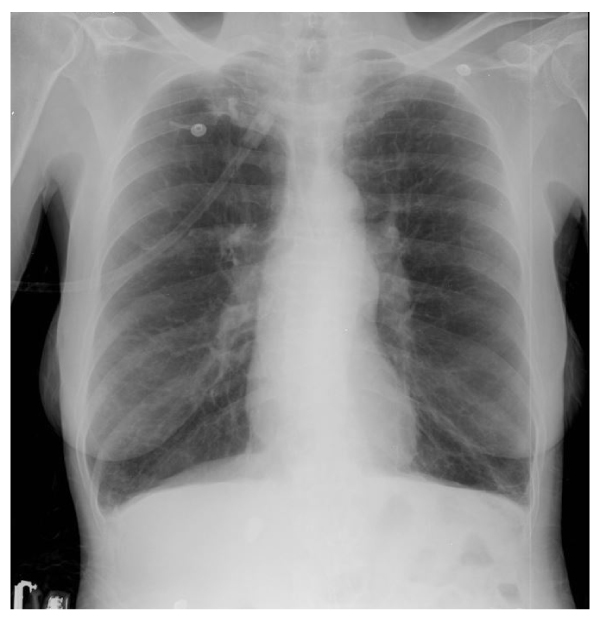 Which of the following is the best next step in management of this patient?
 (Multiple Choice)
4.8/5 (82)
(82) A 40-year-old, previously healthy woman comes to the office due to a 3-month history of progressive weakness, frequent insomnia, palpitations, and an unintentional 4-kg (8.8-lb) weight loss. She also has a constant feeling of anxiety and increased sensitivity to warm temperatures. Blood pressure is 140/70 mm Hg and pulse is 110/min. Physical examination shows lid lag without exophthalmos and a fine tremor of the patient's outstretched hands. The thyroid gland is enlarged and nontender. Laboratory results are as follows:  Treatment options are discussed with the patient, and she elects to proceed with radioiodine therapy. Which of the following is the most likely outcome after treatment in this patient?
 (Multiple Choice)
4.9/5 (67)
(67) A 56-year-old man comes to the physician with a 7-month history of headache, loss of libido, erectile dysfunction, and visual disturbances. His past medical history is unremarkable. He is currently not taking any medications. The patient has a 15-pack-year smoking history and does not use alcohol. On visual field examination, there is a small temporal field defect seen in both eyes. Genitourinary examination shows atrophic testes. An MRI scan reveals a 1.5-cm pituitary tumor. Which of the following biochemical findings will be most consistent with the diagnosis of a prolactinoma in this patient?
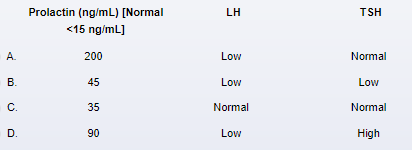
(Multiple Choice)
4.7/5 (67)
(67) A 54-year-old woman presents to your office complaining of difficulty walking. She describes severe weakness and occasional pain in her thigh muscles. She has stumbled and fallen several times over the last week. Her past medical history is significant for hypertension treated with hydrochlorothiazide and metoprolol. She consumes two to three cans of beer on weekends. Her younger brother died of a neurological disease when he was 20 years old. Her mother suffers from hypertension and diabetes mellitus. Her heart rate is 90/min and blood pressure is 170/100 mmHg. Chest examination is within normal limits. A bruit is heard over the left carotid artery. Neurologic examination reveals hyporeflexia and decreased strength in all muscle groups. Her ESR is 12 mm/hr. ECG shows flat and broad T waves with occasional premature ventricular contractions. Which of the following is the most likely cause of this patient's current complaints?
(Multiple Choice)
4.9/5 (83)
(83) A 32-year-old woman comes to the office with rectal pain. The pain is crampy and episodic, occurring at least once every week and lasting about 5 minutes each time before completely resolving. It is not associated with defecation, sexual intercourse, sitting, or standing. The patient reports no rectal bleeding, pruritus, constipation, diarrhea, fecal or urinary incontinence, or unexplained weight loss. She is sexually active. Vital signs are normal. Conjunctival pallor is absent, and mucous membranes are moist. Heart and lung sounds are normal. The abdomen is nontender and nondistended. Pelvic and rectal examinations show no abnormalities. Which of the following is the most likely diagnosis?
(Multiple Choice)
4.9/5 (74)
(74) An 89-year-old man is brought to the office by his daughter for a routine visit. The daughter says she is worried about her father's continued insistence on driving. The patient has had 2 minor accidents in the past 6 months, one in which he hit a mailbox while backing up in the dark and another in a supermarket parking lot where he backed into another car that was also backing out. The patient has not gotten lost while driving. Medical history includes mild cognitive impairment, hypertension, diminished hearing, osteoarthritis, and benign prostatic hyperplasia. Corrected vision is 20/40 in both eyes. Current medications include lisinopril, hydrochlorothiazide, and as-needed ibuprofen. He does not drink alcohol. Vital signs are normal. Physical examination shows decreased range of motion in his neck and mild pain in his hands and knees bilaterally. Mini-Mental State Examination is 23/30, 1 point lower than his score last year. Which of the following is the most appropriate next step in management of this patient?
(Multiple Choice)
4.7/5 (75)
(75) A 39-year-old woman, gravida 1 para 0 aborta 1, comes to the office for follow-up after an abnormal Pap test that showed atypical glandular cells. Two years ago, the patient had a first-trimester spontaneous abortion after conceiving via ovulation induction. Since then, she has had menses every 2-3 months with frequent intermenstrual spotting. The patient is not using contraception because she is trying to conceive. She does not use tobacco, alcohol, or illicit drugs. Vital signs are normal. BMI is 41 kg/m2. Physical examination shows dark, velvety lesions on her neck folds and axilla. A urine pregnancy test is negative. Colposcopy and endocervical curettage are adequate and benign. Endometrial biopsy shows atypical endometrial hyperplasia. This patient's biopsy results are most closely associated with which of the following?
(Multiple Choice)
4.9/5 (98)
(98) A 62-year-old man comes to the emergency department due to sudden-onset, severe abdominal pain 2 hours ago. The patient states that he suddenly felt weak, diaphoretic, and without energy. Medical history includes hypertension, dyslipidemia, sigmoid diverticulosis, and irritable bowel syndrome. He has a 30-pack-year smoking history and drinks alcohol on occasion. Temperature is 36.8 C (98.2 F), blood pressure on arrival is 88/64 mm Hg, pulse is 117/min and regular, and respirations are 18/min. Physical examination shows a diffusely tender abdomen with flank ecchymoses. There is no rigidity or guarding. Bowel sounds are present. During the examination the patient becomes pale and drowsy. Intravenous fluid boluses are started. Which of the following is the most appropriate next step in management of this patient?
(Multiple Choice)
4.7/5 (81)
(81) A 50-year-old man comes to the office due to feeling fatigued and weak for a year. He becomes tired early in the day and also finds it difficult to remember things. He is currently unemployed and lives on Social Security benefits. The patient says that he drinks 2-3 beers a day but has been charged multiple times with driving under the influence. His parents died of old age. He lives with 4 friends. Vital signs are within normal limits. Laboratory results are as follows: 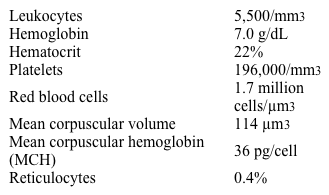 Peripheral smear shows anisocytosis, poikilocytosis, and basophilic stippling. Which of the following is the best next step in management of this patient?
 (Multiple Choice)
4.8/5 (76)
(76) A 65-year-old man is brought to the emergency department due to chest pain and shortness of breath for 1 hour. Prior to the onset of symptoms, he was preparing steak on an indoor charcoal grill. He has never had similar symptoms before. He takes metformin for his diabetes. Temperature is 37 C (98.6 F), blood pressure is 120/78 mm Hg, pulse is 114/min, and respirations are 24/min. Oxygen saturation is 96% on room air. On examination, the patient is drowsy and confused but acknowledges chest discomfort. Pupils are mid-sized and reactive to light. The chest has bilateral crackles. Cardiovascular examination reveals a normal S1 and S2 and no murmur or gallop. Neurologic examination shows no localizing weakness. ECG reveals sinus tachycardia with T-wave inversion in anterior leads. Cardiac troponin I level is elevated. Venous lactate is elevated. Chest x-ray reveals bilateral infiltrates. Emergency cardiac catheterization shows no acute coronary occlusion. Which of the following is the best next step in management?
(Multiple Choice)
4.8/5 (79)
(79) A 50-year-old man comes to the emergency department due to sudden onset of severe, colicky pain in the right flank. He was admitted twice previously for similar symptoms. On both occasions, the patient was managed conservatively and sent home. He has no other medical problems and no history of urinary infections. He usually eats precooked food from a local store and has a soda with each meal. The patient does not use tobacco, alcohol, or illicit drugs. His vital signs are stable. He is given intravenous fluids and pain medications. Laboratory results are as follows: 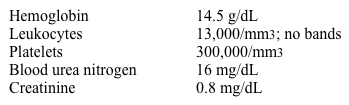 CT scan of the abdomen without contrast reveals renal calculi. Urinalysis shows moderate levels of blood and calcium oxalate crystals. Which of the following is the best recommendation for the prevention of future stones in this patient?
 (Multiple Choice)
4.9/5 (67)
(67) A 34-year-old woman comes to the office due to excessive urination at night. For the past 2 weeks, the patient has been getting up at least 3 times at night to urinate. She has a history of hypothyroidism treated with levothyroxine and bipolar disorder treated with lithium carbonate. Blood pressure is 134/78 mm Hg and pulse is 88/min. BMI is 27 kg/m2. Physical examination shows decreased skin turgor and dry mucous membranes. Laboratory results after overnight fasting are as follows: 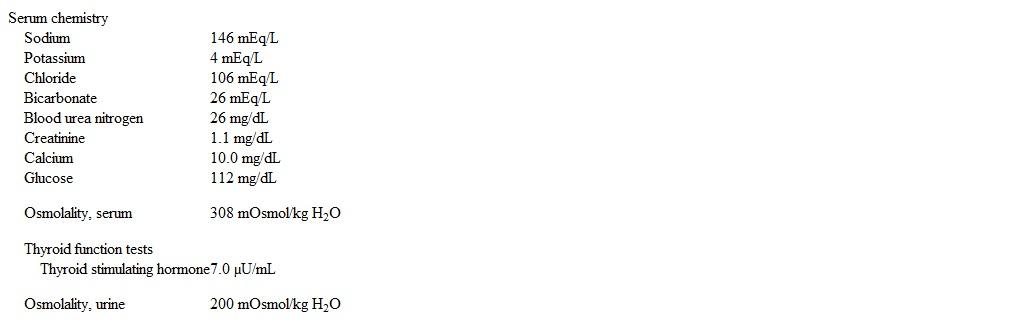 This patient's symptoms are most likely caused by a defect in which of the following sites?
 (Multiple Choice)
4.9/5 (77)
(77) Showing 1441 - 1460 of 1702
 Prev
- 1
- ...
- 2
- ...
- 3
- ...
- 4
- ...
- 5
- ...
- 6
- ...
- 7
- ...
- 8
- ...
- 9
- ...
- 10
- ...
- 11
- ...
- 12
- ...
- 13
- ...
- 14
- ...
- 15
- ...
- 16
- ...
- 17
- ...
- 18
- ...
- 19
- ...
- 20
- ...
- 21
- ...
- 22
- ...
- 23
- ...
- 24
- ...
- 25
- ...
- 26
- ...
- 27
- ...
- 28
- ...
- 29
- ...
- 30
- ...
- 31
- ...
- 32
- ...
- 33
- ...
- 34
- ...
- 35
- ...
- 36
- ...
- 37
- ...
- 38
- ...
- 39
- ...
- 40
- ...
- 41
- ...
- 42
- ...
- 43
- ...
- 44
- ...
- 45
- ...
- 46
- ...
- 47
- ...
- 48
- ...
- 49
- ...
- 50
- ...
- 51
- ...
- 52
- ...
- 53
- ...
- 54
- ...
- 55
- ...
- 56
- ...
- 57
- ...
- 58
- ...
- 59
- ...
- 60
- ...
- 61
- ...
- 62
- ...
- 63
- ...
- 64
- ...
- 65
- ...
- 66
- ...
- 67
- ...
- 68
- ...
- 69
- ...
- 70
- ...
- 71
- ...
- 72
- ...
- 73
- ...
- 74
- ...
- 75
- ...
- 76
- ...
- 77
- ...
- 78
- ...
- 79
- ...
- 80
- ...
- 81
- ...
- 82
- ...
- 83
- ...
- 84
- ...
- 85
- ...
- 86
- ...
- Next

Filters
- Essay(0)
- Multiple Choice(0)
- Short Answer(0)
- True False(0)
- Matching(0)