


 Chat with AI
Exam 1: Medicine

Exam 1: Medicine2 k Questions
Exam 2: Pediatric723 Questions
Exam 3: Psychiatry336 Questions
Exam 4: Surgery563 Questions
Exam 5: Obstetrics & Gynecology469 Questions
Select questions type


A 36-year-old woman comes to the office due to worsening pelvic pressure over the last year. The patient has had increasing pelvic pressure associated with a dull, aching pain. She has also noticed increasing abdominal girth but has had no changes in appetite or bloody stool. The patient is sexually active and has had deep pelvic pain with intercourse for the past few months. She does not use contraception and has regular monthly menses with 7-8 days of bleeding with each cycle; she has no intermenstrual bleeding or spotting. Family history is significant for 2 maternal aunts with ovarian cancer in their 50s but is otherwise noncontributory. Vital signs are normal. BMI is 26 kg/m2. Examination shows an enlarged midline pelvic mass that extends to the umbilicus. The mass is mobile and has several palpable anterior protuberances. There is no fluid wave or tenderness to palpation. Bowel sounds are normal. Urine pregnancy test is negative. Which of the following is the most likely diagnosis in this patient?
(Multiple Choice)
4.9/5  (86)
(86) A 45-year-old woman is evaluated for fatigue and exertional dyspnea. She has had difficulty walking for more than 1 or 2 blocks without becoming short of breath. She uses 2 pillows to sleep. Past medical history is significant for hyperlipidemia, hypertension, and type 2 diabetes mellitus. The patient smoked a pack a day for 15 years but quit 10 years ago. She does not use alcohol or illicit drugs. Temperature is 36.7 C (98 F), blood pressure is 150/90 mm Hg, pulse is 80/min, and respirations are 16/min. BMI is 55 kg/m2. On physical examination, jugular venous distension is difficult to visualize due to a thick neck. Lungs are clear to auscultation without wheezes or crackles. Heart sounds are distant. The abdomen is obese and nontender. There is trace bilateral lower-extremity edema. Neurological examination is within normal limits. Chest x-ray is of poor quality due to under-penetration but shows no obvious abnormalities. ECG shows low-voltage QRS complexes but no significant ST-segment or T-wave abnormalities. Laboratory results are as follows: 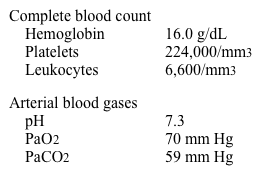 Which of the following is the predominant cause of this patient's dyspnea?
 (Multiple Choice)
4.7/5 (64)
(64) A 46-year-old man comes to the office due to a painful eruption on his left chest and upper abdomen for the past day. Two days prior to the onset of the rash, the patient experienced a burning pain in the same area that was only partially relieved by acetaminophen and ibuprofen. He has never had similar symptoms in the past. Medical history is notable for HIV infection, for which the patient has not yet started antiretroviral therapy. Temperature is 37.2 C (99 F), blood pressure is 140/86 mm Hg, and pulse is 94/min. Skin examination findings are shown below. 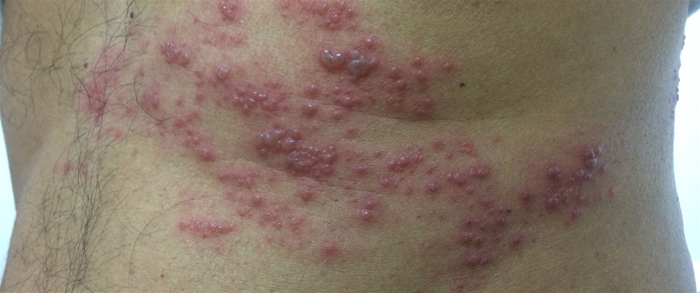 Which of the following is the most appropriate initial pharmacotherapy for this patient's skin condition?
 (Multiple Choice)
4.8/5 (84)
(84) A 34-year-old man comes to the office due to foul-smelling anal discharge and perianal discomfort for the past several weeks. The patient has a history of recurrent anal fissures and takes a fiber supplement, stool softeners, and a topical analgesic. He also has occasional canker sores and recurrent abdominal pain and diarrhea, which he attributes to the use of laxatives. The patient smokes a pack of cigarettes daily but does not use alcohol or illicit drugs. He has not traveled since a trip to South America a year ago. Temperature is 38 C (100.4 F), blood pressure is 120/76 mm Hg, and pulse is 86/min. Tenderness is present in the right lower quadrant on deep palpation. Perianal examination shows a large posterior skin tag. A fistula anterolateral to the anus is draining whitish material. Further evaluation of this patient is most likely to reveal which of the following?
(Multiple Choice)
5.0/5 (72)
(72) A 60-year-old man comes to the office after he was found to have a "low blood count" when attempting to donate blood. The patient is in his usual state of health and feels well. He has no chronic medical problems but has been treated for pneumonia twice during the past year. The patient takes no medications and does not use tobacco or alcohol. Temperature is 37 C (98.6 F), blood pressure is 120/80 mm Hg, and pulse is 76/min. Physical examination reveals mucosal pallor. There are no enlarged lymph nodes. The abdomen is soft and nontender. The spleen tip is palpable 5 cm below the left costal margin; the liver is normal in size. Stool guaiac is negative. Complete blood count results are as follows:  Peripheral blood smear shows predominant lymphocytes with features as seen in the image below.
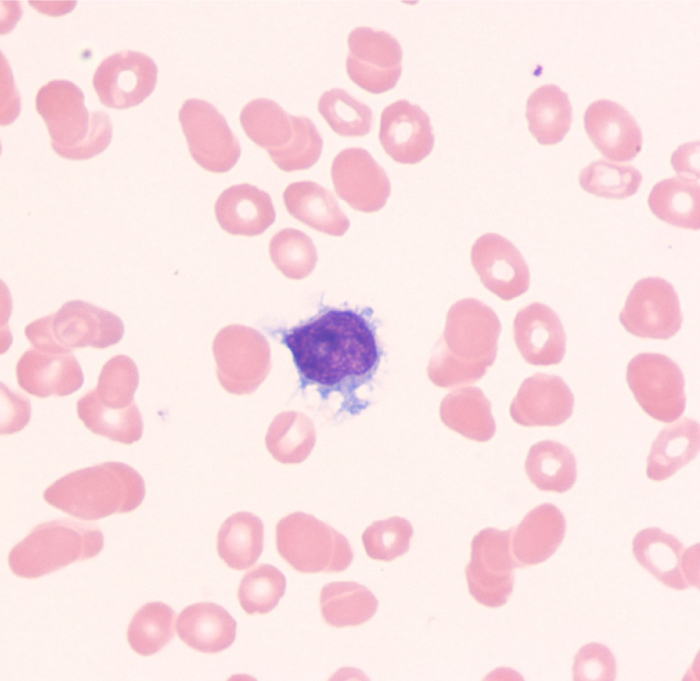 Which of the following is the most likely diagnosis?
Peripheral blood smear shows predominant lymphocytes with features as seen in the image below. Which of the following is the most likely diagnosis? (Multiple Choice)
4.9/5 (80)
(80) A 65-year-old woman is brought to the emergency department due to chest pain. The patient has had intermittent, pressure-like, mid-sternal chest pain since this morning. She has also had mild nausea. Medical history is significant for hypertension. The patient recently underwent screening colonoscopy, and yesterday she was told she has early-stage colon cancer. Her mother died of a stroke at age 70. She has no medication allergies. Blood pressure is 145/90 mm Hg, and pulse is 101/min and regular. Oxygen saturation is 99% on room air. The chest is clear on auscultation, and no heart murmurs are heard. ECG reveals sinus tachycardia with deep, symmetric T wave inversion in leads V2-V4. The patient is taken to the cardiac catheterization lab and coronary angiography shows no obstructive coronary artery disease. Which of the following is the most likely diagnosis?
(Multiple Choice)
4.8/5 (76)
(76) A 45-year-old woman comes to the office for evaluation of reddened areas over her face. The symptoms began a few years ago but have been worse over the last 2 months. She works as a lifeguard and experiences facial redness and burning discomfort within 30-60 minutes of going outdoors. Using high-potency sun blocks and wide-brimmed hats has not led to any improvement. Her friends have commented that she has looked flushed after drinking a glass of wine. Medical history is notable for only seasonal allergies, for which she uses a fluticasone nasal spray and over-the-counter loratadine. On examination, there is erythema and small telangiectasias involving the nose, cheeks, and chin, as shown in the image. The oral pharynx is clear. The remainder of the patient's examination is normal. Which of the following is the most likely diagnosis?
(Multiple Choice)
4.8/5 (77)
(77) A 72-year-old woman with poorly controlled type 2 diabetes mellitus presents to your clinic one week after being discharged from the hospital. She had been admitted with pyelonephritis secondary to a multi-drug resistant organism, and received several days of intravenous antibiotics. Her serum creatinine on admission had been 2.1mg/dL. Today it is found to be 4.9 mg/dL. Urinalysis reveals rare epithelial casts and no white blood cells. FENa is greater than 2%. What antibiotic did she most likely receive during her hospitalization?
(Multiple Choice)
4.9/5 (72)
(72) An 18-month-old boy is brought to the emergency department an hour after drinking liquid oven cleaner from an unlocked kitchen cabinet. His parents tried to give him water and milk, but he has difficulty swallowing. The boy also has blood-tinged oral secretions. His vital signs are stable. Examination shows an anxious child who is crying and drooling. His lips and chin are swollen and erythematous. He has no stridor and his breathing pattern appears normal. Lungs are clear to auscultation. His shirt is covered in oven cleaner. Which of the following is the best next step in management of this patient?
(Multiple Choice)
4.8/5 (77)
(77) A 34-year-old woman comes to the clinic with a facial rash, joint pains, and oral ulcers. She has no associated fever or other systemic symptoms and otherwise feels well. Medical history is unremarkable, and the patient's only concurrent medication is an oral contraceptive. She does not smoke and consumes alcohol only on social occasions. Antinuclear and anti-double-stranded DNA antibody titers are elevated. Creatinine and complement levels are normal. The patient is diagnosed with systemic lupus erythematosus, and therapy with hydroxychloroquine is initiated. Which of the following evaluations should be done periodically while the patient is taking this medication?
(Multiple Choice)
4.9/5 (80)
(80) A 54-year-old woman comes to the office due to fatigue. She also notes a tingling sensation in her feet and light-headedness and palpitations during moderate physical activity. The patient has no chronic health conditions and takes no medication regularly. She has never had surgery. The patient eats a balanced diet and does not use tobacco, alcohol, or illicit drugs. Vital signs are within normal limits. Physical examination shows pale conjunctivae and a shiny tongue. Ankle reflexes are decreased bilaterally. Laboratory results are as follows:  This patient is at greatest risk for which of the following long-term complications?
 (Multiple Choice)
4.8/5 (82)
(82) A 47-year-old man comes to the office due to several months of worsening pain, stiffness, and swelling of the bilateral wrists and hand joints. The symptoms are worse in the morning or after prolonged rest and gradually improve with continued use. He also has had occasional pain in the ankles and low back, which he attributes to working in the construction industry for many years. The patient has no significant medical history. He takes ibuprofen as needed for the pain and over-the-counter emollients for dry skin, but otherwise takes no medications. He has smoked a pack of cigarettes daily for 20 years and drinks 4 or 5 beers on weekends. Vital signs are within normal limits. Physical examination shows swelling and tenderness of the bilateral wrists and hand joints, including the distal interphalangeal joints. Nail examination findings are shown in the exhibit below. Which of the following is the most likely cause of this patient's symptoms? 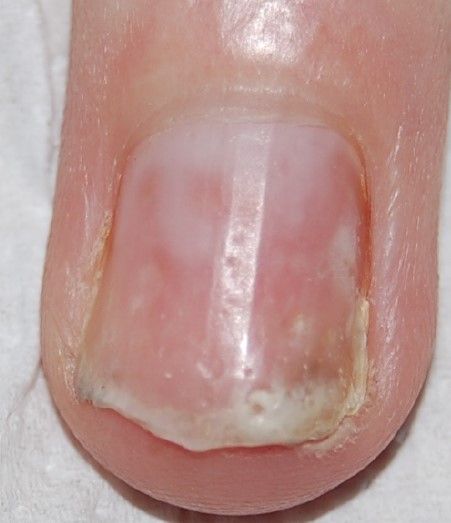
(Multiple Choice)
4.9/5 (86)
(86) A 45-year-old man comes to the clinic for evaluation of chronic diarrhea. He has lost almost 7 kg (15 lb) over the past year. He has no blood in the stool. A 24-hour stool collection shows fecal fat content of 10 g/day (normal <6 g/day). Stool microscopy shows no pathogens and no leukocytes. Serum electrolytes and renal function are within normal limits. The patient is given 25 g oral D-xylose solution, and his urinary excretion of D-xylose at 5 hours is 1.2 g (normal 4.5-7.5 g). After 4 weeks of treatment with rifaximin, the D-xylose test is repeated, and the urinary excretion at 5 hours is 1.3 g. Based on these findings, which of the following is the most likely diagnosis in this patient?
(Multiple Choice)
5.0/5 (85)
(85) A 13-day-old boy is brought to the office by his parents for a well-newborn visit. The patient was born at 38 weeks gestation via normal spontaneous vaginal delivery to a 27-year-old woman, gravida 1 para 1. He had an uncomplicated newborn nursery course with routine newborn care and was discharged with his mother at age 2 days. The patient nurses for 15-20 minutes on each breast every 2 hours. He has approximately 7 wet diapers and 3 stools per day. Weight, length, and head circumference are at the 75th percentile. Vital signs are normal. On examination, the anterior fontanelle is open, soft, and flat. Pupils are equal, round, and reactive to light. Both eyes have mild eyelid swelling, conjunctival injection, and a scant amount of watery, slightly mucopurulent discharge. The parents say that this discharge began 2 days ago. The rest of the examination is normal. A sample of the eye discharge is sent for analysis. Which of the following is the most appropriate treatment for this patient's condition?
(Multiple Choice)
4.9/5 (63)
(63) A 68-year-old man is brought to the emergency department due to 2 days of progressive confusion and lethargy. His symptoms started approximately 4 days ago with malaise, nausea, and vomiting. The patient has hypertension and chronic back pain due to spinal stenosis. Laminectomy 4 years ago provided limited symptom improvement. The patient's medications include daily losartan and as-needed hydrocodone-acetaminophen. His wife says that for the past 2 weeks he has been taking additional acetaminophen for a severe toothache. The patient smokes a pack of cigarettes and drinks 2 shots of whiskey daily. He has a remote history of intravenous drug abuse. His blood pressure is 110/60 mm Hg, pulse is 108/min, and BMI is 32 kg/m2. The patient is sleepy but wakes when spoken to and follows instructions. He is oriented to person and place. There is mild scleral icterus. Cardiopulmonary examination is unremarkable, and a smooth and tender liver edge is palpable 3 cm below the right costal margin. The patient has a mild flapping tremor of both hands. Laboratory results are as follows: 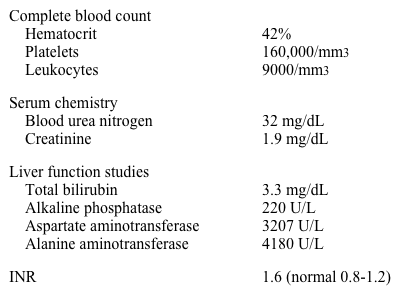 Which of the following is the most likely diagnosis in this patient?
 (Multiple Choice)
4.7/5 (83)
(83) A 48-year-old woman comes to the office due to a 4-day history of pruritic rash on her legs. The lesions initially worsened rapidly over 1-2 hours, and some lesions resolved by the end of the day. The lesions recurred several times over the past 2-3 days, with each episode lasting 6-8 hours. Temperature is 36.1 C (97 F), blood pressure is 138/77 mm Hg, and pulse is 78/min. Skin examination findings are shown in the image below. The remainder of the physical examination is within normal limits. 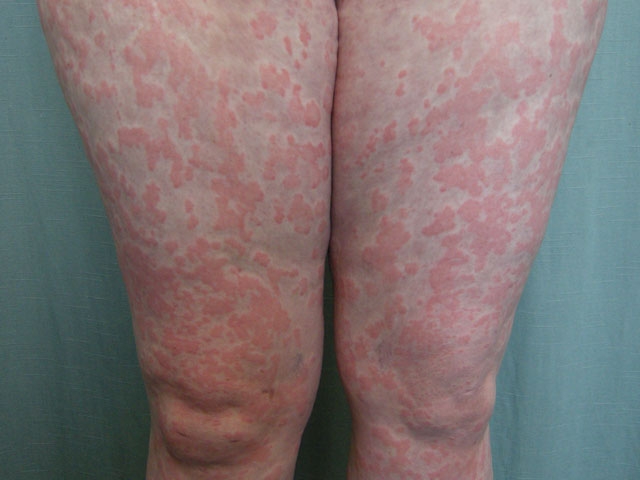 Which of the following is the most likely diagnosis?
 (Multiple Choice)
4.8/5 (72)
(72) A 68-year-old man comes to the emergency department due to chest pain. The patient was hospitalized 2 weeks ago with chest pain and was diagnosed with a non-ST elevation myocardial infarction. Percutaneous coronary intervention was performed with placement of a drug-eluting stent in the left circumflex artery. The patient has taken all medications as prescribed, including aspirin and clopidogrel, and has limited physical activity to prevent "overexerting the heart." He was feeling well until last night when he began having sharp, left-sided chest pain, which worsens with deep inspiration. The patient also feels short of breath but has had no fever or cough. Other medical conditions include hypertension and hyperlipidemia. He smokes half a pack of cigarettes daily but has not smoked over the past 2 weeks. Temperature is 38.1 C (100.6 F), blood pressure is 116/84 mm Hg, pulse is 110/min, and respirations are 20/min. Oxygen saturation is 92% on room air. BMI is 30.2 kg/m2. The patient appears in mild respiratory distress. The lungs are clear on auscultation and there are no cardiac murmurs. There is mild right lower extremity edema, and the distal pulses are full. ECG shows sinus tachycardia with nonspecific T wave changes. Serum creatinine is 0.8 mg/dL and troponin I is 0.4 ng/mL (normal: <0.01). Chest x-ray shows normal cardiac size, small left pleural effusion, and no lung opacities. Which of the following is the best next step in management of this patient?
(Multiple Choice)
4.7/5 (81)
(81) A group of investigators conducted a randomized placebo-controlled clinical trial to assess the effect of a new aldosterone receptor antagonist on the progression of chronic heart failure. The primary outcome was all-cause mortality. A decrease in all-cause mortality in the treatment group was reported, with a relative risk of 0.71 (p = 0.001). Which of the following statements is the best interpretation of the reported association?
(Multiple Choice)
4.9/5 (74)
(74) A 62-year-old man comes to the physician because of urinary frequency. His medical problems include hypertension that is well controlled with hydrochlorothiazide. His father had prostate cancer. A hard prostate nodule is palpated on rectal examination. Prostate biopsies reveal adenocarcinoma, and the patient undergoes radical prostatectomy. Postsurgery specimen shows cancer extension beyond the capsule, with clean surgical margins. Gleason score is 8 (4 + 4). Postsurgery prostate-specific antigen (PSA) level is undetectable. The patient comes to the physician for a follow-up examination 3 months later. He has no complaints. His PSA level is elevated at 9 ng/mL. He undergoes local external beam radiation therapy. The radiation therapy in this patient is most appropriately characterized as which of the following?
(Multiple Choice)
5.0/5 (90)
(90) A 49-year-old woman comes to the office due to swelling and stiffness of the hands for the past several months. For the last year, she has also had intermittent episodes of pain and bluish discoloration of the fingers, especially when exposed to cold. The patient is unable to play tennis on weekends like she did before due to fatigue and breathlessness. She takes pantoprazole for heartburn and lisinopril for hypertension. The patient drinks alcohol on social occasions but does not smoke cigarettes. Temperature is 37.1 C (98.8 F), blood pressure is 140/90 mm Hg, and pulse is 78/min. Physical examination shows puffiness of the hands and skin thickening in the fingers, as shown in the image below. 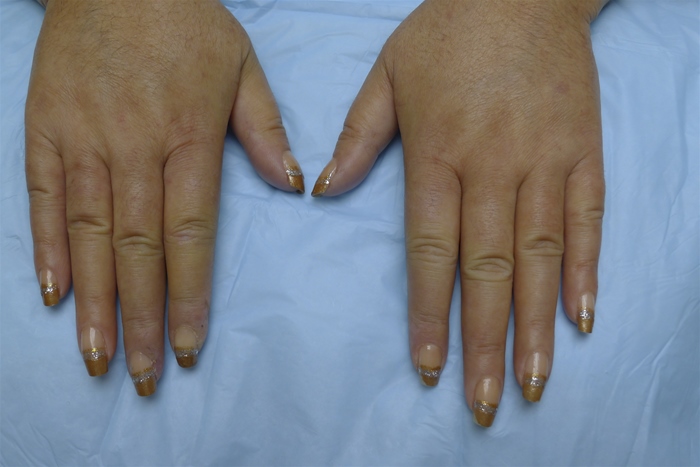 Lung auscultation reveals bibasilar fine inspiratory crackles. Which of the following tests is most likely to be positive in this patient?
 (Multiple Choice)
4.7/5 (85)
(85) Showing 121 - 140 of 1702
 Prev
- 1
- ...
- 2
- ...
- 3
- ...
- 4
- ...
- 5
- ...
- 6
- ...
- 7
- ...
- 8
- ...
- 9
- ...
- 10
- ...
- 11
- ...
- 12
- ...
- 13
- ...
- 14
- ...
- 15
- ...
- 16
- ...
- 17
- ...
- 18
- ...
- 19
- ...
- 20
- ...
- 21
- ...
- 22
- ...
- 23
- ...
- 24
- ...
- 25
- ...
- 26
- ...
- 27
- ...
- 28
- ...
- 29
- ...
- 30
- ...
- 31
- ...
- 32
- ...
- 33
- ...
- 34
- ...
- 35
- ...
- 36
- ...
- 37
- ...
- 38
- ...
- 39
- ...
- 40
- ...
- 41
- ...
- 42
- ...
- 43
- ...
- 44
- ...
- 45
- ...
- 46
- ...
- 47
- ...
- 48
- ...
- 49
- ...
- 50
- ...
- 51
- ...
- 52
- ...
- 53
- ...
- 54
- ...
- 55
- ...
- 56
- ...
- 57
- ...
- 58
- ...
- 59
- ...
- 60
- ...
- 61
- ...
- 62
- ...
- 63
- ...
- 64
- ...
- 65
- ...
- 66
- ...
- 67
- ...
- 68
- ...
- 69
- ...
- 70
- ...
- 71
- ...
- 72
- ...
- 73
- ...
- 74
- ...
- 75
- ...
- 76
- ...
- 77
- ...
- 78
- ...
- 79
- ...
- 80
- ...
- 81
- ...
- 82
- ...
- 83
- ...
- 84
- ...
- 85
- ...
- 86
- ...
- Next

Filters
- Essay(0)
- Multiple Choice(0)
- Short Answer(0)
- True False(0)
- Matching(0)