


 Chat with AI
Exam 1: Medicine

Exam 1: Medicine2 k Questions
Exam 2: Pediatric723 Questions
Exam 3: Psychiatry336 Questions
Exam 4: Surgery563 Questions
Exam 5: Obstetrics & Gynecology469 Questions
Select questions type


A 74-year-old man comes to the office to establish care. The patient has been in good health and has no symptoms. He has not been to a primary care physician for several years. Medical history includes right knee osteoarthritis, for which he occasionally takes ibuprofen. The patient does not use tobacco or alcohol. Blood pressure is 165/75 mm Hg and pulse is 70/min. A 2/6 systolic ejection murmur is heard at the right sternal border without radiation. Peripheral pulses are full without delay. ECG reveals left ventricular hypertrophy with secondary ST-segment and T-wave changes. Echocardiogram reveals moderate left ventricular hypertrophy without significant flow abnormalities. Ejection fraction is 60%. Which of the following is the most likely cause of hypertension in this patient?
(Multiple Choice)
4.9/5  (75)
(75) A 54-year-old man comes to the emergency department complaining of several days of persistent abdominal pain. He also complains of nausea, vomiting, low-grade fever, and appetite loss. He does not drink alcohol. The patient is being treated for seizure disorder; his last seizure was 3 months ago. Chest and abdominal x-rays reveal no abnormalities. The patient's abdominal CT scan is shown below. 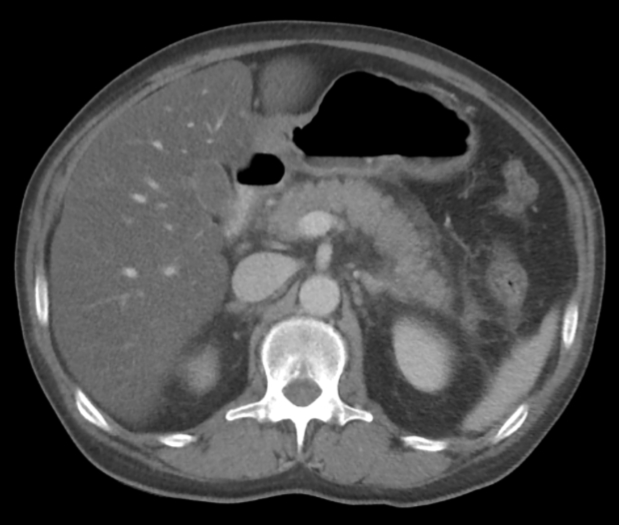 Which of the following is the most likely cause of this patient's current symptoms?
 (Multiple Choice)
4.8/5 (71)
(71) A 51-year-old man develops acute respiratory distress syndrome while hospitalized for acute pancreatitis. On his third day in the intensive care unit, the patient is sedated, intubated, and ventilated with a positive end-expiratory pressure of 15 cm water and fraction of inspired oxygen of 0.6 (60%). His pulse acutely increases from 100 to 140/min, systolic blood pressure drops from 120 to 90 mm Hg, and central venous pressure increases from 10 to 15 cm water. On chest auscultation, breath sounds are absent on the left side. Which of the following is the most likely explanation for the sudden deterioration of this patient?
(Multiple Choice)
4.8/5 (68)
(68) A 15-year-old girl is brought to the emergency department due to 18 hours of headache and lethargy. The headache began last night after she returned from a camping trip with her friends during which she had been healthy. The patient had fever and vomiting overnight, and this morning her family had difficulty waking her. She has no significant medical history. Temperature is 39.6 C (103.3 F), blood pressure is 90/60 mm Hg, pulse is 120/min, and respirations are 22/min. The patient is obtunded and responds only to deep, painful stimuli. Physical examination shows resistance to passive neck flexion and several petechiae on the lower extremities. Cerebrospinal fluid test results are as follows:  Which of the following is the most likely cause of this patient's condition?
 (Multiple Choice)
4.9/5 (67)
(67) A 7-year-old girl is brought to the emergency department due to a cat bite on her right arm. She was bitten while picking up a neighbor's cat by its tail. Afterward, her mother immediately cleaned the wound with hydrogen peroxide. The patient's vaccinations are up to date, and her most recent tetanus vaccine was 3 years ago. Her temperature is 36.9 C (98.4 F), blood pressure is 108/70 mm Hg, pulse is 107/min, and respirations are 21/min. Physical examination shows a deep puncture wound on the anterolateral aspect of her right forearm. There is no visible debris in the wound and no active bleeding. Neurovascular function is intact. Her wound is copiously irrigated with saline and cleaned with povidone-iodine. Which of the following is the best next step in management?
(Multiple Choice)
4.8/5 (67)
(67) A 34-year-old man is admitted to the hospital with sudden onset of severe epigastric pain and vomiting. He has no significant medical history. The patient smokes half a pack of cigarettes a day. He takes no medications and does not use alcohol or illicit drugs. His father died of a heart attack at age 42. The patient is married but has no children. His blood pressure is 144/92 mm Hg and pulse is 110/min. On examination, there is marked epigastric tenderness. Bowel sounds are decreased. Crops of yellow-red papules are seen on the extensor surfaces of his arms and shoulders. Laboratory results are as follows: 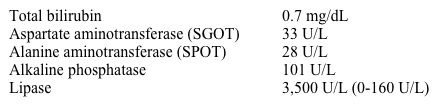 An abdominal ultrasound reveals no evidence of gallstones. The common bile duct appears normal. Which of the following is most likely to reveal the cause of this patient's current condition?
 (Multiple Choice)
4.9/5 (105)
(105) A 72-year-old woman is brought to the office by her daughter for evaluation of leg swelling and fatigue. The patient recently moved in with her daughter and has not seen a physician in several years. She has had bilateral lower extremity swelling for the past 3 months. The patient has had fatigue and joint pains for the past several years, which she attributes to old age. The daughter states that the patient seems tired all the time, barely eats anything, and "is just not herself." The patient takes no medication and does not use tobacco, alcohol, or illicit drugs. Blood pressure is 116/72 mm Hg and pulse is 78/min and regular. The lungs are clear on auscultation and heart sounds are normal. The abdomen is soft and nontender. Examination of the lower extremities reveals 3+ pitting edema. There are scattered ecchymoses, and hand examination findings are shown in the exhibit. 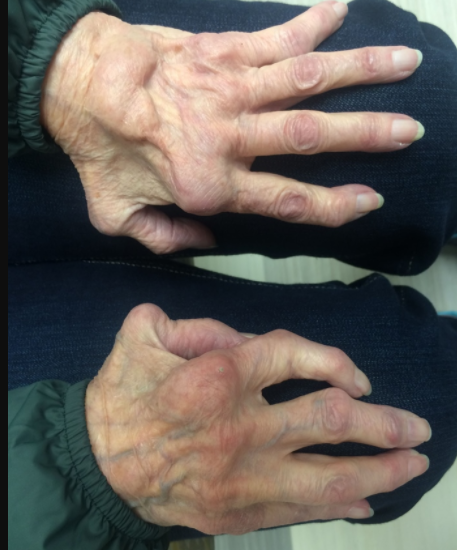 Laboratory results are as follows:
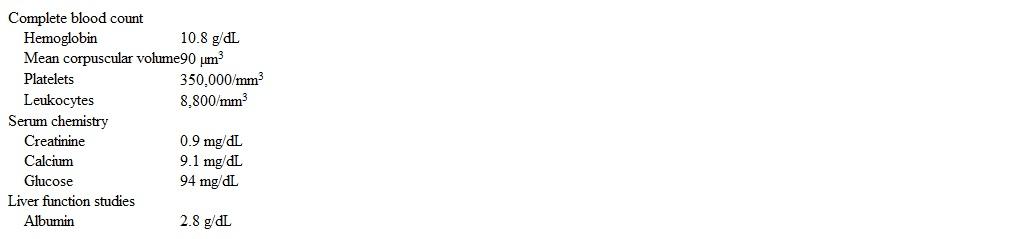 Urinalysis reveals 4+ protein with no cells or casts. A renal biopsy of this patient is most likely to show which of the following findings?
Laboratory results are as follows: Urinalysis reveals 4+ protein with no cells or casts. A renal biopsy of this patient is most likely to show which of the following findings? (Multiple Choice)
4.9/5 (80)
(80) A 53-year-old man is admitted to the hospital with a 4-week history of fatigue and decreased exercise tolerance. Climbing 2 flights of stairs causes significant dyspnea. He has had occasional palpitations for months but no chest pain. Medical history is unremarkable, and a routine checkup 6 months ago was normal. The patient had 2 binge-drinking episodes last month but usually drinks only in moderation. He does not routinely take any medications. Blood pressure is 150/90 mm Hg and pulse is 130/min and irregular. Lungs are clear on auscultation. ECG shows no clear P waves. Echocardiography shows left atrial dilation, left ventricular dilation with global hypokinesis and an ejection fraction of 35%, and moderate central mitral regurgitation. Which of the following interventions is most likely to restore left ventricular function in this patient?
(Multiple Choice)
4.9/5 (73)
(73) A 56-year-old woman is found to have hypercalcemia during routine laboratory testing for a life insurance policy. She has a history of moderate asthma and has been evaluated for 2 episodes of acute bronchitis in the last 3 years. The patient has a 30-pack-year smoking history but does not use alcohol or illicit drugs. Her family history is negative for hypercalcemia. Current medications include inhaled budesonide and albuterol, and the patient takes a daily multivitamin tablet. Her temperature is 36.7 C (98 F), blood pressure is 120/70 mm Hg, pulse is 76/min, and respirations are 14/min. Neurologic examination shows no focal deficits and deep-tendon reflexes are normal. Laboratory results are as follows:  Review of the patient's medical records reveals a serum calcium level of 10.9 mg/dL a year ago. Which of the following is the best next step to determine the cause of this patient's hypercalcemia?
 (Multiple Choice)
4.7/5 (80)
(80) A 50-year-old man comes to the emergency department after a motor vehicle collision. The patient was driving to the office in the morning when he fell asleep at a stop sign, his car rolled into an intersection, and a vehicle collided with his at low speed. The air bags did not deploy, but his coffee cup tipped over and spilled onto his right thigh. The patient reports that he slept 8 hours last night, which is typical, and he usually drinks a cup of coffee on the way to work to help him "wake up." Medical history includes hypertension. He works during the days at an accounting firm and lives alone with his cat. The patient does not use tobacco but drinks 1 or 2 beers on weekends. Blood pressure is 160/100 mm Hg, pulse is 88/min, and respiratory rate is 14/min. BMI is 36 kg/m2. The patient is alert and oriented. Physical examination reveals only a small first-degree burn on the right thigh. The lungs are clear to auscultation and heart sounds are regular with no murmurs. Neurologic examination is normal. Which of the following is the most appropriate next step in management of this patient?
(Multiple Choice)
4.8/5 (93)
(93) A 25-year-old woman comes to the physician complaining of transient vision loss in the right eye. Six months ago, she was told that her blood pressure was high at a local health fair. Her past medical history is otherwise unremarkable and she takes no medications. Her grandmother had a stroke at age 50. Her blood pressure is 164/103 mm Hg and pulse is 77/min. Her body mass index is 26 kg/m2. Examination shows a bruit below the right mandibular angle. Chest and abdominal examinations are unremarkable. She has 2+ lower extremity pulses. Laboratory results are as follows: 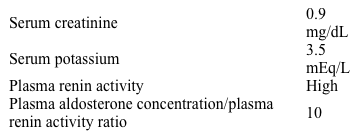 Which of the following is the best next step in management of this patient?
 (Multiple Choice)
4.8/5 (76)
(76) A 62-year-old woman comes to the office due to urinary frequency and burning during urination. The patient reports no fever, chills, nausea, back pain, or abdominal pain. Her medical history is significant for long-standing diabetes mellitus and hypertension, for which she takes metformin and lisinopril. The patient does not use tobacco or alcohol. Blood pressure is 149/100 mm Hg and heart rate is 70/min. Hematocrit is 43% and WBC count is 8,500/mm3. Creatinine is 1.1 mg/dL. Urinalysis results are as follows:  The patient is given a course of trimethoprim-sulfamethoxazole. Two weeks later, urinalysis reveals 2+ protein but no nitrites, white blood cells, or red blood cells. Her urinary symptoms have resolved. Repeat serum creatinine is 1.1 mg/dL. Which of the following is most likely responsible for her persistent urinalysis abnormality?
 (Multiple Choice)
4.8/5 (71)
(71) An 11-month-old girl is brought to the emergency department by her parents due to a rash. Yesterday, the patient developed a rash on her face that has now spread over her entire body. The parents say that she has been ill for the past 3 days with fever, cough, rhinorrhea, and "pink eye." The patient has no other medical problems and has received all age-appropriate vaccinations as of age 6 months. She takes no medications and has no allergies. Approximately 3 weeks ago, the family returned from a trip to the Philippines for her grandfather's funeral. The patient lives with her parents and several pets, including a dog, turtle, and new kitten. Temperature is 39.6 C (103.3 F), blood pressure is 80/50 mm Hg, pulse is 120/min, and respirations are 30/min. The patient appears tired and irritable with dry mucous membranes. The conjunctivae are injected without discharge. The lungs are clear to auscultation. Examination shows a blanching, erythematous maculopapular rash covering the face and entire body except for the palms and soles. Which of the following infection-control measures is most effective in preventing the spread of this patient's infection to others in the emergency department?
(Multiple Choice)
4.8/5 (87)
(87) A 29-year-old man comes to the office for evaluation of blurred vision and right eye pain. The pain increases when he is in bright light. The patient also has a yearlong history of generalized fatigue, sleep problems, back pain, and occasional heel pain. He has no recent illnesses. Medical history is notable for obesity and hypertension treated with lisinopril and chlorthalidone. The patient is monogamous. He lives in Texas and has not traveled outside the state. Temperature is 36.8 C (98.2 F), blood pressure is 134/88 mm Hg, and pulse is 80/min. Examination of the right eye shows redness of the sclera, which is most prominent at the junction between the cornea and the sclera. The right pupil is constricted, and there is photophobia with penlight examination. The left eye is normal. There are no skin lesions. In addition to treating this patient's eye condition, what additional workup is needed?
(Multiple Choice)
4.8/5 (72)
(72) A 32-year-old woman comes to the office due to persistent cough and shortness of breath. She has had 3 episodes of pneumonia over the last 3 years. The patient had severe sinusitis a year ago and an episode of bloody diarrhea that required hospitalization 6 months ago. She usually responds to antibiotics but takes several days to clear the infection. No other family members have similar problems. The patient has not traveled outside of the United States. She does not use tobacco, alcohol, or illicit drugs and currently takes no medications. All of her immunizations are up to date. Blood pressure is 130/80 mm Hg and pulse is 90/min. BMI is 22 kg/m2. Physical examination reveals fine crackles over the right lower lung field. No lower extremity edema is present. Neck palpation does not show any lymph node enlargement. Leukocyte count is 14,000/mm3. HIV testing is negative. Chest x-ray reveals a right lower lobe infiltrate. Which of the following is most likely to reveal the cause of this patient's underlying disease process?
(Multiple Choice)
4.7/5 (74)
(74) A 54-year-old man comes to the physician complaining of fatigue. It is difficult for him to get up in the morning and go to work. He tires easily at work and goes to bed early due to feeling tired and sleepy. He also describes recent upper abdominal pain that is constant and gnawing and interferes with his sleep. The patient's appetite is poor, and he has lost 7 kg (15 lb) during the last month. He has no other medical problems. His medications include over-the-counter ranitidine. The patient works as a police officer. Two months ago, while investigating a serious crime scene, he slipped on blood, fell, and hit his head. He is a former smoker with a 30-pack-year history. Physical examination is significant for tenderness and fullness in the epigastrium. Which of the following is the most likely diagnosis?
(Multiple Choice)
4.9/5 (77)
(77) A 33-year-old woman comes to the office due to intermittent dizziness. The patient describes a sensation of severe spinning accompanied by intense nausea that lasts 1-2 hours. She feels unsteady during these episodes and has to lie down with her eyes closed for relief. The patient has had several similar episodes during the past 2 years but has not noted any factors that precipitate the symptoms. She also hears a "mechanical humming" sound in her right ear during these episodes. The patient has no associated headaches, ear pain, or ear discharge. Temperature is 36.6 C (98 F), blood pressure is 130/84 mm Hg, and pulse is 86/min. On examination, air conduction is greater than bone conduction in both ears. When the base of a tuning fork is placed against her forehead, the sound is heard more prominently in the left ear. Which of the following is the most likely cause of this patient's condition?
(Multiple Choice)
4.8/5 (76)
(76) A 42-year-old woman is brought to the emergency department due to severe headache. Three hours ago, the patient suddenly began experiencing bilateral headache, which rapidly worsened in severity. She also has had neck pain and an episode of vomiting. The patient has had no prior headaches, and medical history is significant for hypertension. She works in a day care. Temperature is 38.3 C (100.9 F), blood pressure is 154/92 mm Hg, and pulse is 102/min. Oxygen saturation is 98% on room air. On physical examination, the patient appears in obvious discomfort and keeps her eyes closed. She follows simple instructions, and there is no focal weakness or numbness. Funduscopy shows no papilledema. There is increased resistance to passive neck flexion, and it also elicits pain. Which of the following is the best next step in management of this patient?
(Multiple Choice)
5.0/5 (85)
(85) A 35-year-old woman comes to the office with a 1-month history of right foot pain. She started her job as a waitress 3 months ago. The pain is worse in the morning and toward the end of her shift. Examination of the feet while standing reveals flat arches. Upon sitting, the arches re-form. She has no bony abnormalities, swelling, or skin changes over the feet and ankles. There is sharp pain on palpation over the anteromedial region of the right heel, which is worsened when the big toes are dorsiflexed at the metatarsal phalangeal joints. Palpation of the posterior heel or tapping inferior to the medial malleolus does not reproduce the pain. Strength and sensation in the foot are normal. Which of the following is the best next step in diagnosis?
(Multiple Choice)
4.8/5 (72)
(72) A 67-year-old man comes to the office due to 2 days of back pain. He was moving boxes in his garage when the pain started. The pain is not relieved by lying down and increases in intensity when straining and coughing. He cannot sleep at night due to pain and has taken acetaminophen several times without relief. He has never had such pain before. Physical examination shows 2+ symmetrical knee and ankle jerk reflexes. Straight leg raising test is negative. There is point tenderness to palpation and percussion along the midline at the fourth lumbar vertebra. Which of the following is the most likely underlying etiology of this patient's current condition?
(Multiple Choice)
4.8/5 (95)
(95) Showing 241 - 260 of 1702
 Prev
- 1
- ...
- 2
- ...
- 3
- ...
- 4
- ...
- 5
- ...
- 6
- ...
- 7
- ...
- 8
- ...
- 9
- ...
- 10
- ...
- 11
- ...
- 12
- ...
- 13
- ...
- 14
- ...
- 15
- ...
- 16
- ...
- 17
- ...
- 18
- ...
- 19
- ...
- 20
- ...
- 21
- ...
- 22
- ...
- 23
- ...
- 24
- ...
- 25
- ...
- 26
- ...
- 27
- ...
- 28
- ...
- 29
- ...
- 30
- ...
- 31
- ...
- 32
- ...
- 33
- ...
- 34
- ...
- 35
- ...
- 36
- ...
- 37
- ...
- 38
- ...
- 39
- ...
- 40
- ...
- 41
- ...
- 42
- ...
- 43
- ...
- 44
- ...
- 45
- ...
- 46
- ...
- 47
- ...
- 48
- ...
- 49
- ...
- 50
- ...
- 51
- ...
- 52
- ...
- 53
- ...
- 54
- ...
- 55
- ...
- 56
- ...
- 57
- ...
- 58
- ...
- 59
- ...
- 60
- ...
- 61
- ...
- 62
- ...
- 63
- ...
- 64
- ...
- 65
- ...
- 66
- ...
- 67
- ...
- 68
- ...
- 69
- ...
- 70
- ...
- 71
- ...
- 72
- ...
- 73
- ...
- 74
- ...
- 75
- ...
- 76
- ...
- 77
- ...
- 78
- ...
- 79
- ...
- 80
- ...
- 81
- ...
- 82
- ...
- 83
- ...
- 84
- ...
- 85
- ...
- 86
- ...
- Next

Filters
- Essay(0)
- Multiple Choice(0)
- Short Answer(0)
- True False(0)
- Matching(0)