


 Chat with AI
Exam 1: Medicine

Exam 1: Medicine2 k Questions
Exam 2: Pediatric723 Questions
Exam 3: Psychiatry336 Questions
Exam 4: Surgery563 Questions
Exam 5: Obstetrics & Gynecology469 Questions
Select questions type


A 36-year-old man is brought to the emergency department due to confusion, nausea, and decreased arousal. He is unable to answer questions, and no other history is available. Temperature is 36.7 C (98.2 F), pulse is 86/min, and respirations are 22/min. His arterial blood gas and serum electrolyte results are shown below: 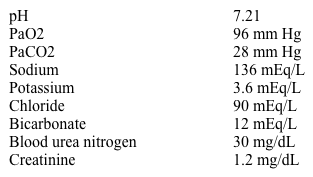 What is the most likely primary acid-base disorder in this patient?
 (Multiple Choice)
4.9/5  (81)
(81) A 46-year-old hospitalized man is evaluated for 1 day of fever, dull facial pain, and nasal discharge. The patient was admitted to the intensive care unit 3 days ago for diabetic ketoacidosis. He has a history of poorly controlled type 1 diabetes mellitus due to medication noncompliance and has had multiple hospitalizations for ketoacidosis. He does not use tobacco or alcohol. He has no known drug allergies. Temperature is 38.5 C (101.3 F), blood pressure is 120/70 mm Hg, pulse is 98/min, and respirations are 16/min. Foul-smelling discharge is present in the right naris, and nasal examination shows a necrotic right nasal turbinate. Cardiopulmonary examination is normal. Morning laboratory studies show resolution of the ketoacidosis and a hemoglobin A1c of 8.5%. Potassium hydroxide stains of scrapings from the nasal turbinates reveal hyphae. Which of the following is the best next step in the management of this patient?
(Multiple Choice)
4.8/5 (71)
(71) A 64-year-old man comes to the emergency department due to chest pain. Two weeks ago, he was hospitalized for an acute myocardial infarction, and he is afraid his heart attack is recurring. He localizes the pain to the middle of the chest and says that he can only take shallow breaths because deep breaths make the pain worse. Leaning forward in his chair makes the pain somewhat better. He notes some associated neck pain and general malaise, but has not had any shortness of breath, palpitations, syncope, or cough. Temperature is 36.7 C (98 F), blood pressure is 135/84 mm Hg, and pulse is 90/min. ECG shows ST segment elevations in all limb and precordial leads except in aVR, where ST depression is seen. Which of the following is the best next step in the management of this patient?
(Multiple Choice)
4.9/5 (74)
(74) A 32-year-old woman comes to the office due to lower back pain for the past week. She developed the pain after lifting some heavy furniture. She has no other symptoms. Physical examination shows mild paraspinal muscle tenderness. There is no radiation of pain with straight leg raise on either side, and no neurologic deficits are noted in the lower extremities. However, multiple bruises of various ages are noted on her abdomen, back, and chest. When the bruises are pointed out, the woman begins to cry. She is also quiet and avoids eye contact. Which of the following is the most appropriate initial response?
(Multiple Choice)
4.8/5 (69)
(69) A 50-year-old man comes to the office due to polyuria and polydipsia for the past month. He has smoked a pack of cigarettes daily for the past 30 years. Temperature is 37 C (98.6 F), blood pressure is 150/90 mm Hg, pulse is 75/min, and respirations are 15/min. BMI is 30 kg/m2. Physical examination is normal. Serum chemistry panel is as follows:  What is the most sensitive test to screen for nephropathy in this patient?
 (Multiple Choice)
4.9/5 (77)
(77) A 58-year-old man is brought to the office by his family with a pruritic rash on his feet. He lives in a group home due to intellectual disability, and his family members noted the rash while visiting him on his birthday. Medical history is notable for hypertension and type 2 diabetes. When the patient's socks are removed for examination, a large quantity of skin flakes falls onto the examination table. Skin examination findings are as shown in the exhibit. 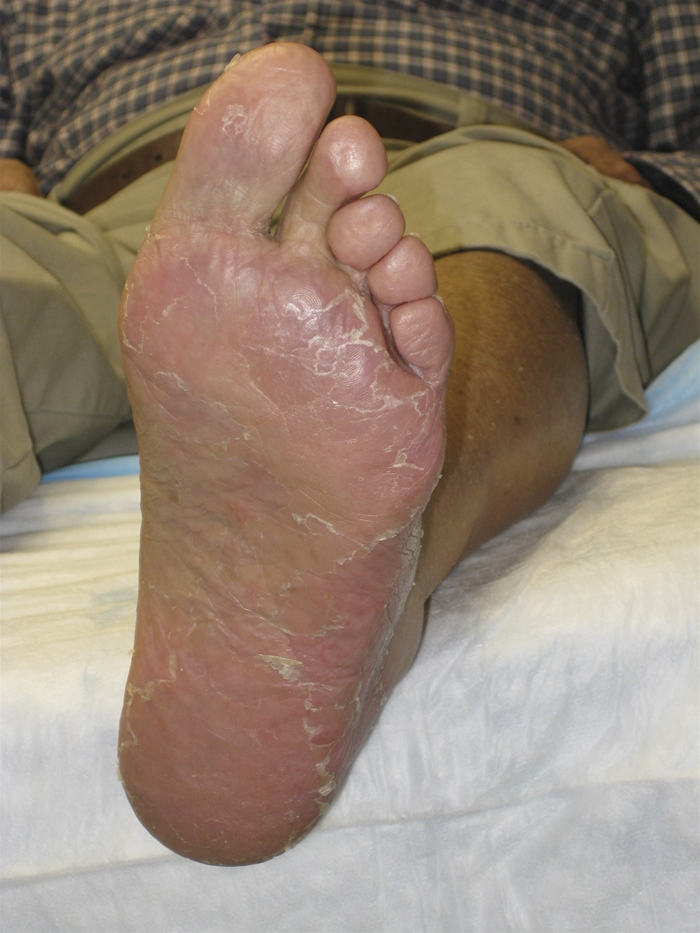 Examination also shows erythema and excoriations at the medial and lateral aspects of both heels. Which of the following is the most appropriate next step in evaluation of this patient's skin condition?
 (Multiple Choice)
4.8/5 (76)
(76) A 63-year-old woman comes to the emergency department due to a severe, right-sided headache that started 2 hours ago. The pain is centered around the right eye and is associated with nausea and vomiting. She is also seeing halos around lights. The patient has never had a headache like this before. Medical history is notable for hypertension and urinary incontinence. Her medications include valsartan and tolterodine, and she has also been taking trimethoprim-sulfamethoxazole for the last 2 days for a urinary tract infection. Family history is notable for migraine headaches in her mother. The patient does not use tobacco, alcohol, or illicit drugs. Vital signs are within normal limits. Physical examination shows a red right eye with a nonreactive, dilated pupil. Excessive lacrimation is present. Visual acuity is decreased. Laboratory results show an erythrocyte sedimentation rate of 35 mm/h. Which of the following is the most likely diagnosis?
(Multiple Choice)
4.7/5 (99)
(99) A 15-year-old, previously healthy girl comes to the office due to "spots" on her face. About a year ago, the patient started having tiny bumps on her forehead; they have progressively increased in number and size. She has used several over-the-counter facial cleansing products without relief. The patient does not use tobacco, alcohol, or illicit drugs and is not sexually active. Physical examination shows an oily complexion and the findings seen in the image below: 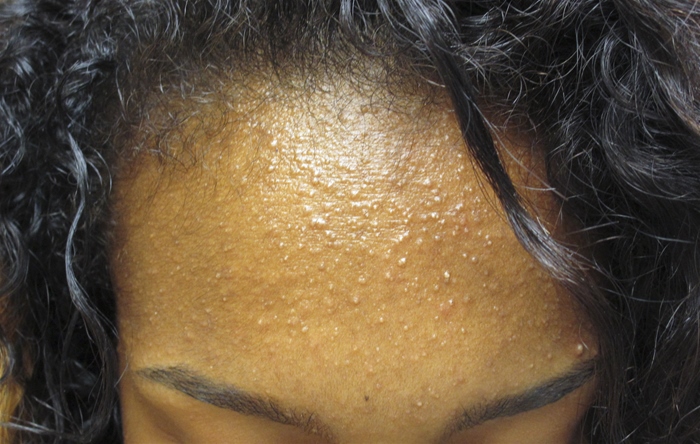 Which of the following is the best next step in management of this patient?
 (Multiple Choice)
4.8/5 (80)
(80) A 29-year-old woman comes to the clinic for routine follow-up. Five years ago, she experienced an unprovoked generalized tonic-clonic seizure. At that time, phenytoin was prescribed, and the patient has been on a stable dose since. She has not experienced seizure recurrence. MRI of the brain performed following the initial episode was normal. She has no other medical problems and is a lifetime nonsmoker. The patient's family history is negative for neurologic disease. She is in a stable relationship and is contemplating pregnancy. Blood pressure is 123/72 mm Hg and pulse is 75/min. Neurologic examination is unremarkable. Serum phenytoin level is 11 mcg/mL (therapeutic range, 10-20 mcg/mL). Electroencephalogram is normal. Which of the following is the best next step in management of this patient?
(Multiple Choice)
4.9/5 (90)
(90) A 26-year-old woman comes to the emergency department with numbness and weakness of both legs. Throughout the prior day, she felt like her legs kept "going to sleep" and on waking this morning, she had difficulty standing up and walking. She also reports urinary urgency and 2 episodes of involuntary urine leakage. The patient has no history of back pain or trauma. Four years ago, she was diagnosed with type 1 diabetes mellitus, and her glycemic control is maintained by continuous subcutaneous insulin infusion pump. One year ago, she was evaluated for right eye pain and impaired vision, but these resolved spontaneously in a week. Temperature is 36.9 C (98.4 F), blood pressure is 134/78 mm Hg, and pulse is 76/min. Visual acuity and pupillary reflexes are normal. Muscle strength in the right and left lower extremities are 3/5 and 4/5, respectively. Patellar reflexes are 3+ on both sides, and plantar reflexes are upgoing. Sensation to vibration, light touch, and pain is decreased in both legs. Her fingerstick glucose level is 144 mg/dL. Which of the following is the most likely cause of this patient's current symptoms?
(Multiple Choice)
5.0/5 (73)
(73) A 25-year-old woman, gravida 2 para 1, at 24 weeks gestation comes to the office in mid-November for a routine prenatal visit. She has felt normal fetal movement and no abdominal pain, vaginal bleeding, or leakage of fluid. Three days ago, the patient's 5-year-old son was diagnosed with varicella; however, she has not had fever, malaise, or a rash. The patient has no chronic medical issues or previous surgeries. She takes a prenatal vitamin and iron supplement. The patient does not use tobacco, alcohol, or illicit drugs. Blood pressure is 110/60 mm Hg and pulse is 64/min. BMI is 27 kg/m2. Physical examination shows no rash or lymphadenopathy. Fundal height is appropriate for gestational age. The fetal heart rate by bedside Doppler is 145/min. The patient's prenatal laboratory results are as follows:  Administration of which of the following is the best next step for this patient?
 (Multiple Choice)
4.8/5 (67)
(67) A 68-year-old man comes to the emergency department due to sudden onset of severe epigastric pain 2 hours ago, accompanied by nausea and an episode of vomiting. The patient has had intermittent abdominal discomfort over the past several months, and an abdominal ultrasound performed 2 weeks ago revealed several small gallstones. Other medical conditions include hypertension, type 2 diabetes mellitus, coronary artery disease, and heart failure with reduced ejection fraction. The patient has a 30-pack-year smoking history and drinks 1 or 2 beers occasionally. Temperature is 38 C (100.4 F), blood pressure is 150/92 mm Hg, pulse is 112/min, and respirations are 26/min. Auscultation reveals normal lung and heart sounds. There is marked upper abdominal tenderness with guarding. ECG reveals no acute ST-segment or T-wave changes. Chest x-ray is shown in the image below: 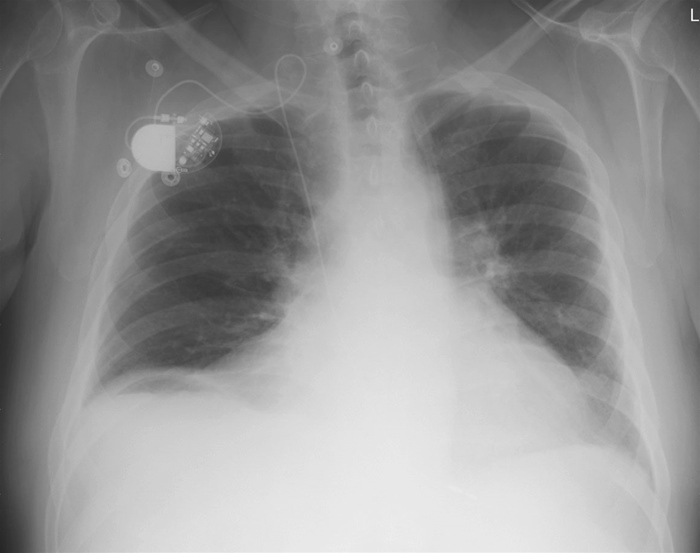 Which of the following is the most likely cause of this patient's current symptoms?
 (Multiple Choice)
4.9/5 (98)
(98) A 53-year-old man comes to the emergency department due to squeezing chest pain that started 2 hours ago. He also has severe shortness of breath that is worse when lying down. He has never had pain like this before. He has no significant medical history and takes no medications. A routine health maintenance visit 2 weeks ago was normal. Blood pressure is 112/60 mm Hg, and pulse is 110/min and regular. Chest auscultation reveals a grade III/VI holosystolic murmur at the cardiac apex and bibasilar crackles in the lungs. ECG shows ST segment elevations in II, III, and aVF. Which of the following is most likely to be significantly increased in this patient?
(Multiple Choice)
4.7/5 (73)
(73) A study is undertaken to evaluate a new serological screening test for the diagnosis of tuberculosis infection. In the study, 1000 people were randomly selected from the population and given the new diagnostic test, and positive and negative results were recorded. Each study participant also was given the gold standard diagnostic procedure to determine the true infection state of the individual. The findings are as follows: 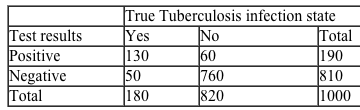 Which of the following is the positive predictive value of the screening test under study?
 (Multiple Choice)
4.9/5 (94)
(94) A 21-year-old college student comes to the office due to swelling in her feet and ankles. The patient noticed the swelling a few days ago when her shoes would not fit. She says, "I have become so fat and have such low energy since coming to college even though I run every day and eat only healthy foods. I am also worried about my grades because my concentration is so poor." The patient has a medical history of chondromalacia patellae, which she uses a knee brace for during runs. Physical examination shows a thin habitus, dry skin, excoriations on her forearms, 2+ pitting edema of her ankles, and a distended abdomen with hypoactive bowel sounds. Temperature is 37.2 C (99 F), blood pressure is 85/60 mm Hg, pulse is 50/min, and respirations are 14/min. BMI is 17 kg/m2. Which of the following abnormalities is most likely present in this patient?
(Multiple Choice)
4.9/5 (86)
(86) A 10-year-old boy is brought to the emergency department after being involved in a motor vehicle collision. Trauma workup is negative for major injuries but significant for bruising and severe pain over the right chest. Chest x-ray is normal. Over the next 6 hours of observation, the patient develops progressive tachycardia and tachypnea with need for supplemental oxygen. Temperature is 36.7 C (98 F), blood pressure is 110/66 mm Hg, pulse is 110/min, and respirations are 24/min. Breath sounds are decreased on the right side. Arterial blood gas results on 6 L of oxygen are as follows:  Repeat chest x-ray reveals patchy, irregular alveolar infiltrates of the peripheral right middle and lower lobes. Which of the following is the most likely diagnosis?
 (Multiple Choice)
4.8/5 (83)
(83) An 80-year-old woman is brought to the hospital due to 3 weeks of persistent fever, pleuritic chest pain, and productive cough. The patient was seen in the office 2 weeks ago for these symptoms and was given a week-long course of levofloxacin due to suspected right lower lobe pneumonia. She has a history of type 2 diabetes mellitus and dementia and resides in a nursing home. Temperature is 38.3 C (100.9 F), blood pressure is 130/78 mm Hg, pulse is 88/min, and respirations are 18/min. Oxygen saturation is 96% on room air. Examination shows decreased breath sounds at the right lower lobe. Chest imaging reveals increased right lower lobe infiltrate, right pleural effusion, and right-sided hilar adenopathy compressing the middle lobe bronchus. What is the most likely cause of this patient's condition?
(Multiple Choice)
4.9/5 (79)
(79) A 48-year-old man is brought to the emergency department after being stabbed once in the abdomen during a robbery. The patient sustained no other injuries. Blood pressure is 114/68 mm Hg and pulse is 118/min. Bilateral breath sounds are clear and equal. Heart sounds are normal without murmur. Abdominal examination shows a nonbleeding puncture wound to the left upper quadrant measuring approximately 2.5×1 cm. The abdomen is rigid and diffusely tender. Rectal examination reveals no blood. Resuscitation with intravenous crystalloid is ongoing. Which of the following is the best next step in management of this patient?
(Multiple Choice)
4.9/5 (78)
(78) A 31-year-old woman comes to the office for follow-up of a high-grade squamous intraepithelial lesion found on a recent Pap test. A Pap test 6 years ago was normal, and the patient did not receive screening in the interim. Her last menstrual period was 2 weeks ago, with menses occurring every 28 days and lasting 4 days. The patient is sexually active with her husband and takes an oral contraceptive. She became sexually active at age 14 and has had 7 sexual partners. The patient had a full-term vaginal delivery at age 20. She has a history of genital herpes, and the last outbreak was several months ago. The patient has no other medical issues or previous surgeries. She does not use tobacco, alcohol, or illicit drugs. Blood pressure is 110/70 mm Hg and pulse is 72/min. BMI is 24 kg/m2. A colposcopic examination is performed and a biopsy is taken. Pathology report of the biopsy shows cervical intraepithelial neoplasia grade 3. Which of the following is the best next step in management of this patient?
(Multiple Choice)
4.8/5 (85)
(85) A 28-year-old man with type 1 diabetes mellitus comes to the emergency department due to abdominal pain, nausea, and vomiting for the past 2 days. The patient has a history of medical noncompliance and has not used insulin for the past 5 days. Temperature is 36.7 C (98.1 F), blood pressure is 96/62 mm Hg, pulse is 112/min, and respirations are 26/min. Examination shows dry mucous membranes. The abdomen is soft with mild, diffuse tenderness. Laboratory results are as follows: 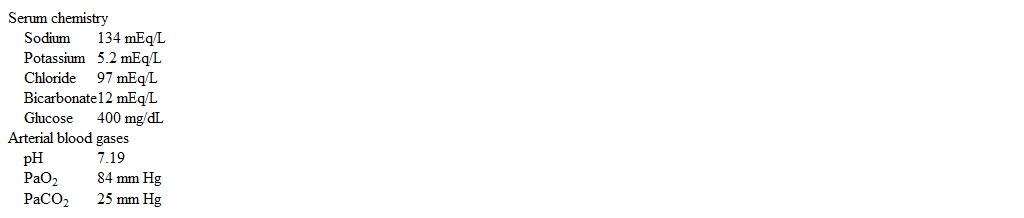 Serum and urine are positive for ketones. Which of the following is the best index to monitor the response to treatment of this patient's condition?
 (Multiple Choice)
5.0/5 (68)
(68) Showing 101 - 120 of 1702
 Prev
- 1
- ...
- 2
- ...
- 3
- ...
- 4
- ...
- 5
- ...
- 6
- ...
- 7
- ...
- 8
- ...
- 9
- ...
- 10
- ...
- 11
- ...
- 12
- ...
- 13
- ...
- 14
- ...
- 15
- ...
- 16
- ...
- 17
- ...
- 18
- ...
- 19
- ...
- 20
- ...
- 21
- ...
- 22
- ...
- 23
- ...
- 24
- ...
- 25
- ...
- 26
- ...
- 27
- ...
- 28
- ...
- 29
- ...
- 30
- ...
- 31
- ...
- 32
- ...
- 33
- ...
- 34
- ...
- 35
- ...
- 36
- ...
- 37
- ...
- 38
- ...
- 39
- ...
- 40
- ...
- 41
- ...
- 42
- ...
- 43
- ...
- 44
- ...
- 45
- ...
- 46
- ...
- 47
- ...
- 48
- ...
- 49
- ...
- 50
- ...
- 51
- ...
- 52
- ...
- 53
- ...
- 54
- ...
- 55
- ...
- 56
- ...
- 57
- ...
- 58
- ...
- 59
- ...
- 60
- ...
- 61
- ...
- 62
- ...
- 63
- ...
- 64
- ...
- 65
- ...
- 66
- ...
- 67
- ...
- 68
- ...
- 69
- ...
- 70
- ...
- 71
- ...
- 72
- ...
- 73
- ...
- 74
- ...
- 75
- ...
- 76
- ...
- 77
- ...
- 78
- ...
- 79
- ...
- 80
- ...
- 81
- ...
- 82
- ...
- 83
- ...
- 84
- ...
- 85
- ...
- 86
- ...
- Next

Filters
- Essay(0)
- Multiple Choice(0)
- Short Answer(0)
- True False(0)
- Matching(0)