


 Chat with AI
Exam 1: Medicine

Exam 1: Medicine2 k Questions
Exam 2: Pediatric723 Questions
Exam 3: Psychiatry336 Questions
Exam 4: Surgery563 Questions
Exam 5: Obstetrics & Gynecology469 Questions
Select questions type


A 52-year-old woman comes to the office due to a diffuse rash that began a few weeks ago. Lately, the patient has also been having difficulty rising from a seated position and climbing stairs. Vital signs are within normal limits. The patient has an erythematous rash on the upper chest and violaceous periorbital edema. Examination shows symmetric proximal muscle weakness in the legs. This patient's condition is most often associated with which of the following?
(Multiple Choice)
4.8/5  (64)
(64) A 34-year-old male is brought to the emergency room after being involved in a motor vehicle accident. He suffers blunt abdominal trauma and bilateral femur fractures. He has no significant past medical history. On physical examination, his blood pressure is 80/40 mmHg and his heart rate is 110/min. He receives several units of packed red blood cells. Once stabilized, the patient begins complaining of a tingling sensation in his toes and fingers. His serum calcium level is noted to be 7.2 mg/dL. Which of the following is the most likely cause of this patient's current symptoms?
(Multiple Choice)
4.8/5 (75)
(75) A 28-year-old woman comes to the office due to an episode of lightheadedness followed by a syncopal episode. She has had several days of headache, malaise, and myalgia but no vomiting or diarrhea. The patient has no history of similar symptoms. She was diagnosed with chlamydia cervicitis 3 weeks ago and received a single dose of azithromycin. The patient has no chronic medical problems or family history of sudden cardiac death. She lives in rural Massachusetts and has not traveled recently. Temperature is 37 C (98.6 F), blood pressure is 120/80 mm Hg, and pulse is 43/min. No orthostatic blood pressure changes are present. Cardiopulmonary auscultation reveals no heart murmurs. The right thigh has 2 erythematous skin lesions. ECG shows sinus rhythm with 2:1 atrioventricular block. Which of the following is the most likely cause of this patient's current condition?
(Multiple Choice)
4.7/5 (78)
(78) A 35-year-old man comes to the office due to concern that his HIV medication is no longer working. Over the last 6 weeks, the patient has had intermittent fevers and awakened several times drenched in sweat. He has not used injection drugs since he was diagnosed with HIV a year ago, and he lives in a house with other individuals recovering from substance use disorder. The patient takes antiretroviral therapy and trimethoprim-sulfamethoxazole. Temperature is 37.9 C (100.2 F), blood pressure is 126/72 mm Hg, and pulse is 102/min. Physical examination reveals several enlarged cervical, supraclavicular, and epitrochlear lymph nodes that are rubbery and mobile. Cardiopulmonary examination is normal, and no organomegaly is present on abdominal examination. There is no rash. Chest x-ray reveals an enlarged cardiac silhouette. Current CD4 count is 208/mm3 and the viral load is undetectable. Which of the following underlying pathogens is most likely responsible for this patient's symptoms?
(Multiple Choice)
4.7/5 (98)
(98) A 38-year-old woman comes to the emergency department with a 2-week history of worsening headaches and low-grade fever. She has no weakness or sensory loss. The patient has lost a significant amount of weight over the last 6 months. Her temperature is 38.1 C (100.5 F), blood pressure is 115/70 mm Hg, pulse is 100/min, and respirations are 14/min. BMI is 18.7 kg/m2. The patient has neck stiffness and cervical lymphadenopathy. Oropharyngeal examination shows thrush. The neurologic examination is nonfocal, and fundoscopy is within normal limits. CT scan of the head without contrast is normal. Lumbar puncture is performed and results of cerebrospinal fluid analysis are as follows: 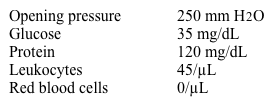 Cerebrospinal fluid fungal stain shows encapsulated yeast. Which of the following is the most appropriate next step in management of this patient?
 (Multiple Choice)
4.9/5 (76)
(76) A 33-year-old woman is brought to the emergency department after an episode of generalized tonic-clonic seizures. She is confused and unable to provide further history. Review of the medical record indicates that she has schizophrenia but stopped taking all her psychiatric medications 3 weeks ago. Temperature is 36.7 C (98 F), blood pressure is 130/76 mm Hg, pulse is 80/min, and respirations are 14/min. Examination shows normal pupils. The patient's lungs are clear to auscultation and her heart sounds are normal. Her abdomen is soft. Extremities examination shows no edema. Laboratory results are as follows: 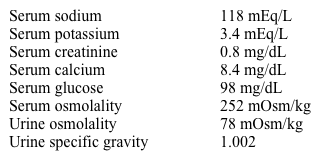 Which of the following is the most likely cause of this patient's electrolyte abnormalities?
 (Multiple Choice)
4.8/5 (94)
(94) A 53-year-old man comes to the physician complaining of increased urinary frequency for the past 4 weeks. He has no burning with urination, urgency, or difficulty initiating urination. He wakes up several times at night to urinate. His mouth feels dry all the time and he drinks fluids almost every hour to alleviate his thirst. The patient's medications include hydrochlorothiazide and amlodipine for hypertension. His sister was diagnosed with diabetes mellitus at a young age. His blood pressure is 120/76 mm Hg, pulse is 85/min, and respirations are 15/min. He is afebrile. His body mass index is 32 kg/m2. Laboratory results are as follows: 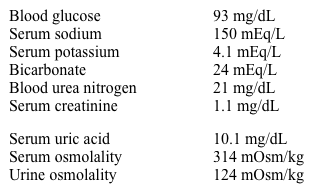 Which of the following is most consistent with this patient's findings?
 (Multiple Choice)
4.9/5 (85)
(85) A 3-year-old girl is brought to the emergency department after a head injury. About 30 minutes ago, she was playing in the backseat of a parked car and leaned against the car door while her mother was loading groceries. When her mother opened the door, the patient fell forward onto the ground, hitting her forehead. The seat was approximately 0.6 m (24 in) from the ground. She cried immediately but has not vomited. Temperature is 37.4 C (99.3 F), pulse is 130/min, and respirations are 24/min. The patient is alert and oriented. During the examination, she is anxious but consolable by her mother. There are abrasions on the forehead and right cheek. There are no step-offs or hematomas. The pupils are equal and reactive. There is no nasal drainage. The tympanic membranes appear clear. Which of the following is the best next step in management of this patient?
(Multiple Choice)
5.0/5 (81)
(81) A 54-year-old man comes to the emergency department due to a cough. He has a 44-pack-year smoking history but quit a month ago. The patient has also experienced weight loss, anorexia, constipation, increased thirst, and fatigue, which he attributes to depression. He lost his wife to breast cancer 4 months ago and says that "life hasn't felt the same since then." Blood pressure is 104/68 mm Hg, pulse is 95/min, and respirations are 24/min. Oxygen saturation is 92% on room air. The patient appears thin, pale, and short of breath. Laboratory results are as follows: 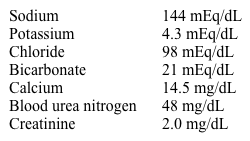 Chest x-ray reveals a hilar mass in the left lung. What is the best next step in management of this patient?
 (Multiple Choice)
4.8/5 (68)
(68) A 55-year-old woman comes to the emergency department due to a 3-week history of fatigue and exertional shortness of breath. She feels "exhausted" all the time and takes several naps during the day. The patient had rheumatic fever as a child and was diagnosed with mild mitral stenosis as an adult. Her last cardiology follow-up was 6 months ago, and she reported no symptoms. The patient's other medical problems include hypercholesterolemia and diet-controlled type 2 diabetes mellitus. She has progressive dental caries requiring several tooth extractions; the last was 4 weeks ago. The patient does not smoke and drinks alcohol occasionally. Temperature is 37.8 C (100.0 F), blood pressure is 120/70 mm Hg, and pulse is 92/min and regular. Cardiac examination shows a 3/6 holosystolic murmur at the apex as well as a diastolic rumble. The lungs are clear on auscultation. Abdominal examination is unremarkable. A linear hemorrhage is present under the right index nail. Laboratory results are as follows:  Urinalysis reveals 1+ protein. Blood cultures are sent. Which of the following organisms is most likely to be isolated in this patient?
 (Multiple Choice)
4.9/5 (68)
(68) A 41-year-old woman comes to clinic due to severe shortness of breath, cough, and hemoptysis. She recently immigrated to the United States and reports that her father, who stayed behind in her country of origin, has similar respiratory symptoms. A chest radiograph reveals right upper lobe fibrosis and her sputum is positive for acid-fast bacilli. A diagnosis of active pulmonary tuberculosis is made and she is begun on a regimen of isoniazid, rifampin, ethambutol, and pyrazinamide. She presents for a follow-up visit one month later and says that her symptoms have improved and she feels "much better." Her sputum is now negative for acid-fast bacilli. Laboratory results are as follows: 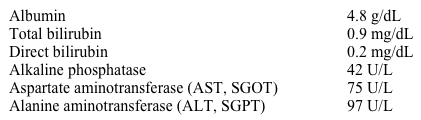 What is the next best step in the management of this patient?
 (Multiple Choice)
4.9/5 (69)
(69) A 34-year-old woman comes to the emergency department with a rash and pruritus. She had a sore throat for several days and took some prescription medication (amoxicillin) left over from 1 year ago. The itchy rash developed about 20-30 minutes after she took the first pill 4 hours ago. She has no dyspnea, dizziness, nausea, diarrhea, or abdominal cramps. She has no prior history of skin rash or allergies. Her temperature is 36.7° C (98° F), blood pressure is 124/82 mm Hg, and pulse is 80/min. Oxygen saturation is 98% on room air. Physical examination shows multiple urticaria and mild excoriations over the upper and lower extremities and upper body. The tonsils are mildly erythematous but without exudates or swelling. There is no lymph node enlargement. Lungs are clear on auscultation without wheezes. There is no stridor. Abdominal examination is unremarkable. Which of the following is the best next step in management of this patient?
(Multiple Choice)
4.8/5 (75)
(75) A 50-year-old man comes to the office for a routine follow-up visit. He has hypertension, diabetes mellitus, depression, secondary hyperparathyroidism, and end-stage renal disease. The patient has been on hemodialysis for the past 3 years. He was admitted 3 months ago for catheter-related infection, which was treated with antibiotics. The patient also had a right below-the-knee amputation 2 years ago following a nonhealing foot ulcer. Physical examination shows a right carotid bruit. Over the next 5 years, this patient is at greatest risk of death from which of the following?
(Multiple Choice)
4.8/5 (81)
(81) A 28-year-old woman comes to the emergency department due to severe right lower quadrant pain. Yesterday, the patient noticed intermittent right lower abdominal pain associated with increased activity. She rested the remainder of the day, but the pain continued to increase. An hour ago, the pain suddenly became constant, severe, and associated with nausea and vomiting. The pain does not radiate. Temperature is 37.2 C (99 F), blood pressure is 130/80 mm Hg, and pulse is 98/min. There is tenderness to palpation over the right lower quadrant with no rebound or guarding. Urine pregnancy test is negative. Which of the following additional information would be most helpful in establishing this patient's diagnosis?
(Multiple Choice)
4.9/5 (76)
(76) A 24-year-old woman is brought to the emergency department after her friend found her unresponsive at home. She was in her usual state of health 12 hours ago. The patient's medical history is significant for generalized anxiety disorder and major depression. On examination, temperature is 36.9 C (98.4 F), blood pressure is 90/56 mm Hg, pulse is 68/min, and respirations are 8/min. There is no response to painful stimuli. Pupils are normal in size. Breath sounds are normal. The patient is given a dose of naloxone but remains unresponsive. Arterial blood gas analysis on room air is as follows:  Which of the following most likely explains this patient's arterial blood gas findings?
 (Multiple Choice)
4.8/5 (95)
(95) A 70-year-old woman is brought to the emergency department by her daughter due to lethargy. The patient has a history of mild cognitive impairment but lives alone and is able to perform daily activities by herself. She experienced a minor febrile illness with upper respiratory symptoms several days ago, and her primary care physician advised symptomatic treatment. Since then, the patient has reported generalized weakness and decreased appetite to the daughter. Today, the patient did not answer her phone and the daughter found her lethargic and confused. The patient takes no medications and does not use tobacco or alcohol. Temperature is 37.2 C (99 F), blood pressure is 92/50 mm Hg, pulse is 110/min, and respirations are 18/min. Physical examination shows dry oral mucosa. Lung auscultation reveals right-sided bronchial breath sounds and crackles. Laboratory results are as follows:  Chest radiography reveals a right lower lobe consolidation. Which of the following additional findings is most likely in this patient?
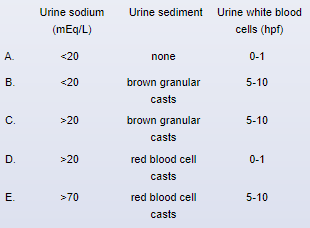
Chest radiography reveals a right lower lobe consolidation. Which of the following additional findings is most likely in this patient?
(Multiple Choice)
4.8/5 (88)
(88) A 54-year-old man comes to the office due to shortness of breath at night. He has also felt weak but has had no dyspnea on exertion or leg swelling. His wife adds that the patient has had occasional cough while eating and that his speech is slightly slurred. He has no chronic medical conditions and is a lifelong nonsmoker. Vital signs are within normal limits. BMI is 25 kg/m2. On physical examination, the soft palate and uvula are completely visualized. The tongue is mildly atrophic with visible fasciculations. The lungs are clear on auscultation and heart sounds are normal. The abdomen is flat and moves outward during expiration. There is no extremity edema. Chest x-ray shows elevated hemidiaphragms but no parenchymal opacities. Compared to a healthy individual's tests, this patient's pulmonary function testing is most likely to reveal which of the following findings?
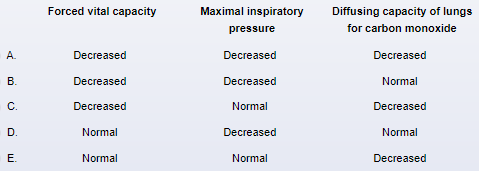
(Multiple Choice)
4.9/5 (93)
(93) A 9-year-old boy comes to the office for health screening after his older brother was found to have colonic polyps. The patient is asymptomatic and has no chronic health conditions. He takes no medications and does not use tobacco, alcohol, or illicit drugs. His father died in a motor vehicle collision several years ago and his mother has no medical conditions. Vital signs are within normal limits. The abdomen is soft, nontender, and nondistended without organomegaly, masses, or ascites. Rectal examination is normal with negative stool occult blood. Colonoscopy is performed and several small nondysplastic adenomatous polyps are removed. Genetic testing of the patient is positive for a germline adenomatous polyposis coli gene mutation. Which of the following is the best initial management for this patient?
(Multiple Choice)
4.9/5 (76)
(76) A 72-year-old man is admitted to the hospital overnight following an elective inguinal hernia repair. There are no immediate postoperative complications, but he awakens the next morning with severe right knee pain. Medical history is notable for hypertension, chronic obstructive pulmonary disease, and mild aortic stenosis. The patient smokes half a pack of cigarettes daily and drinks alcohol on social occasions. His temperature is 38.1 C (100.5 F), blood pressure is 160/110 mm Hg, pulse is 80/min, and respirations are 16/min. Physical examination shows redness and swelling of the right knee with limited motion due to pain. Diagnostic arthrocentesis is performed, with results from synovial fluid analysis as follows: 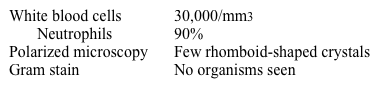 Which of the following is most likely associated with this patient's current condition?
 (Multiple Choice)
4.8/5 (77)
(77) A 22-year-old woman comes to the office due to a skin disorder. The patient has a 5-year history of patchy depigmentation primarily affecting the hands, feet, and face. Some of her lesions have resolved, but overall she has experienced a slowly progressive course. The patient has no associated pain, itching, or erythema. Medical history is unremarkable, and her only regular medication is an oral contraceptive. Vital signs are normal. Physical examination findings are shown in the image below with similar lesions on the face and hands. Examination is otherwise normal. 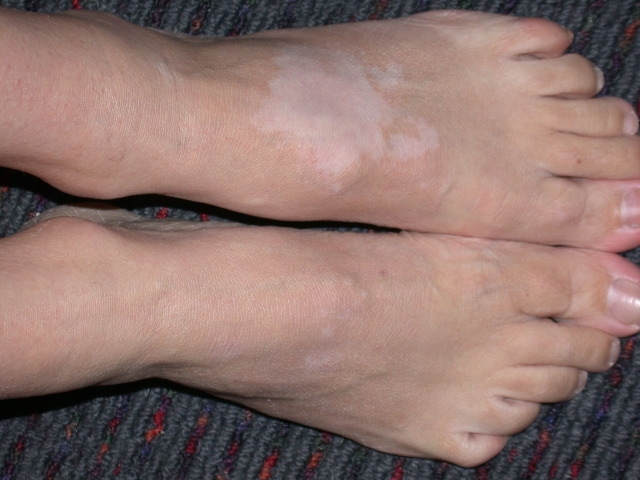 Which of the following diseases is most likely associated with this patient's skin condition?
 (Multiple Choice)
4.8/5 (88)
(88) Showing 861 - 880 of 1702
 Prev
- 1
- ...
- 2
- ...
- 3
- ...
- 4
- ...
- 5
- ...
- 6
- ...
- 7
- ...
- 8
- ...
- 9
- ...
- 10
- ...
- 11
- ...
- 12
- ...
- 13
- ...
- 14
- ...
- 15
- ...
- 16
- ...
- 17
- ...
- 18
- ...
- 19
- ...
- 20
- ...
- 21
- ...
- 22
- ...
- 23
- ...
- 24
- ...
- 25
- ...
- 26
- ...
- 27
- ...
- 28
- ...
- 29
- ...
- 30
- ...
- 31
- ...
- 32
- ...
- 33
- ...
- 34
- ...
- 35
- ...
- 36
- ...
- 37
- ...
- 38
- ...
- 39
- ...
- 40
- ...
- 41
- ...
- 42
- ...
- 43
- ...
- 44
- ...
- 45
- ...
- 46
- ...
- 47
- ...
- 48
- ...
- 49
- ...
- 50
- ...
- 51
- ...
- 52
- ...
- 53
- ...
- 54
- ...
- 55
- ...
- 56
- ...
- 57
- ...
- 58
- ...
- 59
- ...
- 60
- ...
- 61
- ...
- 62
- ...
- 63
- ...
- 64
- ...
- 65
- ...
- 66
- ...
- 67
- ...
- 68
- ...
- 69
- ...
- 70
- ...
- 71
- ...
- 72
- ...
- 73
- ...
- 74
- ...
- 75
- ...
- 76
- ...
- 77
- ...
- 78
- ...
- 79
- ...
- 80
- ...
- 81
- ...
- 82
- ...
- 83
- ...
- 84
- ...
- 85
- ...
- 86
- ...
- Next

Filters
- Essay(0)
- Multiple Choice(0)
- Short Answer(0)
- True False(0)
- Matching(0)