


 Chat with AI
Exam 1: Medicine

Exam 1: Medicine2 k Questions
Exam 2: Pediatric723 Questions
Exam 3: Psychiatry336 Questions
Exam 4: Surgery563 Questions
Exam 5: Obstetrics & Gynecology469 Questions
Select questions type


A 56-year-old woman with a history of asthma comes to the emergency department due to shortness of breath. The patient's asthma was previously well controlled with inhaled albuterol, but she has had increasing dyspnea over the past several weeks. The symptoms became more severe today, and the patient is coughing up dark-colored sputum. Other medical conditions include hypertension and type 2 diabetes mellitus. The patient has never smoked and drinks alcohol occasionally. Temperature is 37.5 C (99.5 F), blood pressure is 130/74 mm Hg, pulse is 92/min, and respirations are 18/min. Pulse oximetry is 93% on room air. The patient speaks in short sentences and is using accessory muscles of respiration. On physical examination, the trachea is deviated to the right, and there is dullness to percussion on the right. Scattered rhonchi are present bilaterally, and breath sounds are diminished over the right lower lung. Which of the following best explains this patient's physical examination findings?
(Multiple Choice)
4.8/5  (73)
(73) A group of scientists developed a new quantitative test to diagnose a childhood disease that is lethal if left untreated. The distribution of patients who have the disease and who are disease-free according to their values on the new test are shown below. 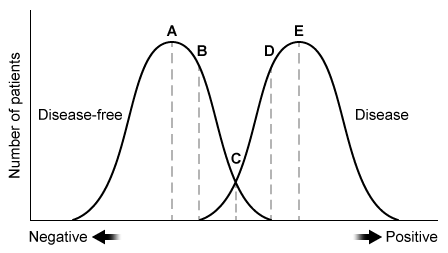 If the treatment for the disease is safe and inexpensive, which of the points labeled on the graph represents the best diagnostic cutoff for the disease?
 (Multiple Choice)
4.8/5 (81)
(81) A 29-year-old woman comes to the office due to frequent episodes of headache. She has moderate to severe, left-sided, throbbing pain associated with nausea and occasional vomiting. Her headache is often preceded by a tingling sensation in the right hand that gradually involves the right arm and face and is followed by numbness lasting <1 hour. She feels irritable while experiencing the headaches. The pain typically improves following several hours of rest in a dark and quiet room. The patient has had these episodes every 1-2 months for the past 5 years. She has taken as-needed sumatriptan with some relief, but the symptoms have caused her to miss several days of work. She has no other medical history and does not use tobacco, alcohol, or recreational drugs. There is a family history of depression. Vital signs are within normal limits and physical examination is normal. Which of the following is most likely to be helpful in preventing this patient's headaches?
(Multiple Choice)
4.9/5 (72)
(72) A 45-year-old previously healthy man is brought to the emergency department due to acute-onset headache. It began 30 minutes ago when the patient was using the bathroom and is severe, generalized, and constant. He also has had nausea and has become progressively lethargic. The patient takes no medications. Temperature is 37.2 C (98.9 F), blood pressure is 150/90 mm Hg, pulse is 98/min, and respirations are 18/min. On physical examination, the patient appears somnolent with closed eyes. When he is instructed to open his eyes, there is obvious right-sided ptosis, and the right pupil is bigger than the left. Which of the following is the most likely diagnosis?
(Multiple Choice)
4.9/5 (81)
(81) A 26-year-old man comes to the physician with sudden onset of redness, watery discharge, and itching of both eyes. His vision is slightly distorted from excess tearing but is not blurred. He otherwise feels fine. The patient's past medical history is significant for obesity, asthma, sleep apnea, and chronic back pain. On eye examination, there is bilateral injection with granular appearance of the conjunctiva. Mild eyelid swelling and clear discharge are also noted. Pupils are equally round and reactive to light. The lungs have a few scattered wheezes. What is the most likely diagnosis in this patient?
(Multiple Choice)
4.9/5 (83)
(83) A 63-year-old man comes to the physician after several weeks of vague abdominal pain and increased fatigability. His past medical history is not significant. The patient smokes a pack of cigarettes a day and consumes 5-6 cans of beer on weekends. His mother died of a stroke, and his father died of a myocardial infarction. Physical examination shows a mildly distended, soft abdomen. The liver edge is hard and is palpated 5 cm below the costal margin. Hepatojugular reflux is not appreciated. Trace ankle edema is present. Laboratory results are as follows: 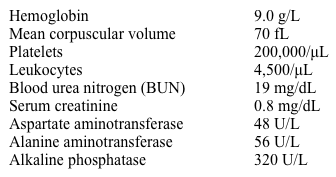 Coagulation studies are within normal limits. Chest x-ray reveals a small left-sided pleural effusion. Fecal occult blood test is positive. Which of the following is the most likely cause of hepatomegaly in this patient?
 (Multiple Choice)
4.7/5 (87)
(87) A 56-year-old man comes to the emergency department due to 5 days of dyspnea. The patient says he wakes up during the night with difficulty breathing that keeps him from going back to sleep. He has never had these symptoms before. Medical history is significant for long-standing hypertension and nonadherence with antihypertensive therapy. The patient developed a deep vein thrombosis 8 years ago after surgery for a tibial fracture and completed 6 months of anticoagulation therapy. He has a 30-pack-year smoking history. Blood pressure is 182/109 mm Hg and pulse is 110/min and regular. Oxygen saturation is 90% on room air. Bibasilar crackles and scattered wheezes are noted on auscultation. Which of the following is the most appropriate next step in management of this patient?
(Multiple Choice)
4.7/5 (96)
(96) A 35-year-old man comes to the office due to 3 months of persistent cough and shortness of breath with exertion. The patient was treated for sinusitis 3 times and pneumonia twice in the past 2 years; symptoms improved after antibiotic therapy but recurred quickly thereafter. He has never smoked cigarettes and takes no medications. Temperature is 37 C (98.6 F), blood pressure is 110/78 mm Hg, pulse is 86/min, and respirations are 15/min. BMI is 23 kg/m2. The oropharynx is clear. There is no lymphadenopathy or hepatosplenomegaly. Complete blood count, serum electrolytes, and renal function tests are normal. HIV testing is negative. CT scans reveal mucosal thickening of the paranasal sinuses and fibrosis at bilateral lung bases. What is the best next step in management of this patient?
(Multiple Choice)
4.9/5 (72)
(72) A 45-year-old woman is brought to the emergency department due to confusion. According to her husband, the patient has had fatigue, poor appetite, and fleeting joint pain for 2 weeks. She has a history of rheumatoid arthritis, which is treated with a tumor necrosis factor-alpha inhibitor. Temperature is 38.9 C (102 F), blood pressure is 142/76 mm Hg, and pulse is 101/min and regular. Two small subconjunctival hemorrhages are noted in the right eye; there is no papilledema. A 2/6 holosystolic murmur is present at the apex. The lungs are clear. There is no swelling or redness of the joints. The patient is poorly cooperative with neurologic examination but moves all extremities. MRI of the head is shown in the exhibit. 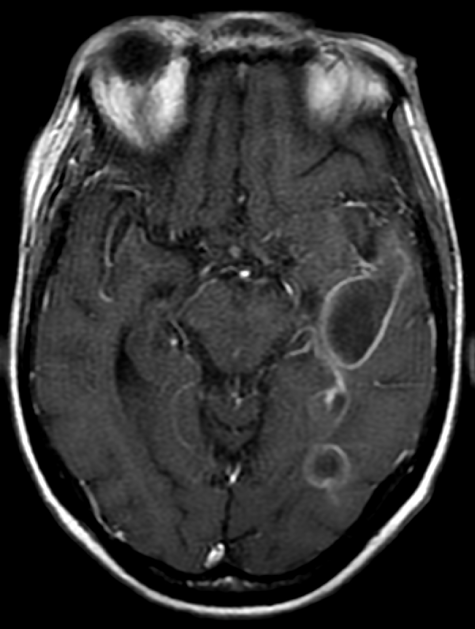 Which of the following is the best next step in management of this patient?
 (Multiple Choice)
4.8/5 (85)
(85) A 3-year-old boy is brought to the office by his mother due to "inattentiveness." Medical history is significant for preterm birth at 35 weeks, 4 ear infections in the past year, and mild eczema. Vaccinations are up to date and a hearing screening performed 8 months earlier was normal. Family history is significant for asthma in the patient's father, anxiety in his mother, and attention-deficit hyperactivity disorder (ADHD) in his older brother. The patient's mother reports that when asked to perform tasks at home, he ignores her and continues to do whatever he is engaged in. He has become more withdrawn lately and often sits in the corner alone playing with rockets instead of playing with his brother. His poor attention span has worsened over the last few months, and his mother wonders if it is related to anxiety about starting preschool 3 months ago. Apart from lack of attention, he is described as an "affectionate, active little boy who loves to run around and loves his pets." Physical examination reveals a small child who responds only intermittently to the physician's directions. The patient is able to draw a square and stand on 1 foot. He speaks in brief phrases of 2 or 3 words, which is similar to his presentation 6 months ago. Neurological examination is normal. Growth curves are tracking just under the 50th percentile for stature and weight. Which of the following is the best next step in management of this patient?
(Multiple Choice)
4.9/5 (64)
(64) An 18-year-old woman comes to the clinic due to persistent headaches, which have occurred daily for 3 months. The headaches are holocranial, pulsating, and especially bothersome at night. Ibuprofen has not helped the pain. The patient has double vision when looking sideways and blurry vision in both eyes. She has no history of head trauma prior to the onset of symptoms and no fever, vomiting, photophobia, or weakness. The patient has no chronic medical conditions and does not use tobacco, alcohol, or illicit drugs. Her mother and sister have migraine headaches. Temperature is 37 C (98.6 F), blood pressure is 130/85 mm Hg, and pulse is 90/min. BMI is 34 kg/m2. Physical examination shows no nuchal rigidity or sinus tenderness. Eye examination reveals optic disc edema and left lateral rectus palsy. CT scan of the head without contrast is normal. Which of the following is the best next step in management of this patient?
(Multiple Choice)
4.9/5 (67)
(67) A 22-year-old man is brought to the emergency department after he passed out on the field while playing soccer. The episode lasted only 2 minutes and was not associated with any post-event confusion, sleepiness, or weakness. The patient describes himself as "healthy" but on detailed review of systems admits to occasional lightheadedness and vague chest discomfort while playing active sports. His grandfather died suddenly at age 40 from a "heart attack." Blood pressure is 128/74 mm Hg and heart rate is 67/min and regular. On examination, a fourth heart sound is heard at the cardiac apex. There is a 3/6 midsystolic murmur best heard at the left lower sternal border that does not radiate to the base of the heart or to the neck. The patient will most likely benefit from which of the following medications?
(Multiple Choice)
4.8/5 (91)
(91) A 19-year-old college student comes to the office due to painful lesions on his right hand for the past several days. He has also felt feverish and tired. The patient has a history of folliculitis and skin abscess requiring surgical drainage. Over the past 6 months, he has had 3 sexual partners and uses condoms inconsistently. He began a part-time landscaping job a month ago. Temperature is 37.4 C (99.3 F), blood pressure is 130/84 mm Hg, and pulse is 86/min. Right hand examination findings are shown below. 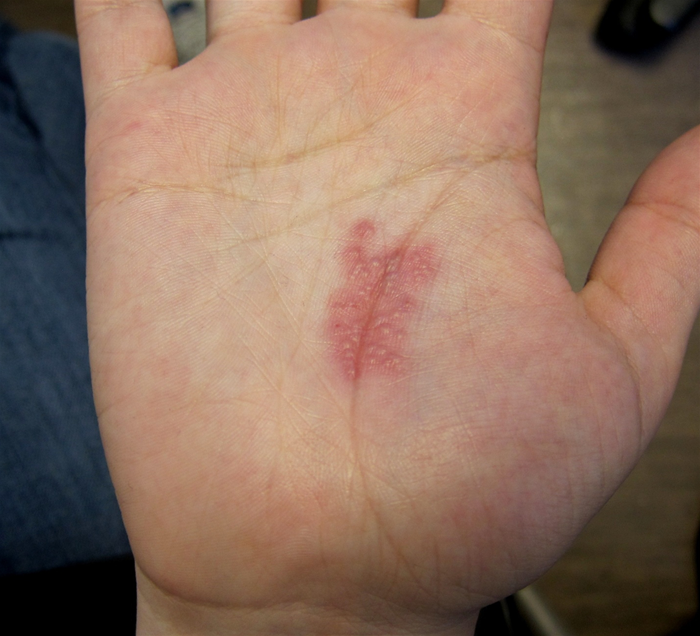 He has no other skin rash and the remainder of the physical examination is normal. Which of the following is the most likely causative organism of this patient's condition?
 (Multiple Choice)
4.8/5 (97)
(97) A 45-year-old woman with type 2 diabetes mellitus is hospitalized due to fever, chills, dysuria, flank pain, and lethargy. Temperature is 39.8 C (103.6 F), blood pressure is 86/42 mm Hg, and pulse is 118/min. Left costovertebral angle tenderness is present, and urinalysis reveals pyuria and bacteriuria. Urine and blood cultures are obtained, and intravenous fluids and empiric antibiotics are administered. Due to persistent hypotension, the patient requires norepinephrine therapy and is admitted to the intensive care unit. Two days later, the hypotension resolves, and the norepinephrine is tapered off. The patient's fever gradually improves, and the antibiotics are adjusted based on culture and sensitivity results. Repeat physical examination reveals discoloration in all the extremities as shown in the exhibit. 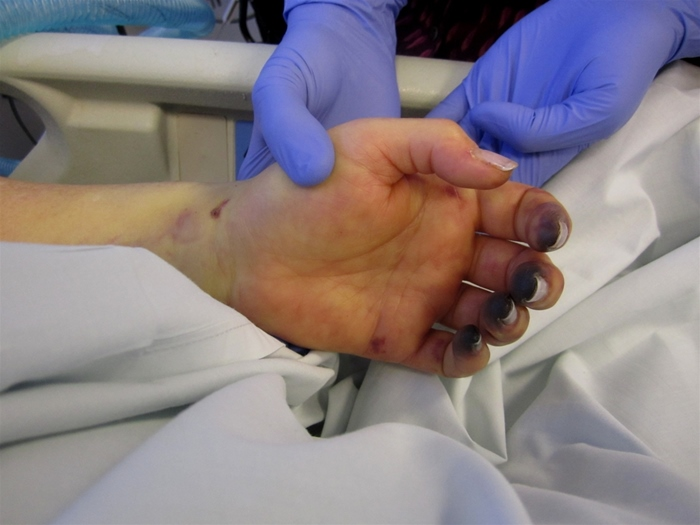 Which of the following is the most likely underlying cause of the findings seen in this patient?
 (Multiple Choice)
4.8/5 (63)
(63) A 66-year-old man with a 10-year history of type 2 diabetes mellitus comes to the office due to burning and stabbing pain in his feet for the past few months. The pain is severe enough to interfere with his daily activities and is worse at night. His medical history is notable for hypertension, hyperlipidemia, and coronary artery disease with a non-ST elevation myocardial infarction 4 years ago. The patient is on a mixed regimen of insulin glargine and insulin aspart, in addition to other medications, including metoprolol, valsartan, atorvastatin, and aspirin. On physical examination, there is loss of ankle reflexes bilaterally, with loss of vibratory sensation and altered proprioception below the knees. Hemoglobin A1c is 8.6% and serum creatinine is 1.55 mg/dL. In addition to optimizing glycemic control, which of the following is the most appropriate medication for management of this patient's current symptoms?
(Multiple Choice)
4.8/5 (91)
(91) A 54-year-old woman comes to the office due to fatigue, anorexia, and weight loss. Over the past 3 months, she has lost 10 kg (22 lb) but has not changed her diet or activity level. The patient has a history of hypertension and type 2 diabetes mellitus. She does not use tobacco, alcohol, or illicit drugs. Temperature is 36.9 C (98.4 F), blood pressure is 120/80 mm Hg, pulse is 80/min, and respirations are 16/min. BMI is 31 kg/m2. Mild temporal wasting is noted. The abdomen is soft, the flanks are full, and shifting dullness is present. There is hepatomegaly and a single palpable liver nodule. Trace edema is present in the bilateral lower extremities. Laboratory results are as follows: 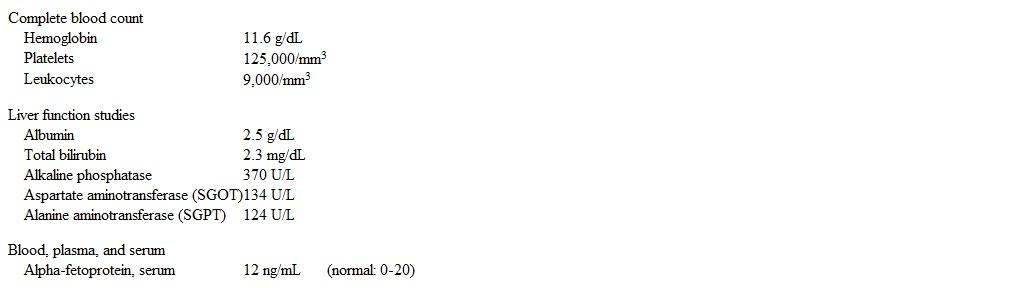 Which of the following is the most likely diagnosis?
 (Multiple Choice)
5.0/5 (67)
(67) A 59-year-old man comes to the emergency department due to sudden-onset, severe dyspnea and right-sided chest pain while driving to work. The patient has a history of chronic obstructive pulmonary disease, hypertension, gastroesophageal reflux, and chronic kidney disease. He has smoked a pack of cigarettes daily for 35 years. Blood pressure is 130/80 mm Hg and pulse is 102/min and regular. Pulse oximetry shows 89% on room air. On physical examination, the trachea is midline. Tactile fremitus and breath sounds are decreased on the right, and scattered wheezes are present on the left. No heart murmurs are heard. He has trace ankle edema. Which of the following is the most likely underlying mechanism of this patient's current condition?
(Multiple Choice)
4.9/5 (94)
(94) A 65-year-old woman comes to the emergency department due to 1 day of painful swelling of the left side of her face, associated with high fever and chills. She has had no facial trauma or injury to that area. The patient was diagnosed with type 2 diabetes mellitus 3 years ago and achieves good glycemic control with diet, exercise, and oral hypoglycemic agents; she has no known complications. Temperature is 39.2 C (102.6 F), blood pressure is 125/75 mm Hg, and pulse is 90/min. Physical examination shows a warm, tender, erythematous rash with raised, well-demarcated borders on the left side of the face, including the left external ear. The ear canal has no discharge, and hearing is intact. Mild regional lymphadenopathy is present. Which of the following is the most likely causative organism of this patient's infection?
(Multiple Choice)
4.7/5 (88)
(88) A 43-year-old woman is brought to the emergency department with bloody emesis. Her medical history is significant for idiopathic cirrhosis. The patient was hospitalized 5 months ago for variceal band ligation. On initial evaluation, blood pressure is 88/52 mm Hg, pulse is 121/min, and respirations are 22/min. Pulse oxymetry is 96% on room air. The patient is somnolent and barely arousable to sternal rub. Dried blood is seen around her mouth. The abdomen is distended with a positive fluid shift. There is 1+ peripheral edema. Her hemoglobin is 7.5 g/dL, and the platelet count is 59,000/mm3. The International Normalized Ratio is 1.9. Two large-bore catheters are placed, and 2 L of normal saline are rapidly infused. Despite resuscitation with crystalloids, the patient remains minimally responsive; her blood pressure is 89/49 mm Hg and pulse is 119/min. While still in the emergency department, she continues to have repeated episodes of bloody vomiting with clots. A unit of packed red blood cells is prepared for transfusion. Which of the following is the best next step in management of this patient?
(Multiple Choice)
4.7/5 (81)
(81) A 52-year-old man comes to the physician due to black stools. He also has occasional abdominal discomfort and nausea but has no hematemesis. Food seems to help his abdominal pain, so he eats frequently during the day and occasionally snacks at night. As a consequence, the patient has gained 5 pounds over the last year. He says his diet is lacking in vegetables and fruit. The patient drinks 1 to 2 cans of beer nightly but does not use tobacco or illicit drugs. His father died of colon cancer, and his mother died from stroke. Physical examination shows mild epigastric abdominal tenderness and a right-sided carotid bruit. Fecal occult blood testing is positive. Which of the following is the most likely diagnosis?
(Multiple Choice)
4.9/5 (73)
(73) Showing 1221 - 1240 of 1702
 Prev
- 1
- ...
- 2
- ...
- 3
- ...
- 4
- ...
- 5
- ...
- 6
- ...
- 7
- ...
- 8
- ...
- 9
- ...
- 10
- ...
- 11
- ...
- 12
- ...
- 13
- ...
- 14
- ...
- 15
- ...
- 16
- ...
- 17
- ...
- 18
- ...
- 19
- ...
- 20
- ...
- 21
- ...
- 22
- ...
- 23
- ...
- 24
- ...
- 25
- ...
- 26
- ...
- 27
- ...
- 28
- ...
- 29
- ...
- 30
- ...
- 31
- ...
- 32
- ...
- 33
- ...
- 34
- ...
- 35
- ...
- 36
- ...
- 37
- ...
- 38
- ...
- 39
- ...
- 40
- ...
- 41
- ...
- 42
- ...
- 43
- ...
- 44
- ...
- 45
- ...
- 46
- ...
- 47
- ...
- 48
- ...
- 49
- ...
- 50
- ...
- 51
- ...
- 52
- ...
- 53
- ...
- 54
- ...
- 55
- ...
- 56
- ...
- 57
- ...
- 58
- ...
- 59
- ...
- 60
- ...
- 61
- ...
- 62
- ...
- 63
- ...
- 64
- ...
- 65
- ...
- 66
- ...
- 67
- ...
- 68
- ...
- 69
- ...
- 70
- ...
- 71
- ...
- 72
- ...
- 73
- ...
- 74
- ...
- 75
- ...
- 76
- ...
- 77
- ...
- 78
- ...
- 79
- ...
- 80
- ...
- 81
- ...
- 82
- ...
- 83
- ...
- 84
- ...
- 85
- ...
- 86
- ...
- Next

Filters
- Essay(0)
- Multiple Choice(0)
- Short Answer(0)
- True False(0)
- Matching(0)