


 Chat with AI
Exam 1: Medicine

Exam 1: Medicine2 k Questions
Exam 2: Pediatric723 Questions
Exam 3: Psychiatry336 Questions
Exam 4: Surgery563 Questions
Exam 5: Obstetrics & Gynecology469 Questions
Select questions type


A 25-year-old man with ankylosing spondylitis comes to the office for reevaluation of persistent low back pain and stiffness. The patient was first seen 6 months ago with intermittent pain that responded well to naproxen. The pain has since progressed and now occurs throughout the day and is no longer relieved by naproxen. The patient is unable to fully participate in an exercise program due to his symptoms. He is a lifetime nonsmoker and does not use alcohol or illicit drugs. Erythrocyte sedimentation rate is 90 mm/hr. Which of the following is the most appropriate next step in management of this patient?
(Multiple Choice)
4.9/5  (81)
(81) A study was conducted to assess the relationship between serum HDL2 level (a subfraction of HDL) and carotid intima-media thickness as a marker of atherosclerosis. Interpretation of the results revealed a linear relationship between these 2 variables, with a correlation coefficient r = -0.25 (p = 0.005). Which of the following statements about the results of the study is the most correct?
(Multiple Choice)
4.7/5 (83)
(83) A 40-year-old woman comes to the office due to daily headaches and facial pain for the past several months. The pain involves the temporal and periorbital region, affects the right side more than the left, is dull, and waxes and wanes. It is often worse toward the end of the day, and the patient gets a heavy and tired feeling in her jaws while eating dinner. Current medications are a multivitamin daily and ibuprofen as needed. She is a research professor and describes her work as stressful. The patient does not use tobacco, alcohol, or illicit drugs. Vital signs are within normal limits. Physical examination shows normal pupils and no facial droop. Facial sensation is normal bilaterally and there is mild tenderness in the right masseter muscle. The remainder of the examination shows no abnormalities. Which of the following is the most likely diagnosis?
(Multiple Choice)
4.9/5 (71)
(71) A 15-day-old boy is brought to the emergency department due to 2 occurrences of green vomit this morning. The patient has been exclusively breastfed since birth but has shown little interest in feeding over the past 24 hours. His last stool was 2 days ago. The patient was born full term by uncomplicated vaginal delivery, and he had an uneventful nursery course, including the passage of meconium on the first day of life. Temperature is 36.7 C (98.1 F), blood pressure is 85/50 mm Hg, pulse is 142/min, and respirations are 46/min. Examination shows a fussy boy with dry mucous membranes and a mildly sunken anterior fontanelle. The abdomen is soft and distended. The mother is instructed to withhold breastfeeding, and intravenous fluids are given. Abdominal x-ray reveals no free air. Which of the following is the best next step in management of this patient?
(Multiple Choice)
4.8/5 (75)
(75) A 70-year-old man is brought to the emergency department by his wife due to rectal bleeding. The patient initially had a bowel movement consisting of a large volume of bright red blood without associated abdominal pain. Since then, he has had persistent lightheadedness along with several urges to defecate in which blood is produced. The patient has no prior history of gastrointestinal bleeding. Past medical history is notable for hypertension and chronic constipation. Current medications include chlorthalidone and low-dose aspirin. Temperature is 36.5 C (97.8 F), blood pressure is 85/45 mm Hg, pulse is 120/min, and respirations are 20/min. The abdomen is soft, nondistended, and nontender; bowel sounds are normal. No masses or organomegaly are palpable. Rectal examination shows bright red blood. Nasogastric aspiration returns nonbilious stomach contents without blood. A plain radiograph of the abdomen is normal. Which of the following is the most likely cause of this patient's bleeding?
(Multiple Choice)
4.7/5 (83)
(83) A 54-year-old man comes to the office due to erectile dysfunction. For the last 6 months, the patient has had progressive difficulty maintaining an erection long enough to have satisfying sexual intercourse. In addition, he has had loss of libido and a decrease in early morning erections. Medical history is significant for hyperlipidemia and coronary artery disease. The patient was admitted for an acute coronary syndrome 7 months ago, and a drug-eluting stent was placed in the right coronary artery. A follow-up treadmill cardiac stress test was negative; he is able to walk briskly for 30 minutes daily without developing angina or other symptoms. Current medications include metoprolol, atorvastatin, aspirin, and ticagrelor. Blood pressure is 122/70 mm Hg and pulse is 66/min. Cardiopulmonary examination is unremarkable except for mildly decreased pedal pulses on the right. He has normal testicular size, normal secondary sexual characteristics, and no gynecomastia. Laboratory results are as follows: 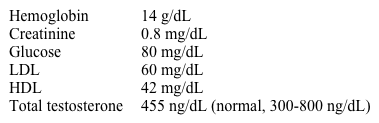 Which of the following is the best next step in treating this patient's erectile dysfunction?
 (Multiple Choice)
4.8/5 (82)
(82) A 28-year-old man is brought to the emergency department for shortness of breath that has been progressively worsening for the last 12 hours. The patient started a new job working in a warehouse, and he thinks that the dust and heat triggered his symptoms. He has had two prior hospitalizations for asthma; during one, he required intubation. The patient uses a fluticasone inhaler daily and an albuterol rescue inhaler as needed and has not had an exacerbation in >2 years. Temperature is 37 C (98.6 F), blood pressure is 158/90 mm Hg, pulse is 105/min, and respirations are 24/min. Pulse oximetry is 91% on room air. On examination, the patient is in respiratory distress. He has prominent bilateral inspiratory and expiratory wheezing. Venous blood pCO2 is 30 mm Hg. Which of the following is the greatest risk factor for severe and life-threatening asthma in this patient?
(Multiple Choice)
4.9/5 (77)
(77) A 52-year-old woman comes to the office with worsening shortness of breath over the last 2 weeks. Her symptoms are particularly worse at night. The patient has no fever or cough. She was diagnosed with breast cancer 2 years ago and had a left complete mastectomy. Chest x-ray is shown in the image below. 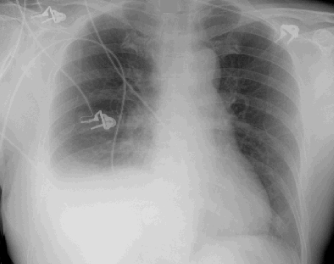 Examination of this patient's right lower lung field would most likely show which of the following?
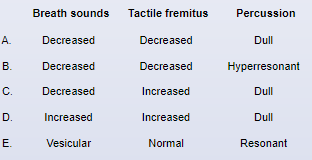
Examination of this patient's right lower lung field would most likely show which of the following?
(Multiple Choice)
5.0/5 (83)
(83) An 18-year-old woman is brought to the emergency department due to a severe headache. Her symptoms began suddenly an hour ago while she was moving into her college dorm room. The patient rested and took acetaminophen; the pain remains severe, and she has vomited once. Her only medication is an oral contraceptive. Temperature is 37.3 C (99.1 F), blood pressure is 156/90 mm Hg, and pulse is 100/min. The patient appears uncomfortable. Neurologic examination shows intact cranial nerves. Strength and sensations are equal bilaterally. Cerebellar examination is normal. CT scan of the head shows no focal abnormalities. Results from cerebrospinal fluid analysis are as follows:  There is no difference in cell counts between the first and the last collection tubes. Which of the following is the most likely diagnosis in this patient?
 (Multiple Choice)
4.7/5 (90)
(90) A 45-year-old man comes to the emergency department due to "coughing up blood." The patient had an episode of harsh coughing this morning and then noticed streaks of bright red blood in his sputum during subsequent coughs. The patient has had 3 weeks of nasal congestion and progressive cough, which now awakens him from sleep. He has no chronic medical conditions. Vital signs are normal. The patient is well-appearing and in no acute distress. The nasal mucosa is boggy, and the posterior oropharynx is erythematous. The lungs have a few scattered crackles, and heart sounds are normal. Laboratory results are as follows:  Which of the following is the most likely diagnosis in this patient?
 (Multiple Choice)
4.9/5 (87)
(87) A 43-year-old man comes to the office due to worsening pedal edema for the last several weeks. He also has had fatigue but no dyspnea, orthopnea, or chest pain. The patient was diagnosed with HIV during a screening 5 years ago. He refused treatment in the past but has been taking antiretroviral therapy and prophylactic trimethoprim-sulfamethoxazole after being hospitalized for Pneumocystis pneumonia 4 months ago. He does not use tobacco, alcohol, or illicit drugs. Temperature is 36.7 C (98.1 F), blood pressure is 140/86 mm Hg, and respirations are 16/min. Physical examination shows normal heart and lung sounds, a nontender abdomen with no organomegaly, and no rashes. There is 2+ pitting edema on the bilateral lower extremities. Laboratory results are as follows:  Urinalysis reveals 3+ proteinuria but no other abnormalities. Serum creatinine was normal at hospital discharge 4 months ago, and CD4 cell count was 220/mm3 a month ago. Which of the following is the most likely cause of this patient's current condition?
 (Multiple Choice)
4.9/5 (85)
(85) A 42-year-old man comes to the office due to a nonpruritic, nonpainful skin lesion on the left upper arm that began 2 months ago. He has also had tingling and numbness of the left fingers. The patient has no medical history and does not take any medications. He emigrated from Southeast Asia to Connecticut a year ago. Temperature is 36.6 C (97.8 F), blood pressure is 126/82 mm Hg, and pulse is 74/min. Skin examination shows a 4-cm, well-circumscribed, hypopigmented patch on the left upper arm with no sensation to pinprick. The ulnar nerve is thickened and tender at the left elbow. Touch and pain sensation is absent in the left ulnar nerve distribution. Which of the following is most likely to confirm the diagnosis in this patient?
(Multiple Choice)
4.8/5 (74)
(74) A 24-year-old woman comes to the office due to yellowing of the eyes that was first noted by her college roommate yesterday. The patient otherwise feels well and has no symptoms. She has no chronic medical conditions. The patient recently completed a prolonged fast in observance of a religious holiday. Her only medication is an oral contraceptive. Temperature is 36.7 C (98 F), blood pressure is 120/80 mm Hg, and pulse is 76/min. Scleral icterus is present. Cardiopulmonary examination is normal. The abdomen is soft, nondistended, and nontender without hepatosplenomegaly or masses. Laboratory results are as follows:  Which of the following is the most appropriate diagnostic step in management?
 (Multiple Choice)
4.9/5 (77)
(77) A 19-year-old woman comes to the office due to severe acne. She had expected the acne to improve after high school, but instead, it is worsening. The patient has tried multiple remedies without significant improvement. She is concerned that the acne is scarring her face. Since the patient started college last year, she has gained 13.6 kg (30 lb). She sings in a local church choir and has not noticed any voice changes. The patient has no chronic medical conditions, has had no surgeries, and takes no medications. BMI is 29 kg/m2. Physical examination shows nodulocystic acne on the face, arms, back, and forehead. The scalp is normal, with no alopecia. Tanner stage is 5. There is no skin discoloration or striae. No masses are palpable on abdominal examination. A urine pregnancy test is negative. Which of the following additional information is required to establish the most likely diagnosis?
(Multiple Choice)
4.8/5 (76)
(76) A 46-year-old man comes to the physician due to exertional dyspnea and dry cough. He also has occasional episodes of suffocating nighttime cough that is relieved only by sitting up. Medical history is significant for myocardial infarction 6 months ago and hypercholesterolemia. Current medications include metoprolol, aspirin, and rosuvastatin. The patient drinks alcohol on social occasions but does not use tobacco or illicit drugs. His father died of a stroke and his mother has type 2 diabetes mellitus. Blood pressure is 150/100 mm Hg and pulse is 60/min. Chest examination shows bibasilar crackles. The cardiac apex is palpated in the left sixth intercostal space. Bilateral pitting leg edema is present. Which of the following is most likely to be associated with this patient's condition?
(Multiple Choice)
4.9/5 (93)
(93) A 25-year-old African American woman comes to the office after experiencing increasingly heavy menstrual cycles for 3 months. The patient has also noticed that her gums frequently bleed when she brushes her teeth. Review of systems is positive for ongoing pain and stiffness in her hands and wrists that is partially responsive to ibuprofen. She is not taking any medications and has no known medical conditions. The patient is afebrile, blood pressure is 149/79 mm Hg, and pulse is 87/min. A nonpainful oral ulcer is present. Multiple petechiae are present on the upper arms and shins. The wrists and hands are tender to palpation and demonstrate reduced range of motion. Laboratory results are as follows:  Which of the following is the most likely cause of thrombocytopenia in this patient?
 (Multiple Choice)
4.9/5 (83)
(83) A 28-year-old woman comes to the office with acute pain in her left knee joint. She had mild discomfort and pain in her right wrist 4 days ago and left ankle pain 2 days ago. The patient has had no recent respiratory illness, diarrhea, urinary symptoms, or vaginal discharge. Her medical history is unremarkable, and she takes no medications except oral contraceptives. The patient drinks a glass of wine daily, but does not smoke or use intravenous drugs. She is single and sexually active. Her last menstrual period was a week ago. Temperature is 38.5 C (101.3 F), blood pressure is 120/80 mm Hg, pulse is 98/min, and respirations are 15/min. Inspection of the knee shows a moderate effusion and faint erythema. There is warmth and tenderness on palpation. Range of motion is limited by significant pain. No skin lesions are present. Synovial fluid analysis shows a white blood cell count of 50,000/mm3 with a predominance of neutrophils. Which of the following is the most likely cause of this patient's symptoms?
(Multiple Choice)
4.8/5 (83)
(83) A 56-year-old man comes to the office for follow-up of high blood pressure. At his 3 previous visits, systolic blood pressure has been 140-145 mm Hg, and diastolic blood pressure has been 90-96 mm Hg. The patient has no other medical problems and takes no medications. He has smoked 2 or 3 cigarettes daily for 30 years and drinks 1 or 2 glasses of wine nightly. The patient's diet mainly consists of fried foods and meat, with limited intake of fruits and vegetables. There is no family history of diabetes mellitus, coronary artery disease, hyperlipidemia, or hypertension. Blood pressure is 146/97 mm Hg and pulse is 80/min. BMI is 27 kg/m2. Physical examination is normal. Which of the following nonpharmacologic interventions is likely to have the greatest impact on this patient's blood pressure?
(Multiple Choice)
4.8/5 (83)
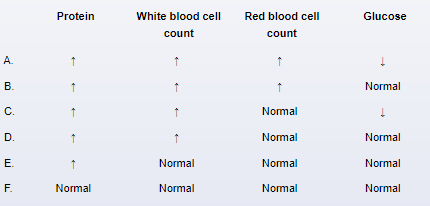
(83) A 27-year-old man is brought to the emergency department with difficulty walking. He noticed leg weakness several days ago, and now he is barely able to walk. He also complains of foot tingling. Two weeks ago, he had an upper respiratory tract infection that resolved on its own. Review of systems is negative for fever, headache, neck or back pain, or other symptoms. Vital signs show tachycardia and orthostatic hypotension. Physical examination shows bilateral lower-extremity muscle weakness and absent knee and ankle reflexes. Sensation is intact. Cerebrospinal fluid analysis of this patient would most likely show which of the following results?
(Multiple Choice)
4.7/5 (81)
(81) A 36-year-old woman comes to the emergency department due to 12 hours of malaise and fever with chills. The patient also has pain in multiple joints. Her menstrual period started 3 days ago, and she is using 4-6 tampons per day. The patient uses intravenous heroin and sometimes has sex in exchange for a dose of the drug. Temperature is 39.3 C (102.7 F), blood pressure is 122/81 mm Hg, pulse is 104/min, and respirations are 14/min. Examination shows several pustules on the chest and extensor surfaces of the forearms. The palms and soles are unaffected. Joint examination shows no redness or swelling, but the right wrist and right ankle are tender on palpation. Heart sounds are normal. Funduscopy and oropharyngeal examination are normal. There is no cervical, axillary, or inguinal lymphadenopathy. Three sets of blood cultures are negative. Based on these findings, which of the following is the most likely diagnosis in this patient?
(Multiple Choice)
4.9/5 (89)
(89) Showing 1201 - 1220 of 1702
 Prev
- 1
- ...
- 2
- ...
- 3
- ...
- 4
- ...
- 5
- ...
- 6
- ...
- 7
- ...
- 8
- ...
- 9
- ...
- 10
- ...
- 11
- ...
- 12
- ...
- 13
- ...
- 14
- ...
- 15
- ...
- 16
- ...
- 17
- ...
- 18
- ...
- 19
- ...
- 20
- ...
- 21
- ...
- 22
- ...
- 23
- ...
- 24
- ...
- 25
- ...
- 26
- ...
- 27
- ...
- 28
- ...
- 29
- ...
- 30
- ...
- 31
- ...
- 32
- ...
- 33
- ...
- 34
- ...
- 35
- ...
- 36
- ...
- 37
- ...
- 38
- ...
- 39
- ...
- 40
- ...
- 41
- ...
- 42
- ...
- 43
- ...
- 44
- ...
- 45
- ...
- 46
- ...
- 47
- ...
- 48
- ...
- 49
- ...
- 50
- ...
- 51
- ...
- 52
- ...
- 53
- ...
- 54
- ...
- 55
- ...
- 56
- ...
- 57
- ...
- 58
- ...
- 59
- ...
- 60
- ...
- 61
- ...
- 62
- ...
- 63
- ...
- 64
- ...
- 65
- ...
- 66
- ...
- 67
- ...
- 68
- ...
- 69
- ...
- 70
- ...
- 71
- ...
- 72
- ...
- 73
- ...
- 74
- ...
- 75
- ...
- 76
- ...
- 77
- ...
- 78
- ...
- 79
- ...
- 80
- ...
- 81
- ...
- 82
- ...
- 83
- ...
- 84
- ...
- 85
- ...
- 86
- ...
- Next

Filters
- Essay(0)
- Multiple Choice(0)
- Short Answer(0)
- True False(0)
- Matching(0)