


 Chat with AI
Exam 1: Medicine

Exam 1: Medicine2 k Questions
Exam 2: Pediatric723 Questions
Exam 3: Psychiatry336 Questions
Exam 4: Surgery563 Questions
Exam 5: Obstetrics & Gynecology469 Questions
Select questions type


A 73-year-old woman comes to the emergency department due to shortness of breath and productive cough for the past 2 weeks. The patient lives independently and is active in her retirement community. She was seen by her primary care physician last year and has no medical conditions. The patient has a history of smoking but quit 20 years ago. Temperature is 37.8 C (100 F). Lung auscultation reveals right-sided crackles. Chest x-ray reveals right lower lobe consolidation and a solitary 1-cm, round lesion in the left upper lung field, which was not seen on previous x-rays. The patient is admitted and treated for community-acquired pneumonia, becomes medically stable, and is ready to be discharged home with oral antibiotics. The physician records the pulmonary lesion finding on the discharge summary, places an outpatient radiology referral for chest CT scan, and informs the patient that she will be contacted regarding her radiology appointment after discharge. Several months later, the patient is readmitted to the hospital with dyspnea and weight loss. Records show that she was called about the scheduled appointment for the CT scan but did not attend it, so the test was not completed. Repeat imaging reveals enlargement of the pulmonary nodule, and biopsy confirms lung adenocarcinoma. Which of the following interventions by hospital providers is most appropriate for reducing future occurrences of similar errors?
(Multiple Choice)
4.9/5  (79)
(79) A 40-year-old man comes to the clinic due to runny nose, cough, and sore throat. He began having rhinorrhea 5 days ago and subsequently developed a cough that is worse at night. The patient has been taking an over-the-counter cough medication, but it has not improved his symptoms. Three days ago, he developed a sore throat, which he attributes to frequent coughing. Today, his throat is more painful, and he has been having difficulty swallowing liquids. The patient has hypertension and type 2 diabetes mellitus, for which he takes an antihypertensive and several medications for glycemic control. Temperature is 37.9 C (100.2 F), blood pressure is 148/90 mm Hg, pulse is 110/min, and respirations are 22/min. BMI is 35 kg/m2. Pulse oximetry shows 99% on room air. The patient winces when swallowing. Examination shows pooling of oral secretions. There are several dental caries. The posterior oropharynx appears mildly erythematous due to postnasal drip. The anterior neck is soft but tender to palpation. Lung examination reveals faint stridor with no crackles or rhonchi. Which of the following is the best next step for establishing the diagnosis in this patient?
(Multiple Choice)
4.9/5 (90)
(90) A 24-year-old man comes to the urgent care clinic with a penile lesion that appeared a week ago as a painful papule and has since changed and worsened. The patient regularly uses intravenous heroin and had unprotected sex with a female acquaintance in exchange for a small amount of heroin 2 weeks ago. He has no history of sexually transmitted infections. Temperature is 36.7 C (98 F), blood pressure is 120/70 mm Hg, and pulse is 78/min. Cardiopulmonary examination is normal. The abdomen is soft and nontender. Genital examination reveals a tender, 1.5-cm ulcer on the prepuce with well-demarcated, undermined borders and a purulent exudate. Two smaller ulcers with a similar appearance are near the larger ulcer. He has no penile discharge and the scrotum appears normal. Several inguinal lymph nodes are enlarged and tender. Skin examination shows track marks in the antecubital area but no other rash. Which of the following is the most likely cause of this patient's penile ulcer?
(Multiple Choice)
4.8/5 (93)
(93) A 38-year-old woman comes to the emergency department due to a week of clumsiness and shaking in her right arm. The patient also feels unsteady and has fallen twice in the past 2 days. One year ago, she had diplopia and vertigo for 2 weeks that resolved without treatment. The patient has no other medical problems. She takes oral contraceptives and occasionally acetaminophen. She does not use tobacco, alcohol, or illicit drugs. She recently started a vegan diet. Her father died of a large stroke, and her mother has diabetes mellitus. Temperature is 37 C (98.6 F), blood pressure is 140/85 mm Hg, and pulse is 84/min and regular. BMI is 34 kg/m2. On physical examination, there is mild right pronator drift but no muscle weakness. The patient is unable to walk a tandem gait. MRI of the brain without contrast is shown in the image below. 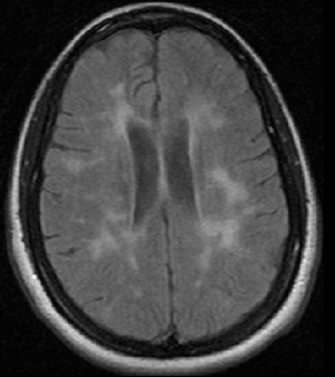 Which of the following is the most appropriate next step in management of this patient?
 (Multiple Choice)
4.8/5 (79)
(79) A 46-year-old man is hospitalized with severe acute pancreatitis. Because of progressive respiratory difficulty, he is intubated and placed on mechanical ventilation. His weight is 70 kg (152 lb), blood pressure is 110/70 mm Hg, and heart rate is 90/min. His respiratory rate is 18/min. Chest x-ray shows patchy opacities bilaterally, consistent with pulmonary edema. His current ventilator settings are: assist control mode, respiratory rate of 18/min, tidal volume of 450 mL, FiO2 of 40%, and positive end-expiratory pressure (PEEP) of 5 cm H2O. His blood gas readings are: 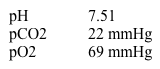 Which of the following is the best next step in managing this patient?
 (Multiple Choice)
4.9/5 (96)
(96) A 21-year-old man comes to the office due to recent irritability and aggressive behavior. He is a star college football linebacker and is training for his senior season. The patient does not use tobacco or alcohol. His mother has diabetes and his father has basal cell skin cancer. Blood pressure is 132/84 mm Hg and pulse is 62/min. The patient is muscular and well appearing. There is no lymphadenopathy in the cervical or supraclavicular chains. Cardiopulmonary examination is normal. Mild gynecomastia is present. The abdomen is soft and nontender. Liver span is 8 cm, and the spleen is not palpable. Laboratory results are as follows: 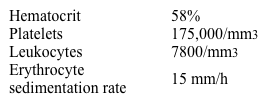 Which of the following is the best single explanation for this patient's presentation?
 (Multiple Choice)
4.9/5 (67)
(67) A 58-year-old woman, gravida 1 para 1, comes to the office for a routine health maintenance examination. The patient has been doing well. She has no chronic medical conditions, and her only surgery was a cesarean delivery at age 20. Menarche was at age 15, and menopause occurred 7 years ago. The patient used vaginal estrogen cream twice weekly for the first 3 years after menopause but currently takes no medications and has no allergies. A paternal cousin died of breast cancer this year, and the patient is concerned about her own risk for breast cancer. BMI is 23 kg/m². Physical examination and screening mammography are normal. Which of the following historical findings is the greatest risk factor for breast cancer in this patient?
(Multiple Choice)
4.8/5 (84)
(84) A 43-year-old man comes to the office due to a rash. He has a 1-week history of a blistering rash on his hands associated with severe pruritus. The patient had a similar rash twice in the previous 2 months that resolved with peeling of the skin on his hands. He has had no changes in household products and no occupational chemical exposure. Medical history is unremarkable. Examination shows a vesicular rash on the hands as shown in the exhibit. 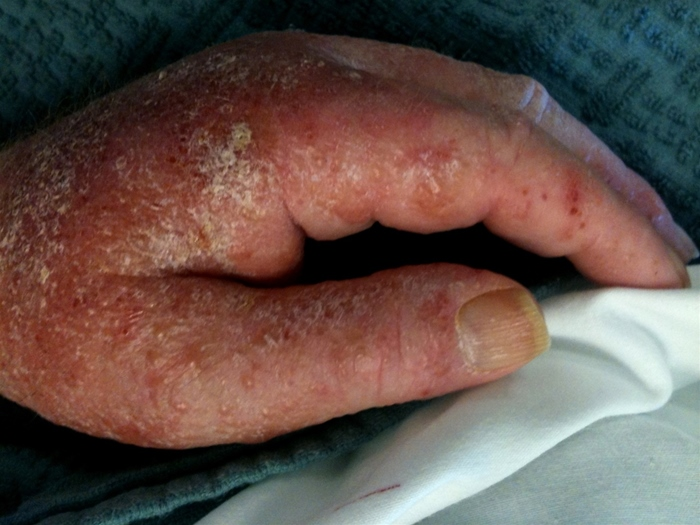 Which of the following is the most likely diagnosis of this patient's skin condition?
 (Multiple Choice)
4.8/5 (88)
(88) A 20-year-old woman comes to the emergency department in January due to severe myalgias, fever, headache, and nausea that developed 4 hours ago. She has also had several episodes of nonbloody emesis over the past hour. The patient was feeling well this morning before her symptoms started. She does not use tobacco, alcohol, or illicit drugs. The patient has no known medication allergies. Temperature is 40.3 C (104.5 F), blood pressure is 100/70 mm Hg, and pulse is 115/min. She is confused and has difficulty concentrating. Lung examination is normal. There is marked tenderness to palpation of the muscles along her extremities, which are mottled and cool to the touch. Complete blood count reveals a white blood cell count of 28,000/mm3 with 12% bands. A noncontrast head CT is unremarkable. Which of the following is the best next step in management of this patient?
(Multiple Choice)
4.8/5 (83)
(83) A 51-year-old man comes to the physician with difficulty swallowing solids but not liquids. His medical history is significant for gastroesophageal reflux disease for the last 12 years. He underwent endoscopy and was diagnosed with Barrett's esophagus 6 months ago. His heartburn resolved 3 months after this diagnosis. The patient's vital signs are within normal limits. His body mass index is 38 kg/m2. Barium swallow now shows an area of symmetric, circumferential narrowing affecting the distal esophagus. Which of the following best explains this finding?
(Multiple Choice)
4.8/5 (65)
(65) A 42-year-old man comes to the office due to 4 weeks of fatigue and weakness. He has also had fleeting joint pains, low-grade fever, dark and cloudy urine, pain in the fingertips, and shortness of breath when walking fast or climbing stairs. Examination shows tender, subcutaneous, violaceous nodules on the pads of the fingers. Laboratory results are as follows:  Urinalysis shows 2+ blood and 1+ protein. Which of the following is the best step in establishing a diagnosis in this patient?
 (Multiple Choice)
4.8/5 (83)
(83) A 44-year-old woman comes to the office with muscle weakness over the past several months. She has difficulty combing her hair and, occasionally, difficulty holding up her head, particularly after prolonged sitting or standing. The patient has had no difficulty walking or getting up from a chair. She has also had 2 episodes of double vision while driving home from work. The patient takes rosuvastatin for hyperlipidemia and lisinopril for hypertension. Blood pressure is 142/84 mm Hg and pulse is 76/min. Neurologic examination shows mild right ptosis, symmetric proximal muscle weakness in the upper extremities, and weakness in the head extensors. Muscle bulk and tone are normal and there is no muscle tenderness. Which of the following is the most likely site of the pathology in this patient?
(Multiple Choice)
4.9/5 (87)
(87) A 28-year-old man is brought to the emergency department after being found confused in his garage. Blood pressure is 110/64 mm Hg, pulse is 48/min, and respirations are 22/min. Oxygen saturation is 92% on room air. The patient is lethargic and diaphoretic. The pupils are constricted bilaterally, and significant drooling is noted. Lung auscultation reveals diffuse wheezing and scattered rhonchi. Which of the following is the best next step in management of this patient?
(Multiple Choice)
4.9/5 (92)
(92) A 76-year-old woman is brought to the office by her daughter due to progressively worsening memory and language difficulties. The patient first started having memory problems and word-finding difficulties 5 years ago. She then began having difficulty balancing her checkbook and buying groceries. The patient became lost while driving to church last year and no longer drives. She is now dependent on her daughter for cooking and cleaning. Over the past 6 months, the patient's personality has changed from seeming apathetic to becoming more paranoid and agitated; she frequently claims to have seen her niece stealing from her purse. The patient recently developed urinary incontinence. She has a history of hyperlipidemia and osteoarthritis of the left hip and both knees. Blood pressure is 130/80 mm Hg and pulse is 90/min. Deep tendon reflexes are 2+ throughout, and she has preserved motor strength. The patient recalls none of 3 objects on memory testing and cannot draw a clock. Laboratory studies show normal electrolytes, lipid panel, TSH, vitamin B12, and complete blood count. Which of the following is the most likely diagnosis?
(Multiple Choice)
4.9/5 (85)
(85) A 70-year-old man comes to the office for a follow-up for gout. It has been well controlled, with no joint pain since he started taking allopurinol 6 months ago. The patient has had no chest pain, trouble breathing, headaches, or lightheadedness. He does not use tobacco, alcohol, or illicit drugs. The patient's blood pressure was 145/90 mm Hg and 150/95 mm Hg at his 2 previous visits. Today, his blood pressure is 148/92 mm Hg on the left arm and 144/90 mm Hg on the right arm. Physical examination is normal. Complete blood cell count, serum creatinine, serum electrolytes, TSH, uric acid, and urinalysis results are normal. ECG indicates left ventricular hypertrophy. Which of the following is the best next step in managing this patient?
(Multiple Choice)
4.8/5 (79)
(79) A 42-year-old woman comes to the office with a 4-month history of heartburn. She describes a periodic "sticking sensation" in her chest during meals. In addition, the patient has recently been unable to participate in her normal exercise routine due to dyspnea on exertion and joint pain in her hands and feet. She does not use tobacco, alcohol, or illicit drugs. Lung examination reveals bilateral end-inspiratory crackles. Endoscopic evaluation shows mild hyperemia in the distal esophagus. Esophageal manometry shows lack of peristaltic waves in the lower two-thirds of the esophagus and a significant decrease in lower esophageal sphincter tone. Which of the following is the most likely mechanism responsible for this patient's manometric findings?
(Multiple Choice)
4.8/5 (66)
(66) A 27-year-old woman, gravida 1 para 0, at 9 weeks gestation comes to the clinic for an initial prenatal visit. The patient has mild nausea but is otherwise feeling well. She recently completed law school and is studying for the bar examination. The patient has no known medical conditions and has had no surgeries. Her mother and sister have anemia. The patient eats fish but otherwise usually follows a vegetarian diet. Prior to this pregnancy, menses occurred monthly with 5-6 days of bleeding that was heaviest the first 2 days. She does not use tobacco, alcohol, or illicit drugs. Temperature is 36.7 C (98 F), blood pressure is 110/80 mm Hg, pulse is 76/min, and respirations are 16/min. Examination shows no abnormalities. Laboratory results are as follows:  Transvaginal ultrasound shows a 9-week intrauterine gestation with normal cardiac activity. Which of the following is the best next step in management of this patient?
 (Multiple Choice)
4.8/5 (78)
(78) A 66-year-old man comes to the office due to heart palpitations for the last 2 weeks. His medical history is significant for coronary artery disease, hypertension, and type 2 diabetes mellitus. Physical examination and ECG demonstrate an irregularly irregular rhythm. Which of the following anatomic sites is the most likely origin of this patient's arrhythmia?
(Multiple Choice)
4.9/5 (68)
(68) A 60-year-old woman comes to the emergency department due to decreasing vision and a dull ache over her left eye for the past 12 hours. She had a successful surgical cataract extraction in her left eye 5 days ago. Temperature is 38.1 C (100.6 F), blood pressure is 140/90 mm Hg, pulse is 92/min, and respirations are 14/min. Examination of the left eye reveals a swollen eyelid, edematous conjunctiva, and exudates in the anterior chamber. Testing with Snellen's chart demonstrates decreased visual acuity in her left eye. What is the most likely diagnosis?
(Multiple Choice)
4.8/5 (86)
(86) An 8-month-old boy is brought to the physician for evaluation of pale mucous membranes, irritability, and listlessness. The stool examination is negative for blood, ova, and parasites. Serum laboratory studies are as follows: 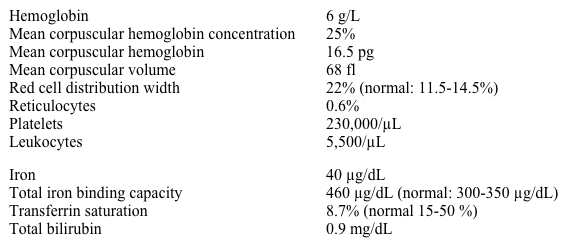 The peripheral blood smear shows marked anisocytosis, microcytosis, and hypochromia. Which of the following is the most likely cause of this patient's anemia?
 (Multiple Choice)
4.8/5 (78)
(78) Showing 761 - 780 of 1702
 Prev
- 1
- ...
- 2
- ...
- 3
- ...
- 4
- ...
- 5
- ...
- 6
- ...
- 7
- ...
- 8
- ...
- 9
- ...
- 10
- ...
- 11
- ...
- 12
- ...
- 13
- ...
- 14
- ...
- 15
- ...
- 16
- ...
- 17
- ...
- 18
- ...
- 19
- ...
- 20
- ...
- 21
- ...
- 22
- ...
- 23
- ...
- 24
- ...
- 25
- ...
- 26
- ...
- 27
- ...
- 28
- ...
- 29
- ...
- 30
- ...
- 31
- ...
- 32
- ...
- 33
- ...
- 34
- ...
- 35
- ...
- 36
- ...
- 37
- ...
- 38
- ...
- 39
- ...
- 40
- ...
- 41
- ...
- 42
- ...
- 43
- ...
- 44
- ...
- 45
- ...
- 46
- ...
- 47
- ...
- 48
- ...
- 49
- ...
- 50
- ...
- 51
- ...
- 52
- ...
- 53
- ...
- 54
- ...
- 55
- ...
- 56
- ...
- 57
- ...
- 58
- ...
- 59
- ...
- 60
- ...
- 61
- ...
- 62
- ...
- 63
- ...
- 64
- ...
- 65
- ...
- 66
- ...
- 67
- ...
- 68
- ...
- 69
- ...
- 70
- ...
- 71
- ...
- 72
- ...
- 73
- ...
- 74
- ...
- 75
- ...
- 76
- ...
- 77
- ...
- 78
- ...
- 79
- ...
- 80
- ...
- 81
- ...
- 82
- ...
- 83
- ...
- 84
- ...
- 85
- ...
- 86
- ...
- Next

Filters
- Essay(0)
- Multiple Choice(0)
- Short Answer(0)
- True False(0)
- Matching(0)