


 Chat with AI
Exam 1: Medicine

Exam 1: Medicine2 k Questions
Exam 2: Pediatric723 Questions
Exam 3: Psychiatry336 Questions
Exam 4: Surgery563 Questions
Exam 5: Obstetrics & Gynecology469 Questions
Select questions type


A 28-year-old woman comes to the office due to worsening of a skin rash on her back and arms for the past 2 weeks. She has had no associated pain or pruritus. During her teenage years, the patient had comedonal acne on her face, which resolved with topical medications. She was diagnosed with systemic lupus erythematosus 2 years ago and is on oral prednisone due to a recent exacerbation with pain and swelling in the small joints of the hands. The patient also takes hydroxychloroquine and as-needed nonsteroidal anti-inflammatory drugs. She does not use tobacco, alcohol, or illicit drugs. She works in a dry-cleaning facility. The patient is sexually active with her boyfriend and has an intrauterine device for contraception. Temperature is 37 C (98.6 F), blood pressure is 130/86 mm Hg, and pulse is 78/min. Skin examination shows uniform-appearing, 1- to 3-mm, erythematous papules across her back, shoulders, and upper arms. There is mild symmetric synovitis in the hands and wrists, but the remainder of the physical examination is unremarkable. Which of the following is the most likely cause of this patient's skin rash?
(Multiple Choice)
4.8/5  (84)
(84) A 32-year-old man comes to the office due to 3 days of fever, malaise, and cough productive of clear sputum. He has had no nasal congestion, rhinorrhea, sore throat, or chest pain. The patient has a history of mild, intermittent asthma and seasonal allergic rhinitis. He does not use tobacco but drinks alcohol occasionally. His 2-year-old son had fever, cough, and rhinorrhea last week. Temperature is 38.3 C (101 F), blood pressure is 120/80 mm Hg, pulse is 92/min, respirations are 20/min, and pulse oximetry is 96% on room air. The oropharynx is normal, and palpation of the neck shows no cervical lymphadenopathy. Lung auscultation reveals crackles at the right lung base and occasional expiratory wheezing. Heart sounds are normal. Which of the following is the best next step in management of this patient?
(Multiple Choice)
5.0/5 (80)
(80) A 31-year-old woman is brought to the emergency department by her boyfriend due to confusion. The boyfriend says that the patient "seemed okay" when he left for work this morning, but when he returned in the evening, she was disoriented and "acting like a drunk person"; she had also vomited "all over the bathroom." The patient was recently fired due to interpersonal problems with other employees. She has a history of bipolar disorder. Medications include clonazepam, lithium, and quetiapine. Temperature is 37 C (98.6 F), blood pressure is 110/68 mm Hg, pulse is 92/min, and respirations are 16/min. On physical examination, the patient is somnolent and has frequent fasciculations. Pupils are equal and reactive. During evaluation, she has a brief episode of a generalized tonic-clonic seizure. Laboratory results are as follows: 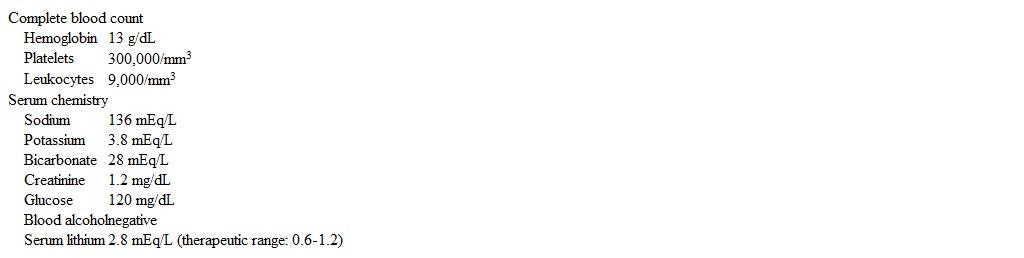 Acetaminophen and salicylate are not detected in the serum, and urine drug screen is negative. A noncontrast CT scan of the head shows no abnormalities. In addition to supportive measures, which of the following is the best next step in management of this patient?
 (Multiple Choice)
4.8/5 (68)
(68) A 28-year-old woman, gravida 2 para 0 aborta 2, comes to the office following a miscarriage. She had a previous first-trimester miscarriage 9 months ago. The patient has no other known medical problems. She has not experienced any recent change in appetite or weight, diarrhea, constipation, heat or cold intolerance, dyspnea, or hoarseness. The patient's mother has hypothyroidism treated with levothyroxine and hypertension treated with hydrochlorothiazide. The patient does not use tobacco or alcohol. Examination shows a symmetrically enlarged, nontender, firm thyroid gland. There is no cervical lymphadenopathy, and the rest of the physical examination is normal. Her TSH level is 7.2 μU/mL and free T4 is normal. Pelvic ultrasonography is normal. Which of the following autoantibodies is most likely associated with this patient's medical condition?
(Multiple Choice)
4.9/5 (81)
(81) A 54-year-old man comes to the office for follow-up after a recent colonoscopy. Six weeks ago, the patient was hospitalized due to left lower quadrant abdominal pain; CT scan of the abdomen revealed focal thickening of the sigmoid wall. The symptoms resolved with treatment and the patient underwent outpatient colonoscopy a week ago, which revealed sigmoid colon findings as shown in the exhibit. 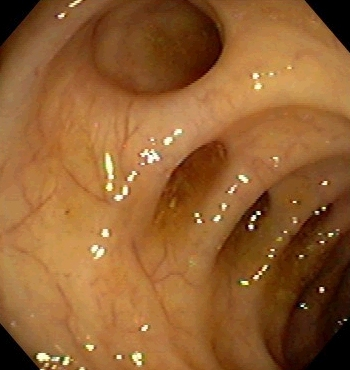 The patient now feels well and reports no residual symptoms. Physical examination is normal. Which of the following is the most appropriate recommendation to prevent future complications from this patient's condition?
 (Multiple Choice)
4.7/5 (87)
(87) A 17-year-old girl comes to the office for follow-up due to worsening acne. The patient has scattered papules and pustules with mild-to-moderate redness on the cheeks. The lesions are not painful, and there is no scarring. The patient has been using topical tazarotene and benzoyl peroxide for 2 months without improvement and is concerned that the acne is getting worse. She is sexually active. Medical history is otherwise negative. On examination, she has moderate pustular acne with erythema on the cheeks. Which of the following is the best next step in management of this patient?
(Multiple Choice)
4.8/5 (72)
(72) A 53-year-old man comes to the office because of difficulty reading fine print over the last year. He now has to hold books, menus, and magazines at an arms length in order to read them. He has never had visual problems before. Which of the following is most likely abnormal in this patient?
(Multiple Choice)
4.9/5 (74)
(74) A 56-year-old woman comes to the office due to epigastric abdominal pain for the past year. The pain worsens after eating and is described as crampy, intermittent, and nonradiating. The patient has had bloating and nausea but no unexpected weight loss, vomiting, constipation, diarrhea, melena, hematochezia, or changes in bowel habits. Medical history is significant for hypertension and hypothyroidism. Family history is unremarkable. She does not use tobacco or alcohol. Temperature is 37.5 C (99.5 F), blood pressure is 142/67 mm Hg, pulse is 80/min, and respirations are 14/min. The patient is not in acute distress. Heart and lung sounds are unremarkable. The abdomen is mildly tender to palpation in the epigastrium without rebound, guarding, or distension. Laboratory results are as follows:  Which of the following is the most likely diagnosis in this patient?
 (Multiple Choice)
4.7/5 (85)
(85) A 59-year-old man comes to visit a friend in the hospital and collapses in the parking lot. He had been feeling unwell all day due to vague chest discomfort. A bystander witnesses his collapse, finds no pulse, and immediately calls for help. Which of the following is the most important factor for survival in this patient?
(Multiple Choice)
4.9/5 (66)
(66) A 4-year-old girl is brought to the office due to a worsening cough and nasal discharge. Two weeks ago, the patient developed nasal congestion and a runny nose, which initially improved over a few days. However, for the past 10 days she has had increasing amounts of thick, yellow-green nasal discharge. She stayed home from preschool for the past 2 days due to a worsening daytime cough and has also been waking up at night with a cough. She has no chronic medical conditions and takes no daily medications. Immunizations are up to date. Temperature is 37.2 C (99 F), pulse is 90/min, and respirations are 18/min. Pulse oximetry is 99% on room air. Examination shows an alert, active child with intermittent coughing. Thick, purulent mucus is present in the nares and visualized in the posterior oropharynx. Nasal turbinates are mildly erythematous and swollen. Bilateral tympanic membranes are translucent and mobile, and the lungs are clear on auscultation. Which of the following is the best next step in management of this patient?
(Multiple Choice)
4.9/5 (93)
(93) A 64-year-old man comes to the emergency department due to palpitations and progressive shortness of breath over the past several weeks. The patient says that he develops "a choking sensation accompanied by a dry cough" every time he lies down. He has had no chest pain, sputum production, lightheadedness, or syncope. His other medical conditions include hypertension for the past 20 years and medication nonadherence. He also has a 35-pack-year smoking history. The patient's father died of a heart attack at age 70, and his mother suffered from asthma. Blood pressure is 182/105 mm Hg and pulse is 120/min and irregularly irregular. Lung examination reveals bibasilar crackles. There is 2+ pitting edema of the lower extremities. Bedside echocardiography shows a normal-sized left ventricle with wall hypertrophy, left ventricular ejection fraction of 55%, and no significant mitral or aortic valve disease. Which of the following is most likely responsible for this patient's symptoms?
(Multiple Choice)
4.9/5 (74)
(74) A 55-year-old woman comes to the office for a preventive visit. She has been feeling well but is concerned about osteoporosis because her older friend had a hip fracture last year and now must use a walker. The patient has no medical problems and never has had a fracture or surgery. Menopause occurred at age 50. She has never smoked and drinks alcohol occasionally. Her parents and siblings have had no osteoporotic fractures. Height is 165 cm (5 ft 5 in), weight is 84 kg (185 lb) and BMI is 31 kg/m2. The remainder of the physical examination is normal. The patient is instructed to initiate a weight-bearing exercise regimen. Which of the following is the most appropriate osteoporosis screening test for this patient?
(Multiple Choice)
4.8/5 (76)
(76) A 56-year-old man comes to the office due to progressively worsening fatigue, difficulty concentrating, and increasing forgetfulness over the past several weeks. In addition, the patient has had vague abdominal pain and constipation and has gained 2.7 kg (6 lb) unintentionally over the last 3 months. Medical history is significant for hypertension, nonischemic cardiomyopathy with left ventricular systolic dysfunction, and atrial fibrillation. Blood pressure is 140/90 mm Hg and pulse is 75/min. Physical examination reveals regular heart sounds with normal S1 and S2. The lungs are clear to auscultation. There is no lower extremity edema, and the skin appears dry. Laboratory studies are as follows:  Which of the following medications is most likely responsible for this patient's current symptoms?
 (Multiple Choice)
5.0/5 (73)
(73) A 52-year-old woman comes to the emergency department due to worsening chest pain and shortness of breath for the past week. The patient has right-sided, "stabbing" pain whenever she takes a deep breath associated with shortness of breath on moderate exertion. She has no fever, chills, or leg swelling but has had frequent pain in her hands and feet. The patient has pain while walking in the morning and is unable to bend her fingers to hold a coffee cup. She has no prior medical conditions and takes no medications. For several years in her twenties, the patient used tobacco (half-pack of cigarettes daily). She does not drink alcohol. Temperature is 37.2 (99 F), blood pressure is 142/80 mm Hg, pulse is 84/min, and respirations are 18/min. BMI is 30 kg/m2. Lung auscultation reveals bilateral fine inspiratory crackles and decreased breath sounds over the right base. Heart sounds are normal with no murmurs. The patient has no rashes. The wrists and small joints of the hands are mildly swollen and tender bilaterally; there is no clubbing. Laboratory results are as follows:  Chest x-ray shows increased interstitial markings and a moderate-sized right pleural effusion. Diagnostic thoracentesis reveals pleural fluid protein of 4 g/dL, lactate dehydrogenase of 950 U/L, and glucose of 10 mg/dL. Which of the following is the most likely underlying cause of this patient's pleural effusion?
 (Multiple Choice)
4.8/5 (81)
(81) A 5-year-old boy is brought to the emergency department by his mother's boyfriend for evaluation of thigh pain. This morning, the patient bumped into the edge of a table in the living room and now has swelling and pain in the right thigh. Family history is significant for a maternal uncle who died after developing intracranial hemorrhages from a minor head injury last year. Examination shows an uncomfortable-appearing boy with marked ecchymoses and swelling over the right quadriceps. Which of the following will most likely be found on further history and examination of this patient?
(Multiple Choice)
4.9/5 (87)
(87) A 64-year-old man comes to the hospital due to fever, diarrhea, hematochezia, and abdominal pain for the past 4-5 days. He has had >10 bloody stools a day. The patient has a history of ulcerative colitis and discontinued treatment a few months ago because he had not had a flare of symptoms for 2 years. He has no other medical problems. Temperature is 37.3 C (99.1 F), blood pressure is 100/74 mm Hg, pulse is 110/min, and respirations are 16/min. Physical examination shows tenderness in the left lower quadrant without rebound or guarding. Digital rectal examination shows gross blood. The patient is started on intravenous fluids, oral glucocorticoids, oral 5-aminosalicylic acid, and glucocorticoid enemas. On the second hospital day, serum sodium is 133 mEq/L, potassium is 3.6 mEq/L, and serum creatinine is 1.4 mg/dL. Thyroid function tests are as follows:  Which of the following is the primary reason for the thyroid test results in this patient?
 (Multiple Choice)
4.8/5 (83)
(83) A 42-year-old woman comes to the physician with bilateral knee pain that severely limits her mobility. She also complains of diffuse morning joint stiffness that takes several hours to improve. She has been taking over-the-counter ibuprofen and aspirin but has experienced little relief of symptoms. She has no other medical problems and does not use tobacco, alcohol, or illicit drugs. Her vital signs are within normal limits. Physical examination shows tenderness and swelling of multiple metacarpophalangeal joints, as well as both wrists and knees. Laboratory results are as follows:  Which of the following is the most appropriate next step in management of this patient's anemia?
 (Multiple Choice)
4.9/5 (78)
(78) A 51-year-old woman comes to the office for a follow-up. The patient has hypertension treated with lisinopril, hydrochlorothiazide, and amlodipine. She also takes paroxetine for hot flashes ever since her menopause at age 50 and says she continues to experience occasional episodes of "hot flashes and anxiety." The patient has been monitoring her blood pressure at home and brings a report with highly variable blood pressure readings. She reports no weight changes, fatigue, chest pain, myalgias, or polyuria. She has been taking her medications as prescribed. The patient does not smoke cigarettes or drink alcohol. Her father died at age 65 from hemorrhagic stroke. Blood pressure is 170/100 in the right arm and 166/94 in the left arm, and pulse is 88/min. BMI is 24 kg/m2. Physical examination is normal. Complete blood count, serum electrolytes, glucose, creatinine, and TSH level are within normal limits. What is the most appropriate next step in management?
(Multiple Choice)
4.9/5 (68)
(68) A 26-year-old previously healthy woman is brought to the emergency department after having an episode of seizure 1 hour ago. She has a 2-day history of fever and headaches, for which she has been taking acetaminophen and ibuprofen without much relief. This morning, her family found her behaving strangely. She has no family history of seizures. There is no recent travel history. Her temperature is 38.9 C (102 F), blood pressure is 120/70 mm Hg, pulse is 110/min, and respirations are 18/min. The patient is lethargic and confused. Hyperreflexia is present. Complete blood count and CT scan of the head are unremarkable. Her cerebrospinal fluid study shows: 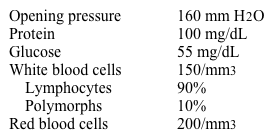 Which of the following is the most likely diagnosis in this patient?
 (Multiple Choice)
4.7/5 (61)
(61) A 45-year-old man comes to the office due to easy fatigability for the last few months. He does not have any chronic medical issues. The patient is vegetarian, has limited dairy consumption, and drinks alcohol daily. Physical examination reveals significant pallor. Laboratory results show a hemoglobin level of 10.8 g/dL and normal serum iron studies. He is started on thiamine and folic acid 1 mg daily. After several months, he reports recurrent falls and increasing forgetfulness. Which of the following is the most likely finding at this point?
(Multiple Choice)
4.9/5 (83)
(83) Showing 361 - 380 of 1702
 Prev
- 1
- ...
- 2
- ...
- 3
- ...
- 4
- ...
- 5
- ...
- 6
- ...
- 7
- ...
- 8
- ...
- 9
- ...
- 10
- ...
- 11
- ...
- 12
- ...
- 13
- ...
- 14
- ...
- 15
- ...
- 16
- ...
- 17
- ...
- 18
- ...
- 19
- ...
- 20
- ...
- 21
- ...
- 22
- ...
- 23
- ...
- 24
- ...
- 25
- ...
- 26
- ...
- 27
- ...
- 28
- ...
- 29
- ...
- 30
- ...
- 31
- ...
- 32
- ...
- 33
- ...
- 34
- ...
- 35
- ...
- 36
- ...
- 37
- ...
- 38
- ...
- 39
- ...
- 40
- ...
- 41
- ...
- 42
- ...
- 43
- ...
- 44
- ...
- 45
- ...
- 46
- ...
- 47
- ...
- 48
- ...
- 49
- ...
- 50
- ...
- 51
- ...
- 52
- ...
- 53
- ...
- 54
- ...
- 55
- ...
- 56
- ...
- 57
- ...
- 58
- ...
- 59
- ...
- 60
- ...
- 61
- ...
- 62
- ...
- 63
- ...
- 64
- ...
- 65
- ...
- 66
- ...
- 67
- ...
- 68
- ...
- 69
- ...
- 70
- ...
- 71
- ...
- 72
- ...
- 73
- ...
- 74
- ...
- 75
- ...
- 76
- ...
- 77
- ...
- 78
- ...
- 79
- ...
- 80
- ...
- 81
- ...
- 82
- ...
- 83
- ...
- 84
- ...
- 85
- ...
- 86
- ...
- Next

Filters
- Essay(0)
- Multiple Choice(0)
- Short Answer(0)
- True False(0)
- Matching(0)