


 Chat with AI
Exam 1: Medicine

Exam 1: Medicine2 k Questions
Exam 2: Pediatric723 Questions
Exam 3: Psychiatry336 Questions
Exam 4: Surgery563 Questions
Exam 5: Obstetrics & Gynecology469 Questions
Select questions type


A 53-year-old man with alcohol use disorder is brought to the emergency department after being found in a park on a cold day in winter. He was unresponsive when found and was intubated in the field by paramedics. On arrival, his body temperature is 31 C (88 F), blood pressure is 77/48 mm Hg, and pulse is 31/min. ECG shows sinus bradycardia and QT interval of 560 msec. Which of the following is the best next step in managing this patient's hemodynamic status?
(Multiple Choice)
4.9/5  (79)
(79) A 55-year-old woman is brought to the hospital due to a day of worsening dyspnea. The patient has no cough, chest pain, or fever. The day before the onset of dyspnea, she had blurred vision, dry mouth, and mild nausea. The patient takes lisinopril for hypertension. She does not use tobacco, alcohol, or illicit drugs. Temperature is 36.8 C (98.2 F), blood pressure is 120/70 mm Hg, pulse is 65/min, and respirations are 18/min. Pulse oximetry on room air is 93%. The patient is alert but has increased work of breathing. The pupils are 6 to 7 mm and sluggishly reactive. The mucous membranes are dry. Cardiopulmonary and abdominal examinations show no abnormalities. The neck muscles are weak. Muscle strength is 4/5 in the upper extremities. Sensations are normal. Deep tendon reflexes are 2+, and Babinski sign is absent. Arterial blood gas analysis on room air reveals the following:  What is the most likely cause of abnormal arterial blood gas findings in this patient?
 (Multiple Choice)
4.9/5 (84)
(84) A 42-year-old prison inmate is brought to the emergency department due to rapidly worsening shortness of breath. He was well at breakfast an hour ago. The patient has been seen in the emergency department several times over the last 2 years for asthma exacerbations, skin allergies, and alcohol intoxication. He is poorly adherent to maintenance asthma medications. Last night the patient took ibuprofen for shoulder pain that started after a physical altercation with another inmate. He is an active smoker with a 15-pack-year history. His last use of alcohol and cocaine was before he was incarcerated 2 months ago. Pulse is 118/min, respirations are 30/min, and oxygen saturation is 87% on 100% oxygen via nonrebreather mask. The patient is tall and thin, and he appears in severe respiratory distress with use of accessory muscles and subclavicular retractions. An urticarial rash is seen over the trunk and upper extremities. Which of the following is the most likely cause of this patient's breathing difficulty?
(Multiple Choice)
4.8/5 (73)
(73) A 35-year-old man comes to the office after a year of weakness, fatigue, and weight loss. He has experienced reduced appetite and intermittent diarrhea. The patient had no improvement after several sessions with a clinical psychologist, who suggested evaluation for a physiological cause of his symptoms. His medical history is unremarkable, and he takes no regularly scheduled medications. The patient does not use tobacco, alcohol, or illicit drugs. Family history is notable for hypothyroidism (sister). Temperature is 37.2 C (99 F), blood pressure is 106/66 mm Hg, pulse is 94/min, and respirations are 14/min. On physical examination, the patient does not appear to be in acute distress. His neck shows no thyromegaly or lymphadenopathy. Cardiopulmonary examination is normal, and the abdomen is soft with normal bowel sounds and no organomegaly. Motor strength and deep tendon reflexes are normal and symmetric. Laboratory results are as follows: 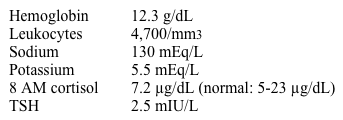 Which of the following is the most appropriate next step in management of this patient?
 (Multiple Choice)
4.9/5 (89)
(89) A 44-year-old previously healthy man is brought to the emergency department in early December by his girlfriend due to confusion. When the girlfriend went to the patient's mobile home yesterday, she found him feeling unwell with headache, nausea, and dizziness. The patient did not seek medical care because he began feeling better after they went out later in the day. This morning when the girlfriend went back, the patient was confused and disoriented on the bed. He had also urinated on himself. Temperature is 36.8 C (98.2 F), blood pressure is 140/84 mm Hg, pulse is 92/min, and respirations are 20/min. Oxygen saturation is 96% on room air. On physical examination, the patient is somnolent but rouses to voice. Pupils are equal and briskly reactive. There is no facial droop, but a small laceration on the lateral border of the tongue is present. The lungs are clear on auscultation and heart sounds are normal. The abdomen is nondistended, soft, and nontender. Extremities are without edema or cyanosis. Muscle strength and deep tendon reflexes are normal throughout and there is no neck stiffness. Fingerstick blood glucose is 118 mg/dL and non-contrast CT scan of the head is normal. What is the best next step in management?
(Multiple Choice)
4.8/5 (75)
(75) A 45-year-old woman is noted to have abnormal liver chemistries. She has no symptoms. The patient has hypercholesterolemia and her only medication is a statin. She lives with her husband and 3 children and works in a grocery store. Temperature is 37 C (98.6 F), blood pressure is 118/72 mm Hg, pulse is 68/min, and respirations are 12/min. BMI is 25 kg/m2. Physical examination reveals no abnormalities. Laboratory results are as follows: 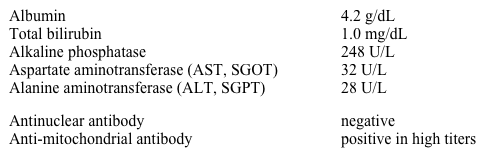 Right upper quadrant ultrasonogram shows no abnormalities. After confirmation of the diagnosis, which of the following is the best next step in management of this patient?
 (Multiple Choice)
5.0/5 (77)
(77) A 24-year-old woman is brought to the emergency department due to feeling lightheaded every time she stands up. The patient has no significant medical problems. She left her boyfriend 4 months ago as he was "eating too much" and has since had decreased appetite and lost 5 kg (11 lb). The patient has also missed her last 2 menstrual periods. She does not use tobacco, alcohol, or illicit drugs. Family history is significant for coronary artery disease and congestive heart failure. Her temperature is 36.7 C (98 F), blood pressure is 100/70 mm Hg, and pulse is 88/min while supine. On standing, blood pressure is 80/55 mm Hg and pulse is 120/min. Other than dry skin and mucous membranes, the patient's physical examination is unremarkable. Initial laboratory results are as follows: 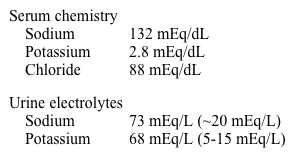 Which of the following is the most likely underlying etiology for this patient's symptoms?
 (Multiple Choice)
4.9/5 (87)
(87) A 42-year-old woman comes to the office due to worsening abdominal pain and distension. The vague upper abdominal discomfort began 4 weeks ago, and her abdomen has become progressively distended over the past week. The patient also notes several months of generalized pruritus, which is worsened by water contact and is not relieved by over-the-counter emollients. She has no other medical conditions and takes no medications. The patient does not use tobacco, alcohol, or illicit drugs. Temperature is 36.5 C (97.7 F), blood pressure is 152/80 mm Hg, pulse is 88/min, and respirations are 16/min. Physical examination shows facial plethora and mild scleral icterus. The neck veins are flat, and heart and lung sounds are normal. The abdomen is distended with flank dullness to percussion, tender hepatomegaly, and splenomegaly. There is no extremity edema or skin rash. Laboratory results are as follows: 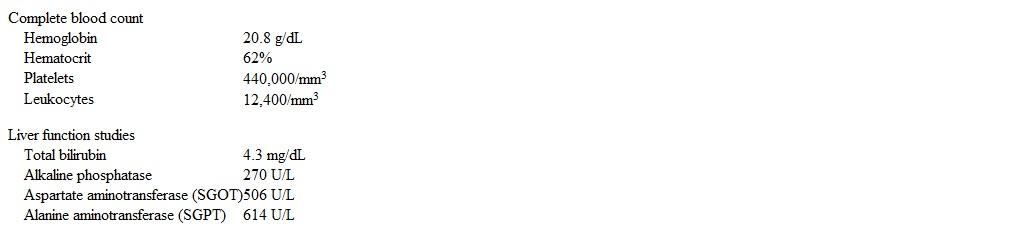 Which of the following is the best next step in evaluation of this patient's abdominal pain?
 (Multiple Choice)
5.0/5 (64)
(64) A 48-year-old overweight man comes to the physician for evaluation of a right foot ulcer that he first noticed 3 weeks ago. He has a history of hypertension, type 2 diabetes mellitus, and hypercholesterolemia. His current medications include ramipril, aspirin, metformin, sitagliptin, and rosuvastatin. He has a 20-pack-year smoking history and occasionally drinks alcohol but does not use illicit drugs. The patient is afebrile. His blood pressure is 132/80 mm Hg and pulse is 76/min. Examination shows a 1.7 x 2 cm ulcer on the plantar surface of the great toe. Which of the following tests will best assess this patient's risk of foot ulcers?
(Multiple Choice)
4.7/5 (72)
(72) A 43-year-old woman comes to the office due to elevated aminotransferase levels, which were identified during routine blood work. She feels well and reports no symptoms. She has no known medical conditions, and her family history is unremarkable. She used heroin 10 years ago but completed rehabilitation and has not used it since. She does not use tobacco or alcohol. Temperature is 37.5 C (99.5 F), blood pressure is 120/80 mm Hg, and pulse is 87/min. BMI is 24.5 kg/m2. There is no scleral icterus or asterixis. Skin and cardiopulmonary examinations are unremarkable. The abdomen is soft and nontender; there is no ascites. Laboratory results are as follows: 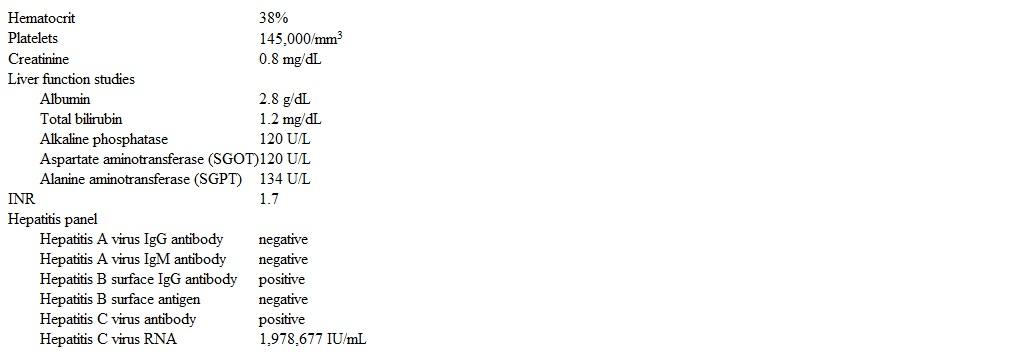 Abdominal ultrasonography reveals a nodular, shrunken liver without evidence of ascites. Upper endoscopy is negative for esophageal or gastric varices. In addition to providing antiviral therapy to treat this patient's hepatitis C infection, which of the following would be recommended at this time?
 (Multiple Choice)
4.9/5 (73)
(73) A 38-year-old woman comes to the office to discuss management of hypertension. She has chronic hypertension, which is managed with a stable dose of chlorthalidone. The patient is nulligravid but is currently contemplating pregnancy within the next year. She is a lifetime nonsmoker and does not use alcohol or illicit drugs. The patient's mother was diagnosed with hypertension at age 35. Blood pressure is 130/81 mm Hg; repeat blood pressure is 128/77 mm Hg. BMI is 26 kg/m2. Physical examination is unremarkable. Laboratory results are as follows:  Which of the following is the best advice to this patient?
 (Multiple Choice)
5.0/5 (86)
(86) A 65-year-old man with chronic obstructive pulmonary disease is hospitalized due to worsening shortness of breath, coughing, and wheezing. On arrival to the emergency department, the patient was in severe respiratory distress with bilateral wheezing. Chest x-ray revealed hyperinflated lungs without infiltrates. Endotracheal intubation was performed and mechanical ventilation initiated. Inhaled bronchodilators, systemic glucocorticoids, and empiric antibiotics were administered. Respiratory status gradually improved, and the patient was admitted to the intensive care unit. Now, 45 minutes later, progressive hypoxemia with elevated peak and plateau pressures has developed. Blood pressure is 150/86 mm Hg, pulse is 108/min, and respirations are 22/min. Oxygen saturation is 88% despite an increase in the fraction of inspired oxygen (FiO2) to 70%. There is no wheezing, but breath sounds are decreased on the right. Tracheal suctioning yields no mucus. Which of the following is the most likely cause of the deterioration in this patient's condition?
(Multiple Choice)
4.8/5 (79)
(79) A 49-year-old man comes to the office due to a rash. For the last year, the patient has had a red, itchy patch of skin on his leg. Clear, yellow fluid occasionally seeps from it. He has tried changing soaps and cleaning products and has applied various emollients without a change in symptoms. Medical history is unremarkable; the patient lives alone with 2 dogs and is not sexually active. Vital signs are normal. Examination findings are shown in the exhibit. 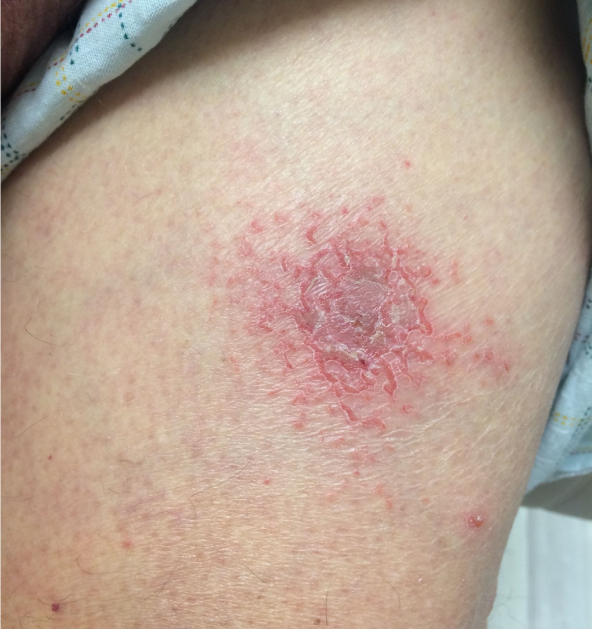 Which of the following is the most likely diagnosis of this patient's rash?
 (Multiple Choice)
4.9/5 (84)
(84) A 34-year-old woman comes to the office with an uncomfortable sensation of rapid heartbeat for the last few weeks. She has had no associated chest pain or shortness of breath. The patient reports that her anxiety level has been high recently due to stress at work, and she has lost close to 2 kg (4.4 lb) during this time. Her last menstrual period was 5 days ago. Medical history is unremarkable, and she takes no medications. On examination, the thyroid gland is diffusely enlarged and nontender. Laboratory results are as follows: 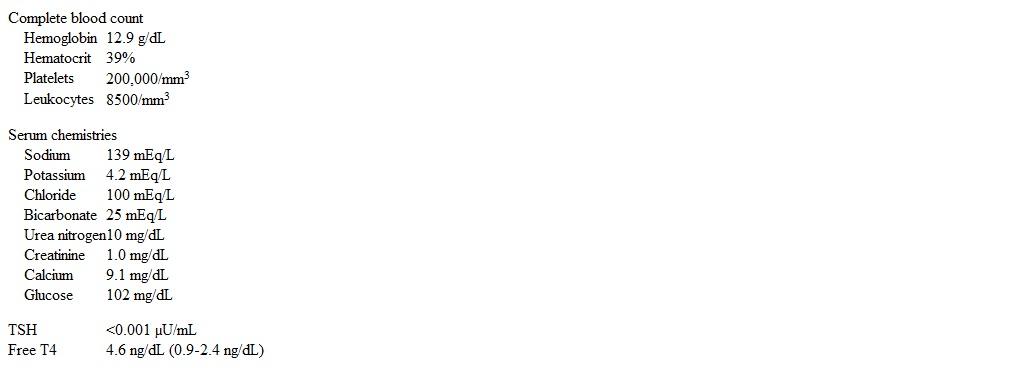 ECG shows sinus tachycardia at 120/min. Radioactive iodine uptake is <5%, and anti-thyroid peroxidase antibodies are present in high titers. Which of the following is the most appropriate next step in management of this patient?
 (Multiple Choice)
4.8/5 (91)
(91) A 45-year-old man is brought to the emergency department due to altered mental status. The patient appears agitated and disoriented. He was recently treated by his physician for cold symptoms. He also takes aspirin for chronic arthritis and ranitidine for acid reflux. He works as an auto mechanic. He has smoked for the last 25 years and drinks heavily during the weekend. His temperature is 37.2 C (99 F), blood pressure is 110/70 mm Hg, pulse is 90/min, and respirations are 22/min. His laboratory findings are as follows: 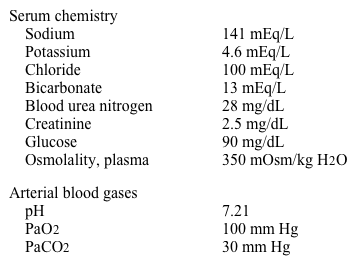 Urinalysis shows square, envelope-shaped crystals. His creatinine 3 months ago was 1.2 mg/dL. What is the most likely cause of the laboratory abnormalities seen in this patient?
 (Multiple Choice)
4.9/5 (86)
(86) A 42-year-old man comes to the hospital after a day of severe abdominal pain and vomiting. He describes the pain as constant and nagging, localizing to the upper abdomen, and radiating to the back. The patient has not been to a physician in years and has no previous medical conditions or surgeries. He takes no medications. He drinks large amounts of alcohol, but does not use tobacco or illicit drugs. His temperature is 36.7° C (98° F), blood pressure is 110/80 mm Hg, pulse is 90/min, and respirations are 14/min. The patient is admitted to the hospital and given opioid analgesics and intravenous fluids. On day 2 of his hospitalization, his blood pressure drops to 80/60 mm Hg and his pulse increases to 120/min and regular. His oxygen saturation is 92% on 2 L nasal canula oxygen. Examination shows normal jugular venous pressure. Bilateral crackles are heard on lung auscultation. The patient's abdomen is mildly distended, and there is tenderness in the epigastrium. His urine output is 8 mL/hr. He has received a total of 4 L IV fluids over the last 24 hours. Laboratory results are as follows: 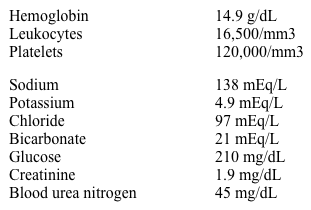 Which of the following is the most likely cause of this patient's hypotension?
 (Multiple Choice)
4.8/5 (84)
(84) A 23-year-old man comes to the clinic for evaluation of a rash. He reports that reddish bumps began to develop on his shins 4 weeks ago. Although painful, they are not itchy. On review of systems, he notes that his stools have become looser than normal over the past 6 months and are associated with intermittent, crampy abdominal pain. He has unintentionally lost 5 kg (11 lb) in the past month. The patient has no hematochezia, nausea, vomiting, joint pains, night sweats, or fevers. Medical and family history are unremarkable. He does not use tobacco, alcohol, or illicit drugs. Temperature is 37.2 C (99 F), blood pressure is 113/72 mm Hg, pulse is 85/min, and respirations are 15/min. Physical examination reveals several 2- to 3-cm erythematous, tender, nonmobile nodules on the anterior aspect of both lower extremities. Careful skin examination reveals no other abnormalities. The abdomen is mildly tender to palpation but without distension, rebound, or guarding. Which of the following most likely explains this patient's presentation?
(Multiple Choice)
4.9/5 (67)
(67) A prospective cohort study was conducted to assess the effects of oral contraceptive (OC) use on the incidence of breast cancer. A crude analysis of the study suggests an association between OC use and breast cancer (relative risk [RR] = 1.40, 95% confidence interval [95%CI]: 1.01, 1.96). Further analysis shows that in women with a family history of breast cancer, OC use increases the risk of breast cancer (RR = 3.33, 95%CI: 2.51, 4.41). In women without a family history of breast cancer, a significantly smaller effect is observed (RR = 1.27, 95%CI: 1.01, 1.60). The results of this study are best explained by which of the following?
(Multiple Choice)
4.8/5 (62)
(62) A 60-year-old man comes to the office for evaluation of a 6-month history of intermittent chest pain. He describes substernal tightness and pain that occur when he walks quickly or climbs stairs. The symptoms last about 10 minutes and slowly fade away with rest. These episodes do not happen at rest. The patient has a known history of coronary artery disease with coronary artery bypass grafting surgery 7 years ago. Other medical problems include hypertension and hyperlipidemia. Blood pressure is 140/78 mm Hg and pulse is 78/min and regular. There are no murmurs on cardiac auscultation. Lungs are clear bilaterally. Treadmill stress test is performed. Seven minutes into the test, the patient develops chest pain and the treadmill is stopped. Sublingual nitroglycerin is administered, which almost immediately relieves the patient's pain. What is the predominant mechanism responsible for the rapid pain relief in this patient?
(Multiple Choice)
4.8/5 (78)
(78) A 69-year-old woman is brought to the office by her husband due to forgetfulness. The patient is a retired law professor who taught classes until a year ago when she began to have difficulty remembering lesson plans. Since then, her memory has worsened, and she has gotten lost during her normal neighborhood walk on more than one occasion. Her husband has taken over responsibility for all cooking and cleaning; moreover, the patient is unable to drive or use public transportation on her own. Medical history is significant for hypertension and type 2 diabetes mellitus for which she takes lisinopril and metformin. The patient has no family history of memory problems. Temperature is 36.7 C (98.1 F), blood pressure is 134/74 mm Hg, pulse is 72/min, and respirations are 14/min. She scores a 22/30 on Montreal Cognitive Assessment (normal: ≥26). There are no focal neurologic deficits. Which of the following is the most appropriate next step in evaluation of this patient?
(Multiple Choice)
4.7/5 (80)
(80) Showing 1641 - 1660 of 1702
 Prev
- 1
- ...
- 2
- ...
- 3
- ...
- 4
- ...
- 5
- ...
- 6
- ...
- 7
- ...
- 8
- ...
- 9
- ...
- 10
- ...
- 11
- ...
- 12
- ...
- 13
- ...
- 14
- ...
- 15
- ...
- 16
- ...
- 17
- ...
- 18
- ...
- 19
- ...
- 20
- ...
- 21
- ...
- 22
- ...
- 23
- ...
- 24
- ...
- 25
- ...
- 26
- ...
- 27
- ...
- 28
- ...
- 29
- ...
- 30
- ...
- 31
- ...
- 32
- ...
- 33
- ...
- 34
- ...
- 35
- ...
- 36
- ...
- 37
- ...
- 38
- ...
- 39
- ...
- 40
- ...
- 41
- ...
- 42
- ...
- 43
- ...
- 44
- ...
- 45
- ...
- 46
- ...
- 47
- ...
- 48
- ...
- 49
- ...
- 50
- ...
- 51
- ...
- 52
- ...
- 53
- ...
- 54
- ...
- 55
- ...
- 56
- ...
- 57
- ...
- 58
- ...
- 59
- ...
- 60
- ...
- 61
- ...
- 62
- ...
- 63
- ...
- 64
- ...
- 65
- ...
- 66
- ...
- 67
- ...
- 68
- ...
- 69
- ...
- 70
- ...
- 71
- ...
- 72
- ...
- 73
- ...
- 74
- ...
- 75
- ...
- 76
- ...
- 77
- ...
- 78
- ...
- 79
- ...
- 80
- ...
- 81
- ...
- 82
- ...
- 83
- ...
- 84
- ...
- 85
- ...
- 86
- ...
- Next

Filters
- Essay(0)
- Multiple Choice(0)
- Short Answer(0)
- True False(0)
- Matching(0)