


 Chat with AI
Exam 1: Medicine

Exam 1: Medicine2 k Questions
Exam 2: Pediatric723 Questions
Exam 3: Psychiatry336 Questions
Exam 4: Surgery563 Questions
Exam 5: Obstetrics & Gynecology469 Questions
Select questions type


A 45-year-old man comes to the office due to progressive shortness of breath on exertion and fatigue for the past several weeks. Two years ago, the patient was diagnosed with alcoholic cirrhosis and esophageal varices after presenting with hematemesis. He underwent banding of the varices. Several months ago, the patient came to the office with massive ascites and a large-volume paracentesis was performed. His current medications include furosemide, spironolactone, and nadolol. He has had no alcohol for the past 2 years. The patient does not use tobacco or illicit drugs. Blood pressure is 114/72 mm Hg and pulse is 63/min. Pulse oximetry shows 95% on room air. There is no change in dyspnea on lying down or moving into an upright position. His neck veins are flat. Heart sounds are normal with no murmur or gallop. Dullness and decreased breath sounds are present on the right. Left-sided breath sounds are normal with no added sounds. The abdomen is moderately distended with shifting dullness. Bowel sounds are normal. Stool guaiac is negative. He has 1+ bilateral lower extremity pitting edema. Which of the following is the most likely cause of this patient's current symptoms?
(Multiple Choice)
4.8/5  (78)
(78) A 56-year-old obese man comes to the emergency department complaining of acute-onset shortness of breath. He twisted his ankle 5 days ago and has had limited mobility since. His other medical problems include type 2 diabetes mellitus, hypertension, chronic kidney disease, and right knee osteoarthritis. His medications include insulin, amlodipine, and low-dose aspirin. His blood pressure is 110/60 mm Hg and pulse is 110/min. His hemoglobin level is 11.2 g/dL and platelet count is 230,000/µL. The estimated glomerular filtration rate is 20 mL/min/1.73 m2. Ventilation perfusion scan shows a right upper-lobe perfusion defect with good ventilation. Which of the following is the best initial treatment for this patient?
(Multiple Choice)
4.8/5 (74)
(74) A 57-year-old woman is admitted to the intensive care unit (ICU) after being involved in a highway motor vehicle accident. She was hypotensive at the scene and received 7 L of fluids, which included crystalloids, blood, and fresh frozen plasma. She had significant external blood loss from multiple fractures and skin loss. She undergoes surgery, after which she is transferred to the ICU and receives continuous IV fluids and vasopressors. Her laboratory studies 24 hours after the accident show the following: 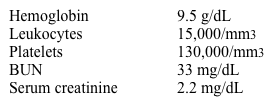 Which of the following is the most likely microscopic finding on urinalysis?
 (Multiple Choice)
4.8/5 (81)
(81) A 35-year-old woman slipped and fell on her side 2 days ago when going downstairs. Since then, she has been having pain in her right shoulder. Ibuprofen provides some relief. She does not use tobacco or alcohol. Examination suggests a shoulder sprain. An x-ray reveals a normal shoulder and a 1.5-cm coin-shaped lesion in the periphery of the right lung with well-aerated surrounding lung. What is the next best step in management of this lung lesion?
(Multiple Choice)
4.7/5 (67)
(67) A 25-year-old woman comes to the emergency department due to 2 days of progressive pain in the left upper quadrant. The pain is constant and deep. Medical history is significant for several years of joint pain. The patient does not use tobacco, alcohol, or illicit drugs. Temperature is 37.1 C (98.8 F), blood pressure is 128/82 mm Hg, pulse is 86/min, and respirations are 16/min. BMI is 25 kg/m2. The lungs are clear to auscultation. Cardiac examination reveals an nondisplaced point of maximum impulse and a 2/6 holosystolic murmur at the apex. Abdominal examination shows tenderness in the left upper quadrant with no rigidity or rebound guarding. Bowel sounds are present. The remainder of the examination shows no abnormalities. Laboratory results are as follows:  CT scan of the abdomen is shown in the exhibit.
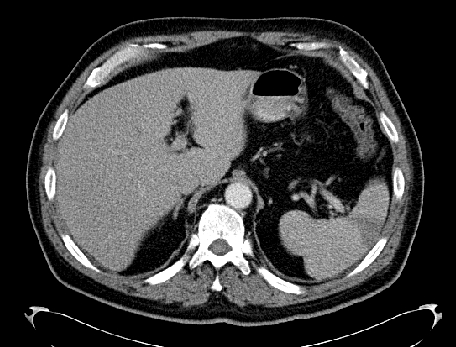 Which of the following is the best next step in management of this patient?
CT scan of the abdomen is shown in the exhibit. Which of the following is the best next step in management of this patient? (Multiple Choice)
4.7/5 (78)
(78) A 56-year-old man comes to the office for follow up. He has type 2 diabetes mellitus of 15 years' duration, hypertension, and hyperlipidemia. His diabetes mellitus is currently managed with metformin and glimepiride. Hemoglobin A1c level is 8.5%. Switching to insulin therapy to attain better glycemic control is discussed with the patient. Achieving a goal hemoglobin A1c of 6.5% with use of insulin is most likely to reduce the risk of which of the following complications over the next 5 years?
(Multiple Choice)
5.0/5 (81)
(81) A 36-year-old woman comes to the office due to a right lower extremity rash. The patient developed a large abrasion over her right ankle after falling off her mountain bike 3 days ago. Yesterday, she noticed progressive, painful red streaks near the wound. She has no chronic medical conditions and takes no medications. Temperature is 38.2 C (100.8 F), blood pressure is 126/78 mm Hg, and pulse is 92/min. Examination reveals a 4-cm abrasion just superior to the right lateral malleolus; no purulence or induration is present, but there are several tender, erythematous streaks extending proximally from the wound toward the knee. Tender, enlarged lymph nodes are also present in the right popliteal fossa. Which of the following is the most appropriate treatment for this patient?
(Multiple Choice)
4.8/5 (80)
(80) A 39-year-old woman comes to the physician with a "pins and needles" sensation around her mouth for the last 2-3 weeks. She occasionally has similar sensations in her feet, along with muscle cramps, especially at the end of the day. Her past medical history is unremarkable, and she does not use tobacco, alcohol, or illicit drugs. Family history is not significant. Vital signs are normal, and examination is unremarkable. Laboratory findings results are as follows: 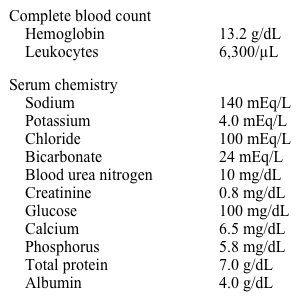 Which of the following is the most likely cause of this patient's condition?
 (Multiple Choice)
4.9/5 (85)
(85) A 16-year-old boy is brought to the emergency department due to a week of fever, dry cough, and weakness. Examination shows diffuse lymph node enlargement, mild hepatosplenomegaly, and scattered petechiae on the extremities. The testicles are normal and no neurologic abnormalities are present. Laboratory results are as follows: 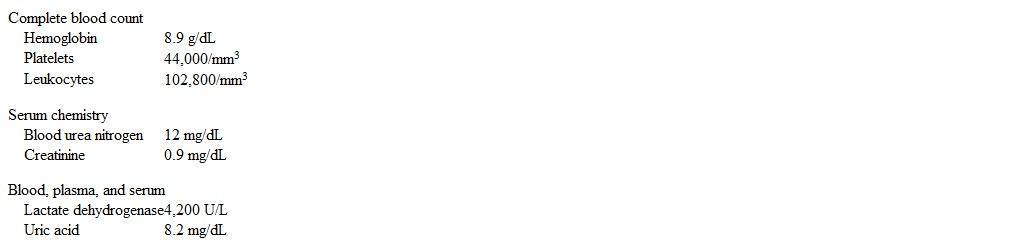 Peripheral blood smear reveals extensive blasts, and subsequent flow cytometry reveals T cell markers. A diagnosis of acute lymphoblastic leukemia is made. The patient is initiated on intravenous fluids, allopurinol, and combination chemotherapy. The following day, he develops nausea. Cardiac monitoring shows frequent premature ventricular beats. Repeat laboratory evaluation reveals leukocytes are 52,000/mm3, blood urea nitrogen is 34 mg/dL, serum creatinine is 2.1 mg/dL, and lactate dehydrogenase level is 12,000 U/L. Which of the following additional results are expected in this patient?
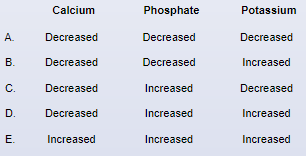
Peripheral blood smear reveals extensive blasts, and subsequent flow cytometry reveals T cell markers. A diagnosis of acute lymphoblastic leukemia is made. The patient is initiated on intravenous fluids, allopurinol, and combination chemotherapy. The following day, he develops nausea. Cardiac monitoring shows frequent premature ventricular beats. Repeat laboratory evaluation reveals leukocytes are 52,000/mm3, blood urea nitrogen is 34 mg/dL, serum creatinine is 2.1 mg/dL, and lactate dehydrogenase level is 12,000 U/L. Which of the following additional results are expected in this patient?
(Multiple Choice)
4.9/5 (77)
(77) A 56-year-old woman comes to the office due to progressive asthma symptoms. The patient describes nighttime cough and wheezing that have increased in recent months. Sometimes she has to use her albuterol inhaler right after a meal. She also reports feeling tired each morning as she works late and has no time to relax after dinner. The patient has no dyspnea on exertion but says that her throat has been sore lately and describes hoarseness in the morning that clears during the day. She has gained 5 kg (11 lb) over the last 6 months. Her medical history is significant for bronchial asthma, type 2 diabetes mellitus, and hypertension. Medications include low-dose inhaled fluticasone, an albuterol inhaler, lisinopril, amlodipine, and aspirin with no change in her medications for years. Blood pressure is 140/90 mm Hg, pulse is 80/min, and respirations are 16/min. BMI is 32 kg/m2. Lung auscultation indicates normal breath sounds without wheezing. Heart sounds are normal. Which of the following is the most appropriate next step in management of this patient?
(Multiple Choice)
4.9/5 (80)
(80) A 65-year-old woman comes to the office due to a rash on both thighs for the past 3 weeks. The rash started as areas of redness with pruritus. In the past week, the pruritus has intensified, and numerous blisters developed on the medial thighs. An over-the-counter oral antihistamine has not provided relief. There are no mouth sores, eye discomfort, weight loss, or diarrhea. Medical history includes hypertension, hypercholesterolemia, and early Parkinson disease. Temperature is 37 C (98.6 F), blood pressure is 125/83 mm Hg, and pulse is 76/min. Skin examination is shown in the exhibit.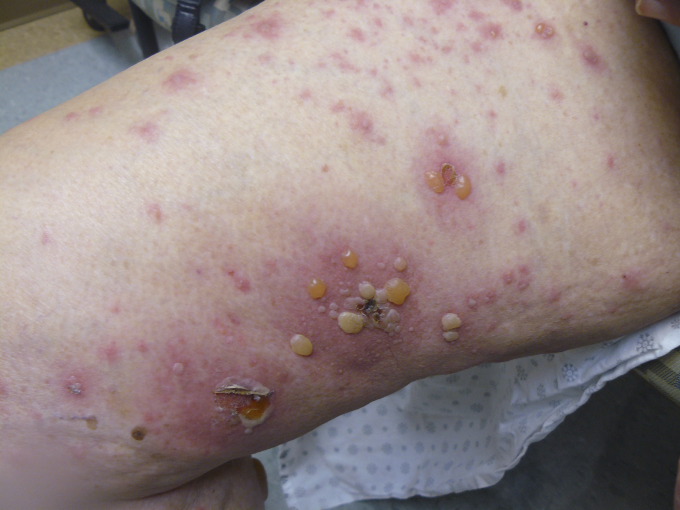 Punch biopsies are performed. Which of the following is the most appropriate initial therapy pending biopsy results?
 (Multiple Choice)
4.7/5 (93)
(93) A 65-year-old woman comes to the office due to a month of back pain. The pain is primarily in her lumbar and thoracic spine and is partially relieved with acetaminophen. It is worse with activity and has limited her ability to take restorative yoga classes. The patient has a history of hypertension, type 2 diabetes mellitus, and osteopenia. She takes over-the-counter calcium and vitamin D supplements in addition to prescription medications. The patient had her yearly physical examination 4 months ago; physical and laboratory examinations were normal at that time. Temperature is 36.6 C (97.8 F), blood pressure is 148/82 mm Hg, and pulse is 94/min. The patient is thin but appears well. Mucous membranes are moist. There is no lymphadenopathy in the cervical or supraclavicular chains. Cardiopulmonary and abdominal examinations are normal. There is no focal tenderness over the spine. Muscle strength is 5/5 in all 4 extremities. Laboratory results are as follows: 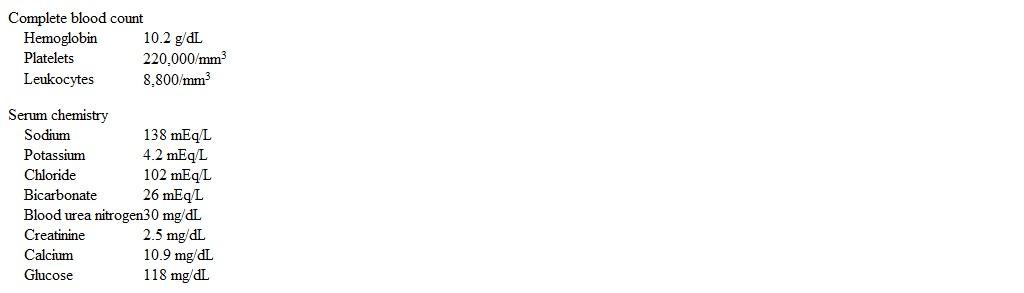 Urine dipstick is negative and urine sediment is bland except for a few granular casts. Which of the following is the most likely cause of this patient's current condition?
 (Multiple Choice)
4.9/5 (70)
(70) A 35-year-old woman comes to the office due to left ear pain and itching that began yesterday. The patient is an avid long-distance runner and uses earbuds to listen to music while training. After a long run yesterday, she took out her earbuds and noticed a thick green discharge on the left side. She used cotton-tipped applicators to clean out both ears. This morning, she was unable to insert her left earbud due to significant pain. A similar episode occurred 9 months ago and resolved with appropriate treatment. She takes no medications. Temperature is 37 C (98.6 F), blood pressure is 110/70 mm Hg, and pulse is 70/min. Examination of the left ear causes significant pain. The ear canal is red and swollen, with green drainage that obscures the tympanic membrane. The right ear appears normal. The scalp and hair are normal. Which of the following is the most likely diagnosis?
(Multiple Choice)
4.8/5 (88)
(88) A new multidrug chemotherapy regimen significantly prolongs the survival in patients with lung cancer. If this new regimen is widely implemented, what changes in the prevalence and incidence of lung cancer would you expect?
(Multiple Choice)
4.7/5 (73)
(73) A 58-year-old woman comes to clinic for follow-up. She has a history of end-stage renal disease due to polycystic kidney disease and underwent renal transplantation 2 years ago. Two months ago, the patient was diagnosed with paroxysmal atrial fibrillation. She had been feeling well until the past several weeks when she noticed decreased urine output and mild fatigue. Current medications include diltiazem, apixaban, prednisone, tacrolimus, and mycophenolate sodium. Temperature is 37 C (98.6 F), blood pressure is 152/86 mm Hg, pulse is 82/min, and respirations are 12/min. Abdominal examination reveals no tenderness to palpation. Laboratory results reveal a serum creatinine of 2.3 mg/dL, which is increased from her baseline of 1.4 mg/dL that was last checked 2 months ago. Urinalysis with microscopy is as follows:  Blood tacrolimus level is moderately elevated. Transplant ultrasound reveals no hydronephrosis. Which of the following is the most likely cause of this patient's worsening renal function?
 (Multiple Choice)
4.8/5 (77)
(77) A 70-year-old man is brought to the Emergency Room because he lost consciousness while working in the garden. He says that he had several episodes of near-syncope on exertion recently. His past medical history is insignificant. He is not taking any medications. His blood pressure is 110/85 mmHg and heart rate is 80/min. Point of maximal impulse is increased in intensity. Cardiac auscultation reveals ejection-type systolic murmur at the base of the heart with radiation to the carotid arteries. ECG demonstrates left ventricular hypertrophy, and secondary ST segment and T wave changes. What is the most probable cause of this patient's condition?
(Multiple Choice)
4.8/5 (71)
(71) A 75-year-old man comes to the clinic due to a 6-month history of periodic substernal chest pressure, which he experiences when walking uphill or climbing 2 flights of stairs. His medical history is significant for hyperlipidemia, for which he takes atorvastatin. The patient smokes a pack of cigarettes daily and occasionally consumes alcohol. Blood pressure is 120/78 mm Hg and pulse is 75/min. Physical examination shows no abnormalities. Resting ECG is normal. A treadmill stress test shows a horizontal ST-segment depression in leads V1-V4 at 73% of predicted maximal heart rate. Echocardiography demonstrates normal resting left ventricular systolic function. The patient prefers medical management. He is prescribed sublingual nitroglycerin to take as needed when anginal pain occurs and he is also prescribed a daily medication to help prevent anginal episodes. The daily medication most likely functions through which of the following mechanisms?
(Multiple Choice)
4.7/5 (93)
(93) A quality assurance committee is establishing best practices for ordering various laboratory and imaging studies in an emergency department. They find that one physician orders significantly more CT scans of the head compared to other physicians in the department. The physician states that he orders more head CT scans on young patients with chronic migraines, even those with normal examination and unremarkable history, because he recently missed a diagnosis of intracranial bleed in an 18-year old patient with a history of chronic migraines. Which of the following most likely explains this physician's tendency to now order excessive CT scans of the head?
(Multiple Choice)
4.7/5 (89)
(89) A 5-year-old boy is brought back to the emergency department by his grandmother due to "bizarre behavior" a day after being seen there for a left eye injury sustained while playing flag football. At that time he was diagnosed with traumatic iritis and prescribed cyclopentolate eye drops for symptomatic relief. Two hours ago, he began acting strangely and said there were green men outside his house. Temperature is 37.8 C (100 F), blood pressure is 130/75 mm Hg, pulse is 150/min, and respirations are 24/min. He is agitated and disoriented, and he does not answer questions appropriately. The pupils are 8 mm bilaterally, and visual acuity is decreased. Perilimbal conjunctival injection of the left eye is present. Extraocular movements are intact. Mucous membranes are dry. Heart sounds are regular and rapid without a murmur or rub. The lungs are clear to auscultation. Deep tendon reflexes are normal. Which of the following is the best next step in management of this patient?
(Multiple Choice)
4.7/5 (81)
(81) A 7-year-old boy is brought to the office due to persistent bedwetting. Since age 3, he has been able to stay dry during the day but continues to have "accidents" 3 nights a week. The child drinks fluids primarily in the morning and early afternoon and does not drink juice or caffeinated beverages. For the past 4 months, his parents have tried enuresis alarms and awarded "gold stars" for dry nights without improvement in the frequency of bedwetting. His parents are frustrated, and the patient is sad about missing activities such as summer camp. He was recently invited to a sleepover party but is nervous about wetting the bed. He has otherwise been in good health, has met all other developmental milestones, and takes no medications. The father had a history of nocturnal enuresis until age 8. Physical examination and urinalysis are normal. Which of the following is the best next step in management of this patient?
(Multiple Choice)
4.8/5 (75)
(75) Showing 1141 - 1160 of 1702
 Prev
- 1
- ...
- 2
- ...
- 3
- ...
- 4
- ...
- 5
- ...
- 6
- ...
- 7
- ...
- 8
- ...
- 9
- ...
- 10
- ...
- 11
- ...
- 12
- ...
- 13
- ...
- 14
- ...
- 15
- ...
- 16
- ...
- 17
- ...
- 18
- ...
- 19
- ...
- 20
- ...
- 21
- ...
- 22
- ...
- 23
- ...
- 24
- ...
- 25
- ...
- 26
- ...
- 27
- ...
- 28
- ...
- 29
- ...
- 30
- ...
- 31
- ...
- 32
- ...
- 33
- ...
- 34
- ...
- 35
- ...
- 36
- ...
- 37
- ...
- 38
- ...
- 39
- ...
- 40
- ...
- 41
- ...
- 42
- ...
- 43
- ...
- 44
- ...
- 45
- ...
- 46
- ...
- 47
- ...
- 48
- ...
- 49
- ...
- 50
- ...
- 51
- ...
- 52
- ...
- 53
- ...
- 54
- ...
- 55
- ...
- 56
- ...
- 57
- ...
- 58
- ...
- 59
- ...
- 60
- ...
- 61
- ...
- 62
- ...
- 63
- ...
- 64
- ...
- 65
- ...
- 66
- ...
- 67
- ...
- 68
- ...
- 69
- ...
- 70
- ...
- 71
- ...
- 72
- ...
- 73
- ...
- 74
- ...
- 75
- ...
- 76
- ...
- 77
- ...
- 78
- ...
- 79
- ...
- 80
- ...
- 81
- ...
- 82
- ...
- 83
- ...
- 84
- ...
- 85
- ...
- 86
- ...
- Next

Filters
- Essay(0)
- Multiple Choice(0)
- Short Answer(0)
- True False(0)
- Matching(0)