


 Chat with AI
Exam 1: Medicine

Exam 1: Medicine2 k Questions
Exam 2: Pediatric723 Questions
Exam 3: Psychiatry336 Questions
Exam 4: Surgery563 Questions
Exam 5: Obstetrics & Gynecology469 Questions
Select questions type


A 26-year-old man comes to the emergency department due to sudden-onset severe, colicky right flank pain. He also has had dysuria, urgency, dark urine, and nausea but no vomiting. The patient has never before had these symptoms. Temperature is 37 C (98.6 F), blood pressure is 126/70 mm Hg, pulse is 90/min, and respirations are 18/min. Examination shows no abnormalities. Analgesics are administered with good control of pain. Noncontrast helical CT scan shows a 4-mm radiopaque stone in the right lower ureter. Laboratory studies show serum calcium of 9.8 mg/dL, serum creatinine of 0.9 mg/dL, and blood urea nitrogen of 15 mg/dL. Urinalysis shows hematuria but no casts. Which of the following is the most appropriate next step in management?
(Multiple Choice)
4.8/5  (66)
(66) A 76-year-old woman comes to the office for evaluation of leukopenia. The patient came to the United States to visit her son a month ago and was seen at an urgent care clinic 2 weeks ago for acute sinusitis, where she was found to have leukopenia. She was prescribed an oral antibiotic, and a repeat blood test was advised. The patient has had 2 episodes of skin infections over the past 3 months. She also has had pain and swelling in the joints of her hands and knees for the past several years. The patient does not use tobacco, alcohol, or illicit drugs. Temperature is 37.2 C (98.9 F), blood pressure is 130/80 mm Hg, and pulse is 74/min. Physical examination shows normal heart and lung sounds, moderate splenomegaly, generalized lymphadenopathy, no sinus tenderness, and well-healing lower extremity ulcerations. The small joints of the hands are swollen and deformed. Laboratory results are as follows:  Additional evaluation of this patient is most likely to reveal which of the following?
 (Multiple Choice)
4.8/5 (73)
(73) A 29-year-old woman comes to the office for evaluation of knee pain. For the last 3 months, the patient has had pain around the anterior aspect of the left knee. She has been taking ibuprofen, which initially improved the symptoms but now does not despite multiple doses throughout the day. The pain is worse when the patient walks up or down stairs, and she has to rest when walking up to her third-floor apartment. She has no chronic medical conditions and has had no previous surgeries. The patient smokes half a pack of cigarettes a day and drinks socially on weekends. Temperature is 36.7 C (98 F), blood pressure is 110/60 mm Hg, and pulse is 68/min. BMI is 26 kg/m2. Inspection of the left leg shows mild quadriceps atrophy with no visible bony deformity. There is no pain with palpation over the patellar tendon and no evidence of swelling. Which of the following additional examination findings is most likely to be seen in this patient?
(Multiple Choice)
4.8/5 (80)
(80) A 55-year-old postmenopausal woman comes to the office for a routine health maintenance examination. She feels well. The patient was briefly hospitalized 6 months ago for bronchitis complicated by a rib fracture due to severe coughing. She has no chronic medical conditions or previous surgeries. Her mother was diagnosed with osteopenia at age 70. The patient smoked half a pack of cigarettes daily until age 40 and eats a vegetarian diet. She drinks 2 or 3 cups of coffee every morning and a glass of wine each night. Blood pressure is 120/70 mm Hg, pulse is 84/min, and respirations are 12/min. BMI is 30 kg/m2. Physical examination is unremarkable. Which of the following is the most significant risk factor for bone fracture in this patient?
(Multiple Choice)
4.9/5 (81)
(81) A 21-year-old woman is evaluated for syncope. She has had recurrent episodes of syncope since her mid-teens. The first episode happened when she was having blood drawn for a test. She has also passed out several times while standing in a crowded church. The syncope is typically preceded by a feeling of warmth, lightheadedness, diaphoresis, and nausea. During one episode, the patient had a minor head injury and facial laceration. Her medical history is otherwise insignificant. She takes no medications and uses no illicit drugs. Blood pressure is 122/76 mm Hg supine and 125/80 mm Hg after 2 minutes of standing. Pulse is 72/min and regular. Physical examination is unremarkable. ECG shows normal sinus rhythm with no significant abnormalities. Long-term ECG monitoring is most likely to show which of the following immediately preceding and during the syncopal episode?
(Multiple Choice)
4.8/5 (80)
(80) A 45-year-old man who recently immigrated to the United States from China comes to the physician because of dyspnea, fatigue, and abdominal distention for the past 2 months. He has no other medical problems and takes no medication. The patient has worked as a farmer his entire life. His temperature is 36.7° C (98° F), blood pressure is 110/60 mm Hg, pulse is 80/min, and respirations are 16/min. Examination shows pedal edema, increased abdominal girth with free fluid, and elevated jugular venous pressure without inspiratory decline. Chest auscultation reveals decreased heart sounds and an accentuated sound directly after the second heart sound in early diastole. Chest x-ray demonstrates a ring of calcification around the heart, and jugular venous pressure tracings show prominent x and y descents. Which of the following is the most likely cause of this patient's symptoms?
(Multiple Choice)
4.8/5 (71)
(71) A 13-year-old boy is brought to the clinic by his mother for evaluation of hip pain. For the past 3 weeks, he has had mild pain in his right hip with an associated limp, which he attributed to a muscle strain from skateboarding. The patient fell while skateboarding last night, which resulted in worsened pain. The patient has taken ibuprofen with some improvement in his pain. He has no chronic medical conditions but did have a runny nose and nasal congestion for a few days last week. Height and weight are in the 95th and 50th percentiles, respectively. Temperature is 37 C (98.6 F). The patient walks with a limp to the examination table, avoiding bearing weight on his right leg. Examination of the right hip shows limited range of motion with internal rotation. There is full range of motion on the left side. Frog-leg lateral x-ray of bilateral hips is shown below: 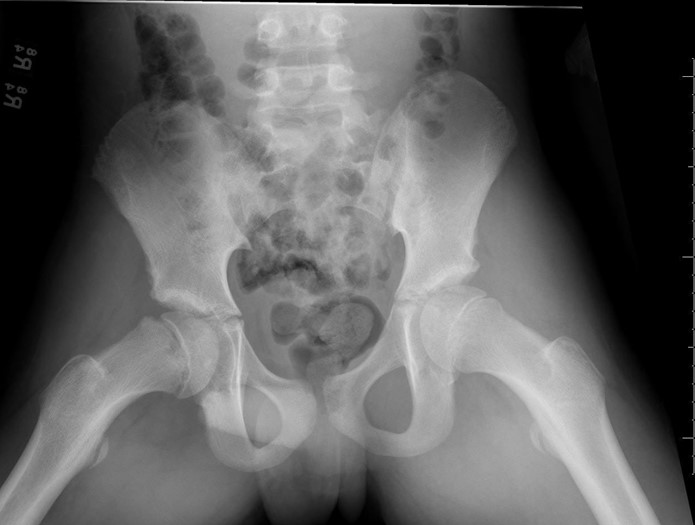 Which of the following is the most likely diagnosis in this patient?
 (Multiple Choice)
4.9/5 (77)
(77) A 44-year-old man comes to the office due to 3 weeks of fever, anorexia, and muscle aches. He has had no cough or shortness of breath. The patient has a 15-pack-year smoking history. Temperature is 38.9 C (102 F), blood pressure is 120/76 mm Hg, pulse is 90/min, and respirations are 16/min. Lungs are clear to auscultation. Cardiac examination reveals a 2/6 holosystolic murmur at the apex. The rest of the physical examination is normal. Both blood cultures grow Streptococcus gallolyticus (formerly Streptococcus bovis biotype I). Echocardiography reveals a small vegetation on the mitral valve with moderate mitral regurgitation. Antibiotics are administered, and 3 days later the patient's fever and systemic symptoms resolve. Which of the following is the best next step in management?
(Multiple Choice)
4.8/5 (81)
(81) A 52-year-old man with a history of alcoholic liver disease is admitted to the hospital due to fatigue and abdominal discomfort. He has had no nausea, vomiting, constipation, or diarrhea. The patient has chronic ascites treated with spironolactone and furosemide. He had an inguinal hernia repaired 20 years ago. His temperature is 37.9 C (100.2 F), blood pressure is 102/68 mm Hg, and pulse is 106/min. The patient is awake, alert, and oriented to time, place, and person but fails to perform a timed connect-the-numbers test. Auscultation of the heart and lungs is normal. Abdominal examination shows moderate ascites with diffuse discomfort to palpation. There is no rigidity or rebound. Bowel sounds are decreased. The rectal examination is normal, with brown stool negative for occult blood. Abdominal x-ray shows dilated loops of large bowel with air in the colon and rectum. Which of the following is the most likely diagnosis in this patient?
(Multiple Choice)
4.7/5 (82)
(82) A 54-year-old man is brought to the emergency department 10 minutes after being involved in a motor vehicle accident. He was an unrestrained driver and hit a car while speeding on the highway. On arrival to the emergency department, he is spontaneously breathing and noncyanotic. His temperature is 37°C (98.6°F), blood pressure is 104/50 mm Hg, pulse is 122/min, and respirations are 16/min. Examination shows facial lacerations and multiple ecchymoses on the anterior chest and abdomen. He appears obtunded. Which of the following is a component of the Glasgow coma scale (GCS) assessment for this patient?
(Multiple Choice)
4.8/5 (88)
(88) A 54-year-old woman comes to the office due to left wrist pain 3 days after a fall. She was walking her dog when it suddenly ran after another dog, causing her to fall. She landed forcefully on her left palm. She had no other injuries. The patient has been taking acetaminophen, which provides partial relief. She does not use tobacco or illicit drugs and drinks alcohol socially. Blood pressure is 120/70 mm Hg and pulse is 84/min. Physical examination shows left wrist tenderness with maximal tenderness at the dorsoradial wrist lateral to the tendon of the extensor pollicis longus. Left wrist radiographs reveal a radiolucent line across the waist of the scaphoid bone. She is treated nonsurgically with analgesics and immobilization. This patient should be monitored closely during treatment due to which of the following potential complications?
(Multiple Choice)
4.9/5 (80)
(80) A 50-year-old man comes to the office to discuss heart disease prevention. The patient has a history of mild abnormality in liver function tests that he says he was told is "nothing to worry about"; he has no other significant medical history. Five years ago, the patient underwent repair of his anterior cruciate ligament. He drinks 1 or 2 beers on most nights and has smoked a half pack of cigarettes daily for the past 20 years. His father had a myocardial infarction at age 62. The patient eats a lot of fast food because of limited time during the workday. Prior to his knee injury, he played in a recreational soccer league and has not exercised regularly since. The patient sits for most of the day at his job. Temperature is 36.7 C (98.1 F) and blood pressure is 138/86 mm Hg. Weight is 91.6 kg (201.9 lb) and height is 175.3 cm (5 ft 9 in). BMI is 29.8 kg/m2. Examination shows moist mucous membranes, normal jugular venous pressure, clear lung fields, and normal S1 and S2. The abdomen is soft and nontender. No hepatomegaly or splenomegaly is present. There is normal range of motion, and neurologic examination is within normal limits. Laboratory results are as follows: 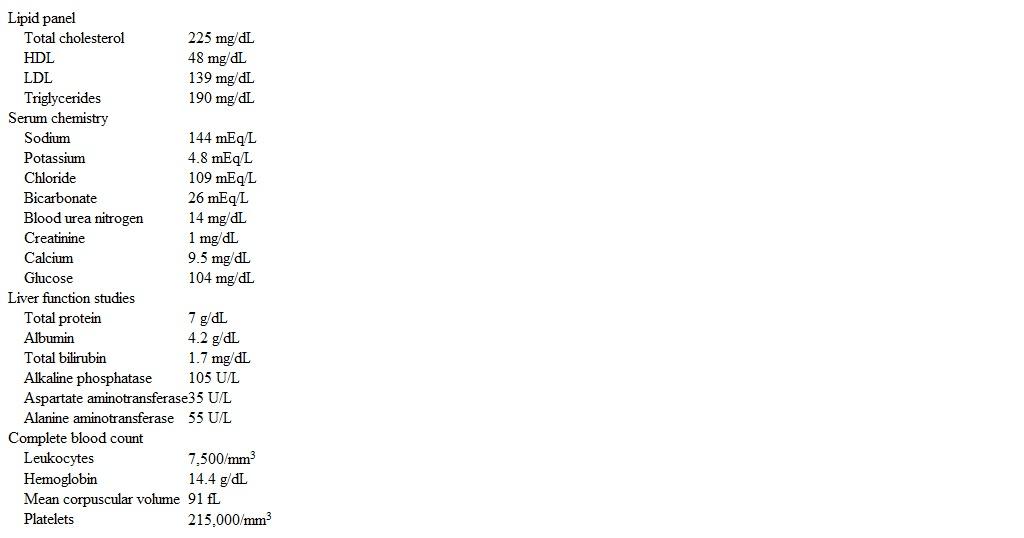 Which of the following would provide the most important information in determining whether to start lipid-lowering therapy in this patient?
 (Multiple Choice)
4.9/5 (92)
(92) A 24-year-old health care worker comes to the employee health clinic due to a needlestick injury. He sustained a percutaneous injury while drawing blood from an HIV-positive patient. The source patient's most recent CD4 count is 90/µL and viral load is 300,000 copies/mL. What is the most appropriate next step in management of the health care worker's exposure to HIV?
(Multiple Choice)
4.9/5 (88)
(88) A 60-year-old man is brought to the emergency department by his daughter due to a 2-day history of confusion and lethargy. According to the daughter, he has had a constant dry cough, fatigue, anorexia, polyuria, and constipation for several weeks. In addition, the patient has lost 9.1 kg (20 lb) over the past 3 months. He has no associated pain. The patient's medical history is significant for hypertension treated with chlorthalidone and for gastroesophageal reflux disease treated with over-the-counter antacids. He smokes 2 packs of cigarettes daily and consumes alcohol occasionally. Blood pressure is 130/90 mm Hg and pulse is 90/min. Temporal wasting is noted. Chest and abdominal examinations are normal. Mental status examination shows somnolence and disorientation to time. Neurologic examination shows decreased deep tendon reflexes. Laboratory results are as follows: 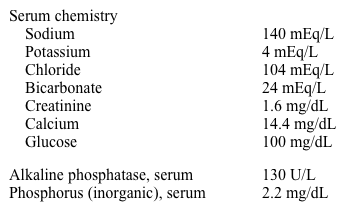 Which of the following is the most likely cause of this patient's symptoms?
 (Multiple Choice)
4.9/5 (79)
(79) A 25-year-old man comes to the emergency department with shortness of breath and cough productive of blood-tinged sputum for the past few days. He has not had any fevers, arthralgias, or weight loss. He has never had these symptoms before and is extremely concerned. The patient has no history of recent travel or sick contacts. He smokes half a pack of cigarettes daily, and has had 2 sexual partners in the past 6 months. Temperature is 37.2 C (98.9 F), blood pressure is 120/70 mm Hg, pulse is 102/min, and respirations are 22/min. Lung auscultation reveals patchy bilateral rales. Chest x-ray demonstrates bilateral pulmonary infiltrates. Serum creatinine is 2.6 mg/dL and urinalysis shows dysmorphic red cells. Which of the following is the most likely cause of his current condition?
(Multiple Choice)
4.9/5 (90)
(90) A 46-year-old man comes to the office for a routine health maintenance examination. He feels well and has no ongoing complaints. His past medical history is significant for generalized anxiety disorder, for which he takes sertraline. Over the past year, he has had 3 female sexual partners and does not regularly use condoms. He drinks 1 or 2 cocktails after work most nights but does not use tobacco or illicit drugs. Vital signs are normal. Laboratory evaluation reveals a positive HIV test. Subsequent laboratory results are as follows:  Which of the following is indicated for this patient?
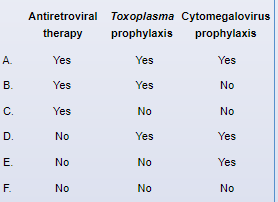
Which of the following is indicated for this patient?
(Multiple Choice)
4.8/5 (90)
(90) A 25-year-old man comes to the emergency department due to a 3-month history of abdominal pain and diarrhea. Bowel movements occur 3 or 4 times a day, and he has occasionally noticed blood in his stool. The patient has no fever but displays "low energy." He was diagnosed with anterior uveitis 3 years ago but has no other medical problems and takes no medications. His parents and 2 siblings are alive and healthy. Vital signs are normal. Abdomen is tender and bowel sounds are hyperactive. The perianal area appears normal. Laboratory results show anemia and an elevated erythrocyte sedimentation rate. Which of the following features would most favor the diagnosis of Crohn disease compared with ulcerative colitis?
(Multiple Choice)
4.9/5 (80)
(80) A 29-year-old man comes to the emergency department following a motor vehicle collision. The patient is alert and oriented; trauma evaluation shows an unstable pelvis with a pelvic fracture confirmed on imaging. He receives multiple boluses of intravenous fluids and is started on a packed red blood cell transfusion. A few minutes after the transfusion starts, the patient develops shortness of breath and has an episode of nonbloody emesis. He has no chest or back pain. Temperature is 37 C (98.6 F), blood pressure is 88/40 mm Hg, pulse is 140/min, and respirations are 30/min. Pulse oximetry is 86% on 100% oxygen provided via a nonrebreather mask. The patient answers questions in short phrases. Lung examination shows decreased breath sounds bilaterally. Pulses are weak. Urinalysis is normal. Which of the following is the most likely cause of this patient's respiratory distress?
(Multiple Choice)
4.8/5 (99)
(99) A 44-year-old man comes to the clinic for evaluation of a "mole." He has a slowly enlarging macule that was first noticed by a sexual partner 6 weeks ago. The lesion has no associated pain or itching, but it has changed in color from pink to violet. On review of systems, he denies fever, night sweats, or urinary symptoms. The patient reports an unintentional weight loss of approximately 8 kg (17.5 lb) over the past year. He was treated for syphilis 2 years ago with long-acting penicillin. Otherwise, his medical history is insignificant. He is not currently taking any medications. The patient has had multiple male sexual partners in the last 20 years and works as a freelance website developer. He does not use tobacco or illicit drugs but drinks alcohol heavily on weekends. Temperature is 37.1 C (98.8 F), blood pressure is 115/70 mm Hg, pulse is 80/min, and respirations are 14/min. The skin lesion is shown in the image below. 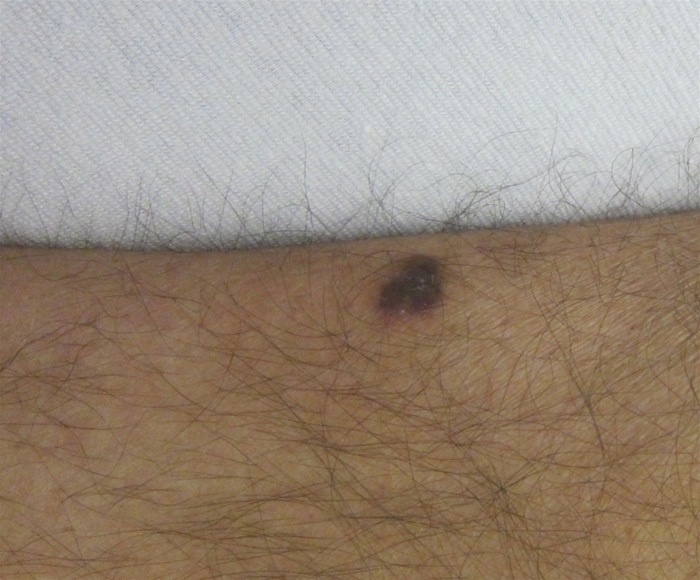 Which of the following is the most likely cause of this patient's skin lesion?
 (Multiple Choice)
4.8/5 (73)
(73) A 42-year-old man comes to the office due to a week of subjective fever, sore throat, malaise, headache, and skin rash. The rash began on his trunk a week ago and has now spread to his entire body. He has had no chest pain, shortness of breath, diarrhea, or urethral discharge. The patient was diagnosed with hypertension 2 months ago and started on lisinopril. He has had 3 new female sexual partners over the last year. He drinks alcohol occasionally but does not smoke or use illicit drugs. The patient has not participated in any unusual outdoor activities. Temperature is 37.2 C (99 F), blood pressure is 130/80 mm Hg, pulse is 78/min, and respirations are 16/min. Examination shows a full-body maculopapular rash without evidence of excoriations. Several raised, grey mucosal patches are seen in the mouth. Cervical, axillary, inguinal, and epitrochlear lymphadenopathy is present. HIV testing is negative. Which of the following is the most likely cause of this patient's current symptoms?
(Multiple Choice)
4.8/5 (80)
(80) Showing 721 - 740 of 1702
 Prev
- 1
- ...
- 2
- ...
- 3
- ...
- 4
- ...
- 5
- ...
- 6
- ...
- 7
- ...
- 8
- ...
- 9
- ...
- 10
- ...
- 11
- ...
- 12
- ...
- 13
- ...
- 14
- ...
- 15
- ...
- 16
- ...
- 17
- ...
- 18
- ...
- 19
- ...
- 20
- ...
- 21
- ...
- 22
- ...
- 23
- ...
- 24
- ...
- 25
- ...
- 26
- ...
- 27
- ...
- 28
- ...
- 29
- ...
- 30
- ...
- 31
- ...
- 32
- ...
- 33
- ...
- 34
- ...
- 35
- ...
- 36
- ...
- 37
- ...
- 38
- ...
- 39
- ...
- 40
- ...
- 41
- ...
- 42
- ...
- 43
- ...
- 44
- ...
- 45
- ...
- 46
- ...
- 47
- ...
- 48
- ...
- 49
- ...
- 50
- ...
- 51
- ...
- 52
- ...
- 53
- ...
- 54
- ...
- 55
- ...
- 56
- ...
- 57
- ...
- 58
- ...
- 59
- ...
- 60
- ...
- 61
- ...
- 62
- ...
- 63
- ...
- 64
- ...
- 65
- ...
- 66
- ...
- 67
- ...
- 68
- ...
- 69
- ...
- 70
- ...
- 71
- ...
- 72
- ...
- 73
- ...
- 74
- ...
- 75
- ...
- 76
- ...
- 77
- ...
- 78
- ...
- 79
- ...
- 80
- ...
- 81
- ...
- 82
- ...
- 83
- ...
- 84
- ...
- 85
- ...
- 86
- ...
- Next

Filters
- Essay(0)
- Multiple Choice(0)
- Short Answer(0)
- True False(0)
- Matching(0)