


 Chat with AI
Exam 1: Medicine

Exam 1: Medicine2 k Questions
Exam 2: Pediatric723 Questions
Exam 3: Psychiatry336 Questions
Exam 4: Surgery563 Questions
Exam 5: Obstetrics & Gynecology469 Questions
Select questions type


A 57-year-old woman comes to the emergency department with 12 hours of fever, chills, and severe generalized weakness. She also has discomfort in her right upper quadrant and has had 2 episodes of vomiting. The patient underwent a liver transplant for primary biliary cirrhosis 2 weeks ago and currently takes prednisone, tacrolimus, and mycophenolate. Temperature is 39.1 C (102.5 F), blood pressure is 85/55 mm Hg, and pulse is 130/min. Physical examination reveals tenderness in her right upper quadrant with mild guarding. Laboratory results are as follows: 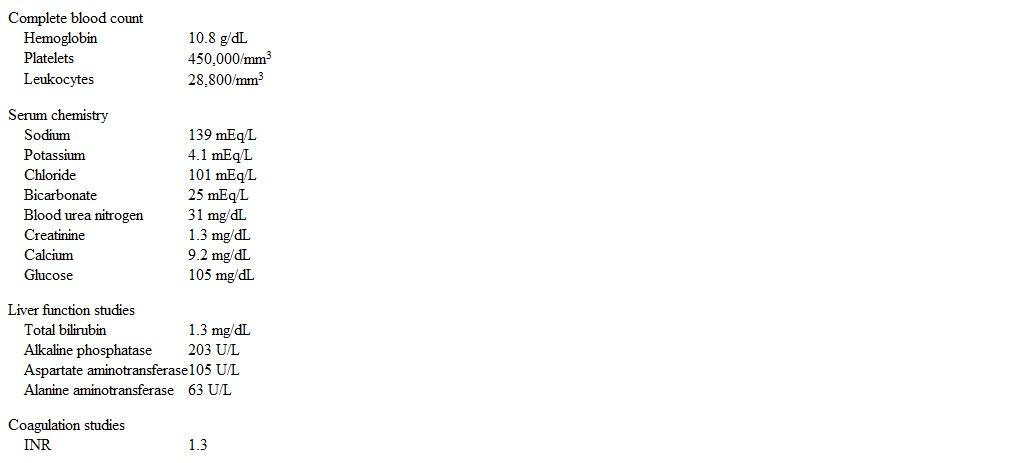 Which of the following is the most likely cause of this patient's condition?
 (Multiple Choice)
4.9/5  (83)
(83) A 53-year-old woman comes to the office due to insomnia, severe hot flashes, and mood swings for the past several months. Her last menstrual period was a year ago. The patient recently had a wrist fracture that did not require surgery. She has a history of hypothyroidism diagnosed 7 years ago, for which she takes levothyroxine, and the dose has been stable for several years. The patient's last TSH level was 3.5 μU/mL. She has no other chronic medical conditions. She does not use tobacco, alcohol, or illicit drugs. Blood pressure is 120/70 mm Hg and pulse is 75/min. BMI is 24 kg/m2. Physical examination shows a nonenlarged thyroid without nodules. Pelvic examination reveals an erythematous, atrophic vulva and vagina without discharge or bleeding. The uterus is small, and the ovaries are not palpable. Initiation of oral estrogen replacement therapy in this patient would most likely result in which of the following changes in thyroid metabolism?
(Multiple Choice)
4.9/5 (89)
(89) A 62-year-old man comes to the office with his daughter due to 3 months of progressive unsteadiness and difficulty walking. The patient recently arrived in the United States to visit his daughter. On several occasions, he has lost balance and almost fallen while taking a shower. The patient also reports episodes of transient, sharp, stabbing pain in his back and lower limbs, as well as involuntary dribbling of urine. He has no history of back injury. The patient lives in rural Nigeria and has not seen a health care provider in many years. He smoked a half pack of cigarettes daily for 30 years and drinks 1 or 2 alcoholic beverages every day. Physical examination shows bilateral knee and ankle reflexes are 1+, and vibratory and position sensations are impaired in both feet. His gait is broad based. Bilateral pupils are small and irregular and constrict poorly to light but constrict normally when he is instructed to look at a finger placed near the tip of his nose. Which of the following would be most helpful in treatment of this patient's current symptoms?
(Multiple Choice)
4.9/5 (87)
(87) A 43-year-old woman with hepatitis C, alcohol use, and liver cirrhosis is admitted to the hospital for severe vomiting over the last 2 days. The vomitus has appeared clear with no blood or coffee-ground material. She feels very weak but has no abdominal pain, fever, or diarrhea. The patient appears tired on examination. Temperature is 36.8 C (98.2 F), blood pressure is 100/70 mm Hg (while supine), pulse is 90/min, and respirations are 14/min. Lungs are clear to auscultation. There is mild epigastric tenderness but no abdominal distension. Extremities have no edema. Laboratory results are as follows: 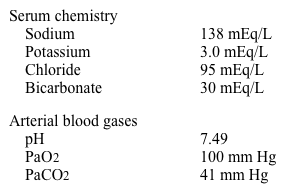 Which of the following is the most appropriate initial treatment for this patient?
 (Multiple Choice)
4.9/5 (75)
(75) A 52-year-old nursing home worker comes to the office with a 4-week history of nonproductive cough and night-time sweating. She has unintentionally lost 2.2 kg (5 lb) over the last month. Her medical history is significant for untreated hepatitis C and left-sided mastectomy for breast cancer 5 years ago. She tested negative for HIV 6 months ago. The patient takes no medications but smokes 1 pack of cigarettes daily and drinks 2 beers every weekend. She emigrated from Vietnam 2 years ago. Chest x-ray shows a right upper-lobe cavity with a surrounding infiltrate. Which of the following is the most important epidemiologic clue to the etiology of this patient's disease?
(Multiple Choice)
4.9/5 (77)
(77) A 72-year-old man comes to the office for a routine preventive visit. The patient feels well and reports no recent health issues. He has a history of hypertension and hyperlipidemia; current medications include hydrochlorothiazide, felodipine, and simvastatin. The patient smoked a pack of cigarettes daily for 40 years but quit 5 years ago. He drinks alcohol occasionally. Vital signs and physical examination are normal. The patient's brother was recently diagnosed with bladder cancer, and the patient asks whether he should be screened for the disease. Which of the following is the most appropriate response to this patient's question?
(Multiple Choice)
5.0/5 (82)
(82) A 24-year-old woman comes to the office with a 4-week history of joint pain. She has had moderate, achy pain and swelling in multiple metacarpophalangeal joints of both hands, with lesser pain in the wrists, knees, and elbows. In addition, the patient experienced intermittent fevers at the onset of her pain, but has been afebrile since then. She has had relief of her symptoms with over-the-counter ibuprofen, but in the week since she scheduled her appointment, she has not required medication as the pain has resolved. The patient is married and has 2 children. Vital signs are normal. Examination shows normal range of motion in all joints tested, with no redness, warmth, or swelling in any hand joints. X-rays of the hands are normal. Which of the following is the most likely diagnosis?
(Multiple Choice)
4.8/5 (94)
(94) A 57-year-old man arrives at the hospital with nausea, dark urine, and decreased urine output for 2 days. For the past week, the patient has had generalized fatigue, muscle pain, and weakness. He reports no recent fever, chills, sore throat, skin infection, or abdominal pain. Medical history is significant for coronary artery disease with stenting to the right coronary artery, hypertension, gout, and obstructive sleep apnea. Current medications include aspirin, ticagrelor, simvastatin, metoprolol, lisinopril, and colchicine. The patient does not use alcohol, tobacco, or illicit drugs. Temperature is 37 C (98.6 F), blood pressure is 140/90 mm Hg, pulse is 88/min, and respirations are 18/min. There is no orthostasis. Skin turgor is normal. Oropharynx is clear. Cardiopulmonary examination shows no abnormalities. The abdomen is soft, nontender, and without bruit; there are no masses felt. There is no peripheral edema. The right great toe is slightly inflamed. Laboratory studies reveal the following: 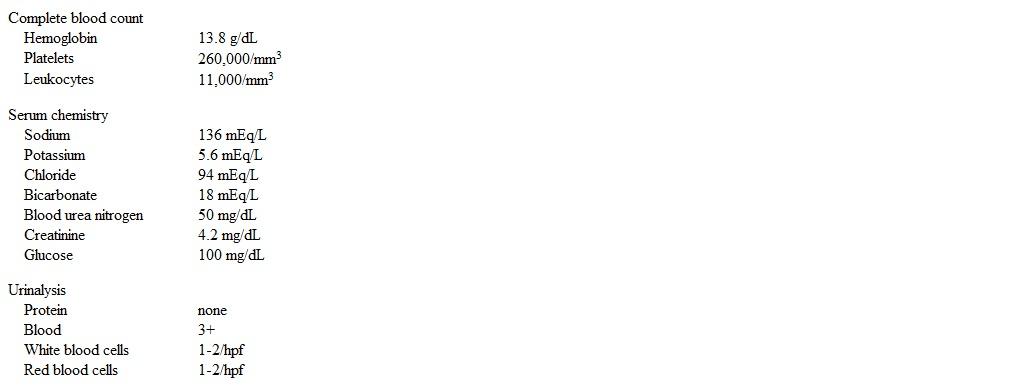 Baseline laboratory studies conducted a month ago were normal. Which of the following is most helpful to establish a diagnosis?
 (Multiple Choice)
4.9/5 (80)
(80) A large-scale randomized, double-blinded clinical trial was conducted to evaluate the effect of beta-blocker therapy on the survival of patients with chronic heart failure, class IV. The patients with severe heart failure were randomly assigned to receive either carvedilol (a beta blocker) or a placebo. In their report of the results of the study, the investigators included a table with baseline characteristics (eg, age, race, prevalence of hypertension) of the patients in the treatment and placebo groups. According to that table, both groups had a similar distribution of these characteristics. With the information given, which of the following is most probable?
(Multiple Choice)
4.8/5 (89)
(89) A 23-year-old man is brought to the emergency department by his family due to a severe sore throat, persistent elevated fevers, pain and difficulty with swallowing, and shortness of breath. His symptoms worsened over the past day. Three days ago, he was seen at an urgent care center for pharyngitis and was prescribed azithromycin. The patient's past medical history is otherwise insignificant. He does not use tobacco, alcohol, or illicit drugs. His temperature is 40 C (104 F), blood pressure is 90/58 mm Hg, pulse is 115/min, and respirations are 24/min. Pulse oximetry shows 94% on room air. Physical examination is notable for a well-built man in moderate distress due to pain. There is mild swelling and erythema of the oropharynx and tonsils without exudate. Dentition is intact and shows good hygiene. The neck is swollen and tender along the left sternocleidomastoid muscle. Lung examination reveals basilar crackles. There are no heart murmurs. Leukocyte count is 17,400/mm3 with 93% neutrophils. A duplex ultrasound shows left internal jugular vein thrombosis. Chest x-ray reveals multiple peripheral lung nodules, some with cavitation. Which of the following is the most likely causative organism?
(Multiple Choice)
4.8/5 (77)
(77) A 17-year-old boy is evaluated due to left-sided chest discomfort for the past week. It is exacerbated by left arm movement and deep inspiration. The patient plays competitive soccer for his high school and has been practicing almost daily. His mother is worried that he has a heart condition because his maternal uncle died from a "massive heart attack" at age 35. Blood pressure is 125/80 mm Hg, pulse is 56/min, and respirations are 15/min. BMI is 27 kg/m2. The patient is well built with increased skeletal muscle mass. There is no jugular venous distension. Physical examination is unremarkable. ECG demonstrates sinus bradycardia with T-wave inversion in lead V1. Echocardiography reveals slightly enlarged left ventricular cavity size, mild left ventricular wall thickening, and no left atrial enlargement. What is the most likely cause of this patient's cardiac findings?
(Multiple Choice)
4.9/5 (84)
(84) A 29-year-old man comes to the office due to 10 days of fatigue and copious watery diarrhea. He has had no fever, stool with blood or mucus, tenesmus, or vomiting. The patient returned a week ago from a 3-week trip to Eastern Europe. During this trip, he spent much time hiking and swimming in local lakes and streams. He has no chronic medical problems and takes no medications. The patient does not use tobacco, alcohol, or illicit drugs. Temperature is 37.2 C (99 F), blood pressure is 120/74 mm Hg, pulse is 80/min, and respirations are 15/min. Cardiopulmonary auscultation is normal. The abdomen is soft and nontender with increased bowel sounds and no organomegaly. Stool is negative for leukocytes and fecal occult blood. Which of the following pathogens is most likely responsible for this patient's symptoms?
(Multiple Choice)
4.9/5 (74)
(74) A 42-year-old man is brought to the emergency department immediately after having a seizure. His family describes a medical history of generalized tonic-clonic seizures. The patient has been on valproic acid for the past 10 years but stopped taking the drug 6 months ago as he had no seizures in the last 9 years. He is otherwise healthy and had been doing well until this seizure episode. He does not use tobacco, alcohol, or illicit drugs. The patient is afebrile. Blood pressure is 105/68 mm Hg, pulse is 96/min, and respirations are 18/min. Pulse oximetry shows 99% on room air. The patient appears confused and lethargic. Chest auscultation is unremarkable, and the abdomen is soft and nontender. A limited neurologic examination is nonfocal. Laboratory results are as follows:  Arterial blood gas shows pH 7.24. Chest x-ray and urinalysis are within normal limits, and a CT scan of the head is unremarkable. Which of the following is the most appropriate next step in management of this patient's metabolic acidosis?
 (Multiple Choice)
4.8/5 (79)
(79) Two cross-sectional studies were conducted using different questionnaires to determine the prevalence of over-the-counter analgesics use in a population. The first study showed a prevalence of 7.5% (95% confidence interval 6.0 - 9.0), and the second study demonstrated a prevalence of 7.3% (95% confidence interval 6.9 - 7.6). If the true prevalence of over-the-counter analgesics use in the population is 7.4%, which of the following statements about the results of the study is the most accurate?
(Multiple Choice)
5.0/5 (77)
(77) A 60-year-old man is brought to the emergency department due to 2 weeks of progressive exertional dyspnea and fatigue. He has difficulty falling asleep and can hardly walk to the bathroom without becoming short of breath. The patient has had no chest pain, syncope, cough, or extremity edema. Two months ago, he was hospitalized with an anterior wall myocardial infarction but was not revascularized due to late presentation. The patient was discharged home with aspirin, clopidogrel, metoprolol, lisinopril, and atorvastatin. Temperature is 36.6 C (97.9 F), blood pressure is 100/67 mm Hg, and pulse is 67/min and regular. Examination shows bilateral crackles in the lower lung fields. The apical impulse is displaced to the left. A faint systolic murmur is heard over the apex. ECG reveals normal sinus rhythm and deep Q waves in leads I, aVL, and V2-V5, with a 2-mm ST-segment elevation; the ECG tracings are unchanged compared to those at discharge 2 months ago. Which of the following is the most likely underlying cause of this patient's symptoms?
(Multiple Choice)
4.9/5 (87)
(87) An 89-year-old woman comes to the physician complaining of an episodic skin discoloration over the last several months. She reports scattered dark purple areas on her hands and forearms without associated pain or itching. She has no fever, chills, or recent weight loss. The patient's other medical problems include diet-controlled diabetes and right knee osteoarthritis treated with acetaminophen. Physical examination shows thin, hyperpigmented skin with several flat, dark purple ecchymotic areas over the dorsum of both forearms. Her abdomen is soft and nontender. The liver span is 6 cm without a palpable spleen. Laboratory results are as follows: 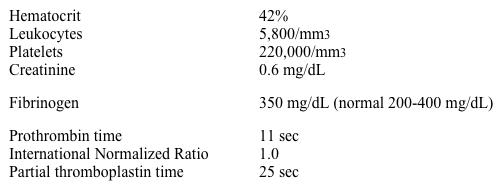 Which of the following is the most likely cause of this patient's complaint?
 (Multiple Choice)
4.9/5 (74)
(74) A 65-year-old woman comes to the office for follow-up. Two months ago, the patient was found to have low bone mineral density on screening dual-energy x-ray absorptiometry. Her serum calcium and vitamin D levels were within normal limits, and weekly alendronate therapy was prescribed. After starting the bisphosphonate, the patient had burning epigastric discomfort and nausea, which improved with over-the-counter antacids. She also has hypertension, for which she takes chlorthalidone. She takes no other medications or supplements and does not use tobacco, alcohol, or illicit drugs. The patient consumes a balanced diet and performs weight-bearing exercises regularly. Blood pressure is 110/66 mm Hg and pulse is 88/min. Physical examination is normal. Laboratory results are as follows:  Serum creatinine was 0.8 mg/dL 2 months ago. Which of the following is the most likely cause of this patient's hypercalcemia?
 (Multiple Choice)
4.9/5 (73)
(73) A 29-year-old woman comes to the office due to back pain. For the last week, she has had moderate, nonradiating pain in the low back that started after she spent the weekend raking leaves in her yard. The patient attempted treatment with a heating pad and ibuprofen but had no relief. She has no associated fever, lower extremity weakness, or urinary symptoms. Medical history is unremarkable, and the patient takes no other medications. Vital signs are normal. BMI is 34 kg/m2. Examination shows tenderness in the right lumbar paraspinal region with normal neurologic findings in the lower extremities. Straight-leg raising test is negative. Which of the following is the most appropriate next step?
(Multiple Choice)
4.8/5 (98)
(98) A 41-year-old woman comes to the office for follow-up of abnormal liver function test results. The patient has a 3-year history of hypercholesterolemia treated with a statin medication that was discontinued 6 months ago when a moderate elevation in hepatic transaminases was noted. She has no jaundice, abdominal pain, or nausea. Medical history is also notable for type 2 diabetes mellitus. Current medications include metformin and lisinopril, both of which she has taken for several years. The patient drinks 1-2 glasses of wine on weekends and does not use tobacco or illicit drugs. There is no family history of liver disease. Vital signs are normal. BMI is 36 kg/m2. Examination shows mild hepatomegaly. Laboratory results are as follows:  Which of the following is the most likely diagnosis in this patient?
 (Multiple Choice)
4.8/5 (89)
(89) A 56-year-old man comes to the emergency department an hour after acute onset of right-sided weakness and numbness. His symptoms progressed over a course of several minutes, and he is now experiencing nausea and headache. The patient has not seen a physician for many years and takes no medications. He has smoked a half pack of cigarettes per day for 32 years. Blood pressure is 170/90 mm Hg and pulse is 88/min. Physical examination shows 3/5 muscle strength and hyperreflexia in the right upper and lower extremities. Sensation to pinprick and light touch is decreased on the right side. He has mild dysarthria. ECG shows normal sinus rhythm and left ventricular hypertrophy. Fingerstick blood glucose is 130 mg/dL and serum LDL is 142 mg/dL. Noncontrast head CT scan is shown below. 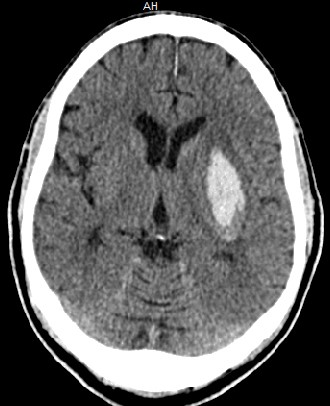 Which of the following is the most likely cause of this patient's symptoms?
 (Multiple Choice)
4.7/5 (82)
(82) Showing 1081 - 1100 of 1702
 Prev
- 1
- ...
- 2
- ...
- 3
- ...
- 4
- ...
- 5
- ...
- 6
- ...
- 7
- ...
- 8
- ...
- 9
- ...
- 10
- ...
- 11
- ...
- 12
- ...
- 13
- ...
- 14
- ...
- 15
- ...
- 16
- ...
- 17
- ...
- 18
- ...
- 19
- ...
- 20
- ...
- 21
- ...
- 22
- ...
- 23
- ...
- 24
- ...
- 25
- ...
- 26
- ...
- 27
- ...
- 28
- ...
- 29
- ...
- 30
- ...
- 31
- ...
- 32
- ...
- 33
- ...
- 34
- ...
- 35
- ...
- 36
- ...
- 37
- ...
- 38
- ...
- 39
- ...
- 40
- ...
- 41
- ...
- 42
- ...
- 43
- ...
- 44
- ...
- 45
- ...
- 46
- ...
- 47
- ...
- 48
- ...
- 49
- ...
- 50
- ...
- 51
- ...
- 52
- ...
- 53
- ...
- 54
- ...
- 55
- ...
- 56
- ...
- 57
- ...
- 58
- ...
- 59
- ...
- 60
- ...
- 61
- ...
- 62
- ...
- 63
- ...
- 64
- ...
- 65
- ...
- 66
- ...
- 67
- ...
- 68
- ...
- 69
- ...
- 70
- ...
- 71
- ...
- 72
- ...
- 73
- ...
- 74
- ...
- 75
- ...
- 76
- ...
- 77
- ...
- 78
- ...
- 79
- ...
- 80
- ...
- 81
- ...
- 82
- ...
- 83
- ...
- 84
- ...
- 85
- ...
- 86
- ...
- Next

Filters
- Essay(0)
- Multiple Choice(0)
- Short Answer(0)
- True False(0)
- Matching(0)