


 Chat with AI
Exam 1: Medicine

Exam 1: Medicine2 k Questions
Exam 2: Pediatric723 Questions
Exam 3: Psychiatry336 Questions
Exam 4: Surgery563 Questions
Exam 5: Obstetrics & Gynecology469 Questions
Select questions type


A 62-year-old woman comes to the office due to moderate osteoarthritis of the knees. At her last appointment 3 months ago, recommendations for weight management and exercise were made. Since then, the patient has exercised only twice and has made no dietary changes. She reports continued stiffness and pain in her knees and has decided to start a glucosamine supplement as recommended to her by a friend. The patient asks which brand of supplement to buy. Which of the following is the most appropriate statement?
(Multiple Choice)
4.8/5  (84)
(84) A 56-year-old man comes to the emergency department due to sudden-onset epigastric pain and dizziness that began 2 hours ago. The patient also has nausea but no shortness of breath. He has a history of hypertension, hyperlipidemia, and gastroesophageal reflux disease. The patient drinks 3 or 4 beers per week and smoked a pack of cigarettes daily for 15 years until quitting 2 years ago. Blood pressure is 85/52 mm Hg, pulse is 55/min, and respirations are 16/min. On physical examination, the patient is diaphoretic and appears uncomfortable. Cardiac auscultation reveals normal heart sounds with no murmurs. The abdomen is nontender to palpation. Chest x-ray reveals no cardiac enlargement or pulmonary edema. ECG reveals sinus bradycardia with symmetric T-wave inversion in leads II, III, and aVF. Which of the following is the most appropriate next step in the management of this patient?
(Multiple Choice)
4.9/5 (80)
(80) A 42-year-old man comes to the office due to a rash. For the last 2 months, he has had a slowly expanding rash on his right upper arm associated with moderate itching. He recently adopted 2 cats and is unsure if he has had any animal bites. Medical history is unremarkable, and the patient takes no medications. Vital signs are normal. Skin examination findings are shown in the exhibit. 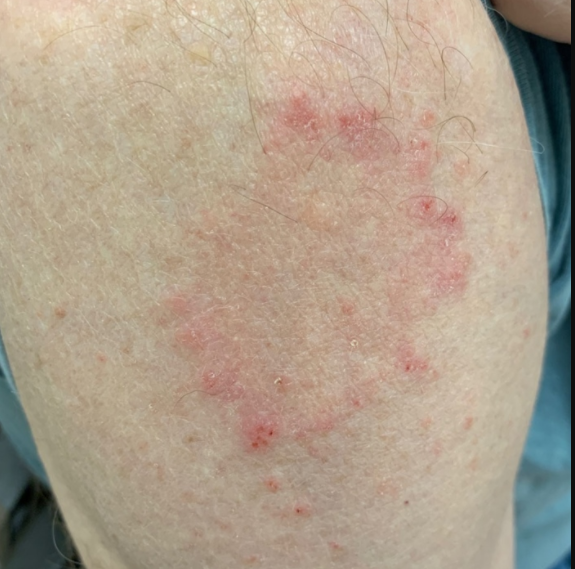 There is no lymphadenopathy. Minor scratches are present over both arms. Which of the following is the most appropriate treatment for this patient's skin condition?
 (Multiple Choice)
4.8/5 (80)
(80) A 20-year-old man comes to the emergency department due to worsening right leg pain. The patient runs 5 miles daily, but several weeks ago, he began having dull pain at the right lower shin during runs. Now, the pain occurs even with light walking. He has had no trauma, fever, chills, or redness in the affected area. The patient has no prior medical conditions and takes no medications. Temperature is 36.7 C (98.1 F), blood pressure is 110/60 mm Hg, pulse is 56/min, and respirations are 16/min. BMI is 17 kg/m2. Physical examination reveals tenderness of the right lower anterior tibia. X-ray of the right lower extremity reveals a small tibial stress fracture. When the findings are explained and treatment with analgesics and limited physical activity is discussed, the patient becomes distressed that he has to stop running. Which of the following is the most appropriate next step in management of this patient?
(Multiple Choice)
4.8/5 (72)
(72) A 34-year-old man comes to the emergency department with palpitations for the past 4 hours. He has no associated chest pain, shortness of breath, or dizziness. His medical history is significant for Wolff-Parkinson-White syndrome with 3 prior episodes of supraventricular tachycardia. The patient does not use tobacco or illicit drugs and drinks alcohol only on social occasions. He had 5 cans of beer at a party the previous night. On examination, his blood pressure is 120/80 mm Hg and pulse is irregularly irregular. ECG shows atrial fibrillation with a rate of 160/min. What is the best next step in management of this patient?
(Multiple Choice)
4.9/5 (86)
(86) A 65-year-old woman comes to the office after a screening DXA scan revealed osteoporosis. The patient has occasional back and hip pain but has had no falls or fractures. She has no significant medical history and takes no medications. Her mother has osteoporosis. The patient does not use tobacco, alcohol, or illicit drugs. She walks 1-2 miles daily and consumes a balanced diet. Vital signs are within normal limits. BMI is 23 kg/m2. Physical examination reveals nonlocalized bony tenderness of the spine. The remainder of the examination shows no abnormalities. Laboratory results are as follows: 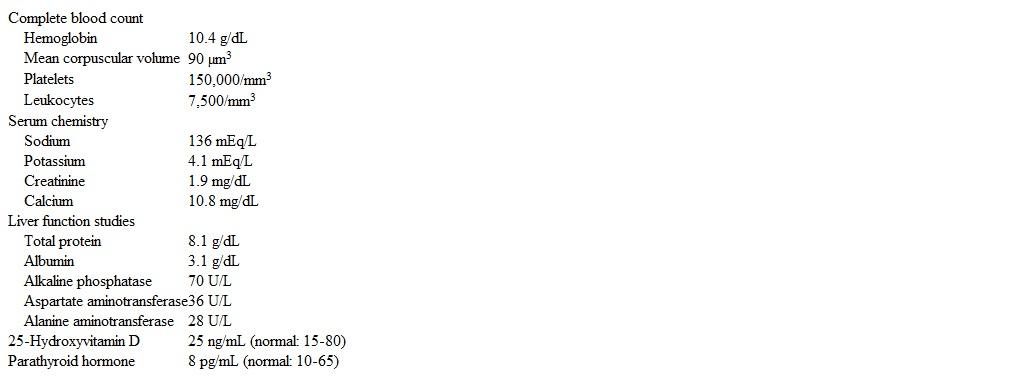 Which of the following is the best next step in management of this patient?
 (Multiple Choice)
4.7/5 (81)
(81) A 32-year-old man with a known history of recreational substance abuse is brought to the emergency department. The patient was found by a friend on the floor of his apartment with a pool of urine around him. He has been previously hospitalized for alcohol intoxication. The patient is confused, not oriented to time or place, and does not recall recent events. Temperature is 37.3 C (99.1 F), blood pressure is 90/70 mm Hg, pulse is 67/min, and respirations are 12/min. He is drowsy and moves all his extremities. The pupils are small. Skin is mottled over the upper back, buttocks, and posterior thighs. Cardiopulmonary examination is normal. The abdomen is soft and nontender. Laboratory findings are the following: 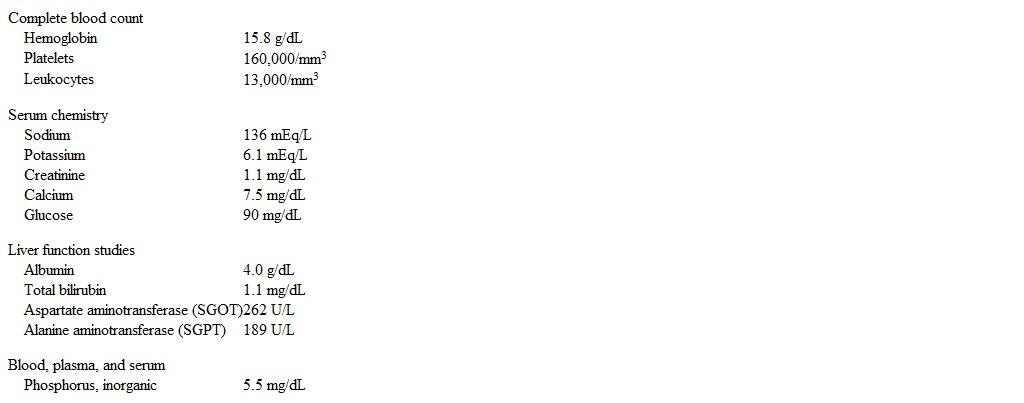 Urine toxicology screen is positive for opioids. Over the next 2 days, this patient is at greatest risk for which of the following?
 (Multiple Choice)
4.8/5 (92)
(92) A 64-year-old woman comes to the office due to a progressive rash. The patient initially had painful, itchy red spots on her right leg 2 months ago, which gradually enlarged and began to crust. Similar spots later appeared on her abdomen and chin. She has used several over-the-counter corticosteroid and antibiotic creams with no improvement. The patient has had no palpitations, abdominal pain, or vomiting, but has had occasional watery stools. She was diagnosed with type 2 diabetes mellitus 6 months ago, and lifestyle modification was advised. The patient does not use tobacco, alcohol, or illicit drugs. Temperature is 37 C (98.6 F), blood pressure is 110/70 mm Hg, pulse is 78/min, and respirations are 14/min. Weight is 10 kg (22 lb) lower than 6 months ago; BMI is 21 kg/m2. Physical examination shows erythematous plaques with central clearing and eroded borders on the right thigh. There are scattered papules with crusting over the lower abdomen and in the perioral skin. The remainder of the examination shows no abnormalities. Laboratory studies are significant for a hemoglobin level of 10.2 g/dL and glucose level of 176 mg/dL. Which of the following would be most helpful in establishing the diagnosis in this patient?
(Multiple Choice)
4.8/5 (83)
(83) A 23-year-old man comes to the emergency department due to severe abdominal pain and fatigue. He has had nausea and vomiting for several hours and is unable to eat. He took ibuprofen but has had no pain relief. The patient has a history of anemia and dark brown urine that has not been evaluated because he tries "to avoid going to the doctor." Review of systems is otherwise negative, and he has no known medical conditions. He emigrated from Scotland during childhood but has not traveled outside the United States since. Temperature is 38.8 C (101.8 F), blood pressure is 120/80 mm Hg, pulse is 102/min, and respirations are 16/min. There is tenderness in the right upper quadrant of the abdomen that is exacerbated by deep inspiration. Splenomegaly and jaundice are present. There are no peritoneal signs. The remainder of the examination is normal. Laboratory results are as follows: 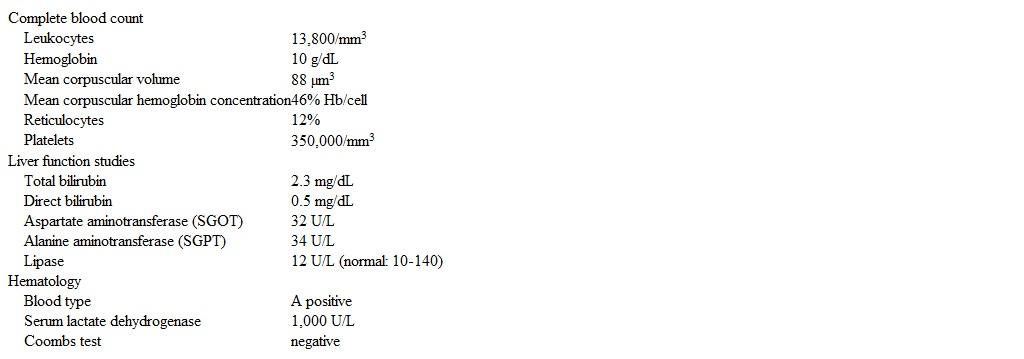 Which of the following is the most likely primary cause of this patient's anemia?
 (Multiple Choice)
4.7/5 (81)
(81) A 32-year-old man is brought to the emergency department after his coworkers found him confused, disoriented, and bleeding from the nose. The patient's medical history is significant for an episode of major depression. He is currently taking no medication. According to his friends, he was in his normal state of health this morning when he came to work. He then spent the morning cutting several bushes and trees to clean the area for a new road construction. Temperature is 42 C (108 F), blood pressure is 110/70 mm Hg, respirations are 16/min, and pulse is 120/min and regular. BMI is 40 kg/m2. The patient's skin is warm and dry, and his neck is supple with no stiffness. The pupils are symmetric, midsize, and reactive to light. There is active bleeding from the right nostril. Deep tendon reflexes are symmetric. No Babinski sign is present. The patient moves all the extremities but is unable to speak or follow simple commands. Skin on his extremities has several scratch marks, likely from thorn injuries. Which of the following is the most likely diagnosis?
(Multiple Choice)
4.7/5 (73)
(73) An 84-year-old woman is brought to the emergency department due to 2 weeks of progressive confusion. She has a history of mild dementia and lives in an assisted living facility. Her caregiver reports that during the past several months she has become progressively weaker, and she has fallen down on several occasions and is now using a walker. In her usual state, the patient recognizes most of the staff, converses appropriately, and performs daily activities with minimal assistance; however, for the past week, she has been more confused and sleeping most of the time. She has also developed a mild headache. The patient has had no fever, vomiting, or urinary symptoms. Her other medical problems include hypertension and osteoarthritis. Blood pressure is 138/76 mm Hg and pulse is 74/min and regular. She is somnolent but arousable. The patient does not recognize her caregiver and gives several inaccurate answers but is able to follow simple instructions. Muscle strength is 4/5 on the right side and 3/5 on the left. Plantar reflex is upgoing on the left. Which of the following is the most likely diagnosis?
(Multiple Choice)
4.8/5 (81)
(81) A 63-year-old man comes to the physician complaining of easy fatigability. He has a history of hypertension treated with lisinopril. Over the last 3 months, he has had right knee pain due to osteoarthritis and has taken naproxen for pain relief. His blood pressure is 123/78 mm Hg and heart rate is 78/min. His right knee is mildly deformed due to bony overgrowth but is not tender or swollen. Physical examination is otherwise normal. Laboratory results are as follows:  Which of the following changes would you expect most in this patient?
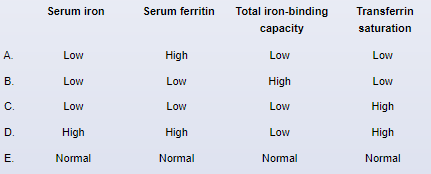
Which of the following changes would you expect most in this patient?
(Multiple Choice)
4.7/5 (80)
(80) A 44-year-old man comes to the office for follow-up after a recent hospitalization. The patient went to the emergency department with palpitations 2 weeks ago and was found to have atrial fibrillation with rapid ventricular response. He was admitted to the hospital, where he spontaneously converted to normal sinus rhythm overnight and was discharged home the next day. Prior to this episode, the patient had gone on an alcohol drinking binge during a friend's bachelor party. He otherwise rarely drinks alcohol. Medical history is unremarkable. He is a lifetime nonsmoker. Blood pressure is 124/70 mm Hg and pulse is 78/min and regular. Estimated jugular venous pressure is normal. Examination shows no abnormalities. Review of laboratory results from the hospital admission shows normal creatinine level, liver function tests, thyroid studies, and lipid panel. Echocardiogram shows normal left and right ventricular function and no valvular abnormalities. Which of the following is the best next step in managing this patient?
(Multiple Choice)
4.8/5 (72)
(72) A 56-year-old diabetic male is brought to the emergency department due to nausea and vomiting. While you are examining the patient, a nurse asks if determination of the patient's acid-base status will help ascertain the etiology and subsequent management of the patient's primary problem. Which of the following pairs of laboratory values will help get the best picture of the patient's acid-base status?
(Multiple Choice)
4.9/5 (66)
(66) A 12-year-old boy is brought to the office for fever. Two weeks ago, he developed rhinorrhea, sore throat, and cough. For the past 2 days, the patient has had a fever and progressively worsening pain behind his eyes that radiates to his right forehead. He woke early this morning and vomited twice. He has had no diarrhea. The patient has no chronic medical conditions and takes no daily medications. Temperature is 39.7 C (103.5 F), blood pressure is 134/86 mm Hg, pulse is 116/min, and respirations are 26/min. The patient appears drowsy and uncomfortable. Examination shows copious green nasal discharge from the right naris. Palpation of the right forehead elicits tenderness. Oropharyngeal examination shows erythema along the posterior oropharynx with purulent drainage. The neurologic examination is nonfocal. Which of the following is the best next step in management?
(Multiple Choice)
4.8/5 (87)
(87) A 27-year-old man comes to the office at his wife's insistence due to issues with concentration that are affecting his job performance. The patient works in information technology and has been easily distracted and unable to complete his assignments after returning from a business trip 4 weeks ago. The trip was stressful because it involved giving multiple presentations. Since his return, instead of working on current projects with assigned deadlines, he has spent hours developing new computer programs and is at risk of losing his job. He hardly sleeps at night and is increasingly anxious and irritable, behavior that is uncharacteristic. Last week, the patient became angry when his wife was skeptical of his idea to leave his job and start an internet company with no resources or investors. The patient has a history of attention-deficit hyperactivity disorder, for which he was treated with cognitive-behavioral therapy for 4 years beginning at age 8. He used cocaine in his early 20s but has not used illicit drugs in 3 years, apart from marijuana on occasion, which he says "helps me feel less anxious." Family history is significant for depression in his mother. On physical examination, the patient is cooperative but appears tense and anxious. He is talkative, easily distracted, and has difficulty sitting still; at one point he gets up to walk around the room. The patient has no psychotic symptoms or suicidal ideation. Urine drug screen is negative. Which of the following is the most likely explanation of the patient's recent behavior?
(Multiple Choice)
4.8/5 (73)
(73) A 22-year-old man comes to the urgent care clinic due to 2 weeks of fever, sore throat, and malaise. He has tried several over-the-counter products with minimal relief. The patient recently returned from a trip to Honduras for volunteer work. Temperature is 38.8 C (101.8 F), blood pressure is 130/70 mm Hg, pulse is 110/min, and respirations are 18/min. Mild jaundice is present. The tonsils are enlarged, erythematous, and covered with white exudates. Enlarged lymph nodes are palpable posterior to the sternocleidomastoid muscle bilaterally and in the axillary region. Breath sounds are normal. A grade 1/6 systolic murmur is heard in the left infraclavicular region. The abdomen is soft and nontender with normoactive bowel sounds; mild splenomegaly is present. Laboratory results are as follows: 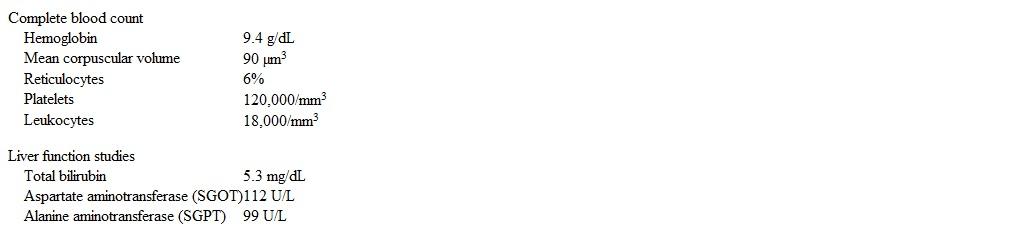 Which of the following is the most likely diagnosis in this patient?
 (Multiple Choice)
4.9/5 (87)
(87) A 47-year-old man comes to the office for a routine health examination. He has no symptoms except for a mild increase in frequency of urination. The patient has a history of elevated glucose levels but no other medical conditions, and he takes no medications. Family history is significant for type 2 diabetes mellitus. He does not use tobacco, alcohol, or illicit drugs. Temperature is 36.7 C (98 F), blood pressure is 132/80 mm Hg, pulse is 72/min, and respirations are 16/min. BMI is 33 kg/m2. Fasting laboratory results are as follows:  Which of the following is the most appropriate next step in management of this patient's condition?
 (Multiple Choice)
4.9/5 (83)
(83) A 27-year-old woman comes to the office to discuss weight loss. She has gradually gained weight since she was married 6 years ago. The patient says, "I have tried every diet I know, and nothing seems to work. There must be something wrong with me." Medical history is unremarkable. She has 2 children and does not use tobacco or alcohol. Vital signs are within normal limits. BMI is 28 kg/m2. Physical examination shows an overweight body habitus and is otherwise normal. Which of the following is the most appropriate response to this patient's concerns?
(Multiple Choice)
4.8/5 (90)
(90) A 54-year-old woman comes to the office due to unsteady gait. The patient's legs have felt "rubbery," and she fell once while walking in the dark several weeks ago. She has had no headache, vision loss, focal weakness, or back pain. The patient has also had irritability and crying spells, which she attributes to menopause. She has a 6-year history of type 2 diabetes mellitus and takes metformin. The patient has had remarkable weight loss following various diets, and her hemoglobin A1c levels have been below 7% over the past year. Blood pressure is 124/68 mm Hg and pulse is 66/min with no orthostatic changes. BMI is 26 kg/m2. Physical examination shows normal pupillary reflexes and funduscopy. Muscle strength in the lower extremities is normal. Bilateral plantar reflexes are upgoing. When the patient is instructed to stand with the feet together and eyes closed, she sways from side to side. Laboratory results are as follows:  Which of the following is the best next step in management of this patient?
 (Multiple Choice)
5.0/5 (83)
(83) Showing 1401 - 1420 of 1702
 Prev
- 1
- ...
- 2
- ...
- 3
- ...
- 4
- ...
- 5
- ...
- 6
- ...
- 7
- ...
- 8
- ...
- 9
- ...
- 10
- ...
- 11
- ...
- 12
- ...
- 13
- ...
- 14
- ...
- 15
- ...
- 16
- ...
- 17
- ...
- 18
- ...
- 19
- ...
- 20
- ...
- 21
- ...
- 22
- ...
- 23
- ...
- 24
- ...
- 25
- ...
- 26
- ...
- 27
- ...
- 28
- ...
- 29
- ...
- 30
- ...
- 31
- ...
- 32
- ...
- 33
- ...
- 34
- ...
- 35
- ...
- 36
- ...
- 37
- ...
- 38
- ...
- 39
- ...
- 40
- ...
- 41
- ...
- 42
- ...
- 43
- ...
- 44
- ...
- 45
- ...
- 46
- ...
- 47
- ...
- 48
- ...
- 49
- ...
- 50
- ...
- 51
- ...
- 52
- ...
- 53
- ...
- 54
- ...
- 55
- ...
- 56
- ...
- 57
- ...
- 58
- ...
- 59
- ...
- 60
- ...
- 61
- ...
- 62
- ...
- 63
- ...
- 64
- ...
- 65
- ...
- 66
- ...
- 67
- ...
- 68
- ...
- 69
- ...
- 70
- ...
- 71
- ...
- 72
- ...
- 73
- ...
- 74
- ...
- 75
- ...
- 76
- ...
- 77
- ...
- 78
- ...
- 79
- ...
- 80
- ...
- 81
- ...
- 82
- ...
- 83
- ...
- 84
- ...
- 85
- ...
- 86
- ...
- Next

Filters
- Essay(0)
- Multiple Choice(0)
- Short Answer(0)
- True False(0)
- Matching(0)