


 Chat with AI
Exam 1: Medicine

Exam 1: Medicine2 k Questions
Exam 2: Pediatric723 Questions
Exam 3: Psychiatry336 Questions
Exam 4: Surgery563 Questions
Exam 5: Obstetrics & Gynecology469 Questions
Select questions type


A 70-year-old man is brought to the hospital by his son due to worsening fatigue. The son states that his father does not like seeing doctors and has not been to one in 20 years. The patient frequently eats at fast food restaurants and rarely eats vegetables and fresh fruit. He has no known medical conditions other than chronic, intermittent back pain for which he uses over-the-counter painkillers. Physical examination shows an S4 heart sound, strong apical impulse, and clear lung fields. Abdomen examination reveals no bruit or other abnormalities. Neurological examination is normal. Laboratory results are as follows:  Urinalysis shows trace protein and bland sediment without casts. Ultrasonogram of the abdomen reveals bilateral small kidneys and no evidence of hydronephrosis. Which of the following best explains this patient's findings?
 (Multiple Choice)
4.7/5  (87)
(87) A 66-year-old man is brought to the emergency department with dyspnea, tachypnea, crampy pain, and paresthesias in his extremities. He arrived home a few hours after a long international flight. His temperature is 36.7 C (98.5 F), blood pressure is 120/80 mm Hg, pulse is 88/min, and respirations are 26/min. Physical examination is significant for carpopedal spasm and left calf swelling. CT scan reveals a segmental pulmonary embolus. Which of the following alterations in calcium metabolism is most likely present in this patient?
(Multiple Choice)
4.9/5 (74)
(74) A 64-year-old man comes to the office due to 2 months of weight loss, dry cough, and progressive pain in his right arm. He was treated for community-acquired pneumonia a year ago. The patient has a history of type 2 diabetes mellitus and hypertension. He used to travel internationally for work but retired several years ago. The patient has a 30-pack-year smoking history but quit 5 years ago. He drinks alcohol occasionally. Vital signs are normal. Physical examination is unremarkable. Imaging of the chest is shown below. 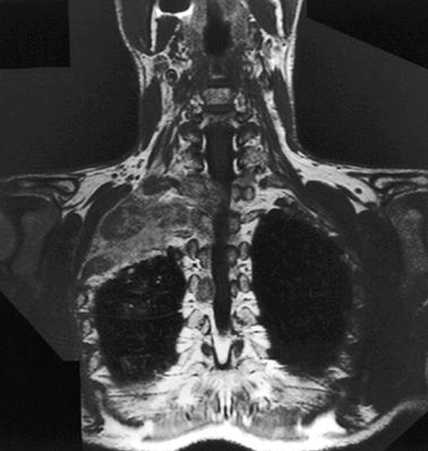 Which of the following is most likely responsible for this patient's symptoms?
 (Multiple Choice)
4.8/5 (87)
(87) A 67-year-old woman is hospitalized for sepsis secondary to a urinary tract infection. Medical history is significant for hypertension, type 2 diabetes mellitus, ischemic stroke, and neurogenic bladder with chronic indwelling Foley catheter. The patient is admitted to the intensive care unit and treated with intravenous fluids and broad-spectrum antibiotics. Blood and urine cultures grow Escherichia coli that are sensitive to all tested antibiotics. The patient's condition gradually improves with the treatment, and antibiotics are changed to oral ciprofloxacin on the 3rd day of hospitalization. On the 7th day of hospitalization, the patient progressively becomes confused, and she also has 6 watery bowel movements with lower abdominal pain. Temperature is 38 C (100.4 F), blood pressure is 111/89 mm Hg, and pulse is 108/min. The abdomen is soft and mildly tender in the left lower quadrant with normoactive bowel sounds. There is no guarding or rebound tenderness. Chest x-ray reveals no new infiltrates. Laboratory evaluation shows a white blood cell count of 14,200/mm3 compared to 8,700/mm3 2 days earlier. A repeat urinalysis shows occasional yeasts. Which of the following is the best next step in management of this patient?
(Multiple Choice)
4.8/5 (81)
(81) A 17-year-old girl is admitted to the hospital due to purging behavior, weight loss, and syncope. Nasogastric feeds are initiated, and her activities are restricted. On the second day of admission, the patient reports severe shortness of breath and has recurrent episodes of nonsustained ventricular tachycardia. Blood pressure is 82/55 mm Hg, pulse is 112/min, and respirations are 22/min. BMI is 14 kg/m2. Physical examination shows an emaciated girl with bibasilar crackles and jugular venous distension. Serum chemistry results are as follows: 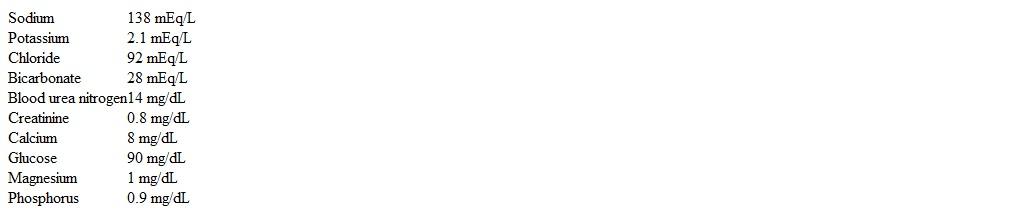 A marked increase in which of the following hormones best explains this patient's deterioration?
 (Multiple Choice)
4.7/5 (74)
(74) A 23-year-old man is brought to the emergency department due to generalized weakness and abdominal pain. One week earlier, he began a diet challenge that involved a "juice cleanse" and exclusive consumption of raw vegetables. He does not use tobacco, alcohol, or illicit drugs. The patient's mother has hypothyroidism and his father died of lung cancer. Temperature is 37.8 C (100 F), blood pressure is 110/70 mm Hg, pulse is 110/min, and respirations are 27/min. The oral mucosa is dry. Laboratory results are as follows:  Which of the following is the most likely cause of the increased potassium level in this patient?
 (Multiple Choice)
4.7/5 (84)
(84) A 40-year-old woman presents to the office with several months history of atypical chest pain. Her family history is positive for hypertension and type II diabetes mellitus. Her past medical history is insignificant. An ECG stress test is performed to evaluate the possibility of coronary heart disease. This test has 85% sensitivity and 80% specificity. In the low-risk group, its positive predictive value is 25%, and negative predictive value is 96%. If the test is negative, what is the probability that the patient has coronary heart disease?
(Multiple Choice)
4.9/5 (86)
(86) A 23-year-old previously healthy woman comes to the clinic due to a 3-month history of intermittent hand stiffness and pain. She has also felt excessively tired and has had occasional episodes of knee and sharp chest pain. The patient takes no medications and does not use tobacco, alcohol, or illicit drugs. Temperature is 37.2 C (99 F), blood pressure is 130/70 mm Hg, and pulse is 80/min. Bilateral hand joints and wrists are mildly tender and swollen. Lungs are clear to auscultation and heart sounds are normal. The abdomen is soft and nontender with no organomegaly. There is mild bilateral lower extremity edema. The patient has no rash or lymphadenopathy. Laboratory results are as follows:  Which of the following is the best next step in establishing the diagnosis?
 (Multiple Choice)
4.9/5 (78)
(78) A 53-year-old man comes to the office with a 2-year history of seasonal cough, episodic shortness of breath, and wheezing. Family history is significant for asthma in his mother. The patient uses hydrocortisone cream as needed for atopic dermatitis. He has a 34-pack-year smoking history and consumes alcohol occasionally. Physical examination shows diminished breath sounds and bilateral scattered expiratory wheezes. Office evaluation shows a decreased peak expiratory flow rate. Which of the following would be most helpful in differentiating asthma from chronic obstructive pulmonary disease in this patient?
(Multiple Choice)
4.7/5 (92)
(92) A 67-year-old woman comes to the office due to right hand pain. For the past 3 months, she has had mild to moderate pain at the base of the thumb that is worse when working with hand tools in her garden. In addition, the patient has stiffness in the hands for 5-10 minutes after awakening. Medical history is notable for type 2 diabetes mellitus. She drinks 2 or 3 glasses of wine a day. Vital signs are normal. Examination shows tenderness at both the palmar and the dorsal aspects of the base of the thumb that is associated with hard enlargement at the carpometacarpal junction. X-ray of the hand is shown in the exhibit. 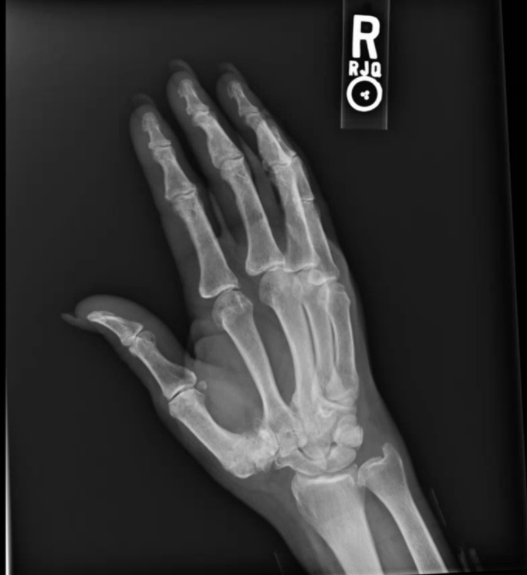 Which of the following is the most likely diagnosis?
 (Multiple Choice)
4.7/5 (76)
(76) A 60-year-old woman has had progressive shortness of breath and dry cough over the last 2 months. The patient has no known medical problems and takes no medications. She does not use tobacco, alcohol, or illicit drugs. Family history is insignificant. Her blood pressure is 155/92 mm Hg, and pulse is 96/min and regular. Pulse oximetry shows 92% on room air. BMI is 31 kg/m2. The jugular venous pressure is estimated at 9 cm H2O. A 2/6 systolic murmur is heard at the lower sternal border and increases with inspiration. Lung auscultation reveals scattered wheezes and bibasilar crackles. There is 2+ symmetric peripheral edema. Echocardiogram shows a dilated left ventricle with ejection fraction of 30% and a mildly dilated right ventricle. The pulmonary artery systolic pressure is estimated at 55 mm Hg (normal <35 mm Hg). Which of the following is the best initial treatment for this patient's pulmonary hypertension?
(Multiple Choice)
4.9/5 (78)
(78) A 32-year-old woman comes to the office with several days of tingling and numbness in both hands. She moved to Arizona in June to care for her ailing mother who died 2 weeks ago of metastatic lung cancer. Since moving, she has had occasional headaches, dizziness, fatigue, poor sleep, and blurry vision. She has had no fevers, weight loss, or anorexia. Her medical history is unremarkable. The patient drinks 1 or 2 glasses of wine daily but does not use tobacco or illicit drugs. Her blood pressure is 132/70 mm Hg and pulse is 78/min. Sensation to light touch and pain is decreased distally in the bilateral upper extremities. Muscle strength is 5/5 in the upper and lower extremities and deep tendon reflexes are normal. On funduscopic examination, the right optic disc appears hyperemic and swollen. Which of the following is the best next step in management of this patient?
(Multiple Choice)
4.8/5 (76)
(76) A 43-year-old man comes to the office due to several weeks of nagging, left-sided chest pain that worsens with deep inspiration. He has also had a progressive, nonproductive cough and mild dyspnea. The patient denies fever or chills. He was diagnosed with Hodgkin lymphoma in his early 20s and was treated with chemotherapy and radiation. Blood pressure is 144/90 mm Hg and pulse is 92/min. The patient appears thin. Examination is otherwise normal. Chest x-ray is shown in the image below: 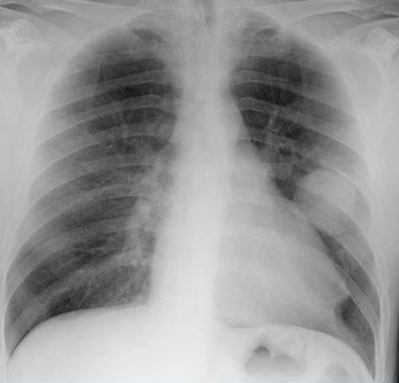 Which of the following is the most likely cause of this patient's current manifestations?
 (Multiple Choice)
4.8/5 (76)
(76) A 31-year-old woman, gravida 3 aborta 3, comes to the office for an annual examination and discussion of contraceptive options. Seven months ago, she experienced her third spontaneous miscarriage and underwent a recurrent miscarriage workup. Results were consistent with antiphospholipid antibody syndrome, and the patient was informed that she is at increased risk for another miscarriage. Due to these risks, the patient and her husband have elected to adopt. She takes no medications and does not use tobacco, alcohol, or illicit drugs. Her blood pressure is 115/60 mm Hg and pulse is 88/min. BMI is 22 kg/m2. Physical examination is normal. Which of the following is the best contraceptive option for this patient?
(Multiple Choice)
4.8/5 (75)
(75) A 25-year-old man comes to the emergency department with difficulty swallowing. He has had a piece of steak stuck substernally for the past 12 hours. The patient has failed to dislodge it despite inducing himself to vomit. He has never had trouble swallowing liquids or solids previously, although he has had frequent heartburn for the past few years and has tried lansoprazole without improvement. He had bronchial asthma since childhood for which he takes inhalers. Temperature is 37.1 C (98.8 F), blood pressure is 136/79, pulse is 85/min, respirations are 12/min. Cardiopulmonary and abdominal examinations are unremarkable. Skin examination is unremarkable. When presented with a glass of water, he vomits the water seconds after swallowing but the piece of steak remains stuck. An urgent endoscopy is arranged to be performed in the emergency department. Which of the following is the most likely explanation for this presentation?
(Multiple Choice)
4.8/5 (82)
(82) A 37-year-old man comes to the office for a routine health maintenance examination. He has been feeling well and has no significant symptoms. The patient does not use tobacco, alcohol, or illicit drugs. His father was diagnosed with rectal cancer at age 50 and underwent partial colectomy. Vital signs and physical examination show no abnormalities. Which of the following is the most appropriate initial screening test for this patient?
(Multiple Choice)
4.8/5 (78)
(78) An 82-year-old man is brought to the hospital with 3 days of fever, productive cough, and shortness of breath. He was admitted to the hospital 2 months ago with right lower lobe pneumonia. His wife reports that he coughs, chokes, and has nasal regurgitation when swallowing liquids or solids. The patient admits the food "gets stuck" in his throat when swallowing. He has a history of hypertension, type 2 diabetes, ischemic stroke, chronic kidney disease, coronary artery disease, and advanced dementia. His temperature is 38.7 C (101.7 F), blood pressure is 142/90 mm Hg, pulse is 104/min, and respirations are 20/min. Neck examination shows midline trachea without palpable masses. Lung examination shows crackles in the right lower lung field. Abdomen is soft and nontender. Chest imaging reveals right lower lobe pneumonia without additional mass lesions. Which of the following is the most appropriate next step in management of this patient's dysphagia?
(Multiple Choice)
4.7/5 (98)
(98) A 68-year-old man is brought to the hospital due to 2 days of progressive shortness of breath and cough. He has a history of severe chronic obstructive pulmonary disease and has had multiple recent exacerbations and several hospitalizations over the past year. During his last hospitalization, he had acute respiratory failure requiring endotracheal intubation. This prompted the patient to make a living will specifying that he does not want any resuscitative measures or invasive therapies in the event of a life-threatening emergency. On examination, he is lethargic and arousable only to noxious physical stimuli. His temperature is 37.2 C (99 F), blood pressure is 132/70 mm Hg, pulse is 102/min, and respirations are 32/min. Examination reveals diffusely decreased breath sounds, bilateral expiratory wheezes, and labored breathing. It is determined that he lacks decision-making capacity. His daughter says, "I have been taking care of my father for many years and I know him better than anyone. He would not want any aggressive measures. Please just make him comfortable." However, the patient's wife demands that everything be done to save her husband's life, including intubation if necessary. She insists that she knows what her husband would have wanted and threatens to file a lawsuit. Which of the following interventions is the most appropriate next step?
(Multiple Choice)
4.8/5 (97)
(97) A 51-year-old woman comes to the office due to pain in her hands. For the past 2 years, she has had daily pain and stiffness in the fingers that are worse when working with hand tools or opening food jars. The patient has tried massaging her hands and doing stretching exercises, with only partial relief. Medical history is unremarkable, and she takes no medications. Vital signs are normal. Examination reveals mild, hard periarticular enlargement at multiple proximal and distal interphalangeal joints of both hands, as shown in the image below: 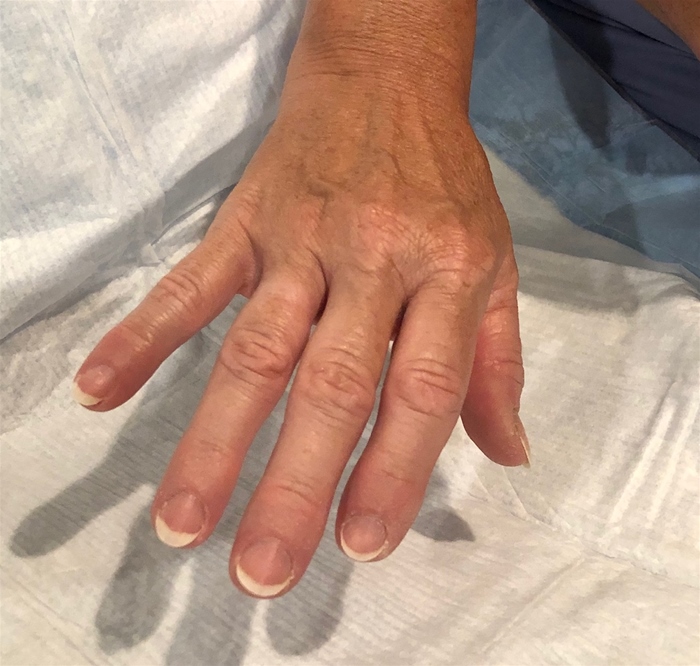 Examination of the metacarpophalangeal joints and wrists is normal. Which of the following is the most appropriate therapy for management of this patient's symptoms?
 (Multiple Choice)
4.9/5 (71)
(71) A 48-year-old woman is evaluated for a painless lump in the right breast, which was first noticed by the patient 3 weeks ago. She has no prior medical problems and has had no mammograms. Her aunt was diagnosed with breast cancer at age 60. Physical examination reveals a 1 x 1.5 cm, firm, mobile mass in the upper outer quadrant of the right breast with no skin or nipple changes. There are no enlarged axillary or cervical lymph nodes. Mammography shows a spiculated mass, and fine-needle aspiration biopsy is positive for invasive ductal carcinoma. The patient undergoes right mastectomy and axillary lymph node dissection. Tumor analysis is negative for estrogen and progesterone receptors but positive for human epidermal growth factor receptor 2 (HER2) gene amplification. Adjuvant therapy containing trastuzumab is planned. Which of the following is most appropriate prior to starting the medication in this patient?
(Multiple Choice)
4.7/5 (70)
(70) Showing 1361 - 1380 of 1702
 Prev
- 1
- ...
- 2
- ...
- 3
- ...
- 4
- ...
- 5
- ...
- 6
- ...
- 7
- ...
- 8
- ...
- 9
- ...
- 10
- ...
- 11
- ...
- 12
- ...
- 13
- ...
- 14
- ...
- 15
- ...
- 16
- ...
- 17
- ...
- 18
- ...
- 19
- ...
- 20
- ...
- 21
- ...
- 22
- ...
- 23
- ...
- 24
- ...
- 25
- ...
- 26
- ...
- 27
- ...
- 28
- ...
- 29
- ...
- 30
- ...
- 31
- ...
- 32
- ...
- 33
- ...
- 34
- ...
- 35
- ...
- 36
- ...
- 37
- ...
- 38
- ...
- 39
- ...
- 40
- ...
- 41
- ...
- 42
- ...
- 43
- ...
- 44
- ...
- 45
- ...
- 46
- ...
- 47
- ...
- 48
- ...
- 49
- ...
- 50
- ...
- 51
- ...
- 52
- ...
- 53
- ...
- 54
- ...
- 55
- ...
- 56
- ...
- 57
- ...
- 58
- ...
- 59
- ...
- 60
- ...
- 61
- ...
- 62
- ...
- 63
- ...
- 64
- ...
- 65
- ...
- 66
- ...
- 67
- ...
- 68
- ...
- 69
- ...
- 70
- ...
- 71
- ...
- 72
- ...
- 73
- ...
- 74
- ...
- 75
- ...
- 76
- ...
- 77
- ...
- 78
- ...
- 79
- ...
- 80
- ...
- 81
- ...
- 82
- ...
- 83
- ...
- 84
- ...
- 85
- ...
- 86
- ...
- Next

Filters
- Essay(0)
- Multiple Choice(0)
- Short Answer(0)
- True False(0)
- Matching(0)