


 Chat with AI
Exam 1: Medicine

Exam 1: Medicine2 k Questions
Exam 2: Pediatric723 Questions
Exam 3: Psychiatry336 Questions
Exam 4: Surgery563 Questions
Exam 5: Obstetrics & Gynecology469 Questions
Select questions type


A 46-year-old man is admitted to the hospital due to right hand cellulitis. He has a history of intravenous drug and problematic alcohol use, hepatitis C infection, and septic arthritis of the knee. Treatment with vancomycin is initiated. The day after admission, the cellulitis has improved; however, the patient now reports that he sees bats flying around his room. He says that he has never experienced visual hallucination before. Temperature is 37.5 C (99.5 F), blood pressure is 131/89 mm Hg, pulse is 93/min, and respirations are 18/min. Examination shows decreased right hand swelling and redness, mild tremors bilaterally, and diaphoresis. The patient is alert and oriented but appears frightened. Which of the following is the most appropriate next step in management of this patient?
(Multiple Choice)
4.7/5  (82)
(82) A 35-year-old woman comes to the office due to 4 weeks of worsening fatigue and painful paresthesia in her feet. She has no back pain, gait disturbance, muscle weakness, or bowel or bladder symptoms. The patient has a history of Crohn disease that required an intestinal surgery. She does not use tobacco, alcohol, or illicit drugs. Temperature is 36.9 C (98.4 F), blood pressure is 110/70 mm Hg, pulse is 80/min, and respirations are 16/min. Muscle strength is 5/5, deep tendon reflexes are intact, and vibration and proprioception are preserved. Gait is normal. Laboratory results are as follows: 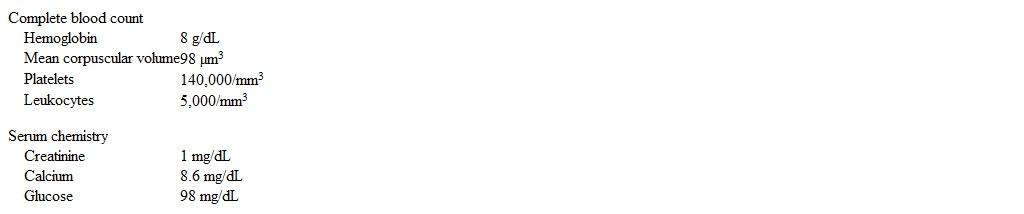 Which of the following is the most appropriate next step in management of this patient?
 (Multiple Choice)
4.9/5 (82)
(82) A 40-year-old woman is brought to the emergency department after an hour of sudden-onset, severe headache and progressive right-sided weakness. She has no chronic medical conditions and takes no medications. Temperature is 38.5 C (101.3 F), blood pressure is 170/100 mm Hg, and pulse is 110/min and regular. The pupils are 5 mm and reactive to light. The neck is supple. Right-sided facial weakness and slurred speech are noted. There is weakness and decreased pinprick sensation in the right upper and lower extremities. Cardiopulmonary examination is normal with no murmurs or gallops. The abdomen is soft, nontender, and without organomegaly. A noncontrast CT scan of the head reveals a left thalamic hemorrhage with no midline shift. Electrocardiogram is normal except sinus tachycardia. Which of the following is most likely to reveal the underlying etiology of this patient's symptoms?
(Multiple Choice)
4.9/5 (74)
(74) A 32-year-old woman, gravida 2 para 1, at 28 weeks gestation comes to the office for a routine prenatal visit. Three weeks ago, she developed a facial rash that has darkened despite the use of lotions. For the past week, the patient has been unable to work at her job at a landscape company due to increasing fatigue and dizziness on standing. She has had no contractions, vaginal bleeding, or leakage of fluid. Fetal movement is normal. The patient has no chronic medical conditions and takes a daily prenatal vitamin and iron supplement. Temperature is 36.7 C (98.1 F), blood pressure is 110/70 mm Hg, and pulse is 72/min. Fetal heart rate is 145/min. Light brown, irregularly shaped macules are arranged in a bilaterally symmetric fashion on the patient's cheeks and nasal bridge. The macules do not affect the nasolabial fold. Laboratory results are as follows:  Which of the following is the best next step in evaluation of this patient?
 (Multiple Choice)
5.0/5 (78)
(78) A 46-year-old woman comes to the office due to pain in her hands and knees. The patient has had pain and stiffness in her hands over the past several months that causes difficulty gripping a coffee cup or holding a pen. Over the past 2 weeks, she has also had pain in her knees. The symptoms are worse in the mornings or after prolonged immobility but gradually improve with physical activity over an hour. The patient has no other medical conditions and takes no medications. She does not use tobacco, alcohol, or illicit drugs, and works as a paralegal. Vital signs are within normal limits. Physical examination shows mild swelling and tenderness of the small joints of the hands. There is a nontender nodule near the right elbow over the back of the forearm. Examination of the remainder of the joints is normal. Erythrocyte sedimentation rate is 45 mm/hr. This patient's current pathologic process is most likely to involve which of the following structures?
(Multiple Choice)
4.9/5 (88)
(88) A 45-year-old man comes to the office after sudden onset of a skin rash and oral lesions with fever. The patient is unable to eat or drink due to pain in his mouth and throat. His wife says that he had a headache, malaise, and joint pain prior to developing the skin lesions. The patient was in generally good health other than an episode of sinusitis for which he was prescribed trimethoprim-sulfamethoxazole 5 days ago. His temperature is 38.3 C (101 F), blood pressure is 110/80 mm Hg, pulse is 92/min, and respirations are 14/min. On examination, conjunctivae in both eyes are inflamed. The patient has extensive erosions involving the oral mucosa. There is also an erythematous, desquamating rash with scattered involvement of the trunk and proximal thighs, as shown in the image below. 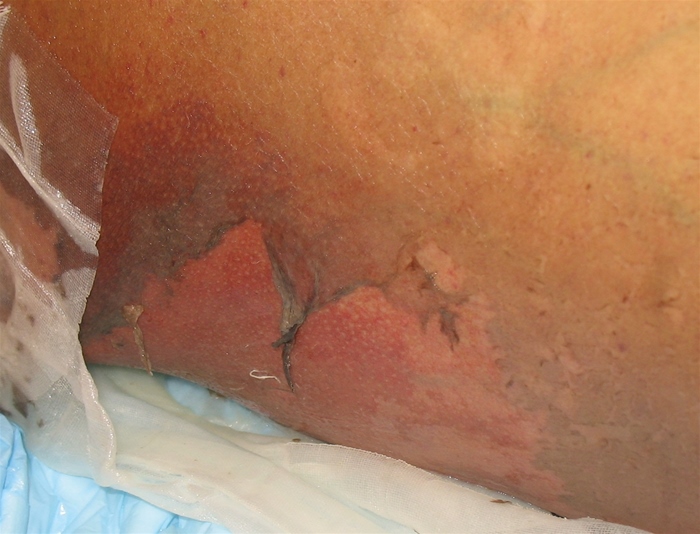 Which of the following is the most likely diagnosis?
 (Multiple Choice)
4.8/5 (84)
(84) A 42-year-old woman comes to the office due to 4 weeks of episodic upper abdominal pain. The patient describes a burning pain that waxes and wanes and is associated with nausea. On several occasions, the pain has awakened her at night, and she has a bloating sensation after meals. The patient has had no dysphagia, regurgitation, weight loss, or change in bowel habits. She emigrated from India 20 years ago and works as a patient care assistant. The patient takes no medications and does not use tobacco or alcohol. She has no family history of gastrointestinal cancer. Vital signs are normal. BMI is 28 kg/m2. The abdomen is soft and nontender with normal bowel sounds and no masses or organomegaly. Stool guaiac is positive. Which of the following is the most likely underlying cause of this patient's symptoms?
(Multiple Choice)
4.9/5 (69)
(69) A 34-year-old woman comes to the physician with dyspnea and severe chest pain. The pain is localized on the left side and increases with inspiration. She also had 1 episode of hemoptysis. Two days ago, the patient flew back to the United States from a trip to Central Asia. She does not use tobacco, alcohol, or illicit drugs. She is sexually active with 1 partner and uses oral contraceptives. Her father died of a myocardial infarction at age 52. Her temperature is 36.7 C (98 F), blood pressure is 110/66 mm Hg, pulse is 106/min, and respirations are 28/min. Which of the following most likely accounts for this patient's chest pain?
(Multiple Choice)
4.8/5 (87)
(87) A 67-year-old man is brought to the emergency department by his wife due to 1 day of worsening fever, chills, productive cough, shortness of breath, and confusion. Five days ago, the patient was diagnosed with influenza. He initially improved but "took a turn for the worse" yesterday. His medical history includes hypertension and osteoarthritis. He smokes half a pack of cigarettes daily and drinks alcohol several times a week. Temperature is 40.5 C (105 F), blood pressure is 95/60 mm Hg, pulse is 106/min, and respirations are 24/min. Pulse oximetry is 90% on room air. Cardiac examination is normal, with the exception of tachycardia. Lung auscultation shows right-sided crackles and bronchial breath sounds. Chest x-ray is shown below. 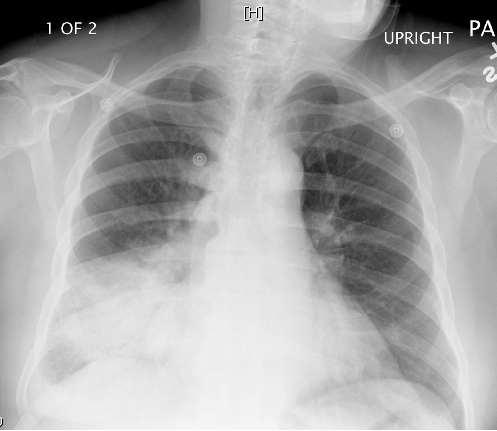 Which of the following is the infectious agent most likely responsible for this patient's condition?
 (Multiple Choice)
5.0/5 (90)
(90) A 40-year-old man is brought to the emergency department after his wife found him alone in a confused state. He suddenly started accusing his wife of cheating on him and conspiring to send him to jail. En route to the hospital, he was drowsy and ataxic with blurry vision. The patient has a history of insomnia, bipolar disorder, and substance use disorder. Temperature is 37.8 C (100 F), blood pressure is 130/80 mm Hg, pulse is 100/min, and respirations are 22/min. The patient is confused, unable to converse meaningfully, and not oriented to time, place, or person. He picks at imaginary objects. Mucous membranes are dry. There is no neck stiffness. The lungs are clear to auscultation bilaterally. Heart sounds are within normal limits. Lower abdominal fullness is present. A Foley catheter is placed, and 600 mL of urine is collected immediately. Which of the following is the most likely diagnosis?
(Multiple Choice)
4.8/5 (83)
(83) A 36-year-old woman comes to the emergency department due to chest pain that started suddenly while she was shopping at the mall. She also has shortness of breath, palpitations, and diaphoresis. The pain is retrosternal and radiates to the left arm. There are no aggravating or relieving factors. She appears to be in mild discomfort. On review of systems, the patient reports having had a runny nose, sore throat, and dry cough for the past 3 days. Her other medical problems include panic attacks treated with paroxetine and dysfunctional uterine bleeding treated with estrogen. Family history is significant for her father's sudden death at age 44 from a heart attack. The patient has a 15-pack-year smoking history. Her blood pressure is 144/90 mm Hg and pulse is 104/min and regular. Her body mass index is 29 kg/m2. Which of the following is the most appropriate initial therapy for this patient?
(Multiple Choice)
4.9/5 (74)
(74) A 34-year-old man comes to the emergency department due to chest pain that started an hour ago. The pain feels like a "substernal pressure," and the patient rates it as severe. He also feels as though his heart "is racing" but has had no shortness of breath, cough, or fever. The patient's medical history is significant for an appendectomy a year ago. He was seen in the emergency department 4 weeks ago for anxiety and palpitations and 6 weeks ago for chest pain that resolved spontaneously. His father died at age 64 due to "some heart problem," and his mother died of ovarian cancer. On physical examination, the patient appears agitated and is sweating profusely. His blood pressure is 160/110 mm Hg, pulse is 110/min, and respirations are 16/min. His pupils are dilated and reactive to light. No heart murmurs are heard. The abdomen is soft and nontender. ECG shows sinus tachycardia with ST elevations in leads V1-V4. What is the most likely explanation for this patient's symptoms?
(Multiple Choice)
4.7/5 (90)
(90) A 64-year-old man is evaluated in the hospital 24 hours after sustaining a pelvic fracture in a motor vehicle collision. Medical history includes chronic obstructive pulmonary disease. The patient has been receiving pain medications, blood transfusion, and prophylactic heparin. For the past 2 hours, he reports increasing shortness of breath. Temperature is 36.9 C (98.4 F), blood pressure is 130/74 mm Hg, pulse is 112/min, and respirations are 24/min. Oxygen saturation is 87% on room air; it increases to 95% with 3 L oxygen. The patient is mildly disoriented. Pupils are small bilaterally. Lung sounds are clear bilaterally, and heart sounds are regular and without murmur or gallop. The abdomen is soft and nontender. The patient can move all 4 extremities, which are warm and pink. Petechiae are noted on the anterior chest and axillary areas. Chest x-ray is unremarkable. ECG shows sinus tachycardia but is otherwise normal. Laboratory results, including arterial blood gas analysis on room air, are as follows: 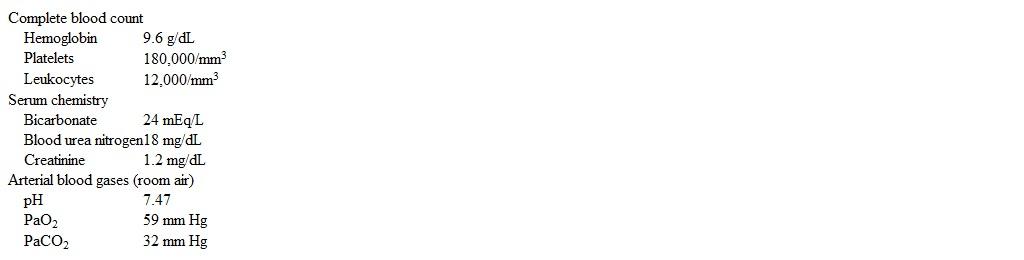 What is the best next step in management?
 (Multiple Choice)
4.8/5 (75)
(75) A 72-year-old man comes to the emergency department after a syncopal episode. The patient briefly lost consciousness an hour ago while getting dressed. He remembers putting on a shirt and tie and the next thing he remembers is finding himself on the floor with his wife at his side. His wife reports that the patient had no abnormal extremity movements or involuntary micturition during the event. The patient has had several episodes of lightheadedness, especially in the morning while shaving, but has never lost consciousness or fallen. He has a history of poorly controlled hypertension and had a recent change in his medications. Other medical conditions include type 2 diabetes mellitus and hyperlipidemia. Blood pressure is 142/86 mm Hg while supine and 134/84 mm Hg while upright, and pulse is 72/min while supine and 80/min while upright. Physical examination shows no carotid bruit and normal jugular venous pressure. There is a grade 2/6 systolic murmur, best heard at the right second intercostal space, and both heart sounds are normal. There is loss of vibration sensation in the feet, and ankle reflexes are absent bilaterally. The remainder of the examination shows no abnormalities. ECG reveals normal sinus rhythm. Which of the following is the most likely cause of this patient's syncope?
(Multiple Choice)
4.7/5 (86)
(86) A 76-year-old man is brought to the hospital from a nursing home due to confusion, high-grade fever, and decreased oral intake. Three days ago, he underwent cystoscopy with removal of a bladder polyp. The patient has a history of benign prostate hyperplasia and recurrent urinary tract infections. Other medical conditions include type 2 diabetes mellitus, hypertension, osteoarthritis, and gout. On admission, the patient has respiratory failure requiring endotracheal intubation and mechanical ventilation. He is resuscitated with intravenous normal saline and treated with broad-spectrum intravenous antibiotics. Ventilator settings are as follows: tidal volume, 370 mL (6 mL/kg of ideal body weight); respiratory rate, 22/min; positive end-expiratory pressure, 5 mm Hg; and FiO2, 70%. Inspiratory plateau pressure is normal (<30 cm H2O). Chest x-ray reveals extensive bilateral alveolar opacities. The results of arterial blood gas analysis are as follows:  Which of the following is the best next step in management of this patient?
 (Multiple Choice)
5.0/5 (78)
(78) A 57-year-old man comes to the emergency department with right arm and leg weakness, first noticed about 2 hours ago when he could not grip a pen. He is now unable to shake hands and walks with a mild limp. The patient has also had a mild, constant headache the past several days that he attributes to stress from a new project at work. His past medical history is significant for hypertension and hyperlipidemia, and he does not smoke or consume alcohol. His blood pressure is 180/100 mm Hg, and pulse is 80/min. There is mild asymmetry of the lower face, decreased muscle strength in the right arm, and positive Babinski sign on the right side. Sensory examination is normal. Blood glucose is 210 mg/dL. ECG shows sinus rhythm with occasional premature ventricular beats. Noncontrast CT scan of the head reveals no abnormalities. Which of the following is the most likely cause of this patient's symptoms?
(Multiple Choice)
4.8/5 (91)
(91) A 65-year-old man comes to the emergency department with substernal chest pain, severe shortness of breath, and diaphoresis that began suddenly 40 minutes ago. The pain radiates to his left arm and does not remit with sublingual nitroglycerin. The patient has vomited twice since the pain started. ECG shows 2-mm ST elevations in the anterior leads. On physical examination, the patient's temperature is 36.9 C (98.4 F), blood pressure is 110/70 mm Hg, pulse is 60/min, respirations are 32/min, and oxygen saturation is 90% on 4 L/min oxygen by nasal canula. Cardiac examination shows an S3. Lung examination shows basilar crackles that extend halfway up the lung fields bilaterally. He is given 325 mg of aspirin, 600 mg of clopidogrel, and 80 mg of atorvastatin. Which of the following is the best next step in management of this patient?
(Multiple Choice)
4.9/5 (81)
(81) An 11-year-old boy with sickle cell disease is brought to the emergency department with worsening shortness of breath, weakness, and fatigue over the past 3 days. The patient has no fever, cough, or chest pain. He has had many hospitalizations for treatment of acute pain and a hospitalization for acute chest syndrome. Temperature is 36.7 C (98 F). Pulse oximetry is 98% on room air. Physical examination shows a pale, tired-appearing boy. Cardiac examination reveals tachycardia; a 3/6 systolic murmur is heard throughout the precordium. The lungs are clear to auscultation. The abdomen is soft and nontender with no palpable liver or spleen. Laboratory results are as follows:  Which of the following is the most likely cause of this patient's symptoms?
 (Multiple Choice)
4.7/5 (79)
(79) A 26-year-old man comes to the emergency department due to sudden onset of severe, colicky, left-sided flank pain that radiates to the scrotum. He also has nausea, vomiting, and dark urine. The patient has never before had these symptoms. Examination shows no abnormalities. Noncontrast helical CT scan reveals a 5-mm radiopaque stone in the left upper ureter. Laboratory results are as follows:  Urinalysis shows hematuria but no casts. Which of the following is the most likely cause of this patient's symptoms?
 (Multiple Choice)
4.9/5 (71)
(71) A 27-year-old man comes to the emergency department (ED) with unremitting nose bleeding. He had a similar bleeding episode one year ago that was stopped in the ED. He works as a computer programmer and has a sedentary lifestyle. He drinks alcohol on social occasions but does not smoke or use illicit substances. On physical examination, there are several ruby-colored papules on his lips that blanch partially with pressure. Digital clubbing is also present. His abdomen is soft and non-tender. The liver span is 8 cm and the spleen is not palpable. Laboratory results are as follows:  Which of the following is most likely responsible for this patient's increased hematocrit?
 (Multiple Choice)
4.7/5 (71)
(71) Showing 641 - 660 of 1702
 Prev
- 1
- ...
- 2
- ...
- 3
- ...
- 4
- ...
- 5
- ...
- 6
- ...
- 7
- ...
- 8
- ...
- 9
- ...
- 10
- ...
- 11
- ...
- 12
- ...
- 13
- ...
- 14
- ...
- 15
- ...
- 16
- ...
- 17
- ...
- 18
- ...
- 19
- ...
- 20
- ...
- 21
- ...
- 22
- ...
- 23
- ...
- 24
- ...
- 25
- ...
- 26
- ...
- 27
- ...
- 28
- ...
- 29
- ...
- 30
- ...
- 31
- ...
- 32
- ...
- 33
- ...
- 34
- ...
- 35
- ...
- 36
- ...
- 37
- ...
- 38
- ...
- 39
- ...
- 40
- ...
- 41
- ...
- 42
- ...
- 43
- ...
- 44
- ...
- 45
- ...
- 46
- ...
- 47
- ...
- 48
- ...
- 49
- ...
- 50
- ...
- 51
- ...
- 52
- ...
- 53
- ...
- 54
- ...
- 55
- ...
- 56
- ...
- 57
- ...
- 58
- ...
- 59
- ...
- 60
- ...
- 61
- ...
- 62
- ...
- 63
- ...
- 64
- ...
- 65
- ...
- 66
- ...
- 67
- ...
- 68
- ...
- 69
- ...
- 70
- ...
- 71
- ...
- 72
- ...
- 73
- ...
- 74
- ...
- 75
- ...
- 76
- ...
- 77
- ...
- 78
- ...
- 79
- ...
- 80
- ...
- 81
- ...
- 82
- ...
- 83
- ...
- 84
- ...
- 85
- ...
- 86
- ...
- Next

Filters
- Essay(0)
- Multiple Choice(0)
- Short Answer(0)
- True False(0)
- Matching(0)