


 Chat with AI
Exam 1: Medicine

Exam 1: Medicine2 k Questions
Exam 2: Pediatric723 Questions
Exam 3: Psychiatry336 Questions
Exam 4: Surgery563 Questions
Exam 5: Obstetrics & Gynecology469 Questions
Select questions type


A 38-year-old woman comes to the emergency department due to progressive shortness of breath over the past 2 weeks. The patient states that she can hardly move without gasping for breath. She delivered a healthy baby 8 months ago, and her pregnancy was uncomplicated. For the last 6 months, the patient has experienced palpitations, poor sleep, and unintentional weight loss. She has no known chronic medical conditions. The patient is a lifetime nonsmoker, does not consume alcohol, and does not use illicit drugs or supplements. Her mother has rheumatoid arthritis. Blood pressure is 145/75 mm Hg and pulse is 110/min and regular. Oxygen saturation is 93% on room air. The neck appears full. The skin is warm and moist. Crackles are heard at the bilateral lung bases. The apical impulse is strong, and a 2/6 midsystolic murmur is heard in the second left intercostal space. There is 1+ symmetric peripheral edema. ECG shows sinus tachycardia. Further investigations are likely to demonstrate which of the following?
(Multiple Choice)
4.8/5  (96)
(96) A 36-year-old woman comes to the emergency department due to weakness and dizziness on and off over the last 3 days. She has had no chest pain or shortness of breath. The patient has no significant medical history. She does not use tobacco, alcohol, or illicit drugs. The patient's father had a myocardial infarction at age 68. BMI is 23 kg/m2. Physical examination shows normal breath sounds. There are no heart murmurs. The extremities are normal. ECG is shown in the exhibit. Bedside transthoracic echocardiogram shows no structural abnormalities. Which of the following is the most appropriate next diagnostic study for this patient?
(Multiple Choice)
4.7/5 (83)
(83) A 42-year-old man is admitted to the hospital after sustaining fractures of his right femur and tibia in a motor vehicle collision. The patient becomes agitated, hypervigilant, and paranoid 12 hours after admission. He repeatedly tells the nurses that he can hear people in the corridor making insulting remarks about him. When hospital staff check the area near the patient's room, no one is found. Medical history is unremarkable, but psychiatric history is significant for cocaine, marijuana, and alcohol misuse. He has smoked 2 packs of cigarettes a day for the past 10 years. On examination, the patient is alert and oriented. Temperature is 37.2 C (99 F), blood pressure is 135/87 mm Hg, pulse is 85/min, and respirations are 18/min. He is slightly tremulous and diaphoretic. Within 2 days, the patient's hallucinations resolve, and his behavior returns to baseline. Soon after, he is discharged home. Which of the following is the most likely diagnosis in this patient?
(Multiple Choice)
4.7/5 (86)
(86) A 44-year-old psychology professor with a history of chronic rheumatoid arthritis comes to the office for a follow-up examination. She is currently taking prednisone and infliximab, a regimen that has successfully stabilized her condition. She enjoys swimming 3 or 4 times a week, which helps with her strength and keeps her weight on target. Temperature is 37.2 C (99 F), blood pressure is 110/70 mm Hg, pulse is 78/min, and respirations are 16/min. The patient weighs 65 kg (143.3 lb) and is 162.5 cm (5 ft 4 in) tall. Physical examination reveals no significant changes. Toward the end of the visit, the patient mentions that a family friend who suffers with chronic pain secondary to a spinal fusion has had a good response to acupuncture. She would like to try acupuncture instead of the medications she is taking currently. Which of the following is the most appropriate response to this patient's request?
(Multiple Choice)
4.7/5 (83)
(83) A 42-year-old woman comes to the office with worsening fatigue and dark yellow urine. She also has anorexia, nausea, mild abdominal pain, and malaise. The patient is uncertain as to when her symptoms began but felt normal during her vacation 4 weeks ago. She has no known medical problems and does not take any medications. The patient does not use alcohol, tobacco, or illicit drugs. She has had unprotected sexual intercourse with 6 different partners within the past year. The patient does not remember getting a hepatitis B vaccination. Laboratory results are as follows: 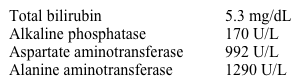 Which of the following is the most appropriate test to diagnose hepatitis B infection in this patient?
 (Multiple Choice)
4.9/5 (79)
(79) A 62-year-old woman comes to the office for follow-up of diabetes treatment. She has had type 2 diabetes mellitus for 10 years, which is managed with oral metformin twice daily and insulin glargine at bedtime. The patient has no chest pain, dizziness, sweating, polyuria, or palpitations. She checks her blood glucose level every morning and has had values of 75-132 mg/dL over the last month. Medical history is notable for hypertension and mild intermittent asthma, for which the patient takes lisinopril, amlodipine, and albuterol as needed. Blood pressure is 128/72 mm Hg and pulse is 79/min. BMI is 41 kg/m2. Laboratory results show a random glucose level of 298 mg/dL and hemoglobin A1c of 8.1%. Which of the following best explains the suboptimal glycemic control in this patient?
(Multiple Choice)
4.8/5 (85)
(85) A 50-year-old woman comes to the office after 4 weeks of nonproductive cough. The cough is constant throughout the day and "very annoying." The patient was diagnosed with nonischemic cardiomyopathy 2 months ago when she was hospitalized with shortness of breath and lower extremity edema. She reports marked improvement with breathing and no nighttime awakenings. The patient has no fever, sore throat, rhinorrhea, chest pain, or hemoptysis. Medications include carvedilol, lisinopril, spironolactone, and torsemide. The patient smoked cigarettes from age 25-30, and she does not use alcohol or illicit drugs. Her temperature is 36.7 C (98 F), pulse is 78/min, blood pressure is 132/74 mm Hg, and respirations are 14/min. BMI is 32 kg/m2. The patient's oropharynx is clear, jugular veins are flat when she is supine, lungs are clear on auscultation, and no peripheral edema is present. A faint systolic murmur is heard at the apex. Chest x-ray reveals mild cardiomegaly and clear lung fields. Which of the following is the best next step in managing this patient's current symptoms?
(Multiple Choice)
4.9/5 (81)
(81) A 32-year-old man is intubated and mechanically ventilated after an opioid drug overdose. He is sedated and passive. The ventilator triggers 14 breaths per minute, each delivering 500 mL of tidal volume at a peak flow rate of 60 L/min. An inspiratory hold is performed for 2 seconds following delivery of the tidal volume, and the airway pressure is measured to be 30 cm H2O. 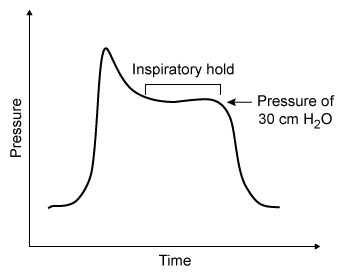 The measured pressure most likely reflects which of the following?
 (Multiple Choice)
4.9/5 (71)
(71) A 42-year-old mildly overweight man is being evaluated for his second episode of deep vein thrombosis in 2 years. Both episodes appear to have been unprovoked. He has no recent prolonged immobility, long-distance travel, or lower-extremity trauma. The patient has no past medical history of diabetes, cancer, or liver disease. A thrombophilia workup is ordered. Use of which of the following drugs is most likely to lead to low protein S levels?
(Multiple Choice)
4.7/5 (78)
(78) A 21-year-old man is brought to the emergency department due to dizziness and palpitations that started abruptly an hour ago. He has had similar episodes provoked by fatigue or strong emotions. The patient can usually stop the episodes by squatting and taking a deep breath. However, this time these actions did not work. Blood pressure is 65/40 mm Hg and pulse is 240/min. He is diaphoretic and his extremities are cold. ECG rhythm strip shows a regular, narrow-complex tachycardia. Which of the following is the best next step in management of this patient?
(Multiple Choice)
4.7/5 (74)
(74) A 26-year-old man undergoing chemotherapy for metastatic seminoma comes to the emergency department with fever and chills for the last 24 hours. He has no chest pain, shortness of breath, cough, abdominal pain, diarrhea, or skin rash. His temperature is 38.9 C (102 F), blood pressure is 118/70 mm Hg, pulse is 102/min, and respirations are 18/min. Examination shows mucosal pallor. There is mild gingival erythema but no evidence of bleeding. The cardiopulmonary examination is normal. The abdomen is soft and nontender to palpation. The perianal area is without lesions. Laboratory results are as follows: 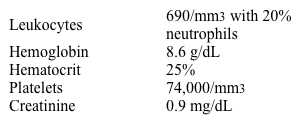 Chest x-ray shows no infiltrates. Urinalysis is normal. The patient is admitted to the hospital. Which of the following is the most appropriate initial therapy for this patient?
 (Multiple Choice)
4.9/5 (80)
(80) Which of the following antifungal agents can be used to treat this patient's condition?
(Multiple Choice)
5.0/5 (79)
(79) A 63-year-old man comes to the office due to 2 days of increasing scrotal pain. The pain is worse with touch or movement and is not relieved by over-the-counter ibuprofen. The patient also has mild burning on urination and increased urinary frequency. He has a history of hypertension, erectile dysfunction, and type 2 diabetes mellitus. He takes tadalafil but no other medications. The patient is married and sexually active with his wife. He does not use tobacco or alcohol. Temperature is 38.1 C (100.8 F), blood pressure is 130/75 mm Hg, and pulse is 86/min. Physical examination shows a tender mass in the left scrotum that is mildly erythematous. Cremasteric reflex is intact. No urethral discharge is present. Which of the following is the most likely cause of this patient's current condition?
(Multiple Choice)
4.9/5 (75)
(75) A 31-year-old man comes to the office due to a week of low-grade fever, dry cough, and right-sided chest pain. The pain is intermittent, sharp, and worse with deep inhalation or cough. The patient also notes mild "achiness" in his knees and ankles that started around the same time. He does not use tobacco, alcohol, or illicit drugs. The patient is an Army officer, and he returned to Connecticut 2 weeks ago after completing desert training exercises in Arizona. He does not know if other participants developed similar symptoms. Temperature is 37.8 C (100 F), blood pressure is 120/80 mm Hg, pulse is 78/min, and respirations are 16/min. Lung auscultation shows right-sided crackles. No joint swelling or tenderness is present, but there are erythematous, tender nodules on the bilateral shins. Chest x-ray reveals a right lower lobe infiltrate with a prominent right hilum. Which of the following is most likely causing this patient's condition?
(Multiple Choice)
4.8/5 (93)
(93) A 19-year-old woman comes to the emergency department due to a 4-5-day history of chest discomfort that radiates to the nuchal fold and shoulders bilaterally. The patient took over-the-counter ibuprofen and had some pain relief. She reports associated fatigue and bilateral knee pain yesterday, which has since resolved. The patient has a history of systemic lupus erythematosus, for which she takes hydroxychloroquine. She does not smoke or take illicit drugs. The patient has no family history of cardiovascular diseases. Temperature is 38.3 C (100.9 F), and blood pressure is 110/70 mm Hg in the upper extremities bilaterally. Examination shows an erythematous rash over the cheeks and the nasal bridge. Pain is not reproducible with chest palpation. A superficial scratchy sound is heard between S1 and S2. Breath sounds are normal. ECG reveals sinus tachycardia at 103/min and diffuse T wave inversion. Laboratory results are as follows:  Serum troponin drawn on presentation is <0.01 ng/dL. Which of the following is the most likely explanation for this patient's symptoms?
 (Multiple Choice)
4.9/5 (72)
(72) A 61-year-old farmer is brought to the emergency department after he was found unresponsive in the barn. The patient was last seen appearing normal 3 hours ago. Medical history is unavailable. The paramedics administered naloxone en route without any subsequent change in mental status. Blood pressure is 190/110 mm Hg, pulse is 58/min, and respirations are 10/min and irregular. On physical examination, he does not respond to painful stimuli. There is no evidence of trauma to the head or neck. The pupils are midsized and do not respond to light. Cardiopulmonary examination is normal. The arms and legs are rigid and held straight out; the toes are pointing downward. Bilateral extensor plantar reflexes are present. Which of the following is the most likely diagnosis in this patient?
(Multiple Choice)
4.8/5 (85)
(85) A 35-year-old man comes to the office due to a one-month history of weight gain and facial edema. The facial edema resolves at the end of the day, but ankle edema develops. Temperature is 37.2 C (99 F), blood pressure is 138/76 mm Hg, pulse is 80/min, and respirations are 16/min. Examination shows 2+ ankle edema. Laboratory studies show: 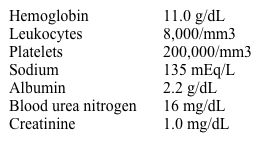 Urinalysis:
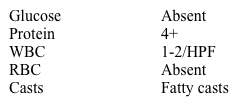 This patient is most likely at risk for developing which of the following?
Urinalysis:
This patient is most likely at risk for developing which of the following? (Multiple Choice)
4.9/5 (76)
(76) A 28-year-old graduate student comes to the office for follow-up of chest pain and poor sleep. The patient continues to experience intermittent, nonradiating chest pain, especially in the evenings when he feels "tired." He describes difficulty relaxing at night and takes up to an hour to fall asleep when he feels the chest discomfort. The patient says, "I'm under a lot of pressure to work on my dissertation," and he is concerned that his chest pain and poor sleep are affecting his productivity. The patient has no shortness of breath or systemic symptoms. He has had similar symptoms for the past year and has been evaluated with repeated ECG and a complete laboratory and radiographic workup; all were negative. Despite reassurance from the physician, the patient continues to be excessively worried about his symptoms. His appetite is normal, and he denies feeling depressed. The patient's medications include naproxen as needed. He does not use alcohol or illicit drugs. Physical examination is normal. Which of the following medications would be most appropriate for this patient's condition?
(Multiple Choice)
5.0/5 (79)
(79) A 42-year-old woman comes to the office for follow-up due to abnormal liver function studies. The patient reports no symptoms. Medical history is significant for primary hypertension, and she has been taking amlodipine for >5 years. Family history is negative for liver disease. The patient drinks a glass of wine 3 or 4 times a week but denies smoking or illicit drug use. Temperature is 37.5 C (99.5 F), blood pressure is 146/80 mm Hg, and heart rate is 80/min. BMI is 28 kg/m2. Scleral icterus and palmar erythema are absent. Cardiopulmonary and abdominal examinations are both unremarkable. Laboratory studies are as follows: 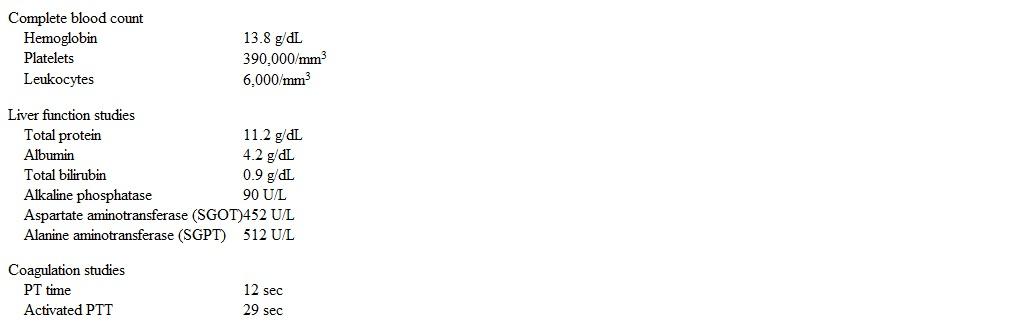 Initial testing 3 months ago showed similar results. Which of the following most likely explains this patient's persistent laboratory abnormalities?
 (Multiple Choice)
4.8/5 (85)
(85) A 34-year-old man comes to the office during summer due to intensely pruritic lesions on his right foot. The patient has no chronic medical conditions and has never had similar symptoms before. He smokes a pack of cigarettes daily and drinks alcohol on social occasions. The patient works as a landscaper and recently went to a company barbeque lunch. His vital signs are normal. Physical examination findings are shown below. 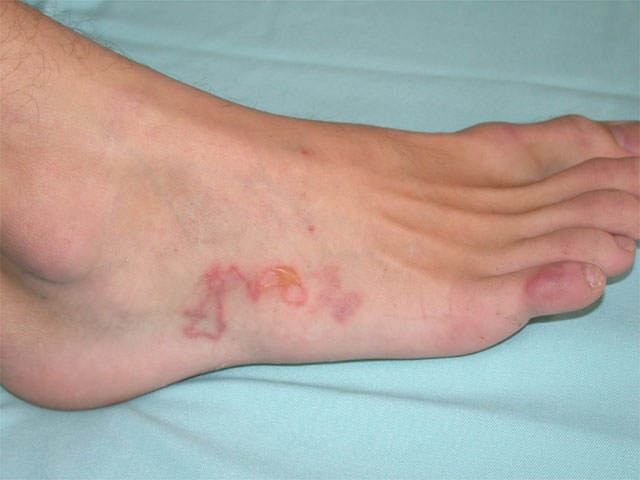 Which of the following most likely occurred before the patient developed these symptoms?
 (Multiple Choice)
4.9/5 (66)
(66) Showing 21 - 40 of 1702
 Prev
- 1
- ...
- 2
- ...
- 3
- ...
- 4
- ...
- 5
- ...
- 6
- ...
- 7
- ...
- 8
- ...
- 9
- ...
- 10
- ...
- 11
- ...
- 12
- ...
- 13
- ...
- 14
- ...
- 15
- ...
- 16
- ...
- 17
- ...
- 18
- ...
- 19
- ...
- 20
- ...
- 21
- ...
- 22
- ...
- 23
- ...
- 24
- ...
- 25
- ...
- 26
- ...
- 27
- ...
- 28
- ...
- 29
- ...
- 30
- ...
- 31
- ...
- 32
- ...
- 33
- ...
- 34
- ...
- 35
- ...
- 36
- ...
- 37
- ...
- 38
- ...
- 39
- ...
- 40
- ...
- 41
- ...
- 42
- ...
- 43
- ...
- 44
- ...
- 45
- ...
- 46
- ...
- 47
- ...
- 48
- ...
- 49
- ...
- 50
- ...
- 51
- ...
- 52
- ...
- 53
- ...
- 54
- ...
- 55
- ...
- 56
- ...
- 57
- ...
- 58
- ...
- 59
- ...
- 60
- ...
- 61
- ...
- 62
- ...
- 63
- ...
- 64
- ...
- 65
- ...
- 66
- ...
- 67
- ...
- 68
- ...
- 69
- ...
- 70
- ...
- 71
- ...
- 72
- ...
- 73
- ...
- 74
- ...
- 75
- ...
- 76
- ...
- 77
- ...
- 78
- ...
- 79
- ...
- 80
- ...
- 81
- ...
- 82
- ...
- 83
- ...
- 84
- ...
- 85
- ...
- 86
- ...
- Next

Filters
- Essay(0)
- Multiple Choice(0)
- Short Answer(0)
- True False(0)
- Matching(0)