


 Chat with AI
Exam 1: Medicine

Exam 1: Medicine2 k Questions
Exam 2: Pediatric723 Questions
Exam 3: Psychiatry336 Questions
Exam 4: Surgery563 Questions
Exam 5: Obstetrics & Gynecology469 Questions
Select questions type


A 21-year-old man is brought to the emergency department by his family after a witnessed generalized tonic-clonic seizure. His sister says that the patient has never had a previous seizure but has had progressive headaches, fever, nasal congestion, and rhinorrhea over the last 3 weeks. He has no chronic medical problems and does not use alcohol, tobacco, or illicit drugs. Temperature is 38.9 C (102 F), blood pressure is 130/85 mm Hg, and pulse is 96/min. The patient is drowsy and postictal. CT scan of the head with intravenous contrast reveals a 3-cm ring-enhancing lesion in the left frontal lobe. There are air-fluid levels and mucosal edema in the paranasal sinuses. Rapid HIV testing is negative. Tissue biopsy of the brain lesion is most likely to demonstrate which of the following?
(Multiple Choice)
4.8/5  (75)
(75) A 45-year-old man from Guatemala comes to the office due to persistent nausea and vomiting of partially digested food. He has had these symptoms for the past 1 month. He has also lost 2.3 kg (5 lb) during this period of time. His appetite is good, but he mentions early satiety. He has not had any hematemesis, black stools, difficulty swallowing, and chest pain. Other medical problems include type 2 diabetes for the past 1 year and a suicide attempt 3 months ago in which he ingested acid. He has a history of peptic ulcer disease and often takes antacids for heartburn. He drinks alcohol and smokes one pack of cigarettes daily. His temperature is 36.8 C (98.2 F), blood pressure is 110/65 mm Hg, pulse is 110/min, and respirations are 16/min. Mucous membranes are dry. Abdominal examination shows succussion splash on the epigastrium. Which of the following is the most likely diagnosis?
(Multiple Choice)
4.9/5 (86)
(86) A 28-year-old woman comes to the office due to persistent nasal congestion and stuffiness. The patient has a constant sensation of dripping in the back of her throat and states that food has tasted bland to her recently. A year ago, she came to the emergency department due to severe wheezing after taking naproxen for menstrual cramping. The patient has no history of head trauma. Family history is significant for asthma in her sister. She does not smoke cigarettes but occasionally smokes marijuana. Which of the following is the most likely cause of this patient's current symptoms?
(Multiple Choice)
4.7/5 (69)
(69) A 62-year-old man comes to the office due to 2 months of progressive weakness, fatigue, and dyspnea on exertion. His daughter adds that he has not taken care of himself since his wife's death a year ago and spends most of his time alone drinking alcohol. Physical examination shows mucosal pallor and several petechiae. Laboratory results are as follows: 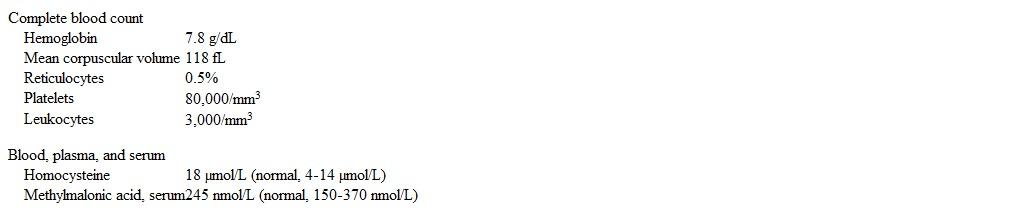 Peripheral blood smear results are shown below.
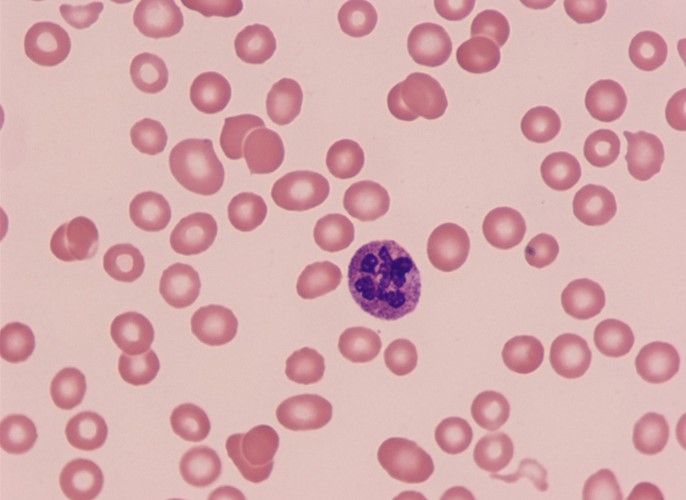 Which of the following is the most likely cause of this patient's condition?
Peripheral blood smear results are shown below.
Which of the following is the most likely cause of this patient's condition? (Multiple Choice)
4.9/5 (74)
(74) A 16-year-old boy comes to the office in October due to right knee swelling. The symptoms began yesterday following soccer practice. The patient recalls no specific injury. He has mild associated stiffness. Over the last several months, he has experienced fatigue with occasional flulike illnesses and pain occurring in variable joints. The patient spent the summer at a soccer camp in Maine. He is sexually active with his girlfriend and uses condoms. Vital signs are normal. The patient can bear weight and has a grossly normal gait. Examination of the right knee shows palpable warmth and a large effusion. It is tender to palpation. Range-of-motion testing shows decreased flexion of the right knee compared with the left. All other joints are normal. Plain radiographs reveal no bony deformity. Aspiration yields yellow, translucent fluid with a leukocyte count of 20,000/mm3 (50% neutrophils) and no organisms on Gram stain. Which of the following is the most likely cause of this patient's knee swelling?
(Multiple Choice)
4.8/5 (83)
(83) A 66-year-old man comes to the physician for regular follow-up. He experiences mild fatigue but otherwise has no complaints. The patient has a history of hypertension, type 2 diabetes mellitus, hyperlipidemia, chronic kidney disease, and ischemic cardiomyopathy. His temperature is 36.7 C (98 F), blood pressure is 122/70 mm Hg, and pulse is 82/min. Physical examination shows moist mucous membranes. There is a 2/6 holosystolic murmur at the apex that is unchanged from a previous finding. He has trace bilateral lower-extremity edema. Laboratory results are as follows: 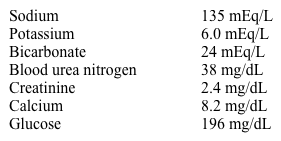 Two months ago, his creatinine was 2.3 mg/dL. Electrocardiogram shows normal sinus rhythm without other abnormalities. Which of the following is the best next step in management of this patient?
 (Multiple Choice)
4.7/5 (61)
(61) In a large population with an almost negligible growth rate and minimal migration, the incidence of type 2 diabetes mellitus is 3 cases per 1,000 individuals a year, and has been stable for the last 30 years. However, the prevalence of type 2 diabetes mellitus has increased progressively over the same period. Which of the following is the most likely explanation for this trend over time?
(Multiple Choice)
4.8/5 (73)
(73) A 30-year-old man comes to the office due to 2 days of right arm pain, swelling, and heaviness. The symptoms are worse with activity or arm elevation above the head and improve with rest. The patient is an avid weight lifter and plays recreational baseball. Several hours prior to the onset of symptoms, he pitched 6 innings in a baseball game. He has no prior medical conditions and takes no medications. The patient does not use tobacco, alcohol, or illicit drugs. Vital signs are normal. Examination shows swelling and redness of the right arm from the elbow to the shoulder. Capillary refill is normal. What is the most likely cause of this patient's current symptoms?
(Multiple Choice)
4.7/5 (78)
(78) A 37-year-old woman comes to the clinic due to occasional episodes of nocturnal substernal chest pain that wake her during sleep. The pain is occasionally associated with sweating, palpitations, and nausea but no dyspnea. The pain episodes resolve spontaneously after 10-15 minutes. She leads a sedentary lifestyle but states that she can climb 2 flights of stairs without any discomfort. The patient has no history of hypertension or diabetes. She smokes half a pack of cigarettes daily. She does not use alcohol or illicit drugs. Blood pressure is 134/70 mm Hg, pulse is 75/min and regular, and respirations are 14/min. There is no jugular venous distension. The thyroid is normal. There is no carotid bruit. Heart sounds are normal without murmurs. Lungs are clear. Extremities have no edema. Extended ambulatory ECG monitoring shows transient ST-segment elevation in leads I, aVL, and V4-V6 during her episodes of pain. She is referred for coronary angiogram, which shows no significant coronary obstruction. Which of the following is the best treatment for this patient?
(Multiple Choice)
4.8/5 (81)
(81) A 25-year-old woman comes to the office due to intermittent double vision, dizziness, and unsteady gait for the last several days. During the past year, she has had several episodes of numbness and dizziness, and her symptoms were attributed to anxiety. She does not use tobacco or alcohol. Her brother died of subarachnoid hemorrhage. Blood pressure is 130/70 mm Hg and pulse is 76/min. On attempted left gaze, her left eye abducts and exhibits horizontal nystagmus, but her right eye remains stationary. When she attempts to look to the right, her right eye abducts and exhibits horizontal nystagmus, but her left eye remains stationary. The patient is able to converge both eyes without any associated nystagmus. Which of the following is the most likely site of the lesion in this patient?
(Multiple Choice)
5.0/5 (77)
(77) A 46-year-old man comes to the office to discuss type 2 diabetes mellitus and obesity. The patient has poorly controlled diabetes despite multiple oral medications and previous attempts at dietary change. He reports that his endocrinologist has recommended insulin therapy, but he has declined because he wishes to avoid injected medications. The patient says, "I found a new diet on the Internet that I am thinking of trying. I know my weight is bad for me, but if I can get the weight off, maybe I won't have to go on insulin." Which of the following is the most appropriate response to this patient's statement?
(Multiple Choice)
5.0/5 (84)
(84) A group of infectious disease specialists interested in the rising prevalence of multidrug-resistant tuberculosis conducts a study to determine predisposing risk factors for the condition. First, they identify 40 patients with multidrug-resistant (MDR) tuberculosis and 64 with pansensitive tuberculosis who were admitted to the hospital over the last 5 years. They then review the patients' past medical records and consider demographic characteristics, previous anti-tuberculosis treatment, HIV status, and major comorbidities as potential risk factors for MDR tuberculosis development. They then compare the frequencies of these potential risk factors between the groups. Which of the following best describes the study design being used?
(Multiple Choice)
4.8/5 (83)
(83) A 35-year-old Caucasian female presents to the office due to a self-palpated breast mass. After the appropriate work-up, fine-needle aspiration (FNA) of the mass is performed. The results of the FNA return as negative. As you are explaining the test result, the patient asks, "What are the chances that I really do not have breast cancer?" Which of the following values best addresses this patient's question?
(Multiple Choice)
4.9/5 (91)
(91) A 21-year-old woman comes to the office for follow-up of a head injury that occurred while playing lacrosse. The patient is a goalie and was hit in the head with the ball yesterday. She had an episode of vomiting at the time but did not lose consciousness. The patient was brought to the emergency department, where she was noted to be confused and unable to recall the events associated with the competition or her injury. Her family reports that she has never had a serious head injury and has no medical concerns. A head CT scan was unremarkable; the patient's neurologic examination was otherwise normal; and she was discharged home with close observation by family members. Today, she has a headache that has responded to naproxen. The patient's neurologic examination is normal, and she remembers 3 of 3 words after five minutes. She would like to know when she can begin to practice sports again. Which of the following is the best response?
(Multiple Choice)
5.0/5 (67)
(67) A 62-year-old woman comes to the office to follow up on elevated blood pressure. Her blood pressure was 152/92 mm Hg a month ago; she has been monitoring it at home since then, with an average blood pressure of 148/88 mm Hg. The patient's only other medical condition is osteoporosis, diagnosed six months ago and treated with vitamin D, calcium, and alendronate. Today in the office her blood pressure is 155/90 mm Hg on the left arm and 150/90 mm Hg on the right arm; pulse is 70/min. Physical examination is normal. Complete blood count, serum creatinine, serum electrolytes, TSH, and urinalysis are normal. ECG is normal. Which of the following is the best next step in management of this patient's blood pressure?
(Multiple Choice)
4.9/5 (79)
(79) A 72-year-old man comes to the office for a health maintenance examination. The patient feels well and does not report any symptoms, aside from occasional pain in his knees. Medical history is significant for hypertension and osteoarthritis, for which he takes hydrochlorothiazide, lisinopril, and as-needed acetaminophen. The patient has a 30-pack-year smoking history but quit 15 years ago. He does not use alcohol. He is a retired plumber and lives with his wife in a retirement community. During the visit, the patient reveals that a friend recently had an abdominal aortic aneurysm repair and inquires whether he should be screened for the same disorder. Which of the following is the most appropriate next step in management of this patient?
(Multiple Choice)
4.8/5 (81)
(81) A 70-year-old man is brought to the emergency department due to 3 hours of intense, constant chest and neck pain that radiates to the interscapular area. The patient describes the pain as sharp. He has never experienced this type of pain before. His other medical problems include a 20-year history of hypertension and a 10-year history of type 2 diabetes mellitus. He does not use tobacco or alcohol. The patient appears anxious and uncomfortable. His blood pressure is 189/110 mm Hg in the right arm and 181/112 mm Hg in the left, pulse is 105/min, and respirations are 18/min. Examination shows an early decrescendo diastolic murmur best heard at the left sternal border of the fourth intercostal space. ECG shows sinus tachycardia, voltage criteria for left ventricular hypertrophy, and T-wave inversions in leads V5 and V6. Serum creatinine is 2.1 mg/dL. Which of the following is the best next step in management of this patient?
(Multiple Choice)
4.9/5 (77)
(77) A 19-year-old man is brought to the emergency department due to a seizure. The patient's roommate was awakened by a noise 30 minutes ago and found him "convulsing" on the bed. Emergency medical services were called, and the patient had another brief seizure episode in the ambulance. He has no history of seizure or other medical conditions. The roommate says the patient went to bed late last night after a fraternity party. Temperature is 37.2 C (99 F), blood pressure is 148/90 mm Hg, and pulse is 94/min. On physical examination, the patient is somnolent, groans to painful physical stimuli, and does not follow instructions. There is a small tongue laceration. While being examined, the patient has another generalized tonic-clonic seizure, which terminates after administration of intravenous lorazepam. Which of the following is the most appropriate next step in the management of this patient?
(Multiple Choice)
4.7/5 (88)
(88) A 65-year-old woman comes to the office due to a 2-month history of shortness of breath and lower extremity edema. The patient reports no chest pain, palpitations, or syncope. She takes chlorthalidone and lisinopril for chronic hypertension. The patient has a sedentary lifestyle. She drinks 1-2 glasses of wine with dinner most days of the week. Blood pressure is 145/94 mm Hg and pulse is 80/min. BMI is 40 kg/m2. Estimated jugular venous pressure is 9 cm H2O. Cardiac examination reveals a regular rate and rhythm with no murmurs. Crackles are heard bilaterally in the lung bases. Bilateral pitting pedal edema is present. Chest x-ray shows a normal cardiac silhouette with pulmonary vascular congestion. Echocardiogram demonstrates left atrial enlargement, mild concentric left ventricular (LV) hypertrophy, mild mitral regurgitation, and no pericardial effusion. LV ejection fraction is 65% and there are no wall motion abnormalities. Serum creatinine is 0.8 mg/dL. Serum lipid studies show a total cholesterol of 208 mg/dL, HDL cholesterol of 35 mg/dL, and LDL cholesterol of 136 mg/dL. Which of the following is the strongest predisposing factor to this patient's current condition?
(Multiple Choice)
4.9/5 (95)
(95) An 84-year-old man comes to the emergency department with a 4-month history of dyspnea that recently has been getting worse. The patient is unable to lie flat and has been sleeping in a chair. Medical history includes hypertension and type 2 diabetes mellitus. He was hospitalized with an acute myocardial infarction a year ago but has not followed up with a physician. Blood pressure is 144/82 mm Hg and pulse is 98/min and regular. Physical examination shows bilateral lower extremity pitting edema. The point of maximal impulse is displaced to the left, and a holosystolic murmur is heard at the apex. Lung examination shows bibasilar crackles. ECG reveals sinus rhythm with nonspecific ST-segment and T-wave changes. Echocardiographic evaluation and cardiac catheterization are performed to determine cardiac index, systemic vascular resistance, and left ventricular end-diastolic volume. Which of the following patterns is most likely to be seen in this patient?
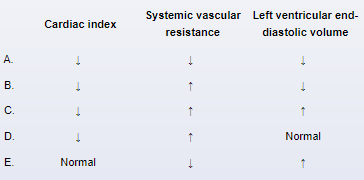
(Multiple Choice)
4.8/5 (81)
(81) Showing 661 - 680 of 1702
 Prev
- 1
- ...
- 2
- ...
- 3
- ...
- 4
- ...
- 5
- ...
- 6
- ...
- 7
- ...
- 8
- ...
- 9
- ...
- 10
- ...
- 11
- ...
- 12
- ...
- 13
- ...
- 14
- ...
- 15
- ...
- 16
- ...
- 17
- ...
- 18
- ...
- 19
- ...
- 20
- ...
- 21
- ...
- 22
- ...
- 23
- ...
- 24
- ...
- 25
- ...
- 26
- ...
- 27
- ...
- 28
- ...
- 29
- ...
- 30
- ...
- 31
- ...
- 32
- ...
- 33
- ...
- 34
- ...
- 35
- ...
- 36
- ...
- 37
- ...
- 38
- ...
- 39
- ...
- 40
- ...
- 41
- ...
- 42
- ...
- 43
- ...
- 44
- ...
- 45
- ...
- 46
- ...
- 47
- ...
- 48
- ...
- 49
- ...
- 50
- ...
- 51
- ...
- 52
- ...
- 53
- ...
- 54
- ...
- 55
- ...
- 56
- ...
- 57
- ...
- 58
- ...
- 59
- ...
- 60
- ...
- 61
- ...
- 62
- ...
- 63
- ...
- 64
- ...
- 65
- ...
- 66
- ...
- 67
- ...
- 68
- ...
- 69
- ...
- 70
- ...
- 71
- ...
- 72
- ...
- 73
- ...
- 74
- ...
- 75
- ...
- 76
- ...
- 77
- ...
- 78
- ...
- 79
- ...
- 80
- ...
- 81
- ...
- 82
- ...
- 83
- ...
- 84
- ...
- 85
- ...
- 86
- ...
- Next

Filters
- Essay(0)
- Multiple Choice(0)
- Short Answer(0)
- True False(0)
- Matching(0)