


 Chat with AI
Exam 1: Medicine

Exam 1: Medicine2 k Questions
Exam 2: Pediatric723 Questions
Exam 3: Psychiatry336 Questions
Exam 4: Surgery563 Questions
Exam 5: Obstetrics & Gynecology469 Questions
Select questions type


A 58-year-old man with a history of extensive alcohol use is admitted with the diagnosis of decompensated liver cirrhosis and ascites. The laboratory panel is shown below on the day of admission and 3 days later. 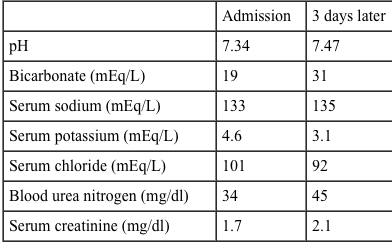 Which of the following best explains the acid-base status change in this patient?
 (Multiple Choice)
4.8/5  (85)
(85) A 71-year-old man with metastatic prostate cancer comes to the office due to progressively worsening back pain. The patient reports pain of 5 on a 10-point scale. The pain is notably worse with movement and limits his activity. He reports no lower extremity weakness or numbness and no bladder or bowel dysfunction. He is taking ibuprofen 3 or 4 times a day, and his pain is not controlled. The patient takes androgen deprivation therapy and has also received palliative radiotherapy for multiple lumbar spine metastases recently. Temperature is 37 C (98.6 F), blood pressure is 140/86 mm Hg, and pulse is 88/min. Lower extremity motor strength, deep tendon reflexes, and sensation are normal. Which of the following is the most appropriate initial therapy for this patient's pain?
(Multiple Choice)
4.9/5 (87)
(87) A 48-year-old man comes to the emergency department due to severe chest pain that started 2 hours ago. He has difficulty localizing the pain, saying that it "hurts all over my chest." He has had no shortness of breath, lightheadedness, syncope, or palpitations. The patient has no known medical conditions. He is a lifetime nonsmoker and does not use illicit drugs. His father died suddenly at age 52 from a presumed heart attack. Temperature is 36.7 C (98.1 F), blood pressure is 178/102 mm Hg, pulse is 105/min and regular, and respirations are 16/min. On physical examination, the lungs are clear to auscultation and heart sounds are normal. ECG reveals sinus tachycardia, voltage criteria for left ventricular hypertrophy, and T-wave inversion in leads V5 and V6. A CT image of the chest is shown below. 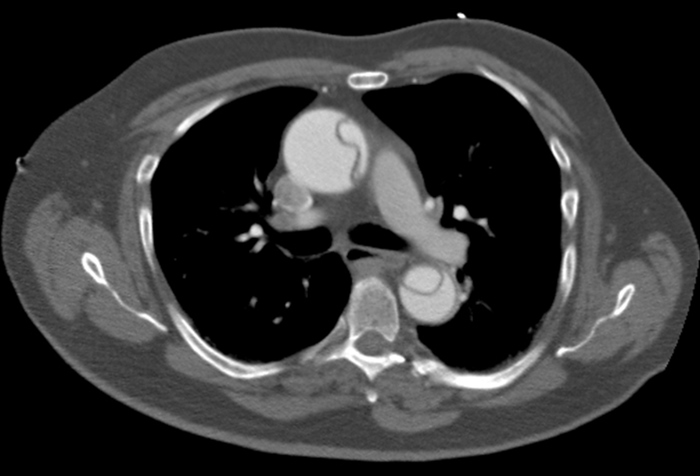 In addition to pain control, which of the following is the most appropriate, immediate pharmacotherapy for this patient?
 (Multiple Choice)
4.7/5 (80)
(80) A 64-year-old man comes to the emergency department due to diarrhea and intermittent abdominal cramps for the last 6 weeks. He has had 4 or 5 bowel movements every day, and the stool contains blood and mucus. He also reports poor appetite and fatigue and has lost 5.9 kg (13 lb) over this period. The patient has intermittent right knee swelling and tenderness that responds to ibuprofen. He has not taken any antibiotics recently. He has no other medical problems. The patient last saw a physician 2 years ago, and his last colonoscopy 4 years ago was normal. Family history is positive for colon cancer in his mother. Temperature is 37.3 C (99.1 F), blood pressure is 142/84 mm Hg, pulse is 98/min, and respirations are 16/min. Physical examination shows tenderness in the left lower quadrant without rebound or guarding. Digital rectal examination is positive for blood. Laboratory results are as follows: 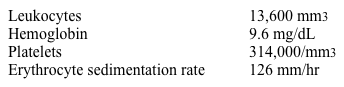 Flexible sigmoidoscopy reveals erythematous friable mucosa extending from the rectum to the sigmoid colon. Small shallow ulcers are also seen. Which of the following is the most likely cause of this patient's current condition?
 (Multiple Choice)
4.8/5 (74)
(74) A 53-year-old woman comes to the office due to hair loss. She has had gradual thinning of her hair since undergoing menopause 3 years ago. There is no associated pain or itching, but the patient is concerned due to the progressive course of hair loss. Medical history is notable for hypertension, which has been managed with dietary modification and exercise. The patient does not use tobacco, alcohol, or illicit drugs. Vital signs are normal. BMI is 31 kg/m2. Examination shows thinning of the hair at the vertex and midline of the scalp, as shown in the exhibit. 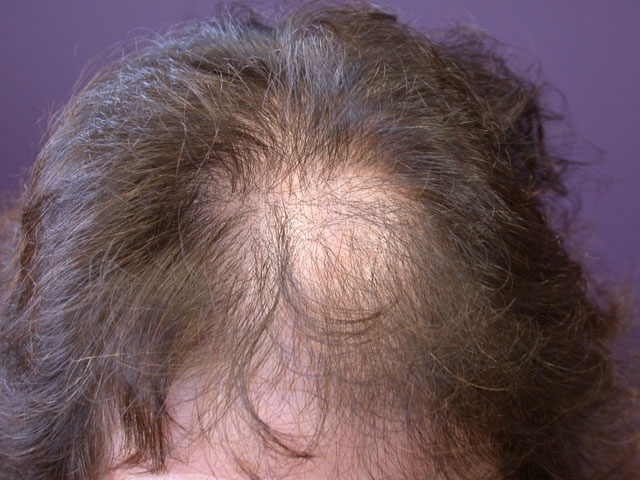 There is no excess hair growth on the face or trunk, and there is a normal female pattern of pubic hair growth. Which of the following is the most appropriate next step in management of this patient's hair loss?
 (Multiple Choice)
4.8/5 (88)
(88) A 38-year-old woman comes to the physician complaining of occasional palpitations. She describes a fast and irregular heartbeat. She has had 3 such episodes over the past 2 months, each lasting about 2 hours. The patient has no associated chest pain, shortness of breath, cough, or ankle swelling. She drinks alcohol on social occasions and does not smoke. She has no other medical problems and takes no medications. Her temperature is 37.1°C (98.9°F), blood pressure is 130/70 mm Hg, pulse is 80/min, and respirations are 14/min. The apical impulse is displaced to the left, and a third heart sound is heard at the apex in the left decubitus position. There is also a holosystolic murmur that is loudest at the apex and radiates to the axilla. Which of the following is the most likely cause of this patient's condition?
(Multiple Choice)
4.9/5 (87)
(87) A 55-year-old man comes to the office for hypertension follow-up. He was diagnosed with hypertension 5 years ago and since then has been treated with benazepril and amlodipine. His blood pressure has been consistently high over the past 6 months despite dietary modifications to decrease salt intake. Medical history is significant for hypercholesterolemia. The patient does not smoke or consume alcohol. Blood pressure is 152/94 mm Hg and pulse is 80/min. BMI is 30 kg/m2 with increased waist-to-hip ratio. Adding chlorthalidone to the patient's current therapy is considered to improve control of the hypertension. Which of the following metabolic effects may be expected as a result of this therapy?
(Multiple Choice)
4.9/5 (95)
(95) A 65-year-old woman comes to the office with several months of progressive cough and generalized weakness. The patient has limited mobility and shortness of breath due to osteoarthritis and chronic obstructive pulmonary disease, respectively. She also has difficulty standing from a chair, combing her hair, and putting dishes in overhead cabinets. The patient's medical history includes hypertension and hyperlipidemia. She quit smoking cigarettes 2 years ago but previously smoked 3 packs daily since age 20. Blood pressure is 112/70 mm Hg, and pulse is 92/min. BMI is 17 kg/m2. Physical examination shows moderate weakness in the proximal muscles of her upper and lower limbs and loss of deep tendon reflexes. CT scan of the chest is shown below. 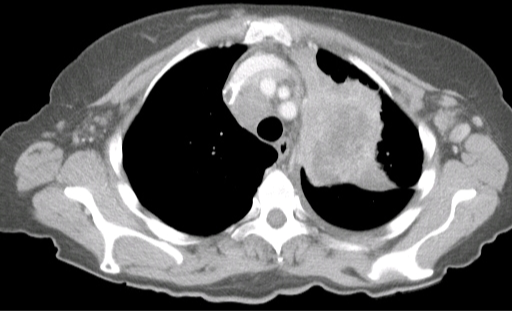 Which of the following is the most likely cause of this patient's weakness?
 (Multiple Choice)
4.8/5 (76)
(76) A 33-year-old man comes to the office due to left flank pain. He has no chronic medical conditions and takes no medications. The patient does not use tobacco, alcohol, or illicit drugs. Ultrasonogram of the left kidney is shown below. The right kidney has similar findings. 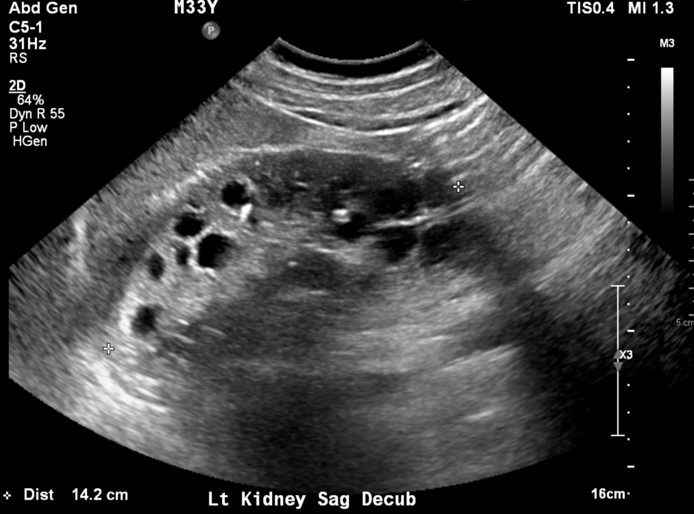 Compared to the general population, this patient's condition most increases the likelihood of which of the following complications?
 (Multiple Choice)
4.8/5 (81)
(81) A 55-year-old man comes to the office due to 2 weeks of urinary urgency, frequency, dysuria, and perineal pain. He had a similar episode 3 months ago, and a short course of antibiotic therapy completely resolved his symptoms. The patient has a history of type 2 diabetes mellitus and hyperlipidemia. He has smoked a pack of cigarettes daily for 20 years. Temperature is 37.5 C (99.5 F), blood pressure is 120/80 mm Hg, and pulse is 80/min. Examination shows suprapubic tenderness. There is no urethral discharge, and testicles are normal without tenderness. There is no costovertebral angle tenderness. Digital rectal examination reveals a symmetrically enlarged, smooth, and tender prostate. Complete blood count is normal. Urinalysis shows pyuria, many bacteria, and no red blood cells. Urine culture will most likely reveal which of the following organisms?
(Multiple Choice)
4.9/5 (87)
(87) A 59-year-old woman comes to the emergency department due to right leg swelling and pain for 2 days. The patient was started on hemodialysis 2 months ago for end-stage renal disease from poorly controlled hypertension and type 2 diabetes mellitus. Duplex ultrasound shows a right popliteal vein thrombosis. The patient is started on intravenous heparin infusion and admitted to the medical floor. On the third day of hospitalization, the right leg is more swollen and painful. Repeat ultrasound shows an extension of thrombus to the right femoral vein. Laboratory results are as follows: 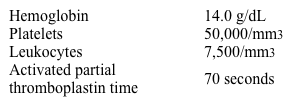 Which of the following is the most likely cause of this patient's worsening condition?
 (Multiple Choice)
4.9/5 (67)
(67) A 56-year-old man is brought to the emergency department with new-onset lethargy and confusion. The patient has a history of cirrhosis secondary to chronic alcoholism. His medications include spironolactone and furosemide. His temperature is 38.0 C (100.4 F), blood pressure is 123/70 mm Hg, pulse is 112/min, and respirations are 24/min. Physical examination reveals a flapping tremor of his hands when they are held out. The patient's breathing is labored, but his lungs are clear to auscultation. Abdominal examination reveals distension with shifting dullness and diffuse tenderness to palpation. There is bilateral pitting edema of his lower extremities. Laboratory results are as follows: 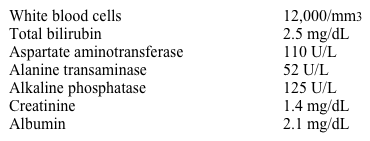 Chest x-ray reveals no abnormalities. Abdominal x-ray reveals gas in the small and large bowels without air-fluid levels. Which of the following is the most appropriate next step in management?
 (Multiple Choice)
4.9/5 (80)
(80) A 74-year-old-man is brought to the emergency department due to confusion. His daughter states that over the past 2 weeks, the patient has been increasingly confused and has decreased oral intake. She shares that he won't stop screaming, "Someone stop the ringing!" He has chronic bilateral osteoarthritis of the knees and hands, hypertension, and chronic kidney disease with a baseline creatinine of 2.2 g/dL. He uses topical methyl salicylate for his arthritis because he does not like taking pills. Temperature is 37.8 C (100 F), blood pressure is 100/60 mm Hg, pulse is 112/min, and respirations are 30/min. Pulse oximetry shows 89% on room air. The patient is awake but disoriented and agitated. Mucous membranes are dry. There is no jugular venous distension. Heart sounds are normal. Lung auscultation reveals bilateral crackles. There is no peripheral edema. Neurological examination is nonfocal. Laboratory results are as follows:  What is the most appropriate treatment for this patient's current condition?
 (Multiple Choice)
4.7/5 (73)
(73) A 1-year-old boy is brought to the office for evaluation of fever and rash. He felt warm to his parents this morning and did not eat breakfast. Subsequently, the patient developed a maculopapular rash over the face and upper trunk. The child has a history of eczema treated with emollients at night and a topical corticosteroid as needed. He has no other medical issues. The patient received the measles-mumps-rubella vaccine and the varicella-zoster virus vaccine 7 days ago. He lives with his parents and 8-year-old twin sisters, all of whom are healthy and up to date on immunizations. Temperature is 39.8 C (103.6 F). On examination, there is a faint maculopapular rash on the face, shoulders, and upper chest that is nontender to palpation. The remainder of the examination is unremarkable. Which of the following is the best next step in management of this patient?
(Multiple Choice)
4.8/5 (72)
(72) A 24-year-old woman, gravida 1 para 1, comes to the office due to not having a menstrual period for 2 months. She gave birth to a healthy boy 8 months ago. She breastfed for a month and has since been formula-feeding. Since the delivery, the patient has received 2 medroxyprogesterone injections for contraception; the last was administered 4 months ago. Over the last 2 weeks, she has begun experiencing breast soreness, weight gain, and increasing fatigue. Menarche occurred at age 14; menses were regular prior to her pregnancy but have been irregular since starting the medroxyprogesterone. The patient requests a different form of contraception due to these symptoms. Which of the following is the most appropriate next step in management of this patient?
(Multiple Choice)
4.8/5 (94)
(94) A 27-year-old woman comes to the emergency department after losing consciousness for 2 minutes while standing in line at a supermarket. She recalls nausea and a feeling of warmth spreading over her body immediately before she passed out. Her friend, a nurse who was with her during the episode, noted a weak pulse of 40/min. The patient was not confused after the episode and has never experienced a similar event. She takes sertraline for generalized anxiety disorder, and the dosage was recently increased. She does not use tobacco, alcohol, or illicit drugs. The patient's father had a heart attack at age 50, and her sister has a seizure disorder. Vital signs are within normal limits. ECG shows normal sinus rhythm with no other abnormalities. Which of the following most likely contributed to this episode?
(Multiple Choice)
4.9/5 (61)
(61) A 34-year-old male presents to the emergency department with a red eye. He says, "I just woke up this morning and saw that my right eye was red." He denies any itching, pain or discharge. He has no known drug or environmental allergies. He takes no medication. His vital signs are stable. The photo of his eye is shown below. 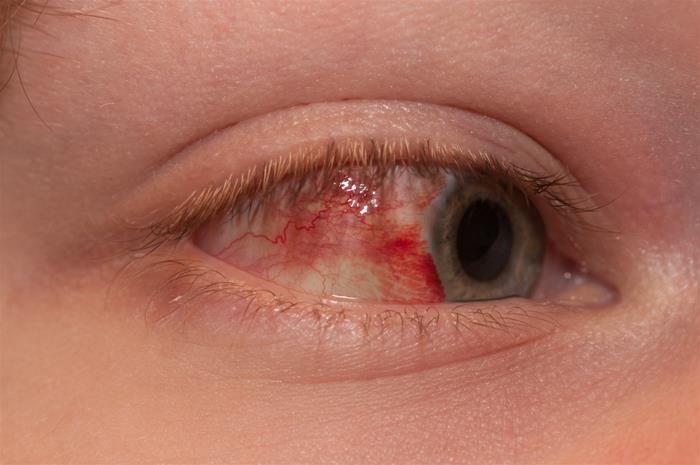 What is the best next step in his management?
 (Multiple Choice)
4.9/5 (71)
(71) A 23-year-old man comes to the clinic for a physical examination prior to joining a professional soccer team. The patient goes on a 10-mile run 3 or 4 times per week, during which he experiences no chest pain, lightheadedness, or shortness of breath. Medical history is unremarkable. He does not smoke or drink alcohol. The patient lives in Texas and has not traveled recently. Family history includes myocardial infarction in his father at age 56. Blood pressure is 114/62 mm Hg and pulse is 54/min. Cardiac examination reveals normal heart sounds with no murmurs. The lungs are clear to auscultation. ECG shows sinus bradycardia with occasional dropped QRS complexes preceded by progressive lengthening of the PR interval. No ST-segment abnormalities are present, and the QTc interval is normal. Which of the following is the most appropriate next step in the management of this patient?
(Multiple Choice)
4.8/5 (78)
(78) A 32-year-old man is brought to the emergency department with progressive ascending paralysis that began 18 hours earlier. He initially noticed paresthesias in his lower extremities, followed by a sense of fatigue and weakness that was more pronounced in his left leg. He has no history of headache, fever, or recent infection or illness. He had just returned from a hiking trip to Colorado. His blood pressure is 122/81 mm Hg, pulse is 86/min, respirations are 16/min, and temperature is 37.3 C (99.2 F). Physical examination reveals intact cranial nerves, absent deep tendon reflexes in the left lower extremity and 1+ in the right lower extremity, and a normal sensory examination. Both lower extremities show weakness, with no motor activity in his left leg. Laboratory results show a normal WBC count. No abnormalities are noted on CSF examination. What is the most appropriate next step in the management of this patient?
(Multiple Choice)
4.9/5 (97)
(97) A 30-year-old woman comes to the emergency department with intermittent dizziness and unsteadiness for the last 2 weeks. Since yesterday, her symptoms appear to be worse and she has had several near-syncope episodes. The patient has no chest pain but has mild shortness of breath. Medical history is significant for obesity, intermittent asthma, and chronic cough. She had an episode of uveitis 6 months ago that was treated with topical therapy. She does not use tobacco and drinks alcohol only on special occasions. The patient has no pets and has been monogamous with a single partner for the last 3 years. On physical examination, her temperature is 37.2 C (98.9 F), blood pressure is 126/76 mm Hg, pulse is 36/min, and respirations are 16/min. There are no heart murmurs. ECG shows sinus rhythm with 2:1 atrioventricular block and left bundle branch block. Chest x-ray reveals bilateral midfield lung opacities. Which of the following is the most likely diagnosis?
(Multiple Choice)
4.8/5 (64)
(64) Showing 81 - 100 of 1702
 Prev
- 1
- ...
- 2
- ...
- 3
- ...
- 4
- ...
- 5
- ...
- 6
- ...
- 7
- ...
- 8
- ...
- 9
- ...
- 10
- ...
- 11
- ...
- 12
- ...
- 13
- ...
- 14
- ...
- 15
- ...
- 16
- ...
- 17
- ...
- 18
- ...
- 19
- ...
- 20
- ...
- 21
- ...
- 22
- ...
- 23
- ...
- 24
- ...
- 25
- ...
- 26
- ...
- 27
- ...
- 28
- ...
- 29
- ...
- 30
- ...
- 31
- ...
- 32
- ...
- 33
- ...
- 34
- ...
- 35
- ...
- 36
- ...
- 37
- ...
- 38
- ...
- 39
- ...
- 40
- ...
- 41
- ...
- 42
- ...
- 43
- ...
- 44
- ...
- 45
- ...
- 46
- ...
- 47
- ...
- 48
- ...
- 49
- ...
- 50
- ...
- 51
- ...
- 52
- ...
- 53
- ...
- 54
- ...
- 55
- ...
- 56
- ...
- 57
- ...
- 58
- ...
- 59
- ...
- 60
- ...
- 61
- ...
- 62
- ...
- 63
- ...
- 64
- ...
- 65
- ...
- 66
- ...
- 67
- ...
- 68
- ...
- 69
- ...
- 70
- ...
- 71
- ...
- 72
- ...
- 73
- ...
- 74
- ...
- 75
- ...
- 76
- ...
- 77
- ...
- 78
- ...
- 79
- ...
- 80
- ...
- 81
- ...
- 82
- ...
- 83
- ...
- 84
- ...
- 85
- ...
- 86
- ...
- Next

Filters
- Essay(0)
- Multiple Choice(0)
- Short Answer(0)
- True False(0)
- Matching(0)