


 Chat with AI
Exam 1: Medicine

Exam 1: Medicine2 k Questions
Exam 2: Pediatric723 Questions
Exam 3: Psychiatry336 Questions
Exam 4: Surgery563 Questions
Exam 5: Obstetrics & Gynecology469 Questions
Select questions type


A 35-year-old woman comes to the clinic complaining of aching pain and stiffness over her entire body for the past 3 months. She also has easy fatigability, poor sleep, and frequent headaches. The patient has had difficulty performing her daily tasks and feels that her work performance as an accountant has worsened. She has used over-the-counter pain medications with no relief. On examination, she has tenderness to gentle palpation over the muscles of her neck, shoulders, and back. Vital signs are within normal limits. Laboratory results show normal electrolytes, complete blood count, erythrocyte sedimentation rate, and thyroid function tests. Which of the following is the best initial therapy to improve this patient's symptoms?
(Multiple Choice)
4.7/5  (76)
(76) A 50-year-old man is admitted to the hospital with worsening jaundice, anorexia, general malaise, and right upper quadrant abdominal pain over the past 3 days. The patient's other medical problems include major depression with an attempted suicide 30 years ago. His temperature is 38.3 C (101 F), blood pressure is 130/86 mm Hg, pulse is 86/min, and respirations are 16/min. Cardiopulmonary examination is unremarkable. Scleral icterus and tender hepatomegaly are present. Laboratory results are as follows: 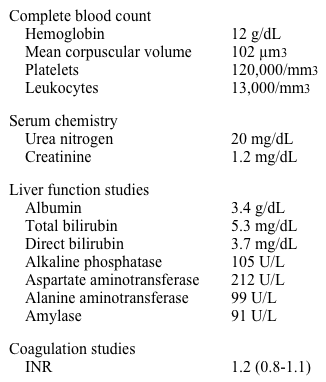 Which of the following would be the most helpful in establishing a diagnosis in this patient?
 (Multiple Choice)
4.9/5 (81)
(81) A 5-year-old boy is brought to the office due to ear pain. Two days ago, the patient developed low-grade fever and pain in the left ear. His parents think he is also having trouble hearing from the left ear as they have noticed him tilt his right ear toward the television. For the past week, the patient has also had a runny nose and cough, which developed soon after the family flew home from vacation. He has no history of ear infections or other chronic issues and takes no medications. Temperature is 38.1 C (100.6 F), blood pressure is 110/60 mm Hg, and pulse is 110/min. Examination shows bulging of the left tympanic membrane, which is pale yellow and immobile with pneumatic insufflation. The right tympanic membrane and bilateral auditory canals appear normal. The nasal mucosa appears boggy, and postnasal drip is present. The maxillary and frontal sinuses are nontender. Which of the following is the most likely diagnosis in this patient?
(Multiple Choice)
4.7/5 (86)
(86) A 55-year-old homeless man comes to the emergency department with muscle cramps and perioral numbness. The patient appears malnourished and says that he has consumed a lot of alcohol recently. His past medical history is significant for chronic-recurrent abdominal pain for which he was advised to quit drinking alcohol. His temperature is 36.7 C (98 F), blood pressure is 110/65 mm Hg, pulse is 80/min, and respirations are 18/min. Examination shows a regular heart rate and clear lung fields. The abdomen is soft without significant tenderness. There are normoactive bowel sounds. Laboratory studies are as follows: 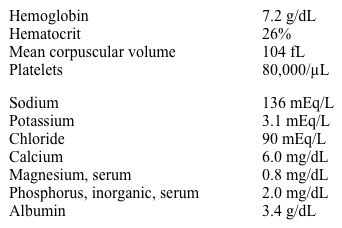 Which of the following is the most probable cause of the hypocalcemia observed in this patient?
 (Multiple Choice)
5.0/5 (79)
(79) A 32-year-old woman is brought to the emergency department due to weakness, tingling, and numbness in her extremities. She takes no medications. Blood pressure is 110/70 mm Hg, pulse is 90/min, and respirations are 14/min. Physical examination is unremarkable. Laboratory results are as follows: 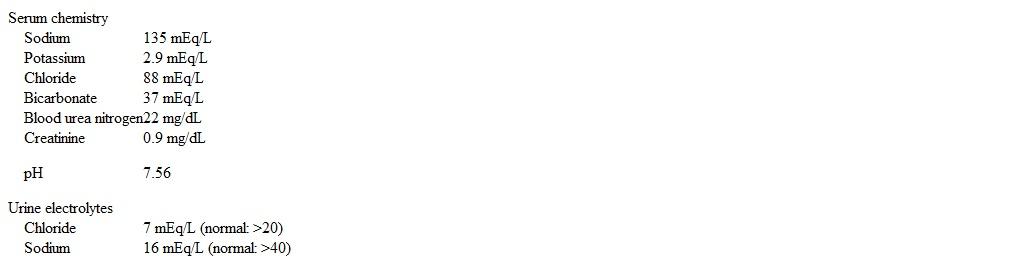 Which of the following is the most likely cause of this patient's condition?
 (Multiple Choice)
4.8/5 (81)
(81) A 9-month-old child is brought to the office for a routine visit. The patient has had several episodes of otitis media since birth, but no major illnesses or hospitalizations. She was previously happy and sociable around other people but now cries when her mother is not in the room and screams when going to day care. Developmentally, the child pulls herself up to stand and can stand on her own briefly. She can hold a spoon with 3 fingers and throw objects. The patient does not yet respond to her name, babble, or use words. When the physician hides a toy with his hand, the child lifts the hand to look for it. She waves goodbye when the physician waves first. Which of the following is the best next step in management of this patient?
(Multiple Choice)
4.9/5 (82)
(82) A 17-year-old boy comes to the office due to a rash. He has had a progressive papular rash involving the trunk, neck, upper arms, and genital area for 8 weeks. The lesions are mildly pruritic, but there are no other associated symptoms. Past medical history is notable for mild intermittent asthma and childhood eczema. The patient also was treated empirically a year ago for chlamydia after exposure to an infected sexual partner. He is up to date with recommended vaccinations. Vital signs are normal. Examination shows normal growth and body habitus, with appropriate sexual development for age. Dermatologic examination shows widespread firm, dome-shaped, flesh-colored papules with central umbilication. This patient's rash is most commonly associated with which of the following conditions?
(Multiple Choice)
4.9/5 (78)
(78) A 34-year-old woman is brought to the emergency department due to a 2-day history of progressive dyspnea and drowsiness. According to her husband, she had difficulty swallowing food and almost choked while having dinner yesterday. One week ago, she was treated with ciprofloxacin for a urinary tract infection. The patient volunteers in a local library and for the past several months has had to reduce her work hours due to difficulty lifting books and placing them on shelves. She drinks alcohol socially and does not smoke. Her blood pressure is 142/90 mm Hg, pulse is 92/min, and respirations are 20/min and shallow. Pulse oximetry shows 93% on room air. The patient's BMI is 32 kg/m2. Her speech sounds nasal. Physical examination demonstrates clear lung fields with the use of accessory muscles of respiration and paradoxical abdominal wall motion with inspiration. Heart sounds are normal without a murmur. Muscle strength is bilaterally decreased with normal deep tendon reflexes. Babinski reflex is absent bilaterally. Arterial blood gas shows pH 7.2, pCO2 65 mm Hg, and pO2 90 mm Hg. Which of the following is the most likely diagnosis?
(Multiple Choice)
4.8/5 (81)
(81) A 2-year-old boy is brought to the clinic by his parents due to 6 days of high-grade fever and rash and a day of difficulty breathing. The rash began on the patient's face and subsequently spread to his trunk and extremities. Prior to the onset of rash, he had a nonproductive cough, tearing of eyes, runny nose, and intermittent nasal congestion. The family lives in a rural town in Zambia and is in the United States to visit relatives. The child has received no immunizations. Temperature is 38.7 C (101.7 F) and respirations are 44/min. Physical examination shows a diffuse erythematous, maculopapular rash all over the body that spares the palms and soles. Auscultation of the chest reveals bilateral crackles. The child is admitted to the local hospital for further care. Which of the following has been shown to reduce morbidity and mortality of patients with this infection?
(Multiple Choice)
4.8/5 (70)
(70) A 68-year-old woman is hospitalized for right lower lobe pneumonia and treated with ceftriaxone and azithromycin. On the third hospital day, she develops acute shortness of breath and palpitation. ECG reveals atrial fibrillation with a heart rate of 150/min. Temperature is 39 C (102.2 F) and blood pressure is 100/60 mm Hg. The patient's heart rate improves following intravenous administration of diltiazem. Subsequent laboratory results are as follows:  Which of the following is the most likely cause of this patient's abnormal thyroid function tests?
 (Multiple Choice)
4.8/5 (84)
(84) A 28-year-old woman comes to the office due to stiffness and weakness of her hands over the past several months. The patient has had decreased grip strength and frequent episodes in which her hands felt so stiff that she could not let go of objects. She also reports fatigue and excessive sleepiness and says, "I can sleep 20 hours straight and still wake up tired." The patient has had occasional difficulty with speech, which she describes as mild slurring and a heavy feeling in the tongue. She has no prior medical conditions and takes no medications. Vital signs are within normal limits. Physical examination shows a flat affect and mild bilateral ptosis. Hand grip is weak bilaterally, and mild atrophy of the small muscles of the hands is present. Deep tendon reflexes are normal throughout and Babinski sign is absent. When the patient is instructed to repeatedly close the eyes tightly, there is a noticeable lag when she opens them. Which of the following is the most likely cause of this patient's current condition?
(Multiple Choice)
4.8/5 (76)
(76) A 58-year-old man with a 45-pack-year smoking history comes to the clinic due to a persistent cough. The cough started about 3 months ago and is distinctly worse than his usual smoker's cough. During this period, he had episodes of hemoptysis and lost 9.1 kg (20 lb). He has had no nausea, vomiting, fever, chills, night sweats, pruritus, seizures, or gait abnormalities. Temperature is 36.9 C (98.4 F), blood pressure is 134/85 mm Hg without an orthostatic drop, and pulse is 76/min. Temporal wasting is evident. The mucous membranes are moist, and the neck is supple without lymphadenopathy. Heart and breath sounds are normal. The abdomen is soft and nontender. No peripheral edema is present. The patient is oriented to time, place, and person. Pupils are equal and reactive, and no nystagmus is elicited. Neurologic examination, including gait, is normal. Laboratory results are as follows: 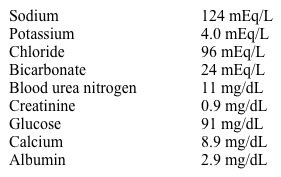 Which of the following is the best initial treatment for this patient?
 (Multiple Choice)
4.9/5 (69)
(69) A 64-year-old man is brought to the emergency department due to sudden onset of painless lower extremity weakness. He was swimming in a pool when he suddenly felt his legs become weak and had to struggle to exit the pool. The patient has had no loss of consciousness or visual or speech problems, but he is unable to pass urine. He also has had back pain for the last 2 months. Medical history is significant for type 2 diabetes mellitus, hypertension, and osteoarthritis. Physical examination shows significant motor weakness in both legs and numbness from the umbilicus to the soles of the feet. He has no sensation in the perineal area. Rectal tone is absent. A urinary catheter is placed, and 800 mL of urine is collected. Which of the following is the best next step in management of this patient?
(Multiple Choice)
4.9/5 (71)
(71) A 31-year-old woman comes to the office with a 6-week history of periorbital edema and abdominal distention. Her temperature is 37.1 C (98.9 F), blood pressure is 125/75 mm Hg, pulse is 80/min, and respirations are 14/min. Examination shows moderate ascites and lower extremity edema. Urinalysis shows proteinuria and 24-hour urinary protein excretion is 4 g/day, total serum protein is 5 g/dL, and serum albumin is 2.5 g/dL. Renal ultrasound is unremarkable. A renal biopsy is performed. The patient is started on diuretics and salt and protein intake is restricted. The edema begins to improve. However, the patient suddenly develops severe right-sided abdominal pain, fever, and gross hematuria. Which of the following is the most likely diagnosis revealed by renal biopsy?
(Multiple Choice)
4.8/5 (85)
(85) A 24-year-old woman brought to the emergency department says that she ingested about twenty 500-mg acetaminophen tablets 2 hours ago after an intense argument with her husband. She currently has no symptoms. The patient does not smoke but drinks alcohol on weekends. She is alert and oriented. Her temperature is 37.2 C (99 F), blood pressure is 110/60 mm Hg, pulse is 90/min, and respirations are 16/min. Examination shows no abnormalities. Complete blood count, coagulation studies (prothrombin time/International Normalized Ratio), and serum chemistries, including liver functions tests, are within normal limits. Which of the following is the most appropriate next step in management of this patient?
(Multiple Choice)
4.8/5 (76)
(76) A 72-year-old man is brought to the emergency department after being intubated by emergency medical services personnel at the scene. The patient was found at home, unconscious, with a weak pulse and agonal respirations. His medical problems include hypertension, hyperlipidemia, type 2 diabetes, coronary artery disease, and metastatic prostate cancer. Blood pressure is 80/40 mm Hg, and pulse is 120/min and regular. Patchy rales are present. A grade 2/6 apical systolic murmur is present. The upper and lower extremities are cold and clammy. A nonhealing wound is noted in the right foot. Pulmonary artery catheterization results are obtained and shown below: Which of the following is the most likely diagnosis?
(Multiple Choice)
4.9/5 (83)
(83) A 48-year-old man with an extensive smoking history is evaluated for cough and an episode of mild hemoptysis. After the patient ignored his symptoms for weeks, his wife finally convinced him to make an appointment. Chest x-ray reveals a mass lesion in the right upper lobe. A chest CT scan and bronchoscopy with biopsy are scheduled for that afternoon, and the patient is instructed to schedule a follow-up visit with the physician 3 days later to discuss the results. The patient agrees to have the tests done but declines the follow-up appointment, saying that he and his wife are leaving for a previously scheduled week-long anniversary celebration and vacation the next day. Despite education about diagnostic possibilities, he is convinced that his symptoms are stress related and that he will feel better by the time he returns. The physician is highly concerned that the workup may show lung cancer although the patient clinically appears to be stable. Which of the following is the most appropriate response by the physician?
(Multiple Choice)
4.9/5 (79)
(79) A 70-year-old woman is brought to the emergency department by her daughter due to 2 days of fever and cough and a day of excessive somnolence. The patient has a history of hypertension and osteoarthritis. She does not use tobacco or alcohol. She lives independently in a senior residential facility and ambulates with the assistance of a cane. Temperature is 39.2 C (102.6 F), blood pressure is 110/76 mm Hg, pulse is 110/min, and respirations are 24/min. No pharyngeal erythema or cervical lymphadenopathy is present. Lung auscultation reveals crackles in the right lower lung field. Laboratory results are as follows:  Chest x-ray reveals a right lower lobe infiltrate. Which of the following pathogens is the most likely cause of this patient's condition?
 (Multiple Choice)
4.9/5 (74)
(74) A 38-year-old man is brought to the emergency department due to confusion and double vision. His family reports that the patient did not feel well for the past several days due to headaches, nausea, and vomiting. Yesterday, he became progressively confused and experienced double vision. He has a history of HIV and does not take antiretroviral therapy consistently. Temperature is 38.2 C (100.7 F), blood pressure is 122/80 mm Hg, and pulse is 90/min. On physical examination, the patient appears lethargic and disoriented. Pupils are equal and reactive, but the left eye does not move laterally with leftward gaze. The rest of the neurologic examination is unremarkable. Skin examination shows scattered, small, umbilicated papules with surrounding erythema. CT scan of the head reveals mildly enlarged ventricles but no hemorrhage, infarction, or mass lesions. Which of the following is the best next step in evaluation of this patient?
(Multiple Choice)
4.8/5 (82)
(82) A 34-year-old woman comes to the physician with a several-month history of chest pain. The pain is left-sided, does not change with deep inspiration, and typically lasts several hours. She currently has the pain; it is unrelated to physical activity but worsens with emotional stress. The patient has no cough, syncope, or shortness of breath. She has no significant family history and does not use tobacco, alcohol, or illicit drugs. She takes no medications and has no drug allergies. Her blood pressure is 110/70 mm Hg and pulse is 78/min. Heart sounds are normal. Lungs are clear to auscultation. ECG shows normal sinus rhythm with no significant abnormalities. Which of the following is the best next step in the management of this patient?
(Multiple Choice)
4.9/5 (79)
(79) Showing 421 - 440 of 1702
 Prev
- 1
- ...
- 2
- ...
- 3
- ...
- 4
- ...
- 5
- ...
- 6
- ...
- 7
- ...
- 8
- ...
- 9
- ...
- 10
- ...
- 11
- ...
- 12
- ...
- 13
- ...
- 14
- ...
- 15
- ...
- 16
- ...
- 17
- ...
- 18
- ...
- 19
- ...
- 20
- ...
- 21
- ...
- 22
- ...
- 23
- ...
- 24
- ...
- 25
- ...
- 26
- ...
- 27
- ...
- 28
- ...
- 29
- ...
- 30
- ...
- 31
- ...
- 32
- ...
- 33
- ...
- 34
- ...
- 35
- ...
- 36
- ...
- 37
- ...
- 38
- ...
- 39
- ...
- 40
- ...
- 41
- ...
- 42
- ...
- 43
- ...
- 44
- ...
- 45
- ...
- 46
- ...
- 47
- ...
- 48
- ...
- 49
- ...
- 50
- ...
- 51
- ...
- 52
- ...
- 53
- ...
- 54
- ...
- 55
- ...
- 56
- ...
- 57
- ...
- 58
- ...
- 59
- ...
- 60
- ...
- 61
- ...
- 62
- ...
- 63
- ...
- 64
- ...
- 65
- ...
- 66
- ...
- 67
- ...
- 68
- ...
- 69
- ...
- 70
- ...
- 71
- ...
- 72
- ...
- 73
- ...
- 74
- ...
- 75
- ...
- 76
- ...
- 77
- ...
- 78
- ...
- 79
- ...
- 80
- ...
- 81
- ...
- 82
- ...
- 83
- ...
- 84
- ...
- 85
- ...
- 86
- ...
- Next

Filters
- Essay(0)
- Multiple Choice(0)
- Short Answer(0)
- True False(0)
- Matching(0)