


 Chat with AI
Exam 1: Medicine

Exam 1: Medicine2 k Questions
Exam 2: Pediatric723 Questions
Exam 3: Psychiatry336 Questions
Exam 4: Surgery563 Questions
Exam 5: Obstetrics & Gynecology469 Questions
Select questions type


A 56-year-old woman is brought to the hospital due to altered mental status after being found at home in a state of confusion by her husband. He reports that the patient has had headaches and intermittent vision changes for the past week. She has no other medical history. Temperature is 36.6 C (98 F), blood pressure is 220/115 mm Hg (previously 100/66 mm Hg), and pulse is 90/min. Oxygen saturation is 99% on room air. On examination, the patient is lethargic. Flexion of the neck does not elicit pain. The skin on the hands is shiny and thickened with multiple telangiectasias. The lungs are clear, and there is 1+ lower extremity edema to the shins. A noncontrast head CT scan is unremarkable. Laboratory results are as follows:  Urinalysis demonstrates 1+ proteinuria without bacteria or casts. Which of the following is the best next step in management of this patient?
 (Multiple Choice)
4.9/5  (78)
(78) A 17-year-old girl is brought to the emergency department due to acute abdominal pain, nausea, and vomiting. She has no chronic medical conditions and has had no surgery. The patient has had irregular menstruation and is not sexually active. Family history is significant for deep venous thrombosis following knee replacement in her mother, who takes apixaban. Temperature is 38.3 C (101 F). BMI is 18 kg/m2. Physical examination shows right lower quadrant abdominal tenderness. CT scan of the abdomen reveals acute appendicitis, and laparoscopic appendectomy is planned. Preoperative laboratory studies demonstrate a platelet count of 400,000/mm3. Coagulation study results are as follows:  Mixing the patient's plasma sample with normal plasma fails to correct the coagulation abnormalities. Which of the following best explains this patient's coagulation study results?
 (Multiple Choice)
4.9/5 (94)
(94) A 57-year-old man comes to the office due to chest pain. The pain is burning in nature and is not related to meals. The patient has lost 18 kg (40 lb) over the last 6 months; he attributes this to eating a selective diet and carefully chewing his food before swallowing. In addition, the patient has had fatigue and malaise as well as decreased interest in his usual activities. His medical history is notable for long-standing gastroesophageal reflux for which he takes ranitidine. He has a 20-pack-year smoking history but quit 4 years ago. The patient occasionally drinks alcohol. He works as a missionary and makes frequent trips abroad. His father died at age 67 from lung cancer. The patient's vital signs are normal. Physical examination, including lymph node, cardiopulmonary, and abdominal examinations, is unremarkable. Chest x-ray reveals no abnormalities. Which of the following is the best next step in management of this patient?
(Multiple Choice)
4.9/5 (58)
(58) A 45-year-old man is brought to the emergency department due to a progressively worsening headache and difficulty breathing. Yesterday morning, he arrived in Colorado from Kansas for a ski vacation. The patient was feeling well until last night, when he began experiencing a headache and shortness of breath with exertion. The headache came on gradually, is generalized, and affects his ability to sleep. This morning, he developed vomiting and dizziness. The patient has had no fever, neck pain, or chest pain. He has no significant medical history and exercises daily. Temperature is 37.2 C (99 F), blood pressure is 130/80 mm Hg, pulse is 99/min, and respirations are 22/min. Pulse oximetry is 96% on room air. The patient is mildly drowsy but can converse. He is oriented to time, place, and person. Cardiopulmonary examination is normal. There are no focal neurologic findings. The skin is normal. Which of the following is the most appropriate next step in management?
(Multiple Choice)
4.8/5 (64)
(64) A 64-year-old man comes to the emergency department due to 2 days of fever, chills, productive cough, and left-sided pleuritic chest pain. The patient has a history of hypertension, hyperlipidemia, and type 2 diabetes mellitus. He is a former smoker and drinks alcohol occasionally. Temperature is 38.9 C (102 F), blood pressure is 110/60 mm Hg, pulse is 110/min, and respirations are 22/min. Oxygen saturation is 94% on room air when he lies on his right side but drops to 89% when he lies on his left. Dullness to percussion and bronchial breath sounds are present on the left side. Which of the following pathophysiologic mechanisms in the left lung is most responsible for the drop in oxygen saturation after the change in position?
(Multiple Choice)
4.7/5 (77)
(77) A 26-year-old man is brought to the emergency department after collapsing 2 hours into basketball practice. Immediately prior to collapse, the patient developed a headache and dizziness. His parents report that he has a history of atypical depression, for which he takes quetiapine; he also underwent laparoscopic appendectomy 3 months ago. Temperature is 41 C (105.8 F), blood pressure is 88/48 mm Hg, pulse is 136/min, and respirations are 26/min. The patient is disoriented but protecting his airway. Mucous membranes are dry. Cardiac examination shows tachycardia with a regular rhythm. Lungs are clear bilaterally. The abdomen is soft and nontender. Muscle tone and reflexes are normal. Which of the following is the best next step in management of this patient?
(Multiple Choice)
4.8/5 (84)
(84) A 53-year-old man comes to the office due to nonspecific chest pain localized to the left chest along the fifth intercostal space. His other medical problems include autosomal dominant polycystic kidney disease and hypertension. He has a 10-pack-year smoking history but quit 14 years ago. He consumes alcohol occasionally and does not use illicit drugs. Blood pressure is 160/90 mm Hg and pulse is 90/min. Physical examination shows no abnormalities. Laboratory results are as follows: 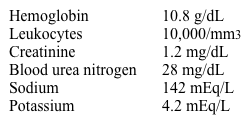 Chest x-ray reveals a solitary round lesion in the left upper lung field 1 cm in diameter with sharp borders. The lesion does not touch the pleura. A chest x-ray from 3 years earlier was normal. Which of the following is the most appropriate next step in evaluating this patient's pulmonary findings?
 (Multiple Choice)
5.0/5 (89)
(89) A 24-year-old woman comes to the clinic due to 4 days of skin rash and pain in her wrists, ankles, and elbows. She also has had a fever but no headache, nausea, or vomiting. The patient has no significant past medical history and does not take medications. She recently went on a weekend vacation with her new boyfriend. The patient has an intrauterine device and does not use condoms. She does not use tobacco, alcohol, or illicit drugs. Temperature is 38.5 C (101.3 F) and pulse is 98/min. The oropharynx is clear, and there is no thrush or lymphadenopathy. Abdominal and pelvic examinations are normal. The patient has pain along the tendon sheaths with active and passive hand movement. The skin rash is shown in the image below. 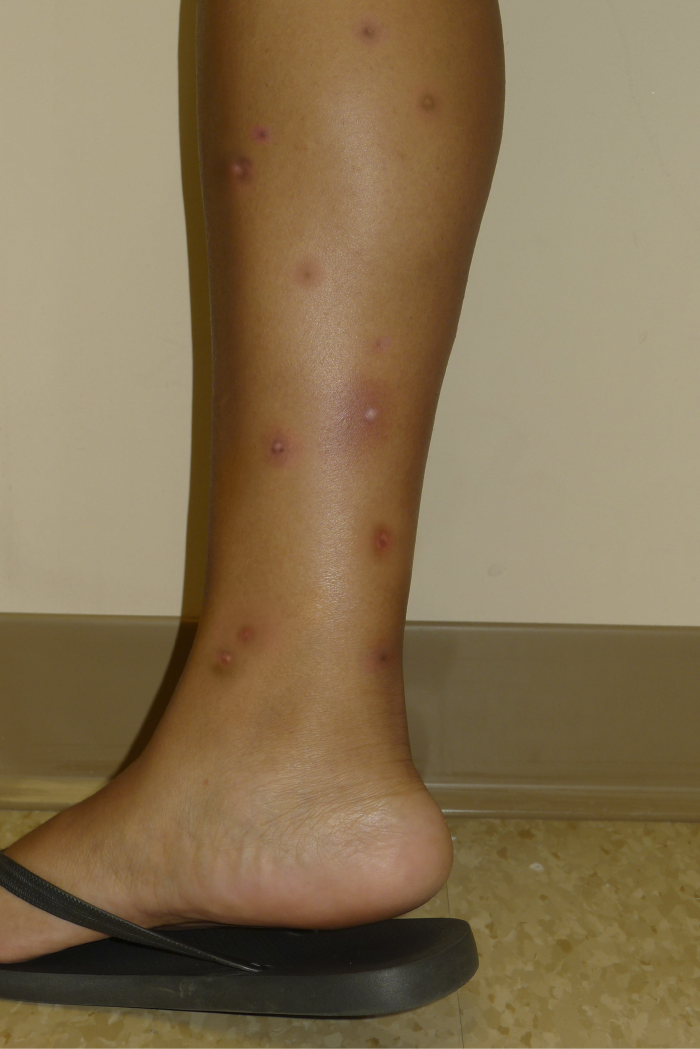 Which of the following is the most likely cause of her symptoms?
 (Multiple Choice)
5.0/5 (71)
(71) A 45-year-old man comes to the emergency department due to 3 weeks of headache and malaise and a week of double vision, vomiting, and fever. Medical history is significant for alcohol use disorder. Temperature is 38.3 C (100.9 F), blood pressure is 140/90 mm Hg, pulse is 88/min, and respirations are 14/min. Mild lethargy is present. Examination shows neck stiffness and lateral deviation of the right eye with impaired adduction. Noncontrast CT scan of the head is normal. Laboratory results are as follows:  Serum HIV testing is negative. What is the most likely diagnosis?
 (Multiple Choice)
4.9/5 (77)
(77) A group of investigators plans to conduct a study to assess the relationship between colon cancer and elevated plasma C-reactive protein (CRP) levels. The study design involves determining the prevalence of elevated plasma CRP levels (based on prespecified cutoff values) and of colon cancer in a sample of individuals at a given point in time. The prevalence of elevated CRP levels is compared between patients with and without colon cancer. Which of the following is the best statement of the null hypothesis for this study?
(Multiple Choice)
4.9/5 (74)
(74) A 28-year-old woman, gravida 2 para 1, at 35 weeks gestation comes to the office for evaluation of decreased fetal movement. Over the past 12 hours, the patient has felt only 4 or 5 fetal movements. She rested for an hour and felt only 2 movements, prompting her to come to the office. The patient has had no contractions, vaginal bleeding, or leakage of fluid. She has no chronic medical conditions and has had no complications during this pregnancy. The patient does not use tobacco, alcohol, or illicit drugs. Blood pressure is 136/84 mm Hg and pulse is 84/min. Fetal heart rate is 145/min on Doppler. Fundal height is 35 cm and a slight fetal movement is palpated through the abdominal wall. The remainder of the physical examination is unremarkable. Which of the following is the best next step in management of this patient?
(Multiple Choice)
4.8/5 (89)
(89) A 50-year-old man comes to the office for evaluation of an itchy rash on his lower abdomen. The rash has been present for many months, and the patient is unable to obtain relief with moisturizers. He has no chronic medical conditions and takes no medications. On examination, the affected skin is noted to be thickened and dry; the rash is shown in the exhibit. 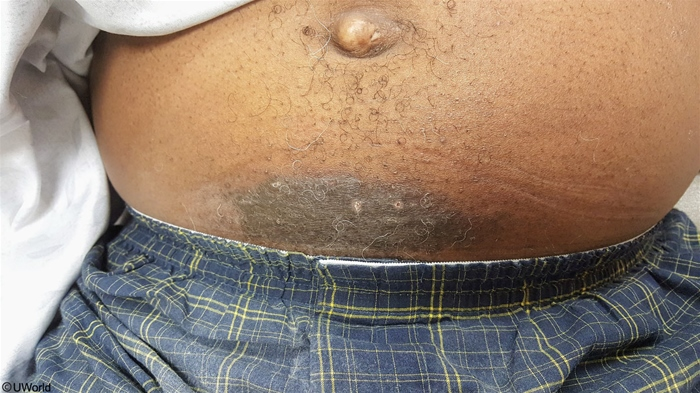 The remainder of the examination reveals no abnormalities. What is the most likely cause of the patient's symptoms?
 (Multiple Choice)
4.9/5 (83)
(83) A 72-year-old man comes to the emergency department due to 2 days of increasing shortness of breath. He has been recovering from an upper respiratory infection that started 4 days ago. The patient has been drinking plenty of water and taking ibuprofen for headache and muscle aches. Medical history is significant for congestive heart failure, coronary artery disease, and type 2 diabetes mellitus. On examination, temperature is 38 C (100.4 F), blood pressure is 130/84 mm Hg, pulse is 104/min, and respirations are 22/min. Oxygen saturation is 94% on room air. Bilateral crackles are present in both lower lobes. No extremity edema is present. Chest x-ray reveals bilateral infiltrates. The patient is given ceftriaxone and azithromycin and one dose of intravenous furosemide. The next day, his dyspnea improved markedly. Repeat chest x-ray reveals marked decrease in bilateral infiltrates. What is the most likely cause of this patient's acute presentation?
(Multiple Choice)
4.8/5 (73)
(73) A 68-year-old man comes to the office with a 2-day history of right foot pain and swelling. The pain started acutely when he awoke in the morning. Initially, the patient had pain only on dorsiflexion of the foot, but he progressively developed pain with any movement at the ankle or weight bearing. The patient has not had similar symptoms before. He is normally very active, and had spent a week bicycling in Utah 3 weeks prior to this presentation. Medical history is notable for type 2 diabetes mellitus, hypertension, and hyperlipidemia. Temperature is 37 C (98.6 F), blood pressure is 140/90 mm Hg, and pulse is 90/min. Examination of the right foot shows warmth, swelling, and tenderness over the dorsal surface of the foot and around the right ankle. Both dorsiflexion and plantar flexion are restricted due to pain. The skin is intact without ulcers or breaks. Pulses are full and equal in both feet, and sensory sensations are normal. X-rays reveal soft tissue swelling, small tibiotalar joint effusion, and chronic calcification of the articular cartilage. There are no fractures or dislocation. Which of the following is the most likely diagnosis?
(Multiple Choice)
4.8/5 (78)
(78) A 64-year-old nondiabetic man complains of cramping pain in his right thigh after walking 2 blocks. The pain goes away once he stops and rests for several minutes. He is an ex-smoker with 35-pack-year history. He has no history of heart disease or stroke. On physical examination, the femoral pulses are normal, but the popliteal and dorsalis pedis pulses are diminished on the right leg. His ankle brachial index is 0.98 on the left and 0.72 on the right. He is started on low-dose aspirin and lipid-lowering therapy. Which of the following is the best initial management for this patient?
(Multiple Choice)
4.9/5 (73)
(73) A 68-year-old woman is brought to the clinic by her daughter due to severe pain in her fingers. Her daughter says, "Mom has had horrible problems with her joints for a long time, but she has never tried to get help." The patient adds that her fingers have become more swollen and painful over the last few weeks. She had similar symptoms in her foot last year. She was given an unknown pain pill, but it was ineffective. Medical history is notable for hypertension, hypothyroidism, and early Alzheimer dementia. Vital signs are normal. Examination findings of the hands are shown in the image below. 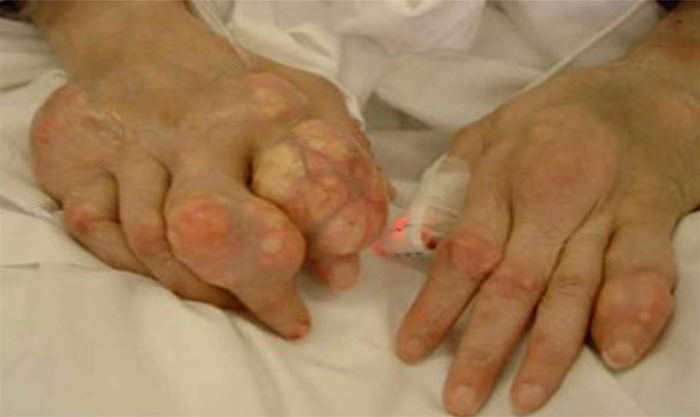 What is the most likely diagnosis in this patient?
 (Multiple Choice)
4.7/5 (76)
(76) A 45-year-old woman comes to the office due to progressive fatigue, myalgias, and muscle weakness in both lower extremities for the past month. She has slight difficulty getting up from a chair, and has weakness and cramping in the legs after walking a short distance. The patient's other medical problems include hypertension, which is treated with lisinopril. She does not use tobacco, alcohol, or illicit drugs. Blood pressure is 140/80 mm Hg, pulse is 64/min, and respirations are 14/min. Examination shows mildly decreased strength in the proximal muscles of the lower extremities with sluggish ankle jerks bilaterally. Laboratory tests show a normal erythrocyte sedimentation rate and an elevated serum creatine kinase level. Serum sodium, glucose, potassium, and creatinine are normal. Which of the following is the most appropriate next step in management of this patient?
(Multiple Choice)
4.8/5 (81)
(81) A 34-year-old woman comes to the physician for evaluation of skin lesions. For the past year, she has noticed darkening and thickening of the skin over her neck and groin areas. These areas occasionally feel itchy. Her blood pressure is 130/80 mm Hg. Skin examination findings are shown in the image below. 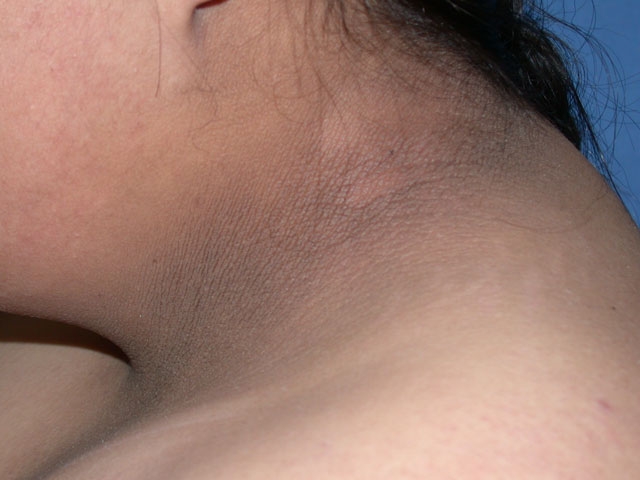 Similar hyperpigmented, velvety lesions are found on the axilla and groin. This patient's condition is most likely associated with which of the following?
 (Multiple Choice)
4.9/5 (83)
(83) A 36-year-old woman who lives in the southern United States comes to the physician for a tuberculin skin test. She will be volunteering in her daughter's school cafeteria, and the school district requires tuberculin testing by law. She says that she feels "perfectly fine" and has never been tested for tuberculosis. The patient has no ill contacts and no underlying medical conditions. She was born in the United States, is not a health care worker, and has never been incarcerated. Two days after intradermal injection of the Mycobacterium tuberculosis purified protein derivative, there is a 12-mm induration. What is the best next step in management of this patient?
(Multiple Choice)
4.8/5 (75)
(75) A 38-year-old man comes to the office for a follow-up visit after routine annual laboratory studies showed a positive HIV test. He is currently asymptomatic and has never had an HIV-related illness. The patient believes he acquired the infection through unprotected sexual intercourse. Treatment has not been initiated due to pending antiretroviral drug resistance results. The patient has no other medical issues. He immigrated to the United States 15 years ago and does not know whether he received all of his childhood immunizations. The patient received tetanus-diphtheria-pertussis and hepatitis B vaccines during his previous office visit. Vital signs are within normal limits, and physical examination is unremarkable. CD4 count is 500/mm3 and plasma viral load is 42,000 copies/mm3. Antibody titer testing shows immunity against measles, mumps, and rubella but low titers of antivaricella antibody. Which of the following is the most appropriate recommendation regarding a live varicella vaccine for this patient?
(Multiple Choice)
4.9/5 (82)
(82) Showing 1101 - 1120 of 1702
 Prev
- 1
- ...
- 2
- ...
- 3
- ...
- 4
- ...
- 5
- ...
- 6
- ...
- 7
- ...
- 8
- ...
- 9
- ...
- 10
- ...
- 11
- ...
- 12
- ...
- 13
- ...
- 14
- ...
- 15
- ...
- 16
- ...
- 17
- ...
- 18
- ...
- 19
- ...
- 20
- ...
- 21
- ...
- 22
- ...
- 23
- ...
- 24
- ...
- 25
- ...
- 26
- ...
- 27
- ...
- 28
- ...
- 29
- ...
- 30
- ...
- 31
- ...
- 32
- ...
- 33
- ...
- 34
- ...
- 35
- ...
- 36
- ...
- 37
- ...
- 38
- ...
- 39
- ...
- 40
- ...
- 41
- ...
- 42
- ...
- 43
- ...
- 44
- ...
- 45
- ...
- 46
- ...
- 47
- ...
- 48
- ...
- 49
- ...
- 50
- ...
- 51
- ...
- 52
- ...
- 53
- ...
- 54
- ...
- 55
- ...
- 56
- ...
- 57
- ...
- 58
- ...
- 59
- ...
- 60
- ...
- 61
- ...
- 62
- ...
- 63
- ...
- 64
- ...
- 65
- ...
- 66
- ...
- 67
- ...
- 68
- ...
- 69
- ...
- 70
- ...
- 71
- ...
- 72
- ...
- 73
- ...
- 74
- ...
- 75
- ...
- 76
- ...
- 77
- ...
- 78
- ...
- 79
- ...
- 80
- ...
- 81
- ...
- 82
- ...
- 83
- ...
- 84
- ...
- 85
- ...
- 86
- ...
- Next

Filters
- Essay(0)
- Multiple Choice(0)
- Short Answer(0)
- True False(0)
- Matching(0)