


 Chat with AI
Exam 1: Medicine

Exam 1: Medicine2 k Questions
Exam 2: Pediatric723 Questions
Exam 3: Psychiatry336 Questions
Exam 4: Surgery563 Questions
Exam 5: Obstetrics & Gynecology469 Questions
Select questions type


A 65-year-old woman comes to the office to follow up for osteoporosis, which was diagnosed by a screening bone mineral density scan. The patient was prescribed alendronate, but she stopped taking it due to intense stomach pain from the medication. She saw a television advertisement about raloxifene and is interested in this treatment option. The patient has a history of deep venous thrombosis in her left leg while on an oral contraceptive at age 38 that was treated with several months of heparin. She currently takes medications for hypertension and hyperlipidemia diagnosed after a minor heart attack at age 63. Her mother had breast cancer at age 52 and died from ovarian cancer at age 61. A maternal aunt died from endometrial cancer at age 72. Blood pressure is 125/80 mm Hg, and physical examination is normal. Which of the following is a contraindication to raloxifene in this patient?
(Multiple Choice)
5.0/5  (77)
(77) A 56-year-old man comes to the office due to progressively worsening exertional dyspnea over the last 4 months. The patient has had no fever, chest pain, orthopnea, cough, or ankle swelling. He does not use tobacco, alcohol, or illicit drugs. The patient works for a home insulation and plumbing company. He has never been abroad and owns no pets. Medications include hydrochlorothiazide and amlodipine for blood pressure control. Temperature is 36.8 C (98.2 F), blood pressure is 130/78 mm Hg, pulse is 76/min, and respirations are 15/min. Examination shows digital clubbing and fine bibasilar end-inspiratory crackles. Jugular venous pressure is 2 cm H2O above the sternal angle. There is no peripheral edema. Which of the following additional findings is most likely to be found in this patient?
(Multiple Choice)
4.8/5 (90)
(90) A 14-year-old boy is brought to the office due to a rash lasting 3 weeks. The patient first noted red spots on his arms and legs that itched and burned; these have since filled with clear fluid, and some have crusted over. He has also had less energy to participate in after-school activities. The patient has lost 3.6 kg (8 lb) in 4 months. Physical examination shows conjunctival pallor and an erythematous, vesicular, symmetrically distributed rash over the extensor surfaces of the elbows and knees. Laboratory results are as follows:  Fecal occult blood testing is negative on 3 samples. Which of the following is the best next step in management of this patient?
 (Multiple Choice)
4.7/5 (87)
(87) A 26-year-old previously healthy woman comes to the emergency department in the early morning with rapid-onset shortness of breath. She attended a rave last night and reports "smoking a bunch of things." Temperature is 37.2 C (99 F), blood pressure is 162/94 mm Hg, pulse is 113/min, and respirations are 32/min. Oxygen saturation is 89% on 4 L/min of oxygen by nasal cannula. The patient appears disheveled and restless but is able to follow commands. The pupils are dilated and equally reactive. Cardiovascular examination demonstrates tachycardia but no other abnormalities. Inspiratory crackles are present on pulmonary auscultation. Superficial burns are present on her fingertips. ECG and B-type natriuretic peptide and troponin-I levels are normal. Chest x-ray shows a normal cardiomediastinal silhouette and diffuse bilateral airspace opacities. What is the most likely process underlying this patient's current respiratory condition?
(Multiple Choice)
5.0/5 (87)
(87) A 34-year-old woman comes to the office due to a 6-month history of easy bruising with minimal or no trauma. She also has had difficulty climbing stairs due to muscle weakness and frequent nocturnal muscle cramps. The patient has experienced a 7-kg (15-lb) weight gain despite following a restricted-calorie vegan diet. Her medical history is notable for an uncomplicated root canal procedure 6 months ago but is otherwise unremarkable. She takes no prescription or over-the-counter medications. The patient is not currently sexually active and has never been pregnant. Her last menstrual period was 3 months ago. There is no family history of bleeding disorders. Her blood pressure is 146/94 mm Hg and pulse is 78/min. BMI is 29 kg/m2. Examination shows facial plethora with dark terminal hair on her upper lip and chin. There is inflammatory acne on her face and back, extensive tinea versicolor on the trunk, and scattered bruises over the extremities. Fasting laboratory results are as follows: 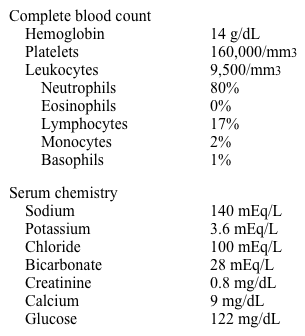 Which of the following is the most likely cause of this patient's symptoms?
 (Multiple Choice)
4.7/5 (77)
(77) A 60-year-old man comes to the office due to edema of his face and ankles for the last 2 weeks. He has had no chest pain or breathlessness. The patient has a 15-year history of type 2 diabetes mellitus, which is currently managed with exercise, dietary modification, and glipizide. A month ago, his glycosylated hemoglobin level was 6.9%. Temperature is 37 C (98.6 F), blood pressure is 146/87 mm Hg, pulse is 75/min, and respirations are 15/min. Physical examination shows periorbital edema and bilateral pitting edema around the ankles. The remainder of the examination is normal. Laboratory studies are as follows:  The patient's electrocardiogram is normal. Urine protein is 3,700 mg/24 hr. Which of the following measures is most likely to slow the progression of this patient's kidney disease?
 (Multiple Choice)
4.9/5 (69)
(69) A 75-year-old man is brought to the emergency department with severe back pain that began 3 weeks ago. The pain has been significantly worse for the last 12 hours. This morning, the patient also noticed difficulty walking and urinating. He has a history of advanced prostate cancer initially treated with local radiation therapy. Temperature is 37 C (98.6 F), blood pressure is 122/83 mm Hg, and pulse is 104/min. The patient appears uncomfortable. He has point tenderness over the midline spine near T10 and T11. Upper extremity strength and reflexes are normal. Muscle strength in the lower extremities is 3/5 and deep-tendon reflexes are 3+ bilaterally. Bilateral plantar reflexes are upgoing. Straight urinary catheterization produces 800 mL of urine. Which of the following is the best initial step in management of this patient?
(Multiple Choice)
4.9/5 (84)
(84) A 52-year-old man is brought to the emergency department by his daughter due to a fall while climbing stairs. He has mild pain in his right arm but no other obvious injuries. The patient has had frequent stumbling and near-falls over the last 2 months. He has also had significant fatigue, chronic abdominal pain, constipation, and recurrent headaches as well as a "pins-and-needles sensation" in his palms and soles. His daughter notes he has been more forgetful recently. The patient has smoked a pack of cigarettes daily for 20 years and drinks beer on weekends. A year ago, he started work as a janitorial custodian at a battery manufacturing plant and finds his job moderately stressful. The patient has not had regular medical follow-ups. Blood pressure is 160/90 mm Hg, and pulse is 84/min. The abdomen is soft and nontender, and no masses are palpable. There is mild tenderness over the right middle ulna with normal range of motion at the wrist and elbow. Neurological evaluation shows reduced pinprick sensation bilaterally in hands and feet. There is weakness of adduction and abduction of the fingers and of bilateral thigh and knee extensors. The patient has a wide-based gait and is unable to tandem walk. Laboratory results are as follows: 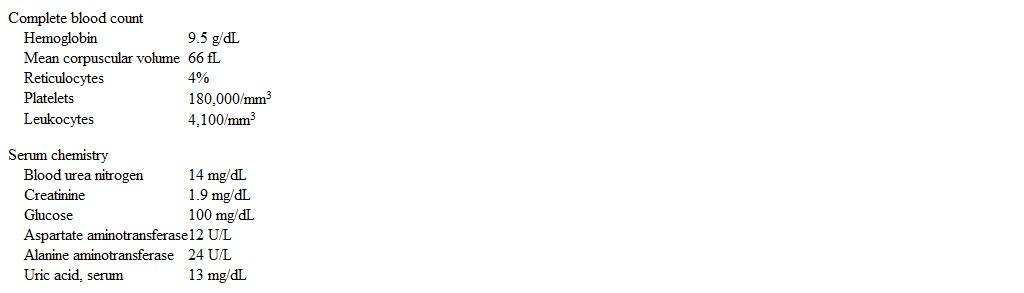 Which of the following is the most likely diagnosis for this patient's clinical presentation?
 (Multiple Choice)
4.9/5 (90)
(90) A 52-year-old man comes to the office for evaluation of hearing loss in the left ear. The patient works in sales and is frequently on the phone. Over the past several months, he has had difficulty hearing phone conversations in the left ear and must move the headset to the right. He has no pain or vertigo but sometimes feels off-balance when walking at night and holds onto walls. Vital signs are within normal limits. Physical examination reveals normal tympanic membranes with no middle ear effusion on either side. A tuning fork placed on the forehead is heard best in the right ear. Air conduction is greater than bone conduction bilaterally. There is decreased sensation to touch on the left side of the face. Bilateral upper and lower extremity strength, deep tendon reflexes, and sensation are normal. Which of the following is the most likely cause of this patient's symptoms?
(Multiple Choice)
4.9/5 (78)
(78) A 68-year-old hospitalized man is evaluated for new-onset leg weakness. Six days ago, he was admitted to the hospital due to fever, right leg pain, and swelling. Physical examination showed right lower extremity edema, erythema, warmth, and tenderness from the foot to the midcalf. Leukocyte count was 16,000/mm3, and venous Doppler ultrasonography revealed patent leg veins without thrombosis. Blood cultures grew Staphylococcus aureus. The patient was treated with intravenous antibiotics, and his leg symptoms improved. However, this morning he had trouble getting out of bed due to significant leg weakness. The patient has a history of hypertension, type 2 diabetes mellitus, coronary artery disease, and systolic heart failure. He also has chronic low back pain from a work-related injury. The patient has had worsening mid-back pain over the last 2 days. Temperature is 38 C (100.4 F), blood pressure is 130/80 mm Hg, and pulse is 88/min. Physical examination shows normal mental status and cranial nerves. Abdominal examination reveals a suprapubic mass. There is midline tenderness over the lower thoracic vertebral area. Upper extremity strength is normal, but he is not able to lift either lower extremity against gravity. Which of the following is the best next step in management of this patient?
(Multiple Choice)
4.8/5 (75)
(75) A 22-year-old female presents with complaints of heat intolerance, sweating and palpitations. She also reports menstrual irregularities, increased appetite and diarrhea. Her pulse is 102/min and regular, blood pressure is 116/80 mm Hg, temperature is 37.2° C (99° F), and respirations are 14/min. Physical examination reveals a diffusely enlarged, nontender thyroid gland. TSH level is 0.05 mU/L. Free T4 and T3 levels are elevated. Radioactive iodine uptake at 24 hours is 50 percent. Thyroid stimulating immunoglobulins are present. She is started on propylthiouracil 300 mg daily in three divided doses. After two weeks, she returns and complains of a sore throat. Her pulse is 98/min and regular, temperature is 38.6° C (101.5° F), blood pressure is 115/76 mm Hg, and respirations are 15/min. The soft palate, pharynx, and tonsils are red and swollen. What is the most appropriate next step in the management of this patient?
(Multiple Choice)
5.0/5 (75)
(75) A 36-year-old woman comes to the office for evaluation of fatigue and generalized weakness for the past several weeks. She has had no appetite or weight changes, heat or cold intolerance, nausea or vomiting, or constipation. The patient's medical and family histories are unremarkable. Temperature is 36.7 C (98 F), blood pressure is 120/70 mm Hg, pulse is 76/min, and respirations are 14/min. Physical examination shows normal heart and lung sounds, an unremarkable abdominal examination, and no focal neurologic deficits. Laboratory results are as follows:  Which of the following is the best next step in management of this patient?
 (Multiple Choice)
4.9/5 (66)
(66) A 63-year-old woman comes to the office due to leg swelling that is especially bothersome in the evening. Her symptoms have gradually worsened over the last year. Her medical problems include hypertension treated with lisinopril and obstructive sleep apnea for which she uses continuous positive airway pressure during sleep. She was hospitalized 2 years ago for a chest infection that was treated with antibiotics. The patient has smoked a pack of cigarettes daily for 30 years and does not drink alcohol. Blood pressure is 160/90 mm Hg and pulse is 80/min. BMI is 32 kg/m2. Jugular venous pulsation is seen 2 cm above the sternal angle with the head of the bed elevated to 45°. Chest examination shows bilateral scattered wheezes and prolonged expirations. Her abdomen is soft and nondistended. She has bilateral 2+ pitting edema in her lower extremities to the midshin with dilated and tortuous superficial veins. A small ulcer is noted on the left medial ankle. All peripheral pulses are palpable. Which of the following is most likely to relieve this patient's current symptoms?
(Multiple Choice)
4.9/5 (77)
(77) A 41-year-old man comes to the emergency department due to 4 days of rapidly worsening dyspnea, nonproductive cough, fever, and chills. The patient developed acute liver failure due to Wilson disease and underwent orthotopic liver transplantation 5 months ago. He takes several immunosuppressants, including a glucocorticoid, but no antibiotics. The patient does not use tobacco, alcohol, or illicit drugs. Temperature is 38.9 C (102 F), blood pressure is 116/72 mm Hg, pulse is 112/min, and respirations are 28/min. Oxygen saturation is 82% on ambient air. Pulmonary examination reveals bilateral crackles. Leukocyte count is 12,000/mm3 and serum lactate dehydrogenase level is 330 U/L. Chest x-ray reveals bilateral, diffuse interstitial infiltrates. An adequate sputum sample cannot be obtained. Which of the following tests is most likely to yield the diagnosis in this patient?
(Multiple Choice)
4.8/5 (88)
(88) A 67-year-old man comes to the office for a new patient evaluation after recently relocating to a retirement community. The patient has a history of hypertension treated with losartan. He has a 40-pack-year history but quit smoking 5 years ago. Blood pressure is 130/80 mm Hg and pulse is 80/min. Examination reveals a bruit in the right side of the neck; the remainder of the examination is normal. Carotid duplex ultrasonography reveals 45% stenosis at the right common carotid artery bifurcation. The left common carotid artery has a lesion causing 40% stenosis. Hemoglobin A1c is 5.3% and LDL cholesterol is 120 mg/dL. Which of the following is the best next step in management of this patient's arterial abnormalities?
(Multiple Choice)
4.9/5 (71)
(71) A 48-year-old woman comes to the office for evaluation of elevated blood pressure, which was first noted at her dentist's office 4 weeks ago. Repeated home blood pressure measurements since then have remained around 150/90 mm Hg. The patient has had no symptoms and has no history of hypertension or other medical conditions. She takes no medications and does not use tobacco, alcohol, or illicit drugs. Family history is significant for hypertension in her father. Blood pressure is 152/88 mm Hg and pulse is 76/min. A repeat blood pressure measurement after 15 minutes shows a similar reading. BMI is 28.6 kg/m2. Physical examination reveals clear lungs, normal heart sounds, a nontender abdomen with no organomegaly, and no lower extremity edema. There are no abnormalities on ECG. Laboratory testing shows normal serum electrolytes and creatinine and no proteinuria. Which of the following additional evaluations is most appropriate in this patient?
(Multiple Choice)
4.9/5 (82)
(82) A 28-year-old man comes to the physician for evaluation of infertility. He is healthy and has no other complaints. He eats a high-protein diet and exercises daily in order to be muscular. He weighs 85 kg (187 lb) and is 175 cm (5'8") tall. His temperature is 37.2° C (98.9° F) and blood pressure is 130/82 mm Hg. Physical examination shows small testes. The remainder of the examination shows no abnormalities. Initial laboratory studies show: 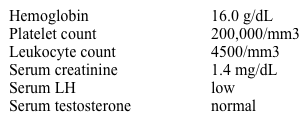 Which of the following is the most likely cause of his infertility?
 (Multiple Choice)
4.7/5 (79)
(79) Two patients with community-acquired pneumonia, Patient A and Patient B, are admitted to the intensive care unit (ICU) of a small community hospital. Blood cultures are ordered on both patients. At the start of a 12-hour day shift, an on-call senior resident who is caring for both patients receives notification from the laboratory that Patient A's blood cultures are growing gram-positive cocci in clusters. The resident enters an electronic order for intravenous vancomycin but mistakenly places the order for Patient B instead of Patient A. Two days later, Patient B experiences acute kidney injury. The nephrologist identifies the error, and vancomycin is immediately discontinued. Which of the following changes would root cause analysis most strongly support to prevent future occurrences of this error?
(Multiple Choice)
4.8/5 (77)
(77) A 64-year-old woman comes to the office due to a bitemporal headache that has slowly worsened over the past week. The patient has also had dizziness, blurry vision, and tingling and numbness of her feet. She has had no fever or jaw pain. The patient has a history of hypertension, for which she takes lisinopril. She does not use tobacco or alcohol. Temperature is 37.2 C (99.0 F), blood pressure is 140/90 mm Hg, pulse is 70/min, and respirations are 16/min. Physical examination shows moist mucous membranes, normal tympanic membranes, and no sinus or temporal area tenderness. Bilateral pupils are equal and reactive. Visual acuity is decreased in both eyes, and funduscopic examination reveals dilated, segmented, and tortuous retinal veins. Facial sensation and strength are normal. Bilateral upper and lower extremity muscle strength is normal. There is decreased pinprick sensation and loss of ankle reflex bilaterally in the feet. Laboratory results are as follows: 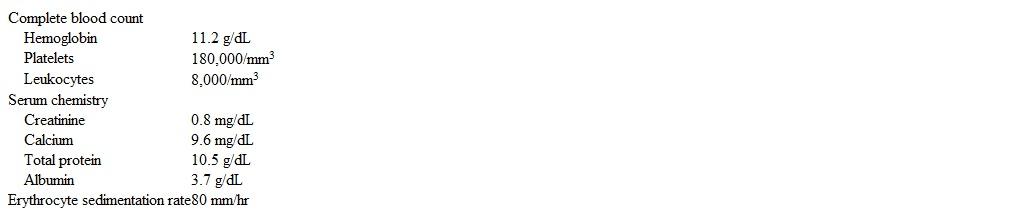 Which of the following is the best next diagnostic study for this patient?
 (Multiple Choice)
4.8/5 (76)
(76) A 57-year-old man comes to the office due to constant middle and low thoracic back pain. The pain started 4 weeks ago and has progressively worsened. It is greatest at night, particularly when he lies down. The patient has had no trauma to the back and has no bowel or bladder symptoms. Review of systems is positive for a 4.5 kg (10 lb) weight loss and fatigue. He has no chronic medical conditions and takes no medications other than a multivitamin. The patient has smoked cigarettes since high school and occasionally drinks beer on weekends. Temperature is 37 C (98.6 F), blood pressure is 110/70 mm Hg, pulse is 80/min, and respirations are 16/min. BMI is 28 kg/m2. Examination of the spine shows no focal tenderness, and spinal range of motion is normal. Straight leg raise testing does not elicit pain. Muscle strength and sensation are intact in the lower extremities. Deep tendon reflexes are 2+ bilaterally. Babinski sign is absent. X-ray of the spine shows no abnormalities. Complete blood count and serum creatinine are within normal limits. Which of the following is the most appropriate next step in management?
(Multiple Choice)
4.8/5 (57)
(57) Showing 1341 - 1360 of 1702
 Prev
- 1
- ...
- 2
- ...
- 3
- ...
- 4
- ...
- 5
- ...
- 6
- ...
- 7
- ...
- 8
- ...
- 9
- ...
- 10
- ...
- 11
- ...
- 12
- ...
- 13
- ...
- 14
- ...
- 15
- ...
- 16
- ...
- 17
- ...
- 18
- ...
- 19
- ...
- 20
- ...
- 21
- ...
- 22
- ...
- 23
- ...
- 24
- ...
- 25
- ...
- 26
- ...
- 27
- ...
- 28
- ...
- 29
- ...
- 30
- ...
- 31
- ...
- 32
- ...
- 33
- ...
- 34
- ...
- 35
- ...
- 36
- ...
- 37
- ...
- 38
- ...
- 39
- ...
- 40
- ...
- 41
- ...
- 42
- ...
- 43
- ...
- 44
- ...
- 45
- ...
- 46
- ...
- 47
- ...
- 48
- ...
- 49
- ...
- 50
- ...
- 51
- ...
- 52
- ...
- 53
- ...
- 54
- ...
- 55
- ...
- 56
- ...
- 57
- ...
- 58
- ...
- 59
- ...
- 60
- ...
- 61
- ...
- 62
- ...
- 63
- ...
- 64
- ...
- 65
- ...
- 66
- ...
- 67
- ...
- 68
- ...
- 69
- ...
- 70
- ...
- 71
- ...
- 72
- ...
- 73
- ...
- 74
- ...
- 75
- ...
- 76
- ...
- 77
- ...
- 78
- ...
- 79
- ...
- 80
- ...
- 81
- ...
- 82
- ...
- 83
- ...
- 84
- ...
- 85
- ...
- 86
- ...
- Next

Filters
- Essay(0)
- Multiple Choice(0)
- Short Answer(0)
- True False(0)
- Matching(0)