


 Chat with AI
Exam 1: Medicine

Exam 1: Medicine2 k Questions
Exam 2: Pediatric723 Questions
Exam 3: Psychiatry336 Questions
Exam 4: Surgery563 Questions
Exam 5: Obstetrics & Gynecology469 Questions
Select questions type


A 68-year-old man comes to the office for follow-up of an abnormal finding on abdominal CT scan. Two weeks ago, the patient was seen in the emergency department for left lower quadrant abdominal pain. CT scan revealed acute sigmoid diverticulitis, which improved with oral antibiotics, as well as a cyst in the head of the pancreas. The patient has no history of pancreatic diseases and reports no epigastric pain, diarrhea, or weight loss. He used to drink alcohol heavily but stopped several years ago and does not smoke cigarettes. Family history is unremarkable. Vital signs are within normal limits. Physical examination shows no abnormalities. MRI of the abdomen confirms a 4.6-cm, multilocular cyst in the head of the pancreas with thickened walls. The main pancreatic duct is mildly dilated. Serum amylase, lipase, and liver chemistry studies are within normal limits. Which of the following is the next best step in management of this patient?
(Multiple Choice)
4.7/5  (81)
(81) A 56-year-old woman comes to the emergency department due to a severe headache that has not responded to over-the-counter analgesics. The generalized headache began 4 hours ago and rapidly worsened over several minutes. The patient has also experienced photophobia and an episode of vomiting and now reports vague discomfort in her neck and back. She has occasionally had headaches that were not as severe. She has a history of hypertension and takes lisinopril. The patient does not use tobacco, alcohol, or illicit drugs. She is an architect and reports high stress due to a large new project. Temperature is 37.3 C (99.1 F), blood pressure is 150/84 mm Hg, pulse is 94/min and regular, and respirations are 16/min. Pulse oximetry is 98% on room air. The pupils are equal and reactive. Extraocular movements and funduscopy are normal. There is mild neck stiffness, but muscle strength, deep tendon reflexes, and sensation are normal in the bilateral upper and lower extremities. Babinski sign is absent. The remainder of the examination shows no abnormalities. Noncontrast CT scan of the head is normal. Which of the following is the best next step in management of this patient?
(Multiple Choice)
4.9/5 (77)
(77) A 65-year-old man comes to the office due to a week of low-grade fever and dull pain in his right foot. He developed a small ulcer on his right foot 2 months ago that slowly worsened and never healed. He does not recall any precipitating trauma. The patient has a history of type 2 diabetes mellitus, hypertension, hyperlipidemia, coronary artery disease, and peripheral artery disease. He smoked a pack of cigarettes daily for 35 years but quit 5 years ago. Temperature is 38.3 C (101 F), blood pressure is 130/80 mm Hg, and pulse is 88/min. Physical examination shows a 2x2 cm ulcer on the plantar surface of the right forefoot surrounded by a halo of erythema and edema. There is no visible bone at the base of the ulcer, and metal probing does not contact bone. Pedal pulses are decreased bilaterally. Right foot x-ray reveals cortical erosion of the first metatarsal. Which of the following is the most likely mechanism for bone infection in this patient?
(Multiple Choice)
4.7/5 (88)
(88) A 26-year-old woman comes to the office due to progressive tiredness. The patient has no known chronic medical conditions and takes no medications. Her menstrual periods are regular, and bleeding lasts 3 days. The patient does not use tobacco, alcohol, or illicit drugs. Examination shows no abnormalities. Complete blood count is as follows:  Fecal occult blood test is negative. Iron therapy is initiated. When the patient returns 6 weeks later, her laboratory findings are unchanged. Which of the following is the most likely cause of this patient's condition?
 (Multiple Choice)
5.0/5 (87)
(87) A 74-year-old man comes to the office due to 3 months of "problems of old age." He has daily temporal headaches and feels quite fatigued. Intermittently, the patient's ears ring and his eyes become blurry. Both feet feel as if someone is "sticking them with electric pins." The patient used to smoke cigarettes but now uses vaporized nicotine. His medical history is unremarkable. Temperature is 36.6 C (97.8 F), blood pressure is 128/74 mm Hg, and pulse is 88/min. He is well appearing. There is moderate cervical lymphadenopathy. Cardiopulmonary examination is normal. Hepatosplenomegaly is present. Funduscopy shows dilated, segmented, and tortuous retinal veins. There are sensory deficits in his feet, but reflexes and strength are intact. Laboratory results are as follows: 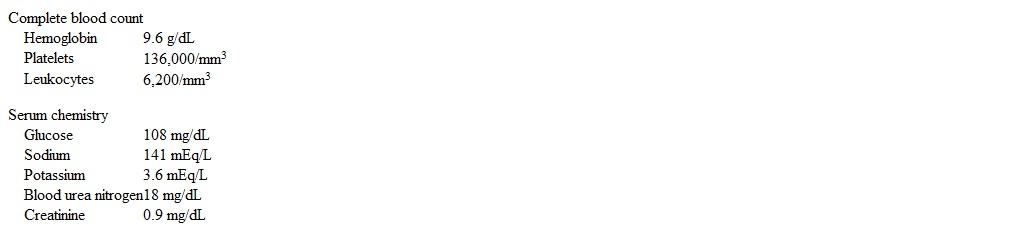 Serum protein electrophoresis reveals a sharp IgM spike. Which of the following is the most likely diagnosis for this patient?
 (Multiple Choice)
4.8/5 (84)
(84) A 50-year-old man comes to the office due to lightheadedness and fatigue for the last several weeks. Over the last few days, he has become lightheaded when standing up. He has also experienced subjective fevers and a daily cough for the past 3 months and has lost 8 kg (17.6 lb) during that time. The patient has no known medical history. He does not use tobacco, alcohol, or illicit drugs and takes no medications. He immigrated from Southeast Asia 25 years ago and occasionally makes trips back there to visit family. Temperature is 38 C (100.4 F), blood pressure is 96/62 mm Hg, pulse is 98/min and regular, and respirations are 14/min. Oxygen saturation is 94% on room air. On physical examination, the neck veins are flat. Laboratory results are as follows: 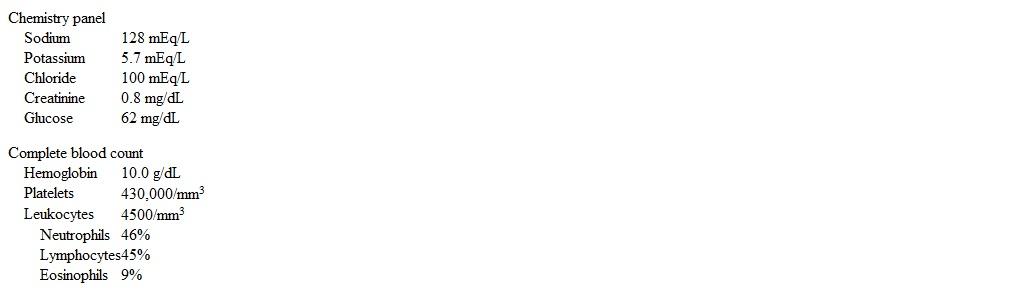 Chest x-ray reveals patchy airspace disease in the left upper lung lobe as well as mediastinal lymphadenopathy. Which of the following is most likely responsible for this patient's lightheadedness?
 (Multiple Choice)
4.9/5 (76)
(76) A 45-year-old man comes to the physician for follow-up after a recent emergency department visit for abdominal pain. The pain subsided with analgesics. However, he was found to have elevated blood pressure and an incidental right adrenal mass on abdominal imaging. The patient has no prior abnormal findings. He has no symptoms except mild headache, which he attributes to stress at work. He does not use tobacco, alcohol, or illicit drugs. The patient's blood pressure today is 160/94 mm Hg. Serum potassium is 3.0 mEq/L and sodium is 146 mEq/L. Further workup shows a plasma aldosterone/plasma renin activity ratio of 45. He refuses to undergo surgery for removal of the adrenal mass. Which of the following is the best initial therapy for this patient?
(Multiple Choice)
4.8/5 (82)
(82) A 25-year-old woman comes to the physician complaining of a 3-day history of burning with urination and increased urinary frequency. She has suprapubic discomfort but no unusual vaginal discharge. The patient has been sexually active and monogamous with her husband for the past 4 years. She has never been pregnant and uses condoms for contraception. Her last menstrual period was 2 weeks ago, and her last sexual encounter was 2 days ago. She takes no medications and has no known drug allergies. Her temperature is 37.1 C (98.9 F), blood pressure is 110/70 mm Hg, pulse is 68/min, and respirations are 15/min. Examination shows suprapubic tenderness without flank tenderness. The rest of the examination is within normal limits. Her urine pregnancy test is negative. Laboratory results are as follows: 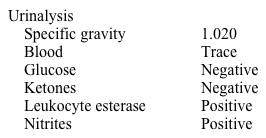 Which of the following is the most appropriate next step in management of this patient?
 (Multiple Choice)
4.9/5 (79)
(79) A 32-year-old man comes to the emergency department due to a day of worsening pain and swelling in his right leg. He has no fever, chest pain, or shortness of breath. The patient was hospitalized 2 weeks ago for right lower extremity deep vein thrombosis after a minor sports injury; he was discharged on warfarin. When he left the hospital, his INR was 2.2 (goal: 2-3). The patient has been taking warfarin daily; however, due to a busy work schedule, his dietary intake has been variable and last week he missed his clinic appointment for anticoagulation monitoring. He has no other medical problems. Blood pressure is 120/70 mm Hg, pulse is 70/min, and respirations are 14/min. Examination shows moderate pretibial edema in the right leg. Today, his INR is 1.3. Platelet count, creatinine, and liver function tests are within normal limits. Venous Doppler ultrasound shows a right popliteal vein thrombus that extends into the femoral vein and is worse than on previous ultrasound. What is the best next step in management of this patient?
(Multiple Choice)
4.8/5 (85)
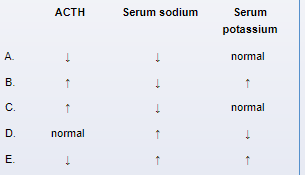
(85) A 31-year-old woman comes to the office due to worsening fatigue and abdominal pain for the last month since the birth of her child. She had an emergency cesarean delivery complicated by significant hemorrhage that required transfusion of multiple units of blood. The patient reports that she has been unable to breastfeed and has switched to formula to feed her infant. She also reports occasional dizziness when standing. Temperature is 36.1 C (97 F), blood pressure is 96/64 mm Hg, and pulse is 96/min. The skin is dry, and the abdomen is nontender to palpation. The patient has sparse axillary and pubic hair. The remainder of the examination is unremarkable. Which of the following laboratory findings would likely be seen in this patient?
(Multiple Choice)
4.9/5 (65)
(65) A 35-year-old woman comes to the office due to a rash. For the past year, she has had progressive development of multiple lesions on her face, neck, and central chest associated with mild pruritus. The patient otherwise feels well and has no chronic medical conditions. Vital signs are normal. Skin examination reveals numerous scaly lesions with pigment changes and shallow ulceration, as shown in the exhibit.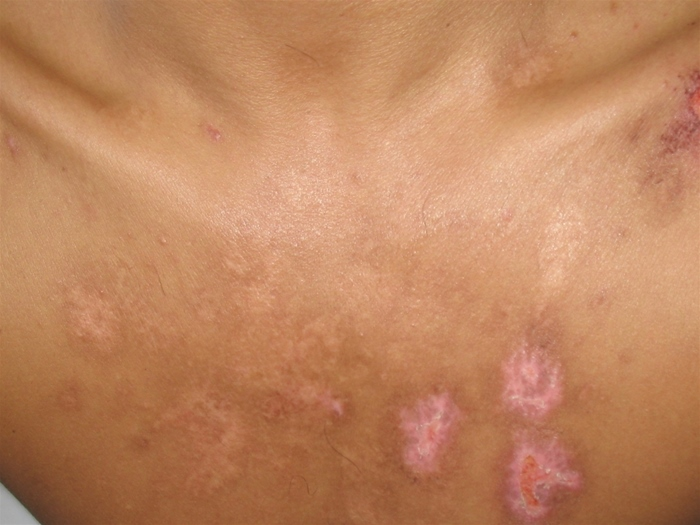 Which of the following is the most likely diagnosis for this patient's skin disorder?
 (Multiple Choice)
4.7/5 (82)
(82) An 18-month-old boy is brought to the emergency department due to respiratory distress. Severe cough and wheezing began an hour ago while the patient was playing at his cousin's house. Temperature, blood pressure, and pulse are normal. Respirations are 46/min, and pulse oximetry is 90% on room air. Oropharynx is unremarkable. There are suprasternal and intercostal retractions. Auscultation reveals a prolonged expiratory phase as well as wheezing without crackles over the right lung. There is hyperresonance to percussion on the right chest. The left lung is clear without crackles or wheezes. Cardiac examination shows normal S1 and S2. The abdomen is soft and nontender. Skin examination shows no rashes. The patient receives a dose of nebulized albuterol and supplemental oxygen with no improvement. Chest radiograph is shown in the image below: 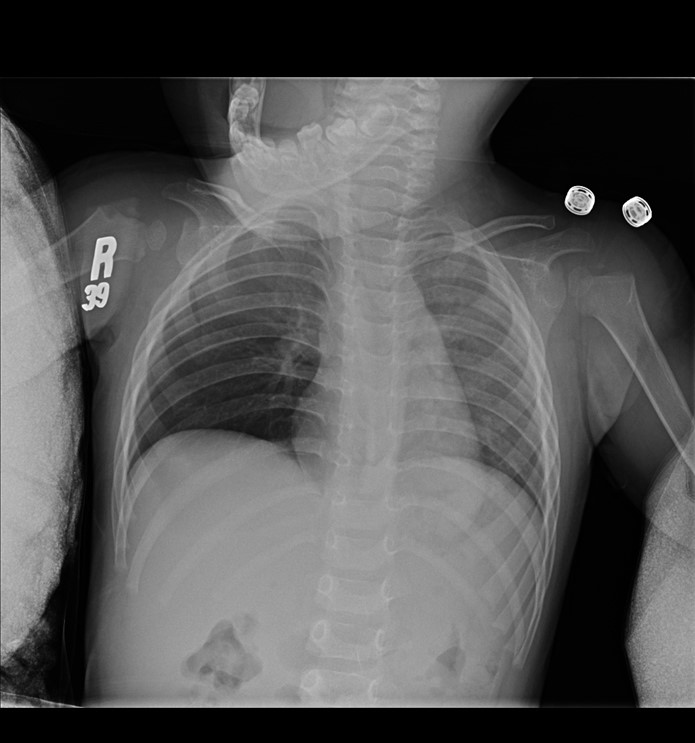 Which of the following is the most likely cause of this patient's symptoms?
 (Multiple Choice)
4.7/5 (77)
(77) A 45-year-old man presents with two days of bilateral hand pain that is most severe in his wrists. Physical examination reveals bilateral wrist tenderness, thickening of the distal fingers, and convex nail beds. There is nicotine staining of the right index and middle fingers. He states that he has been smoking 2 packs of cigarettes a day for the past 25 years. Chest examination reveals decreased breath sounds and a prolonged expiratory phase. The patient relates the pain's onset to a data entry job he recently started. He notes that his boss believes he is fabricating his pain to get off work. His job record reveals numerous sick leaves. Which of the following is the most appropriate course of action?
(Multiple Choice)
4.9/5 (72)
(72) A 75-year-old man comes to the office due to progressive hearing loss. The patient reports a decline in his ability to hear conversations, especially in noisy places like restaurants, and difficulty tolerating loud sounds. He also hears a constant buzzing noise in both ears. The patient does not know when the symptoms began, but they have worsened over the past year. Medical history includes hypertension and type 2 diabetes mellitus. He takes atorvastatin, metformin, and lisinopril. He has a 40-pack-year history of smoking but stopped 20 years ago. Otoscopic examination is normal. A tuning fork placed in the middle of the forehead is heard equally on both sides, and air conduction is greater than bone conduction bilaterally. Which of the following is the most likely diagnosis in this patient?
(Multiple Choice)
4.8/5 (71)
(71) A 45-year-old woman comes to the hospital due to sudden-onset, right-sided flank pain that started 12 hours ago. The patient has had fever and malaise for the past 2 weeks and has been taking over-the-counter ibuprofen intermittently for a presumed viral infection. She has had no dyspnea, cough, chest pain, or urinary symptoms. Temperature is 38.7 C (101.7 F), blood pressure is 110/78 mm Hg, pulse is 102/min, and respirations are 16/min. Lung sounds are normal. A 2/6 systolic murmur is present at the cardiac apex. Right flank tenderness is present. The remainder of the examination shows no abnormalities. Laboratory results are as follows: 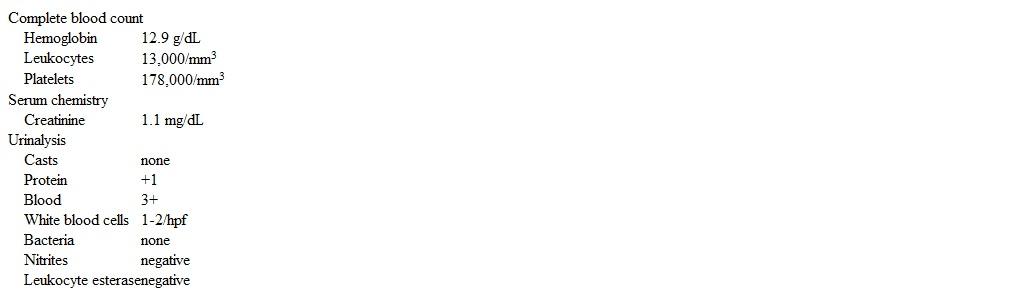 CT scan of the abdomen is shown below:
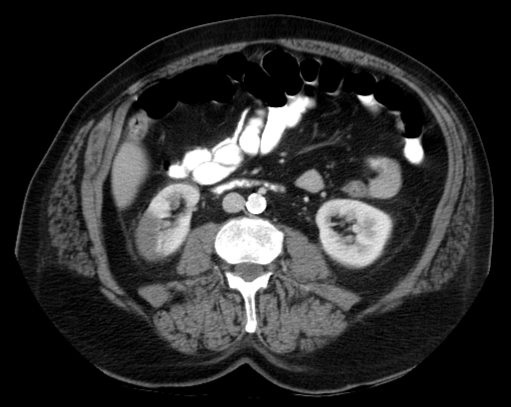 Which of the following is the most likely cause of this patient's current symptoms?
CT scan of the abdomen is shown below:
Which of the following is the most likely cause of this patient's current symptoms? (Multiple Choice)
4.8/5 (81)
(81) A study was conducted to assess the association between hormone replacement therapy (HRT) in post-menopausal women and the level of serum C-reactive protein (CRP), categorized as "high" or "normal" based on predefined values. The data from the study are presented below: 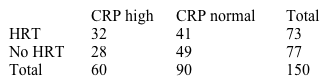 Which of the following is the best statistical method to assess the association between HRT and CRP levels?
 (Multiple Choice)
4.8/5 (81)
(81) A 66-year-old man comes to the office for evaluation of low back pain and difficulty walking for the past several months. The pain is worse with prolonged standing and is relieved by sitting. The pain is also less severe with walking uphill than with walking downhill. Medical history is significant for degenerative joint disease of both knees. The patient does not use tobacco, alcohol, or drugs. He takes acetaminophen as needed. His temperature is 37.2 C (98.9 F), and blood pressure is 126/76 mm Hg. His abdomen is soft and nontender. There is no spinal tenderness to palpation and a straight leg raise elicits no pain. Reflexes are 2+ in both legs. There is no Babinski sign. Dorsalis pedis pulses are full and equal in both feet. Which of the following is most helpful in diagnosing his current condition?
(Multiple Choice)
4.8/5 (75)
(75) A 65-year-old man comes to the office due to recurrent falls. For the last several months, the patient has had a sensation of imbalance that is worse at night but has no associated pain or motor weakness. Medical history is notable for type 2 diabetes mellitus diagnosed 20 years ago and hypertension diagnosed 10 years ago. The patient was found to have nonproliferative diabetic retinopathy at his last ophthalmologic visit. Current medications include insulin, metformin, rosuvastatin, and ramipril. He does not use tobacco but drinks 1 or 2 beers daily and, often, more on weekends. Physical examination shows decreased proprioception and vibration sense in the feet. Ankle jerk reflexes are absent. Finger-to-nose and heel-to-shin tests are normal, but the patient sways and tends to fall when his eyes are closed. Bilateral hammer toe deformities are present. The remainder of the examination is unremarkable. Which of the following processes is predominantly responsible for this patient's neurologic symptoms?
(Multiple Choice)
4.8/5 (85)
(85) A 60-year-old woman is brought to the hospital due to lethargy and confusion that have progressed over the last 2 days. This morning she was hard to arouse. The patient's husband says that she has lost 4.5 kg (10 lb) over the preceding 2-month period and has had a dry cough. She has no other medical problems and takes no medication. The patient has a 40-pack-year smoking history. She does not drink alcohol. Temperature is 37 C (98.6 F), blood pressure is 110/70 mm Hg, pulse is 75/min, and respirations are 16/min. She is not orthostatic. The patient is markedly confused. Her mucous membranes are moist. There is no jugular venous distension. Breath and heart sounds are normal. Neurologic examination shows no focal abnormalities. There is no ankle edema or ascites. Laboratory results are as follows: 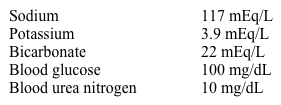 Serum osmolality is 250 mOsm/kg H2O, and urine osmolality is 500 mOsm/kg H2O. Chest x-ray reveals a mass in the right hilar region. CT scan of the head is unremarkable. Which of the following is the best next step in management of this patient?
 (Multiple Choice)
4.8/5 (91)
(91) A 54-year-old woman comes to the office due to a slow-growing, painless mass in the right submandibular region. The patient had a right molar extraction for severe tooth decay 2 months ago and soon thereafter developed swelling of the right jaw. There was no pain or fever so she did not seek medical attention. The swelling slowly worsened and 3 days ago began draining a thick yellow discharge. The patient has a history of poorly controlled type 2 diabetes mellitus. Temperature is 37.2 C (99 F), blood pressure is 134/78 mm Hg, pulse is 88/min, and respirations are 18/min. Physical examination shows a 4x4 cm, firm, nontender, indurated mass below the angle of the right mandible with erythematous overlying skin. Palpation expresses serosanguineous fluid with small yellow granules through a small defect in the center of the lesion. There is no crepitus. Anaerobic culture of the needle aspirate grows filamentous gram-positive rods with rudimentary branching. Which of the following is the best initial treatment for this patient?
(Multiple Choice)
5.0/5 (79)
(79) Showing 701 - 720 of 1702
 Prev
- 1
- ...
- 2
- ...
- 3
- ...
- 4
- ...
- 5
- ...
- 6
- ...
- 7
- ...
- 8
- ...
- 9
- ...
- 10
- ...
- 11
- ...
- 12
- ...
- 13
- ...
- 14
- ...
- 15
- ...
- 16
- ...
- 17
- ...
- 18
- ...
- 19
- ...
- 20
- ...
- 21
- ...
- 22
- ...
- 23
- ...
- 24
- ...
- 25
- ...
- 26
- ...
- 27
- ...
- 28
- ...
- 29
- ...
- 30
- ...
- 31
- ...
- 32
- ...
- 33
- ...
- 34
- ...
- 35
- ...
- 36
- ...
- 37
- ...
- 38
- ...
- 39
- ...
- 40
- ...
- 41
- ...
- 42
- ...
- 43
- ...
- 44
- ...
- 45
- ...
- 46
- ...
- 47
- ...
- 48
- ...
- 49
- ...
- 50
- ...
- 51
- ...
- 52
- ...
- 53
- ...
- 54
- ...
- 55
- ...
- 56
- ...
- 57
- ...
- 58
- ...
- 59
- ...
- 60
- ...
- 61
- ...
- 62
- ...
- 63
- ...
- 64
- ...
- 65
- ...
- 66
- ...
- 67
- ...
- 68
- ...
- 69
- ...
- 70
- ...
- 71
- ...
- 72
- ...
- 73
- ...
- 74
- ...
- 75
- ...
- 76
- ...
- 77
- ...
- 78
- ...
- 79
- ...
- 80
- ...
- 81
- ...
- 82
- ...
- 83
- ...
- 84
- ...
- 85
- ...
- 86
- ...
- Next

Filters
- Essay(0)
- Multiple Choice(0)
- Short Answer(0)
- True False(0)
- Matching(0)