


 Chat with AI
Exam 1: Medicine

Exam 1: Medicine2 k Questions
Exam 2: Pediatric723 Questions
Exam 3: Psychiatry336 Questions
Exam 4: Surgery563 Questions
Exam 5: Obstetrics & Gynecology469 Questions
Select questions type


A 74-year-old man comes to the office with increasing shortness of breath, especially on exertion. He also has cough with mucoid expectoration, especially in the morning. He has no orthopnea, paroxysmal nocturnal dyspnea, or chest pain. The patient was hospitalized for community-acquired pneumonia 2 years ago. His other medical problems include glaucoma, benign prostatic hyperplasia, and hypertension. He smoked a pack of cigarettes daily for 40 years and quit 2 years ago. His temperature is 37.2 C (98.9 F), blood pressure is 144/96 mm Hg, pulse is 82/min, and respirations are 16/min. Pulse oximetry shows an oxygen saturation of 89% on room air at rest. His face appears plethoric. The chest is barrel shaped. Breath sounds are diminished throughout, and the expiratory phase is prolonged. Heart sounds are distant but regular, and there are no murmurs or gallops. There is no peripheral edema or jugular venous distension. Laboratory results are as follows: 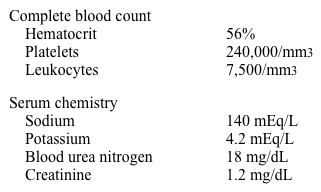 Which of the following interventions will have the maximum impact on this patient's survival?
 (Multiple Choice)
4.8/5  (68)
(68) A 2-year-old girl is brought to the emergency department for fever. Eight days ago, the patient developed fever, abdominal pain, vomiting, and watery diarrhea. Her gastrointestinal symptoms subsided in 3 days, but her fever has persisted and has not responded to ibuprofen and acetaminophen. The patient has also been irritable with decreased oral intake. Temperature is 39.4 C (102.9 F), blood pressure is 110/60 mm Hg, pulse is 120/min, and respirations are 24/min. Examination shows injected sclera and dry, red, cracked lips. Heart and lungs are clear to auscultation. The abdomen is soft and nontender without organomegaly. Perineal erythema and a macular rash are present over the trunk and distal extremities. Laboratory results are as follows:  Which of the following is the most appropriate next step in management?
 (Multiple Choice)
4.8/5 (82)
(82) A 34-year-old previously healthy woman comes to the office due to itchy eyes for the past several months. The patient also reports frequent gritty sensations in her eyes and crusting of her eyelashes in the morning. She has had no eye pain, photophobia, or vision disturbances. The patient has not been exposed to ill contacts, uses no facial cosmetic products, and has not changed bath products recently. Eye examination is shown in the exhibit. 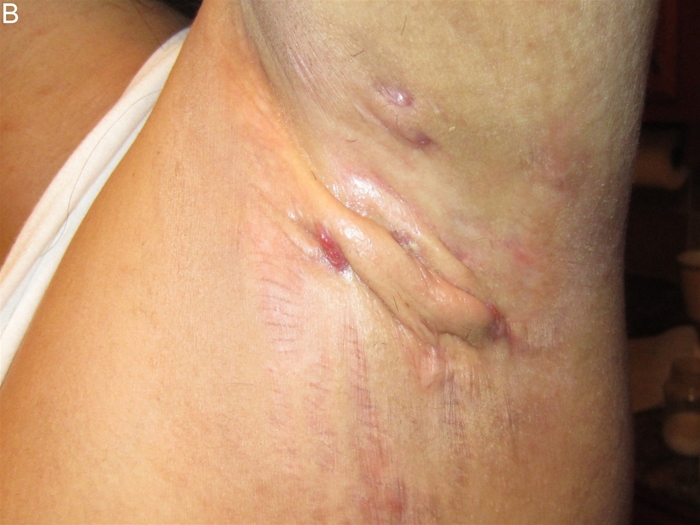 Seborrhea is present at the scalp and eyebrows, but the skin of the face is otherwise normal. Nasal and oropharyngeal mucosa are normal. Which of the following is the most likely diagnosis?
 (Multiple Choice)
4.9/5 (70)
(70) A 62-year-old man comes to the emergency department due to chest pain. The patient had occasional episodes of chest heaviness yesterday. Two hours ago, he had burning midline chest pain that lasted 30 minutes. The patient took aspirin on the way to the hospital; he currently has no chest pain or other issues. Medical history is significant for diet-controlled type 2 diabetes mellitus. The patient is an ex-smoker with a 20-pack-year smoking history. He has no known drug allergies. Blood pressure is 135/80 mm Hg, and pulse is 82/min and regular. Oxygen saturation is 95% on room air. BMI is 32 kg/m2. The lungs are clear on auscultation. There are no heart murmurs. Peripheral pulses are full and symmetric. ECG shows normal sinus rhythm with T-wave inversions in leads aVF and III. Cardiac troponin I level is 2.1 ng/mL (normal: <0.01 ng/mL). This patient would benefit most from which of the following?
(Multiple Choice)
4.8/5 (94)
(94) A 68-year-old man comes to the office due to right knee pain for the last several months. The pain is exacerbated by activity and occasionally associated with transient swelling but no warmth or fever. Medical history includes type 2 diabetes, hypertension, and hyperlipidemia. The patient was also diagnosed with gout 5 years ago when he had severe right foot pain, and it is treated chronically with low-dose allopurinol. He drinks 1 or 2 beers a day. Vital signs are normal. BMI is 32 kg/m2. The right knee is not swollen or erythematous, but active range of motion elicits pain. Hemoglobin A1c is 7.3% and serum uric acid level is 5.2 mg/dL (normal: 3.0-8.2). Knee x-ray is shown in the exhibit. 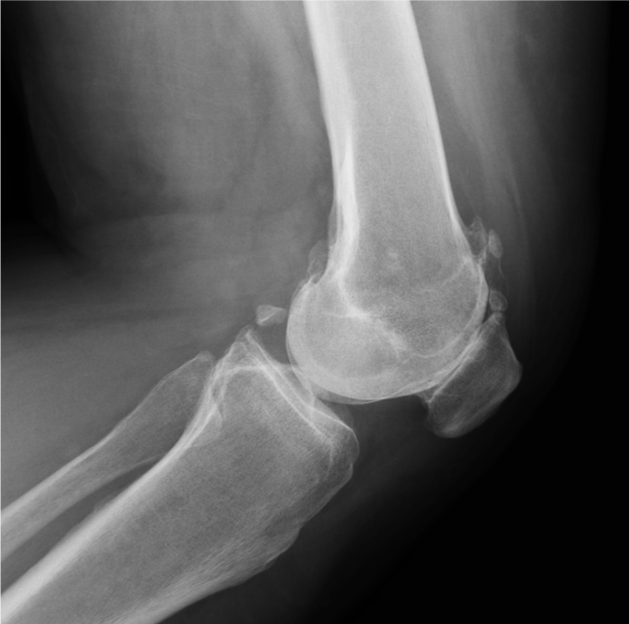 Which of the following interventions would provide the greatest long-term benefit for this patient's current symptoms?
 (Multiple Choice)
4.9/5 (87)
(87) A 25-year-old woman comes to the physician with 6 weeks of dyspnea and fatigue. She has no other medical problems and takes no medications. She does not use tobacco, alcohol, or illicit drugs. There is no family history of asthma or blood disorders. Her blood pressure is 110/70 mm Hg, pulse is 96/min, and respirations are 12/min. Examination shows pallor, scleral icterus, mild jaundice, and splenomegaly. Laboratory results are as follows: 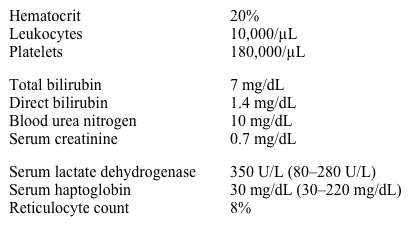 Peripheral blood smear shows spherocytes without central pallor. Direct Coombs test is positive. Based on these findings, which of the following is the most likely diagnosis?
 (Multiple Choice)
4.9/5 (78)
(78) A 68-year-old man is admitted with a left lower lobe pneumonia and is started on antibiotics. He has a long history of diabetes, hypothyroidism, hypercholesterolemia, and hypertension. He also has diabetic retinopathy, peripheral neuropathy, and nephropathy. He has an arterio-venous fistula placed for a possible dialysis. Medications are insulin, furosemide, atorvastatin, metoprolol and levothyroxine. After having his blood drawn for some laboratory studies today, he bleeds persistently. Laboratory studies show: 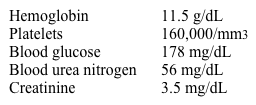 His baseline creatinine level is between 3.2-3.5 mg/dL. Which of the following is the most likely cause of his bleeding?
 (Multiple Choice)
4.9/5 (96)
(96) A 60-year-old man is brought to the emergency department due to fever, chills, and confusion. The patient was fishing in the ocean yesterday and cut his foot on a jagged rock while wading through shallow water. He was unable to clean the wound right away, and overnight, it became increasingly red and painful. The patient was awakened several times by fever and chills, and this morning, his wife found him disoriented. Medical history includes hypertension. Temperature is 38.8 C (101.8 F), blood pressure is 86/62 mm Hg, pulse is 118/min, and respirations are 24/min. On physical examination, the patient is in moderate distress. Heart sounds are rapid and regular with no murmurs. The lungs are clear to auscultation. Breathing is fast and shallow. The right foot shows a laceration with purulent drainage and erythema spreading to the midshin. The results of arterial blood gas testing on room air are as follows:  Which of the following best describes the acid-base status of this patient?
 (Multiple Choice)
4.7/5 (85)
(85) A 72-year-old man is brought to the emergency department after passing out while getting out of bed in the morning. The episode lasted a few minutes, and the patient rapidly recovered consciousness. Currently he reports generalized weakness but no chest pain, shortness of breath, or abdominal pain. He had decreased appetite and watery diarrhea for 2-3 days before admission. The patient takes atorvastatin for hyperlipidemia and lansoprazole for frequent heartburn. He has a strong family history of coronary artery disease. Blood pressure is 120/70 mm Hg when supine and 98/50 mm Hg when standing. The jugular veins are flat when the patient is in a sitting position. Auscultation of the chest reveals clear lung fields and normal cardiac sounds. The abdomen is soft and nontender, without organomegaly. ECG is normal. Which of the following laboratory values is the most sensitive indicator of the patient's current condition?
(Multiple Choice)
4.9/5 (74)
(74) A 15-year-old girl is brought to the office due to prolonged, irregular menstrual periods. Menses occur at 2- to 4-month intervals and last for 7-10 days with heavy bleeding and passage of large clots. The patient's menstrual cycles are nonpainful and she has no associated dizziness, fatigue, palpitations, or abnormal vaginal discharge. Menarche was at age 14 and her last menstrual period was a month ago. She has no other chronic medical conditions or previous surgeries. The patient has never been sexually active. Blood pressure is 110/70 mm Hg and pulse is 72/min. Height and weight are at the 40th and 56th percentiles, respectively. The thyroid is without nodules. The skin has no discoloration or ecchymosis. Breast and pubic hair development are Tanner stage V. External pelvic examination shows no lacerations, lesions, discharge, or bleeding. The hymenal membrane is intact. Hemoglobin is 10.4 g/dL. PT and aPTT are normal. Which of the following is the best next step in management of this patient?
(Multiple Choice)
4.9/5 (77)
(77) A 35-year-old woman comes to the office due to oral ulcers. She has multiple painful sores on her oral mucosa that began a few days ago. The patient had similar lesions 3 months ago that healed without scarring. In addition, she recently was evaluated by an ophthalmologist for blurred vision and was diagnosed with anterior uveitis. She has also had recurrent genital lesions requiring frequent gynecology appointments over the last year. On examination, there are visible oral ulcerations as well as scattered hyperpigmented skin lesions and tender, indurated areas on her legs. Which of the following is the most likely diagnosis?
(Multiple Choice)
4.7/5 (77)
(77) A 35-year-old man comes to the office for evaluation of left knee pain that is worse when kneeling and when walking up or down stairs. Medical history is significant for type 1 diabetes mellitus and vitamin D deficiency. In high school, the patient had reconstruction of the left anterior cruciate ligament. He works as a software engineer and rarely exercises. He drinks 1 or 2 beers a night but does not use tobacco or illicit drugs. Temperature is 36.7 C (98 F), blood pressure is 120/70 mm Hg, pulse is 76/min, and respirations are 14/min. BMI is 24 kg/m2. On examination, the left knee has full range of motion. There is mild tenderness at the medial joint line, and the Lachman test is negative. There is no clicking, locking, or swelling. Laboratory studies show a low serum vitamin D level and a hemoglobin A1c of 8%. Which of the following is the most significant contributor to this patient's knee pain?
(Multiple Choice)
4.9/5 (79)
(79) A 45-year-old man with mild persistent asthma comes to the office for a routine checkup. He is taking a low-dose beclomethasone inhaler daily and inhaled albuterol, as needed, for the last year. His medical history is otherwise not significant. Family history is significant for diabetes mellitus type 2, hypertension, and obesity. Blood pressure is 136/90 mm Hg and pulse is 80/min. BMI is 26 kg/m2. Which of the following is the most likely complication of chronic beclomethasone use in this patient?
(Multiple Choice)
4.9/5 (89)
(89) A 22-year-old man comes to the office due to a left scrotal mass that he first noticed a few months ago. The patient has scrotal heaviness and an increase in the size of the mass after prolonged standing at his job as a supermarket cashier. His symptoms improve when lying down. The patient plays basketball and has not had any scrotal trauma. He is sexually active with his girlfriend and uses condoms consistently. Physical examination shows an irregular, soft mass in the left scrotum above and separate from the left testis. The mass increases in size during Valsalva maneuver and does not transilluminate. Which of the following is the most likely cause of this patient's condition?
(Multiple Choice)
4.8/5 (73)
(73) A 45-year-old Asian-American woman comes to the physician due to bloating, flatulence, abdominal cramps and explosive watery diarrhea. These symptoms occur after ingesting dairy products. She has not had any weight loss. She has not had bone pain or easy bruising. Physical examination shows abdominal distention and borborygmi. You decide to investigate the patient further. Which of the following test results is most likely to be observed?
(Multiple Choice)
4.9/5 (87)
(87) A 28-year-old woman comes to the emergency department due to palpitations and a feeling of her heart racing for the past 3 hours. Over the past year, she has had similar episodes that resolved with deep breathing, but this episode has lasted longer. The patient has no chronic medical conditions and takes no medications. She does not use tobacco, alcohol, caffeine, or illicit drugs. Blood pressure is 100/68 mm Hg, and pulse is 164/min and regular. The neck is supple, the thyroid is normal, and there is no lymphadenopathy. The lungs are clear to auscultation. ECG is shown in the exhibit.  Which of the following is the most likely cause of this patient's symptoms?
 (Multiple Choice)
4.9/5 (86)
(86) A 42-year-old man comes to the office due to an itchy rash. The rash began 3 months ago during the summer and since then has enlarged and spread across his back, chest, and abdomen. The patient has attempted treatment with topical emollients and over-the-counter hydrocortisone cream without relief. Examination reveals scaly, annular plaques, as shown in the exhibit. 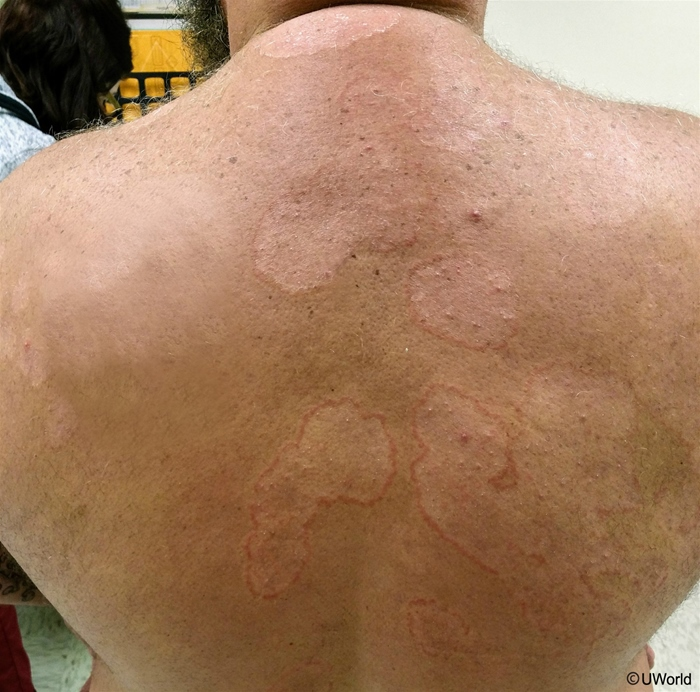 Potassium hydroxide microscopy of skin scrapings from one of the lesions shows segmented hyphae. In addition to appropriate measures for treatment of the rash, which of the following should be done at this time?
 (Multiple Choice)
4.9/5 (88)
(88) A 68-year old man is brought to the emergency room by his daughter due to slurred speech and weakness for the last 12 hours. He has a history of primary hypertension, type 2 diabetes mellitus, and obesity. Three days ago, the patient completed a course of oral prednisone due to severe poison ivy. Temperature is 36.7 C (98 F), blood pressure is 99/80 mm Hg, and pulse is 99/min. BMI is 35 kg/m2. On examination, the patient is oriented only to place and is unable to consistently follow commands. The mucous membranes are dry. Neurologic examination reveals dysarthria and muffled speech. The remainder of the physical examination is normal. Laboratory results are as follows:  CT scan of the head is normal. Intravenous access is secured, and an infusion of normal saline and regular insulin is started. Which of the following is the best next step in management?
 (Multiple Choice)
4.9/5 (67)
(67) A 64-year-old woman comes to the physician with a 10-day history of progressive difficulty walking and poor balance. Two days ago, she fell at home but did not sustain any injuries. Her chronic back pain is worse than usual and is especially bothersome at night. She has no headaches, trauma, bowel or bladder incontinence, or loss of consciousness. The patient's past medical history is significant for type 2 diabetes mellitus, hypertension, transient ischemic attack, and breast cancer status post lumpectomy followed by chemoradiation 2 years ago. Her blood pressure is 162/78 mm Hg and pulse is 73/min. Physical examination shows an unsteady gait, bilateral leg weakness, increased deep-tendon reflexes, and decreased pinprick sensation in both lower extremities up to the umbilicus. There is percussion tenderness over the lower thoracic spine. Digital rectal examination shows good sphincter tone. Mental status, memory, and cognition are intact. Which of the following is most likely responsible for this patient's clinical presentation?
(Multiple Choice)
4.8/5 (63)
(63) A 37-year-old woman comes to the office with a 7-month history of galactorrhea and amenorrhea. She has also had worsening vaginal dryness, but no headaches or visual symptoms. The patient's medical history is unremarkable, and she does not use tobacco, alcohol, or illicit drugs. She is married, has 2 children, and remarks that her family is "complete." The patient's husband has undergone vasectomy. Her temperature is 36.7 C (98 F), blood pressure is 120/80 mm Hg, pulse is 72/min, and respirations are 14/min. Visual field testing is normal. Pregnancy test is negative, serum prolactin level is 150 ng/mL (154 ng/mL on repeat measurement), and thyrotropin (TSH) and serum creatinine are normal. MRI of the pituitary gland reveals a 6-mm hypointense lesion, as shown in the image below, which is consistent with a pituitary adenoma. 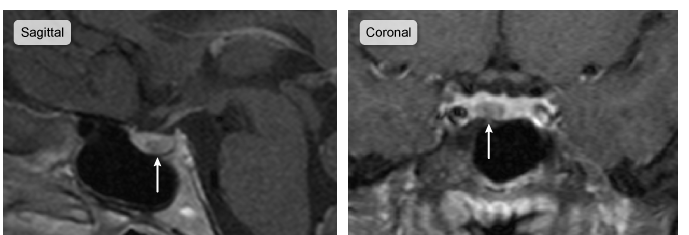 Which of the following is the most appropriate next step in management of this patient?
 (Multiple Choice)
4.8/5 (67)
(67) Showing 321 - 340 of 1702
 Prev
- 1
- ...
- 2
- ...
- 3
- ...
- 4
- ...
- 5
- ...
- 6
- ...
- 7
- ...
- 8
- ...
- 9
- ...
- 10
- ...
- 11
- ...
- 12
- ...
- 13
- ...
- 14
- ...
- 15
- ...
- 16
- ...
- 17
- ...
- 18
- ...
- 19
- ...
- 20
- ...
- 21
- ...
- 22
- ...
- 23
- ...
- 24
- ...
- 25
- ...
- 26
- ...
- 27
- ...
- 28
- ...
- 29
- ...
- 30
- ...
- 31
- ...
- 32
- ...
- 33
- ...
- 34
- ...
- 35
- ...
- 36
- ...
- 37
- ...
- 38
- ...
- 39
- ...
- 40
- ...
- 41
- ...
- 42
- ...
- 43
- ...
- 44
- ...
- 45
- ...
- 46
- ...
- 47
- ...
- 48
- ...
- 49
- ...
- 50
- ...
- 51
- ...
- 52
- ...
- 53
- ...
- 54
- ...
- 55
- ...
- 56
- ...
- 57
- ...
- 58
- ...
- 59
- ...
- 60
- ...
- 61
- ...
- 62
- ...
- 63
- ...
- 64
- ...
- 65
- ...
- 66
- ...
- 67
- ...
- 68
- ...
- 69
- ...
- 70
- ...
- 71
- ...
- 72
- ...
- 73
- ...
- 74
- ...
- 75
- ...
- 76
- ...
- 77
- ...
- 78
- ...
- 79
- ...
- 80
- ...
- 81
- ...
- 82
- ...
- 83
- ...
- 84
- ...
- 85
- ...
- 86
- ...
- Next

Filters
- Essay(0)
- Multiple Choice(0)
- Short Answer(0)
- True False(0)
- Matching(0)