


 Chat with AI
Exam 1: Medicine

Exam 1: Medicine2 k Questions
Exam 2: Pediatric723 Questions
Exam 3: Psychiatry336 Questions
Exam 4: Surgery563 Questions
Exam 5: Obstetrics & Gynecology469 Questions
Select questions type


A 54-year-old man is brought to the emergency department with 2 days of severe diarrhea and 6 hours of abdominal pain. He is confused and lethargic. His daughter, who is at the bedside, notes that the patient has a history of hypertension and was recently treated for "strep throat." Temperature is 38.7 C (101.6 F), blood pressure is 92/58 mm Hg, pulse is 128/min, and respirations are 24/min. The patient appears agitated. The abdomen is mildly distended, and the patient winces with deep palpation of the left lower quadrant. Laboratory results are as follows: 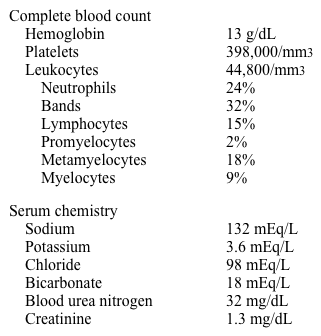 Intravenous fluids and antibiotics are administered. The next morning, the patient's temperature is still elevated. Repeat laboratory examination shows a leukocyte count of 52,000/mm3 with a similar differential. The leukocyte alkaline phosphatase score is high. Which of the following is the likely cause of this patient's hematologic abnormalities?
 (Multiple Choice)
4.9/5  (87)
(87) A 65-year-old man comes to the office due to a skin condition. For the last 6 years, the patient has had slowly progressive, patchy depigmentation involving the face, posterior scalp, hands, genital area, and feet. There is no associated itching, pain, or scaling. Medical history is notable for hypertension, stable coronary artery disease, rheumatoid arthritis, and benign prostatic hyperplasia. The patient quit smoking 20 years ago and does not use alcohol or illicit drugs. Temperature is 36.9 C (98.4 F), blood pressure is 136/88 mm Hg, and pulse is 76/min. Skin examination shows widespread areas of depigmentation as shown below. Physical examination is otherwise unremarkable. 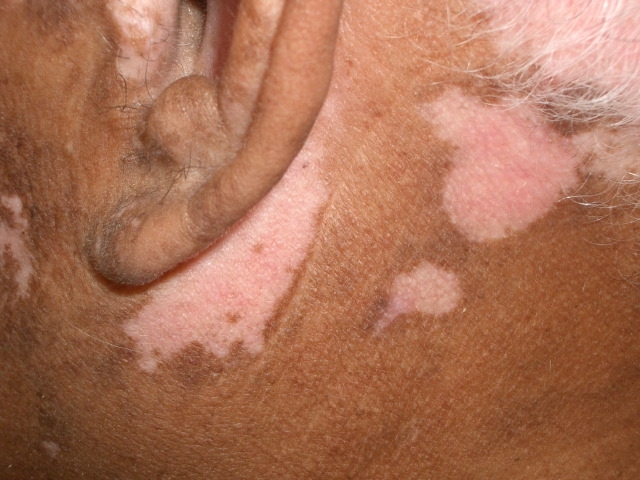 Which of the following best explains the pathology of this patient's condition?
 (Multiple Choice)
4.8/5 (82)
(82) A 65-year-old woman comes to the emergency department due to a 2-week history of constipation and abdominal pain. The patient also has urinary frequency and constant thirst. Her medical history is significant for persistent atrial fibrillation treated with diltiazem and rivaroxaban, hypertension treated with hydrochlorothiazide, and hypothyroidism treated with levothyroxine. There has been no recent change in any of these medications. In addition, the patient was diagnosed with osteoporosis 3 months ago; she declined treatment with bisphosphonates and instead opted to treat only with over-the-counter vitamin and mineral supplements. She does not use tobacco or alcohol. On physical examination, temperature is 36.8 C (98.2 F), blood pressure is 120/70 mm Hg, pulse is 90/min and irregular, and respirations are 12/min. Mucous membranes are dry, and the abdomen is soft and nontender without rebound tenderness or rigidity. Bowel sounds are decreased but present. Bedside dipstick urinalysis is within normal limits. Which of the following is the most likely cause of this patient's current symptoms?
(Multiple Choice)
4.8/5 (70)
(70) A 38-year-old hospitalized woman is evaluated for new-onset confusion. The patient has a prolonged history of Crohn disease and was admitted 2 days ago due to worsening abdominal pain, nausea, and watery diarrhea. She tested positive for Clostridioides (formerly Clostridium) difficile infection and is receiving oral vancomycin and intravenous fluids. Her gastrointestinal symptoms have been improving, but since yesterday the patient has been incoherent, disoriented, and unsteady. She has no other medical conditions but has had small bowel resections due to stricture and fistula in the past and has lost 10 kg (22 lbs) over the past 6 months. The patient does not use tobacco, alcohol, or illicit drugs. Temperature is 36.6 C (98 F), blood pressure is 120/70 mm Hg, and pulse is 92/min with no orthostatic changes. BMI is 19.5 kg/m2. On examination, she is not oriented to time or place. Pupils are equal and reactive to light. Abduction of the right eye is limited and elicits bilateral horizontal nystagmus. Motor strength and deep tendon reflexes are normal throughout. Finger-to-nose and heel-to-shin testing are normal, but the gait is wide based. Which of the following is the most likely cause of this patient's neurologic symptoms?
(Multiple Choice)
4.9/5 (82)
(82) A 55-year-old man comes to the office due to a week of nausea and generalized weakness. He also has had muscle cramps for the past 3 days. The patient has a history of type 2 diabetes mellitus diagnosed 2 years ago, hypertension diagnosed 10 years ago, and hyperlipidemia. The patient has been on a stable medication regimen of metformin, lisinopril, and rosuvastatin for 2 years. He does not use tobacco, alcohol, or illicit drugs. Temperature is 37 C (98.6 F), blood pressure is 160/98 mm Hg, pulse is 84/min, and respirations are 18/min. The mucous membranes are moist. Bilateral basal crackles are present. The abdomen is soft and nontender. Bilateral 2+ lower extremity edema is present. Laboratory results are as follows: 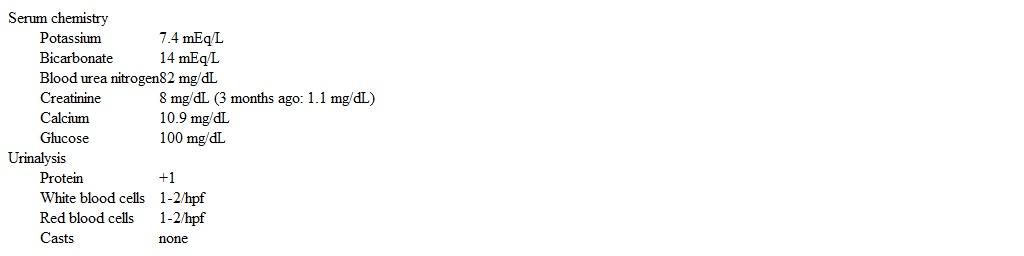 Urine sodium is 70 mEq/L. Renal ultrasound shows normal-sized kidneys with no evidence of hydronephrosis. Which of the following is the most likely cause of this patient's current condition?
 (Multiple Choice)
4.9/5 (79)
(79) A 60-year-old man comes to the office due to problems with his right hearing aid. The patient has worn hearing aids for many years but recently got fitted for new molds because his old ones were cracked and would scratch his ear canals on insertion. Over the past 2 days, he has had drainage from the right ear that causes the aid to become clogged. His right ear canal also feels swollen, itchy, and painful. It is unclear if the patient's hearing has changed because he cannot wear his aid. He is not dizzy and does not have a sore throat, rhinorrhea, or cough. The patient has no chronic medical conditions or prior surgeries. Temperature is 37.0 C (98.6 F), blood pressure is 146/92 mm Hg, and pulse is 90/min. The right ear examination elicits moderate pain. The ear canal is swollen, is erythematous, and has purulent drainage. There is no granulation tissue, and the tympanic membrane is clear. Cranial nerve function is normal. Which of the following is the most likely diagnosis?
(Multiple Choice)
4.8/5 (75)
(75) A 72-year-old woman comes to the office due to frequent headaches, fatigue, and recent weight loss. Her shoulder muscles feel stiff in the morning. A tender cord is palpated in the right temporal area. The erythrocyte sedimentation rate is 85 mm/hr. Which of the following is the most likely complication of this patient's condition?
(Multiple Choice)
4.9/5 (83)
(83) An 18-year-old girl comes to the emergency department due to a painful rash. She had just spent an hour at the beach when she began to experience a burning sensation, followed by sudden onset of redness and swelling in sun-exposed areas. The patient sees a dermatologist for facial acne and was recently started on a new treatment. Temperature is 37.2 C (99 F), blood pressure is 108/68 mm Hg, pulse is 82/min, and respirations are 14/min. Skin examination is notable for erythema, edema, and vesicles at the face, anterior neck, upper chest, and dorsal surface of the hands and forearms. There are no mucosal lesions. Which of the following best explains the patient's current condition?
(Multiple Choice)
4.8/5 (91)
(91) A 58-year-old woman undergoing systemic chemotherapy for advanced breast cancer with metastases to bone comes to the office for routine follow-up. She has mild, vague bone pain that is relieved by the occasional use of acetaminophen. Physical examination shows a well-healed mastectomy scar on the right and a palpable right supraclavicular lymph node. Mucous membranes are moist. Laboratory results are as follows: 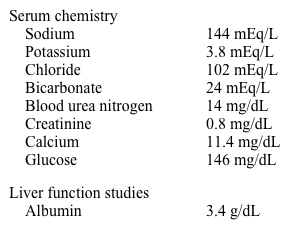 Which of the following is the best next step in management of this patient?
 (Multiple Choice)
4.8/5 (65)
(65) A 55-year-old man comes to the office for a follow-up visit. The patient has a 5-year history of type 2 diabetes mellitus and hypertension and had an acute myocardial infarction 2 years ago. He reports no symptoms but says he is frustrated at his inability to lose weight despite exercising and following dietary recommendations. The patient takes metformin and has noticed frequently elevated blood glucose readings at home. He does not use tobacco, alcohol, or illicit drugs. Blood pressure is 126/70 mm Hg and pulse is 74/min. BMI is 32 kg/m2. Physical examination is otherwise unremarkable. Laboratory results are as follows: Lifestyle modifications are reinforced, and an additional medication is prescribed to improve glycemic control and assist with weight loss. Which of the following medications was most likely prescribed for this patient?
(Multiple Choice)
4.9/5 (87)
(87) A 35-year-old woman comes to the office due to 2 months of productive cough, fever, and weight loss. The patient has no chronic medical conditions and takes no medications. She works as a janitor at a prison in Baltimore. The patient has never traveled outside of Baltimore. She does not use tobacco or illicit drugs but drinks 1 or 2 beers each evening. Temperature is 38.3 C (100.9 F), blood pressure is 120/78 mm Hg, pulse is 84/min, and respirations are 15/min. Examination shows cervical lymphadenopathy and fine crackles at the left upper posterior thorax. Chest x-ray reveals an infiltrate with a small cavity in the left upper lobe. Sputum Gram stain and acid-fast staining show no organisms. Sputum culture is pending. What is the most appropriate next step in management?
(Multiple Choice)
4.8/5 (66)
(66) A 56-year-old man is brought to the emergency department due to severe, crushing midsternal chest pain accompanied by diaphoresis and shortness of breath. The patient had been having exertional angina for several months, and, 10 days ago, he underwent coronary angiography that revealed a 90% stenosis of the proximal left anterior descending artery. A drug-eluting stent was placed, and the postprocedural course was uncomplicated. Echocardiogram at discharge was normal. Medical history is also significant for hyperlipidemia, type 2 diabetes mellitus, obesity, and gout. The patient is currently unemployed and uninsured. ECG reveals sinus tachycardia with 2-mm ST-segment elevations in leads V1-V4. Which of the following is the most likely cause of this patient's current condition?
(Multiple Choice)
4.8/5 (73)
(73) A 65-year-old man is brought to the emergency department after having a seizure. Past medical history is significant for non-small cell lung carcinoma diagnosed 2 years ago and treated surgically. He continues to work as a college professor and usually walks 1-2 miles daily. MRI of the brain shows a solitary cortical mass (2 cm x 3.5 cm) in the right hemisphere at the grey-white matter junction that is most consistent with metastasis. CT scan of the chest and abdomen shows no evidence of recurrent malignancy. The patient is admitted for further management and started on phenytoin. Which of the following is the most appropriate next step in the management of this patient?
(Multiple Choice)
5.0/5 (85)
(85) A 45-year-old man comes to the office for follow-up. He was diagnosed with diabetes mellitus 5 years ago and has had good control during most of that time on a program of long-acting and sliding-scale short-acting insulin analogues. However, the patient was admitted to the hospital 6 months ago for a hypoglycemic seizure, and his home glucose readings have been over 200 mg/dL frequently since. Medical history is notable for chronic pancreatitis related to excessive alcohol use. Vital signs and physical examination are normal. Hemoglobin A1c is 8.6%; a year ago, it was 7.2%. When the physician asks about the reasons for the change in glycemic control, the patient says, "I'm not sure, doctor. I feel pretty good right now." Which of the following is the most appropriate statement for initiating a discussion with this patient?
(Multiple Choice)
4.8/5 (92)
(92) A 25-year-old man is brought to the emergency department due to a generalized tonic-clonic seizure. According to his roommate, the patient has had worsening confusion and lethargy for the last 2 weeks. Today, he had a seizure lasting approximately 3 minutes. The patient has a history of HIV and is not adherent with antiretroviral therapy or other HIV-related medications. He is an active injection drug user. Temperature is 37.7 C (99.9 F), blood pressure is 130/80 mm Hg, pulse is 98/min, and respirations are 16/min. On physical examination, the patient is somnolent but arousable. There is no focal extremity weakness or sensory loss. CD4 count is 26/mm3 and viral load is 86,000 copies/mL. MRI of the brain with contrast shows a solitary, irregular, nonhomogenous ring-enhancing lesion in the periventricular area. Cerebrospinal fluid PCR is positive for Epstein-Barr virus DNA. Which of the following is the most likely diagnosis in this patient?
(Multiple Choice)
4.8/5 (81)
(81) A 43-year-old previously healthy man is brought by his wife to a rural emergency department after he accidentally amputated most of his right thumb with a bandsaw. Initially there was profuse bleeding from the stump, but this stopped with application of direct pressure. The patient's wife picked up the amputated part and brought it along in a plastic bag. The patient is right hand dominant and works as a heavy equipment mechanic. Blood pressure is 128/86 mm Hg and pulse is 96/min. Physical examination shows a transverse amputation through the middle of the right thumb proximal phalanx, with exposed bone. The rest of the right hand and fingers are uninjured. The amputated part is in one piece without overt contamination. Transfer of the patient to a hospital with an on-call hand surgeon is arranged. Which of the following is the best way to transport the amputated digit?
(Multiple Choice)
4.8/5 (74)
(74) A 61-year-old man comes to the office for evaluation of urinary symptoms. Review of systems is positive for nocturnal urinary frequency, occasional dribbling, and a weak urinary stream for the past 3 months. The patient was diagnosed with type 2 diabetes mellitus 16 years ago. Other medical conditions include hypertension, myocardial infarction 2 years ago, and moderately decreased visual acuity. Blood pressure is 160/100 mm Hg and pulse is 60/min. Examination shows a left-sided carotid bruit and trace bilateral ankle edema. Postvoid bladder residual volume is 40 mL. Dipstick urinalysis reveals 2+ protein and no blood. Serum creatinine level is 2.1 mg/dL. Hemoglobin A1c is 7.3%. Which of the following is the most likely cause of this patient's chronic kidney disease?
(Multiple Choice)
4.7/5 (85)
(85) A 28-year-old man develops headache, nausea, cough, shortness of breath, and fatigue while hiking the Mount Whitney Summit Trail in California. The patient arrived 3 days ago from Los Angeles. He is also accompanied by his friend who came from New Jersey, but his friend does not have any symptoms. The patient has no medical conditions and takes no medications. He drinks 3 or 4 beers every day. Temperature is 38.3 C (101 F), blood pressure is 130/90 mm Hg, pulse is 120/min, and oxygen saturation is 85% on ambient air. Examination shows cyanosis, dry mucous membranes, and bilateral crackles. Chest x-ray reveals diffuse, patchy infiltrates and normal heart size. Laboratory studies reveal leukocytes of 14,000/mm3 with 74% neutrophils. Serum procalcitonin level is 0.10 mcg/L (normal: <0.25). What is the most likely diagnosis in this patient?
(Multiple Choice)
5.0/5 (84)
(84) A 30-year-old woman comes to the emergency department due to worsening, bilateral lower extremity weakness and numbness for the past 4 days. She has had no fever, headache, or back pain, but she had an incident of urinary incontinence today. The patient has no other medical conditions and takes no medications. She does not use tobacco, alcohol, or illicit drugs. Temperature is 37 C (98.6 F), blood pressure is 110/60 mm Hg, pulse is 72/min, and respirations are 16/min. On physical examination, the patient is alert and oriented with normal comprehension and speech. The pupils are equal and reactive, and there is no facial weakness. Upper extremity muscle strength is normal with normal reflexes, but both legs are diffusely weak. Bilateral lower extremity deep tendon reflexes are increased with extensor plantar response. Sensation to pinprick is decreased below the level of the umbilicus, and vibratory sensation is absent in the toes. Which of the following is the most likely cause of this patient's current symptoms?
(Multiple Choice)
4.9/5 (71)
(71) A 65-year-old woman comes to the emergency department for transient weakness. She experienced muscle weakness in her right arm and leg this morning that lasted approximately 20 minutes and has since resolved completely. The patient has had no headache, vision loss, or vomiting. She has never before had similar symptoms. Medical history is significant for hypertension and diet-controlled type 2 diabetes mellitus. The patient underwent mitral valve replacement with a bioprosthetic valve 5 years ago due to mitral valve endocarditis. She is a life-long nonsmoker. Blood pressure is 131/70 mm Hg, and pulse is 65/min and regular. Chest examination is unremarkable. Neurologic examination reveals no muscle weakness or sensory loss. ECG, complete blood count, and renal function are within normal limits. In addition to a neuroimaging study, which of the following is the best next step in management of this patient?
(Multiple Choice)
4.9/5 (78)
(78) Showing 981 - 1000 of 1702
 Prev
- 1
- ...
- 2
- ...
- 3
- ...
- 4
- ...
- 5
- ...
- 6
- ...
- 7
- ...
- 8
- ...
- 9
- ...
- 10
- ...
- 11
- ...
- 12
- ...
- 13
- ...
- 14
- ...
- 15
- ...
- 16
- ...
- 17
- ...
- 18
- ...
- 19
- ...
- 20
- ...
- 21
- ...
- 22
- ...
- 23
- ...
- 24
- ...
- 25
- ...
- 26
- ...
- 27
- ...
- 28
- ...
- 29
- ...
- 30
- ...
- 31
- ...
- 32
- ...
- 33
- ...
- 34
- ...
- 35
- ...
- 36
- ...
- 37
- ...
- 38
- ...
- 39
- ...
- 40
- ...
- 41
- ...
- 42
- ...
- 43
- ...
- 44
- ...
- 45
- ...
- 46
- ...
- 47
- ...
- 48
- ...
- 49
- ...
- 50
- ...
- 51
- ...
- 52
- ...
- 53
- ...
- 54
- ...
- 55
- ...
- 56
- ...
- 57
- ...
- 58
- ...
- 59
- ...
- 60
- ...
- 61
- ...
- 62
- ...
- 63
- ...
- 64
- ...
- 65
- ...
- 66
- ...
- 67
- ...
- 68
- ...
- 69
- ...
- 70
- ...
- 71
- ...
- 72
- ...
- 73
- ...
- 74
- ...
- 75
- ...
- 76
- ...
- 77
- ...
- 78
- ...
- 79
- ...
- 80
- ...
- 81
- ...
- 82
- ...
- 83
- ...
- 84
- ...
- 85
- ...
- 86
- ...
- Next

Filters
- Essay(0)
- Multiple Choice(0)
- Short Answer(0)
- True False(0)
- Matching(0)