


 Chat with AI
Exam 1: Medicine

Exam 1: Medicine2 k Questions
Exam 2: Pediatric723 Questions
Exam 3: Psychiatry336 Questions
Exam 4: Surgery563 Questions
Exam 5: Obstetrics & Gynecology469 Questions
Select questions type


A 67-year-old woman is brought to the office by her son. He reports that his mother has had periodic confusion, memory loss, and poor sleep and seems "kind of out of it sometimes." These symptoms have gradually worsened over the past 1-2 years. The patient occasionally sees "strangers in the backyard," who are not there when her son looks for them. More recently, she has begun walking more slowly and has fallen twice in the past month without any significant injuries. The patient has a history of hypertension and depression. She does not drink alcohol or use illicit drugs. On physical examination, she walks slowly and has mild bilateral hand tremors and mild bilateral lower limb rigidity. On cognitive examination, the patient appears to be oriented to person and place, and can recall 1 of 3 items in 5 minutes; she can state the days of the week forward but does not cooperate with stating them backward. Chemistries, complete blood count, vitamin B12, and thyroid function tests are normal. Serum treponemal test is nonreactive. MRI of the brain shows mild generalized cortical atrophy. Which of the following is the most likely diagnosis in this patient?

Free
(Multiple Choice)
4.9/5  (92)
(92) Correct Answer: Verified
B
A 62-year-old woman comes to the physician complaining of 6-8 weeks of fatigue and yellowish skin discoloration. She feels tired, has lost 4.5 kg (10 lb), and has occasional mild nausea. She has no change in bowel habits or abdominal pain. The patient had a colposcopy for an abnormal Pap smear 15 years ago. Her last mammogram 6 months ago was normal. She is a nonsmoker and drinks 2 or 3 beers each night. The patient's father has hypertension and hyperlipidemia and had a stroke. Her temperature is 36.7 C (98 F), blood pressure is 110/70 mm Hg, pulse is 88/min, and respirations are 14/min. There is marked scleral icterus. Abdominal examination shows normal bowel sounds and no organomegaly. No occult blood is detected in her stool. Laboratory results are as follows:  Which of the following is the most likely cause of this patient's condition?
Free
(Multiple Choice)
4.8/5 (95)
(95) Correct Answer:Verified
VerifiedE
A 27-year-old man is brought to the emergency department due to a syncopal episode. He passed out while unloading heavy packages from his truck during a hot summer day. According to a witness, the episode lasted 30 seconds, and he regained consciousness quickly. The patient has had no chest pain or palpitations. Over the past year, he has had brief episodes of lightheadedness related to intense exercise. Medical history is otherwise insignificant. He works for a landscaping company. Blood pressure is 130/75 mm Hg while supine and 125/75 mm Hg while standing and pulse is 78/min and regular. Oxygen saturation is 98% on room air. On examination, the patient has no murmur. The lungs are clear to auscultation. ECG shows T-wave inversion in leads V4-V6. Complete blood count, serum electrolytes, and cardiac enzymes are within normal limits. Which of the following is the most appropriate next step in management?
Free
(Multiple Choice)
4.9/5 (88)
(88) Correct Answer:Verified
VerifiedB
A 45-year-old male presents for a routine checkup because he wishes to purchase life insurance. He says he feels "perfectly healthy" and has no complaints. His medical history is significant for a remote bout of cellulitis and a fractured clavicle from playing football in high school. He works as a supervisor at a corporate call center. He is monogamous and lives with his wife and two children. Laboratory testing reveals the following: Liver studies
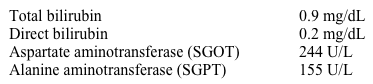 Complete blood count
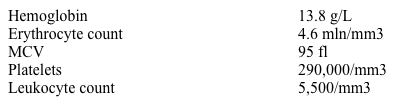 Chemistry panel
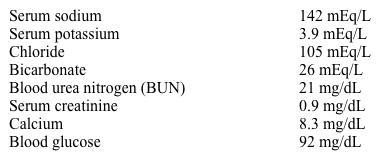 What is the next best step in the evaluation of this patient?
Complete blood count
Chemistry panel
What is the next best step in the evaluation of this patient? (Multiple Choice)
4.8/5 (83)
(83) A 32-year-old man with opioid use disorder comes to the emergency department with a temperature of 39.4 C (103 F) and is diagnosed with tricuspid valve endocarditis due to Staphylococcus aureus. A 6-week course of intravenous (IV) antibiotics is initiated. On hospital day 3, the patient develops diaphoresis, tachycardia, and diarrhea consistent with opioid withdrawal and requests to leave the hospital. He says, "I know IV antibiotics are the best treatment and that I could die without them, but I gotta get out of here. Can you at least give me some antibiotic pills to take?" Which of the following is the most appropriate response to this patient's question?
(Multiple Choice)
4.7/5 (84)
(84) A 60-year-old woman undergoes elective coronary artery bypass surgery and aortic valve replacement. The postoperative course is complicated by acute renal failure, atrial fibrillation, and pulmonary edema. On the third postoperative day, the patient cannot tolerate attempted extubation and requires reintubation. On the fifth postoperative day, she develops a fever to 38.9 C (102 F). Her blood pressure is 110/65 mm Hg, pulse is 110-120/min and irregular, and respirations are 32/min. Chest x-ray shows dense infiltrates in the right middle and lower lobes. White blood cell count is 16,200/mm3 with 8% bands. Which of the following is the most appropriate next step in management of this patient?
(Multiple Choice)
4.8/5 (78)
(78) A 32-year-old man comes to the emergency department due to 5 days of intermittent high fever, chills, and drenching sweats. He also has malaise, fatigue, and dark urine. The patient has no medical history other than a splenectomy after a motor vehicle collision 10 years ago. He drinks alcohol on social occasions and does not use tobacco or illicit drugs. He is married and in a monogamous relationship with his wife. The patient lives on Long Island, New York, and works in Manhattan as a software programmer. He has not traveled outside the country but likes to hike and explore the woods. He recently camped in New England and found 2 ticks on his legs when he returned home. Temperature is 39.5 C (103 F), blood pressure is 110/70 mm Hg, and pulse is 116/min. Mild scleral icterus is present. There are no enlarged lymph nodes or skin rash. A mildly tender liver edge is palpable 3 cm below the right costal margin. Laboratory results are as follows: 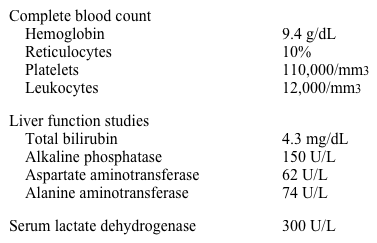 Which of the following is most likely to yield the diagnosis in this patient?
 (Multiple Choice)
4.9/5 (76)
(76) A 73-year-old man is brought to the emergency department after repeat episodes of lightheadedness. Yesterday, the patient felt lightheaded while jogging and sat down on the curb to prevent a fall. A similar episode occurred 6 weeks ago when he felt lightheaded while climbing stairs. He has had some exertional shortness of breath associated with chest discomfort for the past few months but has had no headache, blurry vision, or chest pain. Medical history includes hypertension. The patient takes hydrochlorothiazide and low-dose aspirin daily. He has a 20-pack-year history and occasionally drinks a glass of wine. Blood pressure is 142/90 mm Hg, pulse is 80/min, and respirations are 16/min. ECG shows normal sinus rhythm with left ventricular hypertrophy. Which of the following is most likely to diagnose this patient's condition?
(Multiple Choice)
4.8/5 (77)
(77) A 70-year-old man who lives in a group home is brought to the emergency department due to 3 months of persistent cough and anorexia. The cough occurs mainly in the early morning and is often productive. He has a history of chronic kidney disease, type 2 diabetes mellitus, and an ischemic stroke that resulted in right-sided residual paralysis. He has never smoked cigarettes. Temperature is 38.2 C (100.8 F), blood pressure is 124/80 mm Hg, pulse is 90/min, and respirations are 16/min. BMI is 22 kg/m2. Examination shows cervical lymphadenopathy and muscle wasting. Cardiopulmonary examination shows no abnormalities. Laboratory results are as follows: 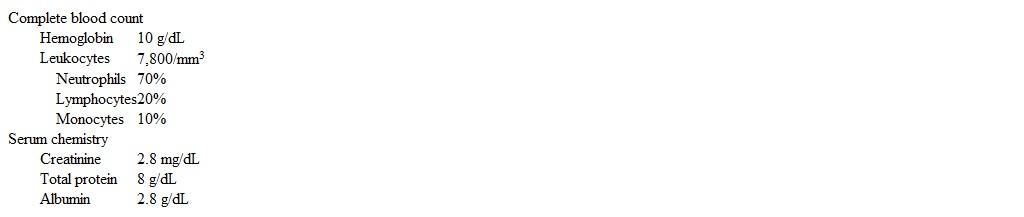 Chest x-ray is shown in the exhibit.
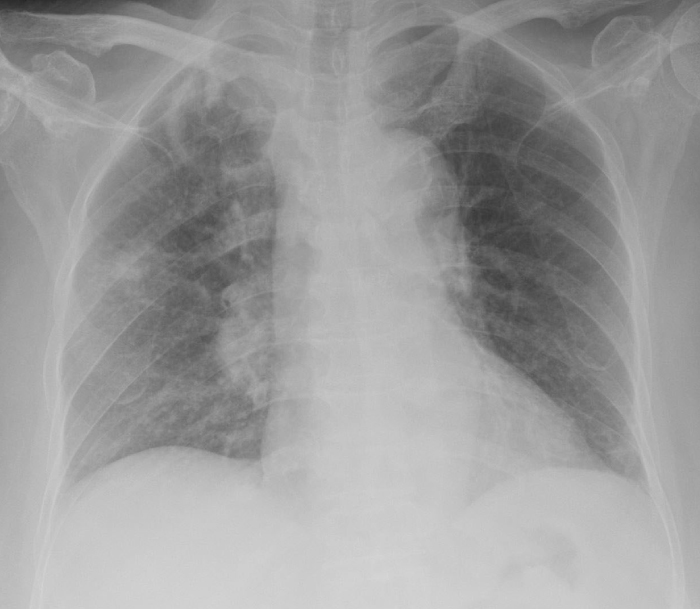 Tuberculin skin testing is negative. What is the most likely diagnosis?
Chest x-ray is shown in the exhibit.
Tuberculin skin testing is negative. What is the most likely diagnosis? (Multiple Choice)
4.9/5 (76)
(76) A 29-year-old woman comes to the emergency department due to pelvic pain that started immediately after sexual intercourse 3 hours earlier. The pain is sharp and stabbing in nature and has intensified significantly. She has no fever but is slightly nauseous. The patient has no chronic medical conditions and has had no surgeries. Her last menstrual period was 3 weeks ago. Temperature is 36.7 C (98.1 F), blood pressure is 110/70 mm Hg, and pulse is 98/min. The abdomen is soft and tender to palpation in the right lower quadrant. Laboratory results are as follows:  Urine pregnancy test is negative. Pelvic ultrasound shows an enlarged uterus with multiple fibroids and a 4×5 cm right cystic ovarian mass with a moderate amount of free fluid in the pelvis. Doppler shows normal blood flow to the adnexa. Which of the following is the most likely cause of this patient's acute symptoms?
 (Multiple Choice)
4.8/5 (72)
(72) A 34-year-old man calls the office requesting an urgent appointment due to cough and cold symptoms. His temperature is 37.2 C (99 F), but he feels "miserable" and is unsure if he should go to work the next day. The patient has a history of seasonal allergies and knee pain from a past sports injury. He has no other medical problems but does have a history of frequent office visits. The receptionist informs him that the physician is preparing to leave as it is near closing time but that an appointment is available for the next morning. The patient declines the offer of an appointment and hangs up. As the physician leaves the office 30 minutes later to make evening rounds at the hospital, the patient arrives and insists on being seen immediately. He sounds congested and coughs occasionally but is breathing normally. He has no other symptoms. He again asks to be examined. Which of the following is the most appropriate response?
(Multiple Choice)
4.8/5 (84)
(84) A 30-year-old woman comes to the office due to pain over the lateral side of the right wrist for the last 4 days. She is 6 weeks postpartum from her first child, and the pain is most severe when she lifts the infant from the crib. The patient has not had acute trauma to the wrist or hand. Vital signs are normal. Examination shows tenderness over the radial side of the wrist and first dorsal compartment. With the hand in a fist and the fingers closed over the thumb, passive adduction of the wrist reproduces the pain. Which of the following is the most likely diagnosis in this patient?
(Multiple Choice)
4.9/5 (90)
(90) A 38-year-old woman comes to the office due to jaundice. Her eyes have been yellow for the past 8 days, and she has also had pruritus, fever, nausea, and vomiting. The patient has had no unexpected weight loss or bloody stools. Medical history is significant for hypertension; current medications include amlodipine and an oral contraceptive. The patient works in a day care center, where some of the children were recently ill. She drinks alcohol but does not use illicit drugs and is in a monogamous relationship with her husband. Family history is unremarkable. Temperature is 38.7 C (101.7 F), blood pressure is 125/80 mm Hg, and pulse is 80/min. Scleral icterus is present. Oropharyngeal and cardiopulmonary examinations are unremarkable. The neck is supple without lymphadenopathy. The abdomen is nontender and nondistended. The liver edge is smooth and palpable below the right costal margin. Laboratory evaluation reveals the following: 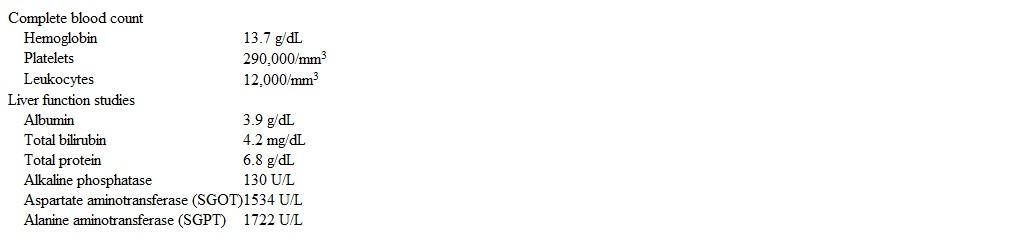 Which of the following is the most likely diagnosis?
 (Multiple Choice)
4.9/5 (70)
(70) A 53-year-old woman comes to the office for a routine annual examination. Her last menstrual period was 2 years ago. The patient has hot flashes throughout the day. She awakens several times each night drenched with sweat. The patient has tried weight loss and over-the-counter medications to manage these symptoms, but they have not improved. She has hypertension and type 2 diabetes mellitus controlled with diet and exercise. The patient's mother had a bilateral hip replacement after a fall at age 77. Blood pressure is 124/80 mm Hg and pulse is 76/min. BMI is 28 kg/m2. Cardiopulmonary examination is normal. On pelvic examination, the uterus is small and nontender, and there are no adnexal masses. The extremities have 2+ peripheral pulses. HbA1c is 6.9%. Which of the following is an indication for systemic estrogen/progestin replacement therapy in this patient?
(Multiple Choice)
4.9/5 (85)
(85) A 35-year-old man comes to the physician with a 3-week history of hacking, nonproductive cough that occurs more frequently at night. He also has a sensation of liquid dripping into the back of the throat. He had an upper respiratory infection 4 weeks ago that resolved, except for the cough. He has no runny nose, chest pain, heartburn, difficulty breathing, or wheezing. The patient's past medical history is unremarkable, and he takes no medications. He is a lifetime nonsmoker. His father died at age 72 from lung cancer due to smoking. His vital signs are normal and physical examination is unremarkable. Which of the following is the best initial management for this patient?
(Multiple Choice)
4.8/5 (94)
(94) A healthy 28-year-old primigravida comes to the office for her first prenatal visit. Her last menstrual period was 7 weeks ago. The patient is a former competitive gymnast and still trains recreationally 5 times a week. Her training includes 30 minutes of jogging on a treadmill as a warm up. The patient does not use tobacco, alcohol, or illicit drugs. She is taking prenatal vitamins and no other medications. BMI is 20 kg/m2. Vital signs and physical examination are normal. Urine β-hCG is positive. Transvaginal ultrasound confirms an intrauterine pregnancy. Which of the following is the most appropriate advice for this patient?
(Multiple Choice)
4.9/5 (68)
(68) A 68-year-old man comes to the office due to a rash, which he first noticed several months ago. The rash is not painful or itchy but is slowly enlarging. The patient has tried an over-the-counter, low-potency corticosteroid cream without significant relief. Medical history includes hypertension and hypothyroidism. Vital signs are within normal limits. Skin examination findings are shown in the exhibit. 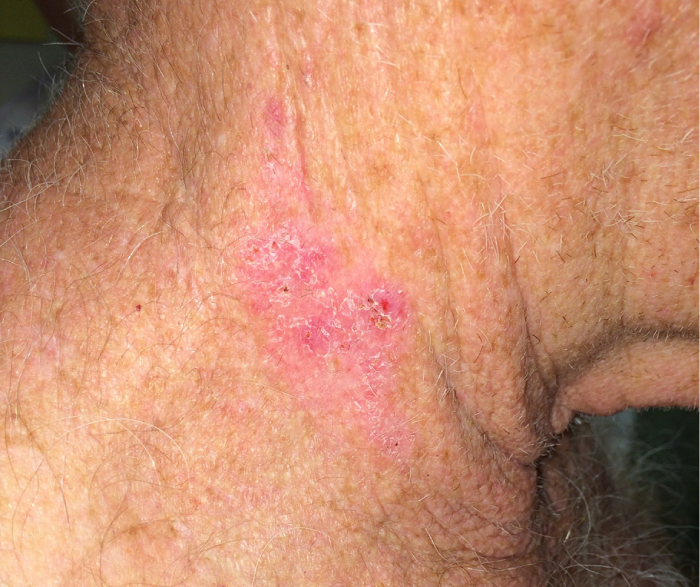 There are no other skin lesions or enlarged lymph nodes. Which of the following is the best next step in management of this patient?
 (Multiple Choice)
4.9/5 (96)
(96) A 38-year-old woman comes to the emergency department for right flank pain radiating to the groin. She also has hematuria but no dysuria or urinary frequency. She has no other medical problems and takes no medications. Her temperature is 36.7 C (98 F), blood pressure is 110/80 mm Hg, and pulse is 68/min. The patient has no costovertebral angle tenderness. Abdominal imaging shows a 6-mm calculus in the distal right ureter with no hydronephrosis. The patient's symptoms improve with intravenous hydration and analgesics. Which of the following medications will be most helpful in facilitating stone passage?
(Multiple Choice)
4.9/5 (64)
(64) A 66-year-old man comes to the office with nausea, loss of appetite, fatigue, and marked weakness. Medical history is significant for hypertension treated with amlodipine. The patient also has polymyalgia rheumatica, for which he was prescribed daily prednisone 12 months ago, but he stopped taking it 7 days ago because he was unhappy with the associated weight gain. Temperature is 36.7 C (98.1 F), blood pressure is 100/70 mm Hg without orthostatic changes, pulse is 100/min, and respirations are 18/min. The patient's face is round and plethoric, and there is excess supraclavicular fat deposition. Laboratory results are as follows:  Chest x-ray is unremarkable. Which of the following biochemical abnormalities is most likely to be present in this patient?
 (Multiple Choice)
4.7/5 (80)
(80) A 22-year-old man comes to the urgent care clinic for evaluation due to dark urine that he noticed earlier this morning. The patient is recovering from an upper respiratory tract infection that started 3 days ago, for which he has been taking ibuprofen as needed. Medical and family histories are unremarkable. Temperature is 37.7 C (99.9 F), blood pressure is 145/92 mm Hg, pulse is 80/min, and respirations are 14/min. Physical examination shows no rash or joint abnormalities. Laboratory results are as follows: 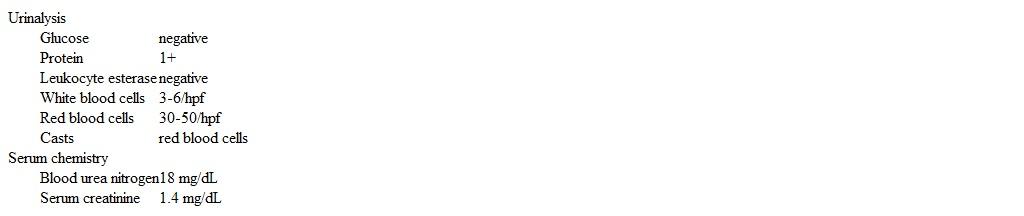 Serum complement levels (C3, C4) are within normal limits, and other serologic workup is pending. Which of the following is the most likely diagnosis in this patient?
 (Multiple Choice)
4.8/5 (80)
(80) Showing 1 - 20 of 1702
 Prev
- 1
- ...
- 2
- ...
- 3
- ...
- 4
- ...
- 5
- ...
- 6
- ...
- 7
- ...
- 8
- ...
- 9
- ...
- 10
- ...
- 11
- ...
- 12
- ...
- 13
- ...
- 14
- ...
- 15
- ...
- 16
- ...
- 17
- ...
- 18
- ...
- 19
- ...
- 20
- ...
- 21
- ...
- 22
- ...
- 23
- ...
- 24
- ...
- 25
- ...
- 26
- ...
- 27
- ...
- 28
- ...
- 29
- ...
- 30
- ...
- 31
- ...
- 32
- ...
- 33
- ...
- 34
- ...
- 35
- ...
- 36
- ...
- 37
- ...
- 38
- ...
- 39
- ...
- 40
- ...
- 41
- ...
- 42
- ...
- 43
- ...
- 44
- ...
- 45
- ...
- 46
- ...
- 47
- ...
- 48
- ...
- 49
- ...
- 50
- ...
- 51
- ...
- 52
- ...
- 53
- ...
- 54
- ...
- 55
- ...
- 56
- ...
- 57
- ...
- 58
- ...
- 59
- ...
- 60
- ...
- 61
- ...
- 62
- ...
- 63
- ...
- 64
- ...
- 65
- ...
- 66
- ...
- 67
- ...
- 68
- ...
- 69
- ...
- 70
- ...
- 71
- ...
- 72
- ...
- 73
- ...
- 74
- ...
- 75
- ...
- 76
- ...
- 77
- ...
- 78
- ...
- 79
- ...
- 80
- ...
- 81
- ...
- 82
- ...
- 83
- ...
- 84
- ...
- 85
- ...
- 86
- ...
- Next

Filters
- Essay(0)
- Multiple Choice(0)
- Short Answer(0)
- True False(0)
- Matching(0)