


 Chat with AI
Exam 1: Medicine

Exam 1: Medicine2 k Questions
Exam 2: Pediatric723 Questions
Exam 3: Psychiatry336 Questions
Exam 4: Surgery563 Questions
Exam 5: Obstetrics & Gynecology469 Questions
Select questions type


A 51-year-old man comes to the office due to nausea and fatigue for the past several weeks. The patient has had occasional episodes of bilateral flank pain over the past several years and nocturia 2 or 3 times per night for the past 10 years. He has had no change in appetite or weight. The patient does not use tobacco, alcohol, or illicit drugs. Temperature is 36.9 C (98.4 F), blood pressure is 164/100 mm Hg, pulse is 80/min, and respirations are 16/min. BMI is 24 kg/m2. Cardiopulmonary examination shows no abnormalities. The liver is enlarged, and a mass is felt at the right flank on deep palpation. The prostate is mildly enlarged and nontender. There is no extremity edema. Laboratory results are as follows:  Which of the following best explains this patient's findings?
 (Multiple Choice)
4.9/5  (75)
(75) A 27-year-old woman comes to the office due to facial weakness. When the patient woke up this morning, the left side of her face seemed to be "pulling down." She had difficulty eating breakfast, and orange juice leaked out the left side of her mouth. The patient had some minor left ear pain last night that responded to acetaminophen and is fully resolved. She has no chronic medical conditions and takes no other medications. Vital signs are within normal limits. On examination, the external ear, external auditory canal, and tympanic membrane are normal. There is weakness of the entire left side of the face, including the forehead and incomplete eye closure. The pupils are equal and reactive to light. Hearing is intact. Which of the following is the most appropriate next step in diagnosis of this patient?
(Multiple Choice)
4.9/5 (79)
(79) A 57-year-old man comes to the office due to several months of persistent tingling in both legs. The patient also says he feels clumsy and often bumps into furniture. He has a history of hip osteoarthritis, but the pain is well controlled with acetaminophen and occasional ibuprofen and does not limit his mobility. The patient also has a history of gastroesophageal reflux disease and Barrett esophagus; he has used omeprazole for the past several years and has had no recent heartburn or dysphagia. He does not use tobacco, alcohol, or illicit drugs. The patient consumes a balanced diet and walks 1 or 2 miles every other day. Vital signs are within normal limits. Lower extremity muscle strength is intact. Sensation to light touch and vibration are diminished in the feet bilaterally. The remainder of the physical examination shows no abnormalities. Which of the following is the most appropriate next step in evaluation of this patient's symptoms?
(Multiple Choice)
4.8/5 (88)
(88) A 67-year-old man comes to the office due to 2 weeks of intermittent blood in the urine. He has had no pain, urgency, dysuria, frequency, urethral discharge, or nocturia. The bleeding is present throughout micturition. The patient has a history of coronary artery disease, hypertension, and hyperlipidemia. He has smoked a pack of cigarettes daily for 40 years. He is sexually active. Temperature is 36.9 C (98.4 F), blood pressure is 120/80 mm Hg, pulse is 78/min, and respirations are 16/min. Abdomen is soft and nontender with no masses; bowel sounds are normal. Rectal examination shows an enlarged prostate with no tenderness, asymmetry, or induration. Urinalysis shows >50 red blood cells/hpf; there are no leukocytes, casts, or dysmorphic erythrocytes. Urine cytology shows no abnormal cells. Which of the following is the most appropriate next step in evaluation of this patient?
(Multiple Choice)
4.9/5 (72)
(72) A 42-year-old woman with rheumatoid arthritis returns to the clinic for follow-up. The patient reports improvement in joint pain after methotrexate therapy was begun 6 months ago. Over the past 2 months, she has felt increasingly winded, causing her to stop jogging. She has a nonproductive cough and low-grade fevers. She has no other medical conditions and is a lifelong nonsmoker. Temperature is 37.5 C (99.5 F), blood pressure is 120/70 mm Hg, pulse is 88/min, and respirations are 18/min. Oxygen saturation is 89% on room air at rest. Jugular venous pressure is normal. Lung auscultation reveals fine bibasilar inspiratory crackles. Heart sounds are normal. Musculoskeletal examination shows mild interphalangeal synovitis. High-resolution CT scan of the chest reveals patchy areas of consolidation and reticular thickening. A respiratory sample obtained by bronchoscopy yields lymphocyte-predominant fluid negative for bacterial, viral, and fungal pathogens. Which of the following is the best next step in management of this patient?
(Multiple Choice)
4.8/5 (85)
(85) A 39-year-old man is brought to the emergency department after immediately collapsing at the finish line when he completed a marathon. Although he was unable to stand or walk, the patient did not lose consciousness. He says he has run multiple marathons in the past without any problems. Medical history includes mild intermittent asthma. He uses albuterol as needed and last took it a week ago. Temperature is 38 C (100.4 F), blood pressure is 98/52 mm Hg, pulse is 118/min, and respirations are 22/min. The patient is alert and oriented and does not report any pain. Neurologic examination is normal. Which of the following is the most likely cause of this patient's collapse?
(Multiple Choice)
4.8/5 (79)
(79) A 36-year-old woman is found to have a thyroid nodule during a routine physical examination. She has had no heat or cold intolerance, skin changes, or fatigue. Her appetite and stooling habits have not changed, and her weight is stable. Menstrual cycles are regular with no excessive bleeding. The patient has no other medical conditions and takes no medications. She has had no prior radiation exposure. Family history is negative for thyroid disorders. The patient does not use tobacco, alcohol, or illicit drugs. She is an architect at a construction firm. Temperature is 36.7 C (98 F), blood pressure is 130/80 mm Hg, pulse is 80/min, and respirations are 16/min. Physical examination shows no abnormalities with the exception of a 1-cm, discrete, nontender, and firm nodule in the left thyroid lobe. Which of the following is the most appropriate next step in management of this patient?
(Multiple Choice)
4.9/5 (80)
(80) A 6-year-old boy is brought to the office by his mother due to noisy breathing. Approximately 6 months ago, his older brother asked to be moved to a different room because the patient's noisy breathing was keeping him up at night; his mother reports that it sounds like he gasps for air while sleeping. During the day, the patient breathes through his mouth and eats and drinks without gagging or choking. He is able to keep up with his peers during outdoor play. The patient takes no medications and is up to date with vaccinations. He lives with his mother, father, older brother, and the family cat. No one in the household smokes. Height is at the 40th percentile and weight is at the 25th percentile. Which of the following is the most likely diagnosis in this patient?
(Multiple Choice)
4.8/5 (80)
(80) A 28-year-old man comes to the office due to chronic diarrhea. He reports having 5 or 6 nonbloody, liquid bowel movements daily that also sometimes awaken him at night. The patient has lost 2 kg (4.4 lb) and says he has diarrhea even when not eating. He has occasional bloating sensations but no abdominal pain, nausea, or vomiting. Several years ago, the patient was robbed at gunpoint and shot in the abdomen. He underwent multiple surgeries and developed posttraumatic stress disorder. Temperature is 37.1 C (98.8 F), blood pressure is 118/70 mm Hg, and pulse is 78/min. BMI is 20 kg/m2. The abdomen is soft, nondistended, and nontender. Bowel sounds are normoactive in all 4 quadrants. On rectal examination, brown stool is present. Occult blood test is negative. Serum electrolytes are normal. The stool osmotic gap is low. Which of the following is the most likely mechanism of this patient's diarrhea?
(Multiple Choice)
4.8/5 (91)
(91) A 50-year-old man comes to the physician complaining of 2 months of muscle cramps. He also complains of weakness and fatigue. He has a 20-pack-year smoking history but does not drink alcohol. The patient's past medical and family histories are noncontributory. His temperature is 36.7 C (98 F), blood pressure is 150/96 mm Hg, and pulse is 78/min. His body mass index is 28 kg/m2. The rest of the examination is within normal limits. Laboratory results are as follows: 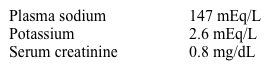 Which of the following is the most appropriate next step in management of this patient?
 (Multiple Choice)
5.0/5 (90)
(90) A 32-year-old man comes to the emergency department due to joint pains that began about an hour after a scuba diving excursion and have been worsening over the past 12 hours. He describes significant pain in his shoulders and elbows that does not change with movement. The patient has no medical history and takes no medications. Blood pressure is 122/80 mm Hg, pulse is 104/min, and respirations are 20/min. Pulse oximetry is 97% on room air. The patient is alert and oriented but appears uncomfortable. Cardiopulmonary examination is normal. The joints are nontender with full range of motion. He has normal strength and sensation in the extremities. The patient is placed on 100% oxygen, and intravenous fluids are administered. Which of the following is the best next step in management?
(Multiple Choice)
4.8/5 (74)
(74) A 60-year-old man comes to the physician due to nausea and abdominal pain. He had a coronary angiogram and stent placement for chest pain 5 days ago and was discharged home the day after the procedure. His other medical problems include hypertension, hypercholesterolemia, peripheral artery disease, and type 2 diabetes mellitus. Physical examination shows painless, purple mottling of the skin of both feet. Laboratory results are as follows: 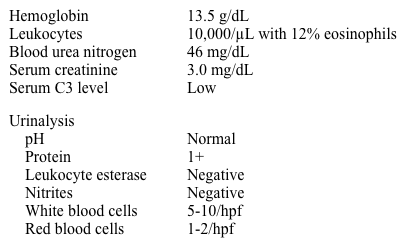 Which of the following is the most likely cause of this patient's findings?
 (Multiple Choice)
5.0/5 (76)
(76) A 44-year-old man comes to the office due to a 6-month history of fatigue, weakness, and intermittent nausea. The patient has no prior medical problems and takes no medications. He drinks 6-8 cans of beer daily. His blood pressure is 116/74 mm Hg and pulse is 78/min. The patient is alert and oriented. He has significant muscle wasting and nontender enlargement of bilateral parotid glands. Multiple spider angiomas on the upper trunk and extremities are seen. Heart sounds are normal without murmur. Breath sounds are diminished at the right base. The abdomen is mildly distended with shifting dullness. Rectal examination reveals internal hemorrhoids, and stool is guaiac-negative. There is no tremor, and neurologic examination is normal. Laboratory results are as follows:
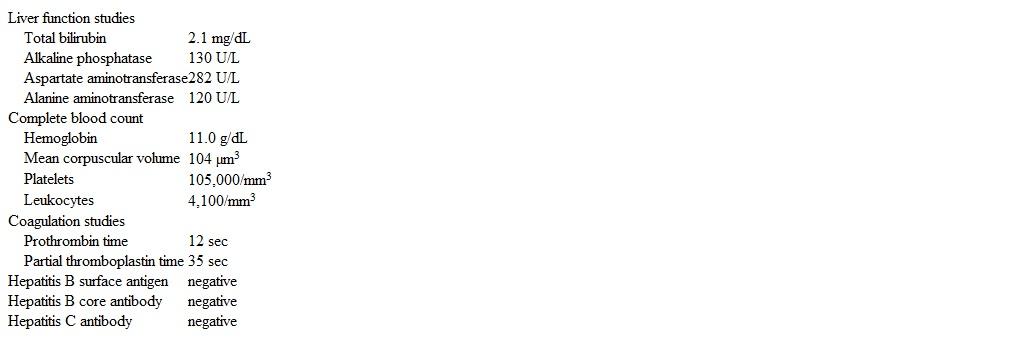 Abdominal ultrasound reveals splenomegaly, ascites, and an echogenic, shrunken liver without any mass. After his clinical condition is discussed, the patient agrees to strictly follow medical recommendations.
Which of the following studies is most appropriate for this patient?
Abdominal ultrasound reveals splenomegaly, ascites, and an echogenic, shrunken liver without any mass. After his clinical condition is discussed, the patient agrees to strictly follow medical recommendations.
Which of the following studies is most appropriate for this patient? (Multiple Choice)
4.9/5 (89)
(89) A 41-year-old woman is brought to the emergency department after being rescued during an open-water swim. She became weak and disoriented after swimming 2 miles but did not lose consciousness. The patient's past medical history is unremarkable, although she is taking amoxicillin for streptococcal pharyngitis that was diagnosed 4 days ago. Temperature is 33.3 C (92 F), blood pressure is 86/45 mm Hg, and pulse is 106/min. The heart has regular rate and rhythm. The patient is shivering and vomiting. She responds to questions sluggishly, but neurologic examination is otherwise normal. Laboratory results are as follows: 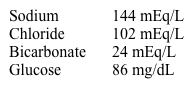 Which of the following is the most appropriate next step in management of this patient?
 (Multiple Choice)
4.8/5 (70)
(70) A 46-year-old man is brought to the emergency department due to a generalized tonic-clonic seizure. The patient has no chronic medical problems and, prior to today, had never had a seizure. He does not use tobacco, alcohol, or illicit drugs. The patient is a Christian missionary and recently spent 3 months with rural Bolivian pig farmers. Temperature is 36.8 C (98.2 F), blood pressure is 120/70 mm Hg, and pulse is 86/min. The patient is drowsy and postictal. Electroencephalogram shows epileptiform activity. MRI of the brain demonstrates several intraparenchymal, 5- to 10-mm cystic lesions with surrounding edema. There is no mass effect or midline shift. A rapid HIV test is negative. Which of the following is the most likely cause of this patient's current condition?
(Multiple Choice)
4.7/5 (75)
(75) A 34-year-old man comes to the emergency department at 2:00 AM due to several episodes of acute right periorbital pain for the past week. The pain wakes him at night, spreading from behind his right eye to his face and right temple, and lasts 30-45 minutes. He says that the pain is so severe that his right eye waters and he has nasal drainage. The patient has no nausea or visual disturbances. Two years ago, he had similar episodes daily for about a month. Temperature is 37 C (98.6 F), blood pressure is 136/84 mm Hg, and pulse is 88/min. The patient is restless and continuously rocks back and forth or paces around the room. Physical examination shows conjunctival injection and a constricted right pupil. Other examination findings, including neurologic examination, are normal. Which of the following is most likely to quickly improve this patient's current condition?
(Multiple Choice)
4.8/5 (82)
(82) A 22-year-old woman comes to the office with a 3-week history of rash on her face and upper back, which first appeared during a spring break trip to a Florida beach. During the trip, she also had a flu-like illness and continues to experience fatigue and aching pain in her joints. The patient has no prior medical conditions and takes no medications. She occasionally drinks alcohol but does not use tobacco or illicit drugs. She is sexually active with multiple partners. Temperature is 38 C (100.4 F), blood pressure is 142/80 mm Hg, and pulse is 92/min and regular. Physical examination shows an erythematous, maculopapular rash on the face and upper back. Nontender, generalized lymphadenopathy is present. The lungs are clear on auscultation and a faint diastolic murmur is present. The abdomen is soft and nontender with mild splenomegaly. Laboratory results are as follows:  Which of the following is the most appropriate next step in establishing this patient's diagnosis?
 (Multiple Choice)
4.9/5 (86)
(86) A 36-year-old woman comes to the emergency department due to a persistent spinning sensation associated with nausea and vomiting. Since the onset of symptoms 2 days ago, the patient has stayed in bed most of the time due to feeling unsteady when walking. She has had no headache, hearing loss, speech disturbance, or muscle weakness. Two weeks ago, she had an upper respiratory infection with sore throat, right ear fullness, and a feeling of "muffled" hearing. Medical history is notable for childhood asthma, and her only medication is a combined oral contraceptive pill. This patient's history is most consistent with which of the following diagnoses?
(Multiple Choice)
4.9/5 (82)
(82) A 44-year-old white male presents with a long history of joint pains in several joints. He has seen a physician before but no diagnosis was made. He has been taking ibuprofen with partial relief. He has now developed fever, diarrhea and weight loss. He denies any genitourinary or eye symptoms. He does not use tobacco, alcohol or drugs. He is a farmer. On examination, he has generalized lymphadenopathy and non-deforming arthritis. Small intestinal biopsy reveals periodic acid-Schiff (PAS)-positive macrophages. Which of the following is the most likely diagnosis?
(Multiple Choice)
4.9/5 (84)
(84) In a large clinical trial, patients with recent myocardial infarction and heart failure were randomized to a study medication or placebo. The average left ventricular ejection fraction of the study subjects was 33%. Most patients in both groups were concomitantly treated with a beta blocker and an angiotensin system inhibitor, in addition to the study medication or placebo. The long-term, all-cause mortality curves are shown in the image below, with the solid line representing the study medication and the dashed line representing the placebo. The difference between the curves is statistically significant. Which of the following medications most likely was used in the clinical trial? 
(Multiple Choice)
4.8/5 (86)
(86) Showing 561 - 580 of 1702
 Prev
- 1
- ...
- 2
- ...
- 3
- ...
- 4
- ...
- 5
- ...
- 6
- ...
- 7
- ...
- 8
- ...
- 9
- ...
- 10
- ...
- 11
- ...
- 12
- ...
- 13
- ...
- 14
- ...
- 15
- ...
- 16
- ...
- 17
- ...
- 18
- ...
- 19
- ...
- 20
- ...
- 21
- ...
- 22
- ...
- 23
- ...
- 24
- ...
- 25
- ...
- 26
- ...
- 27
- ...
- 28
- ...
- 29
- ...
- 30
- ...
- 31
- ...
- 32
- ...
- 33
- ...
- 34
- ...
- 35
- ...
- 36
- ...
- 37
- ...
- 38
- ...
- 39
- ...
- 40
- ...
- 41
- ...
- 42
- ...
- 43
- ...
- 44
- ...
- 45
- ...
- 46
- ...
- 47
- ...
- 48
- ...
- 49
- ...
- 50
- ...
- 51
- ...
- 52
- ...
- 53
- ...
- 54
- ...
- 55
- ...
- 56
- ...
- 57
- ...
- 58
- ...
- 59
- ...
- 60
- ...
- 61
- ...
- 62
- ...
- 63
- ...
- 64
- ...
- 65
- ...
- 66
- ...
- 67
- ...
- 68
- ...
- 69
- ...
- 70
- ...
- 71
- ...
- 72
- ...
- 73
- ...
- 74
- ...
- 75
- ...
- 76
- ...
- 77
- ...
- 78
- ...
- 79
- ...
- 80
- ...
- 81
- ...
- 82
- ...
- 83
- ...
- 84
- ...
- 85
- ...
- 86
- ...
- Next

Filters
- Essay(0)
- Multiple Choice(0)
- Short Answer(0)
- True False(0)
- Matching(0)