


 Chat with AI
Exam 1: Medicine

Exam 1: Medicine2 k Questions
Exam 2: Pediatric723 Questions
Exam 3: Psychiatry336 Questions
Exam 4: Surgery563 Questions
Exam 5: Obstetrics & Gynecology469 Questions
Select questions type


A 75-year-old man comes to the office due to intermittent right eye vision loss. The patient reports 3 episodes over the past 2 months in which he suddenly experienced "a curtain falling over the right eye" for several minutes before it spontaneously resolved. He has no eye pain or discomfort, focal weakness, numbness, or headache. His medical history is significant for hypertension, hyperlipidemia, and osteoarthritis. He smoked cigarettes for 25 years before quitting at age 50. Blood pressure is 140/85 mm Hg and pulse is 74/min. Visual acuity, pupillary reflex, and funduscopic examinations are unremarkable. Further neurologic examination shows normal reflexes, motor strength, and sensation. Which of the following is most likely to yield the diagnosis in this patient?
(Multiple Choice)
4.9/5  (87)
(87) A 36-year-old man comes to the office due to a month of diarrhea, nausea, and abdominal cramps. He has also had night sweats, arthralgias, and weight loss of 6.8 kg (15 lb) during this period. Pink, oval lesions developed on the patient's upper chest, neck, and face at the beginning of the illness but have now resolved. Temperature is 38.2 C (100.8 F), blood pressure is 112/74 mm Hg, pulse is 104/min, and respirations are 16/min. Nontender lymphadenopathy is present in the cervical and inguinal lymph nodes. There are no joint effusions or skin lesions. The abdomen is soft and nontender with no organomegaly. Which of the following is the best next step in evaluation of this patient?
(Multiple Choice)
4.9/5 (74)
(74) A 35-year-old man comes to the emergency department with a 3-day history of pain and redness in the left eye. He is a school bus driver and was exposed to a child with pink eye. The patient has no associated fever, headache, nasal congestion, or sore throat. However, he has experienced episodic abdominal discomfort and diarrhea over the past several months. The patient has no other medical problems and takes no medications. Family history is notable for glaucoma in his mother. Ocular examination findings are shown in the exhibit. 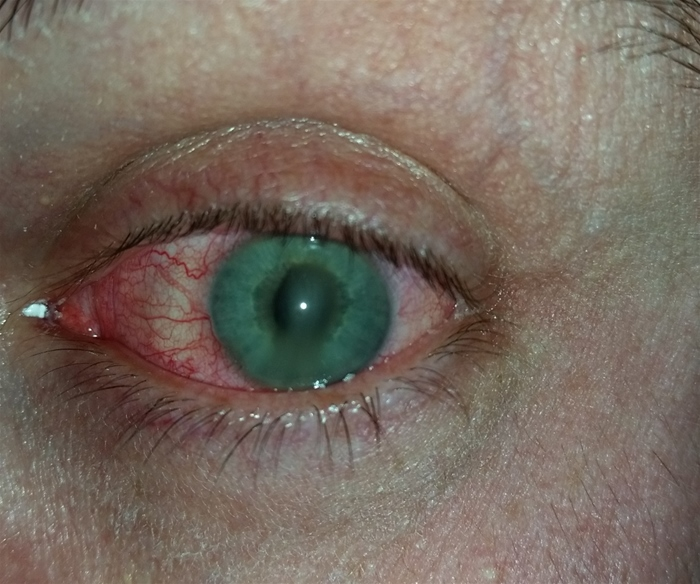 During the examination, the patient keeps the eye closed and says, "It is painful to look at the light." There is increased tearing from the left eye but no mucoid or purulent discharge. Right eye examination is normal. Visual acuity is 20/50 in the left eye and 20/20 in the right eye. There is no nasal discharge and the pharyngeal mucosa is not erythematous. An aphthous ulcer is present on the buccal mucosa. Abdominal examination shows tenderness in the right lower quadrant on deep palpation. The remainder of the physical examination is normal. Which of the following is the most likely cause of this patient's eye symptoms?
 (Multiple Choice)
5.0/5 (76)
(76) A 48-year-old man comes to the office for evaluation of a facial rash. He first noticed the rash approximately 3 months ago. It started on his forehead and eyebrows and has now progressed to involve his nose down to his chin. He has also noticed a lot of dandruff in his hair recently. The patient has no other medical problems and takes no medications. Skin examination findings are shown in the image below. Close examination shows greasy-looking, fine yellowish scales on an erythematous base. The trunk and extremities have no lesions. 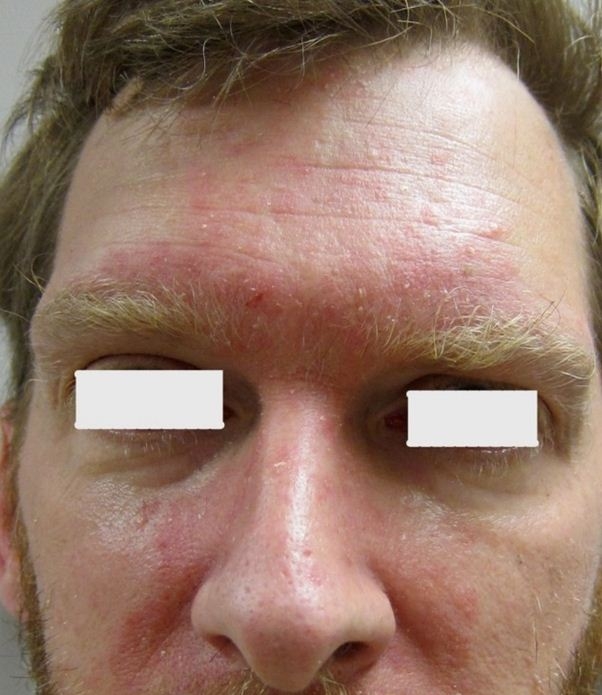 Which of the following is the most likely diagnosis?
 (Multiple Choice)
4.9/5 (76)
(76) A 42-year-old man comes to the office for evaluation of worsening joint pain and deformity. The patient initially experienced intermittent pain in his feet 2 years ago, which has progressed to constant pain in the knees and hands. Several months ago, he noticed nodular growths around the hand joints. Over-the-counter analgesics, taken as needed, provide some symptom relief. The patient did not see a physician earlier because he lost medical insurance after he became unable to work as an auto mechanic, but he recently got a new job. Physical examination shows joint swelling and deformities, as shown below. Range of motion of the finger joints is limited, and the patient has difficulty making a fist. Which of the following is the most likely underlying cause of this patient's current condition? 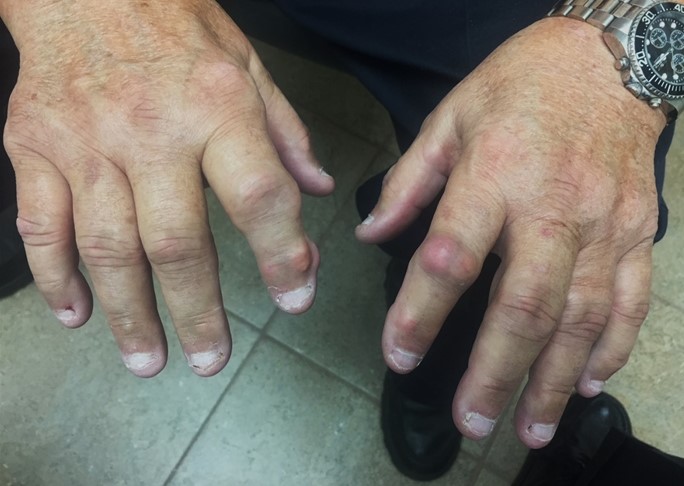
(Multiple Choice)
4.8/5 (82)
(82) A 25-year-old woman, gravida 3 para 0 aborta 2, at 6 weeks gestation comes to the office for a routine prenatal visit. The patient says she feels fine except for mild nausea; she takes no medications other than a prenatal vitamin. Her 2 prior pregnancies ended in first-trimester spontaneous abortions. Prior to this pregnancy, the patient drank alcohol on social occasions, and she does not use tobacco or illicit drugs. She is in a monogamous relationship and has never been diagnosed with or treated for a sexually transmitted infection. Laboratory results are as follows:  Urinalysis shows no blood or protein. Sonogram shows a 6-week fetal pole with cardiac motion. Which of the following is the best next step in the management of this patient?
 (Multiple Choice)
4.8/5 (72)
(72) A 33-year-old man with an unremarkable medical history comes to the office due to fatigue and weight loss over the past 3 months. He awakens at 4:00 AM each day and is unable to fall back asleep. The patient also mentions that he had enjoyed golf and playing with his children but now has little interest in either activity. Although he used to excel at work, he now has no motivation and "spaces out" at times. Physical examination and laboratory studies, including TSH level, are normal. The patient is diagnosed with major depressive disorder and prescribed fluoxetine. Two weeks later, he calls to report that he is sleeping and eating better but is still depressed. The patient is discouraged about his lack of improvement and says, "I don't feel like the medication is doing very much." Which of the following is the most appropriate next step in pharmacological management?
(Multiple Choice)
4.8/5 (77)
(77) A 75-year-old woman is evaluated for agitation and confusion while hospitalized. She was admitted 4 days ago due to fever, productive cough, and shortness of breath. The patient was diagnosed with community-acquired pneumonia and her condition has improved with antibiotics. However, for the past 2 days, she has had episodes of confusion and agitation, especially during the evening and night. The patient's medical history includes hypertension, osteoarthritis, and mild dementia. She lives with her husband at a senior living facility and is able to perform her daily activities with minimal assistance. Her temperature is 37.0 C (98.6 F), blood pressure is 130/80 mm Hg, and pulse is 84/min. Pulse oximetry is 98% on room air. The patient recognizes her husband at the bedside but is not oriented to time or location. During the examination, she repeatedly tries to climb out of bed but calms when reoriented. The patient follows simple instructions and has no focal weakness or sensory loss. She has moist mucous membranes and crackles in the right upper lung. Laboratory testing shows an improving leukocytosis and normal electrolytes. Which of the following would be most helpful in managing this patient's current condition?
(Multiple Choice)
4.9/5 (71)
(71) A 65-year-old woman is brought to the office by her family due to increasing forgetfulness over the past year. The patient previously had trouble remembering where she left her keys or glasses, and lately she has had difficulty recalling familiar names. She says, "I'm just getting older and slowing down," but her daughter became concerned when her mother couldn't remember the steps to make a favorite dish that she had previously cooked from memory for years. The patient has a history of well-controlled hypertension. She does not use tobacco but has 2 glasses of wine daily. Her husband unexpectedly died of a myocardial infarction a year ago. The patient's mother died of Alzheimer disease in her 80s. Blood pressure is 130/85 mm Hg and pulse is 85/min. The patient is alert, oriented, and cooperative. Muscle strength, sensation, deep tendon reflexes, and gait are normal. Which of the following is the best next step in management of this patient?
(Multiple Choice)
4.9/5 (71)
(71) A 22-year-old woman comes to the emergency department due to continuous gum bleeding after a mouth injury a few hours ago. She was playing doubles tennis and was accidentally struck on her bottom lip by her partner's racquet. The patient has a history of bruising with minor trauma and of heavy menstruation with crampy pain. She has no other medical conditions and takes no medications other than occasional ibuprofen. The patient does not use tobacco, alcohol, or illicit drugs; she eats a balanced diet. Her mother also had a history of "bleeding issues." Blood pressure is 120/70 mm Hg and pulse is 80/min. Oropharyngeal examination shows blood oozing from a gum abrasion. A fading ecchymosis is present on the right calf, but there are no other skin abnormalities. The remainder of the physical examination is normal. Laboratory results are as follows:  Which of the following is the most likely cause of this patient's bleeding problem?
 (Multiple Choice)
4.8/5 (90)
(90) A 68-year-old man was admitted to the intensive care unit 5 days ago due to septic shock and respiratory failure from pneumonia. The patient has been treated with intravenous fluids, vasopressors, broad-spectrum antibiotics, and intubation with mechanical ventilation. Blood cultures have resulted with Streptococcus pneumoniae, and the antibiotics have been tailored based on the sensitivity. Vasopressors have been weaned off and the sedation has been held. Current ventilator settings are assist-control mode with tidal volume 480 mL (8 mL/kg body weight), fraction of inspired oxygen (FiO2) 35%, and positive end-expiratory pressure (PEEP) 5 cm H2O. Temperature is 37.2 C (99 F), blood pressure is 118/74 mm Hg, pulse is 86/min, and respirations are 18/min. On physical examination, the patient is awake with the endotracheal tube in adequate position. He answers questions with head nods and follows simple commands such as to lift his head off the pillow. Lung auscultation reveals right-sided crackles. Heart sounds are normal. The extremities are warm without edema and the distal pulses are normal. Leukocyte count is 10,800/mm3, and arterial blood gas testing reveals pH 7.45, pCO2 35 mm Hg, and PaO2 82 mm Hg. Which of the following is the most appropriate next step in management of this patient?
(Multiple Choice)
4.9/5 (70)
(70) A 38-year-old woman comes to the office with progressive muscle weakness over the last 6 months. She finds it difficult to climb stairs and comb her hair, and she is unable to walk even short distances without rest. There is no associated muscle pain. The patient was diagnosed with hypothyroidism a year ago when she started gaining weight and has been taking levothyroxine since then. Four months ago, she developed acute back pain. X-ray at that time revealed demineralization of the vertebral bones. Temperature is 37 C (98.6 F), blood pressure is 155/100 mm Hg, pulse is 76/min, and respirations are 15/min. BMI is 32 kg/m2. Physical examination shows facial hirsutism and mild proximal muscle weakness in the extremities. The patient's muscles are not tender on palpation, and no fasciculations are noted. Deep tendon reflexes and sensory examination are normal. TSH is normal. Which of the following is most likely responsible for this patient's muscle weakness?
(Multiple Choice)
4.7/5 (82)
(82) A 45-year-old man comes to the office due to a 2-month history of painless, nonpruritic, purple lesions on his legs. He has also had progressive fatigue, weakness, and fleeting joint pain in his knees and elbows for the past several months. The patient has had no fever, weight loss, diarrhea, or abdominal pain. Temperature is 36.7 C (98.1 F), blood pressure is 147/91 mm Hg, and pulse is 84/min. Cardiac examination reveals no murmurs or additional sounds. There are multiple palpable lesions on both lower extremities that do not blanch with pressure. Laboratory results are as follows: 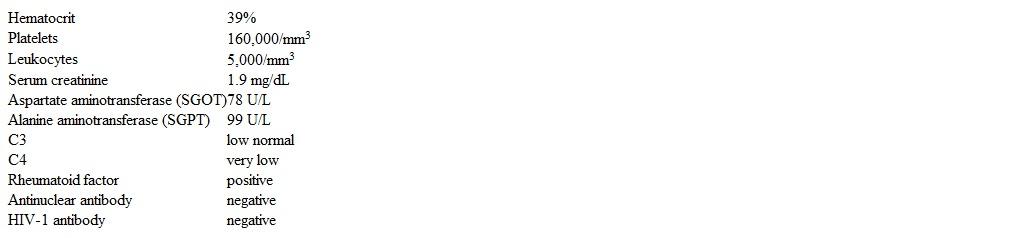 Urinalysis shows 3+ blood, 3+ protein, and a few dysmorphic red blood cells. Which of the following would be most helpful in establishing this patient's diagnosis?
 (Multiple Choice)
4.8/5 (71)
(71) A 6-hour-old boy is evaluated in the newborn nursery due to scalp swelling. The patient was born at term via cesarean delivery to a 21-year-old primigravida. The pregnancy was unremarkable, and the mother's only medication was a prenatal multivitamin. Delivery was complicated by 18 hours of active labor followed by arrest of descent, necessitating cesarean delivery. Family history is notable for a maternal uncle with severe hemophilia A. Temperature is 37.3 C (99.1 F) and pulse is 190/min. The patient appears pale. Examination of the scalp shows diffuse, fluctuant edema extending from the right ear across the vertex to just above the left ear. Laboratory results are as follows:  Which of the following is the most likely cause of this patient's clinical presentation?
 (Multiple Choice)
4.9/5 (83)
(83) A 30-year-old white man comes to the emergency department with shortness of breath that began this morning. The patient has no chest pain, fevers, or chills. His medical history is insignificant, and he describes himself as healthy. He does not use tobacco or alcohol. The patient is physically active and has not traveled recently. His father died of a heart attack at age 45. Temperature is 36.1 C (97 F), blood pressure is 110/80 mm Hg, and pulse is 104/min. Chest auscultation indicates normal vesicular breath sounds. There are no heart murmurs. There is mild swelling of the right lower leg. ECG shows sinus tachycardia but is otherwise unremarkable. Laboratory results are as follows:  Which of the following is the most likely contributor to this patient's current condition?
 (Multiple Choice)
4.8/5 (77)
(77) A 19-year-old woman comes to the office for evaluation of chronic acne. Over the last 6 months, the patient has tried several over-the-counter acne treatments without improvement. She has a history of attention-deficit hyperactivity disorder and mild intellectual disability. Her mother has a seizure disorder, and her maternal grandmother died of kidney failure. Vital signs are within normal limits. Facial examination findings are shown below. 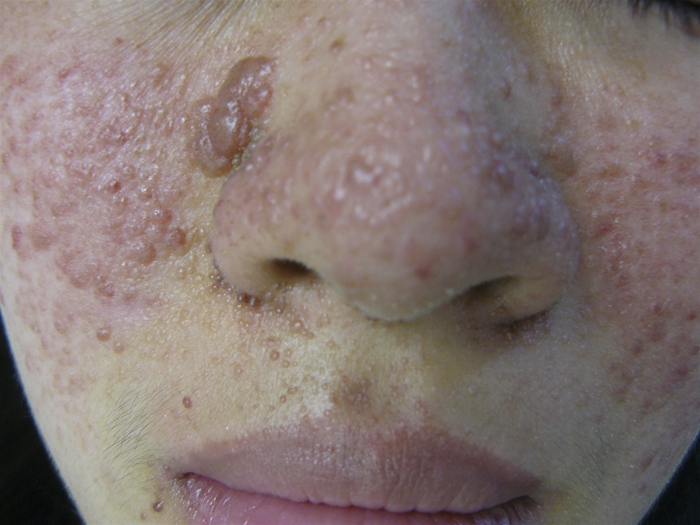 There are several elliptical, hypopigmented macules on the trunk. Which of the following is the most likely underlying cause of this patient's condition?
 (Multiple Choice)
4.9/5 (78)
(78) A 62-year-old woman comes to the office due to difficulty remembering important dates and appointments. She also describes poor concentration, daytime sleepiness, and easy fatigability. She is concerned about her forgetfulness because her mother suffered from recurrent strokes and had severe memory loss. Her father died of chronic leukemia. Her daughter's recent job loss has caused her a lot of stress. She does not use alcohol or tobacco. Her appetite is decreased but she has gained 2 kg (4.4 lbs) over the last 3 months. She recently visited an otolaryngologist for hoarseness. She takes occasional aspirin for joint pain and has been taking over-the-counter laxatives for constipation. She denies any other medication use. Which of the following is the most likely diagnosis in this patient?
(Multiple Choice)
4.7/5 (62)
(62) A 54-year-old woman is brought to the emergency department due to fever and lethargy. The patient has had several days of productive cough and yesterday developed severe headache, nausea, and vomiting. This morning, she became weak and confused and could not get out of bed by herself. She has a history of type 2 diabetes mellitus. The patient drinks 1 or 2 glasses of wine daily. Temperature is 39.1 C (102.4 F), blood pressure is 110/70 mm Hg, and pulse is 108/min. The patient is somnolent and requires constant physical stimuli to remain awake. She is oriented to person only. Marked neck rigidity is present. Pulmonary auscultation reveals crackles and bronchial breath sounds in the right lower lung field. There is no skin rash. Laboratory testing shows leukocytosis. CT scan of the head is normal. Lumbar puncture is performed. Which of the following organisms is most likely to be seen in the spinal fluid of this patient?
(Multiple Choice)
4.8/5 (82)
(82) A 23-year-old woman comes to the office for "trouble" with her bowel movements. Despite experiencing urgency to use the bathroom, the patient frequently strains on the toilet with minimal production of stool. She describes a whitish-appearing anal discharge and itchiness but has no pain, fever, or unexpected weight loss. The patient reports several new male sexual partners in the past year. Aside from oral contraceptives, she does not take any medications. Temperature is 37.7 C (99.9 F), blood pressure is 132/65 mm Hg, pulse is 70/min, and respirations are 14/min. The abdomen is nontender and nondistended without hepatosplenomegaly. There is no palpable lymphadenopathy. External appearance of the genitalia is unremarkable. Rectal examination reveals mucopurulent anal discharge without perianal abnormalities. Which of the following is the most likely diagnosis?
(Multiple Choice)
4.9/5 (71)
(71) A 66-year-old woman is brought to the emergency department due to agitation, restlessness, and poor sleep. Over the past 3 months, she has had headaches and gained 6.3 kg (13.9 lb). The patient's medical history is unremarkable, and she takes no medications. She has smoked a pack of cigarettes daily for the last 50 years but does not use illicit drugs. Blood pressure is 160/110 mm Hg and pulse is 90/min. Skin examination shows facial plethora and scattered bruises on her extremities. Laboratory results are as follows: 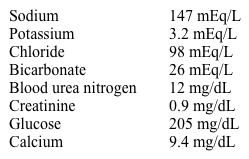 Which of the following is the most likely cause of this patient's hypertension?
 (Multiple Choice)
5.0/5 (84)
(84) Showing 161 - 180 of 1702
 Prev
- 1
- ...
- 2
- ...
- 3
- ...
- 4
- ...
- 5
- ...
- 6
- ...
- 7
- ...
- 8
- ...
- 9
- ...
- 10
- ...
- 11
- ...
- 12
- ...
- 13
- ...
- 14
- ...
- 15
- ...
- 16
- ...
- 17
- ...
- 18
- ...
- 19
- ...
- 20
- ...
- 21
- ...
- 22
- ...
- 23
- ...
- 24
- ...
- 25
- ...
- 26
- ...
- 27
- ...
- 28
- ...
- 29
- ...
- 30
- ...
- 31
- ...
- 32
- ...
- 33
- ...
- 34
- ...
- 35
- ...
- 36
- ...
- 37
- ...
- 38
- ...
- 39
- ...
- 40
- ...
- 41
- ...
- 42
- ...
- 43
- ...
- 44
- ...
- 45
- ...
- 46
- ...
- 47
- ...
- 48
- ...
- 49
- ...
- 50
- ...
- 51
- ...
- 52
- ...
- 53
- ...
- 54
- ...
- 55
- ...
- 56
- ...
- 57
- ...
- 58
- ...
- 59
- ...
- 60
- ...
- 61
- ...
- 62
- ...
- 63
- ...
- 64
- ...
- 65
- ...
- 66
- ...
- 67
- ...
- 68
- ...
- 69
- ...
- 70
- ...
- 71
- ...
- 72
- ...
- 73
- ...
- 74
- ...
- 75
- ...
- 76
- ...
- 77
- ...
- 78
- ...
- 79
- ...
- 80
- ...
- 81
- ...
- 82
- ...
- 83
- ...
- 84
- ...
- 85
- ...
- 86
- ...
- Next

Filters
- Essay(0)
- Multiple Choice(0)
- Short Answer(0)
- True False(0)
- Matching(0)