


 Chat with AI
Exam 1: Medicine

Exam 1: Medicine2 k Questions
Exam 2: Pediatric723 Questions
Exam 3: Psychiatry336 Questions
Exam 4: Surgery563 Questions
Exam 5: Obstetrics & Gynecology469 Questions
Select questions type


A 58-year-old woman is brought to the emergency department after she is found unconscious in her bedroom. The patient recently had an argument with her husband, and her family suspects a drug overdose. They last saw her 4 hours ago. The patient has multiple medical conditions, including major depression for which she takes several medications. Temperature is 35.5 C (95.9 F), blood pressure is 82/46 mm Hg, pulse is 40/min, and respirations are 12/min. Pulse oximetry is 84% on room air. Pupils are 4 mm and reactive. Jugular veins are flat. Lung sounds are normal. Heart sounds are muffled. Capillary refill is 3 seconds. Finger-stick blood glucose is 52 mg/dL. Overdose of which of the following medications is the most likely cause of this patient's symptoms?
(Multiple Choice)
4.8/5  (80)
(80) A 32-year-old man comes to the clinic due to a week of escalating low back pain. The pain is dull, achy, present at rest, and worse with activity. The patient has no significant medical history. He smokes a pack of cigarettes daily and drinks alcohol occasionally. He recently began using intravenous heroin due to significant psychosocial stress at home. There is a family history of prostate cancer in his father. Temperature is 36.7 C (98 F), blood pressure is 120/80 mm Hg, pulse is 90/min, and respirations are 16/min. Gentle percussion over the lumbar vertebrae (L3 and L4) elicits exquisite pain. A full neurologic examination, including straight leg raise, is normal. Laboratory results are as follows: 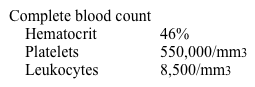 Which of the following is the most likely diagnosis?
 (Multiple Choice)
4.8/5 (76)
(76) An 81-year-old nursing home resident is brought to the emergency department due to a day of progressive lethargy and shortness of breath. The patient has a medical history of hypertension and Alzheimer dementia. Blood pressure is 96/55 mm Hg and pulse is 120/min. Auscultation of the chest reveals reduced breath sounds and crackles in the right infrascapular region. There is a 2/6 systolic ejection murmur heard at the right upper sternal border. Invasive hemodynamic monitoring reveals a cardiac index of 4.4 L/min/m2 (normal, 2.5-4.2 L/min/m2), right atrial pressure of 4 mm Hg (normal, 2-10 mm Hg), and pulmonary capillary wedge pressure of 6 mm Hg (normal, 6-15 mm Hg). The systemic vascular resistance is decreased. Which of the following is a likely additional finding in this patient?
(Multiple Choice)
4.8/5 (85)
(85) A 45-year-old man comes to the office for evaluation of intermittent episodes of cough and dyspnea for 2 months. The episodes usually occur after exposure to the cold air outside during jogging. The patient gets some relief after expectorating white sputum. Medical history is significant for myasthenia gravis. Four months ago, the patient was intubated for 5 days due to a myasthenic crisis triggered by a viral upper respiratory infection. He takes pyridostigmine and does not use tobacco, alcohol, or illicit drugs. Temperature is 37 C (98.6 F), blood pressure is 128/78 mm Hg, pulse is 78/min, and respirations are 16/min. Pulse oximetry on room air is 98%. Examination shows occasional wheezes on the posterior aspect of both lungs upon forceful exhalation. Heart sounds are normal. Muscle strength is 5/5 in all extremities, cranial nerve function is normal, and deep tendon reflexes are normal. The remainder of the examination shows no abnormalities. Which of the following is the most likely cause of this patient's symptoms?
(Multiple Choice)
4.9/5 (82)
(82) A 61-year-old man comes to the office for follow-up for coronary artery disease. He says that he feels "fine." The patient has had no chest pain, syncope, or lower extremity swelling. He has had some shortness of breath on moderate exertion. Medical follow-up has been inconsistent, and he has missed multiple medical appointments. Medical history includes a myocardial infarction 2 years ago. The patient is an ex-smoker with a 20-pack-year smoking history. Blood pressure is 122/70 mm Hg, and pulse is 70/min and regular. Echocardiogram reveals left ventricular dilation, apical left ventricular aneurysm, and ejection fraction of 23%. There are no significant valvular abnormalities. Appropriate pharmacotherapy is prescribed, medical compliance is reinforced, and a follow-up appointment is scheduled. Several days later, the patient suddenly dies at home. Which of the following is the most likely cause of death in this patient?
(Multiple Choice)
4.8/5 (75)
(75) A 64-year-old man comes to the office due to increasing pain in the right groin for the past several months. The pain increases with activity, is relieved with rest, and sometimes radiates to the upper thigh. The patient has no history of trauma or falls. There is no associated fever, weight loss, or change in appetite. He has a history of lumbar disk herniation but has no back pain currently. Medical history is notable for type 2 diabetes mellitus and hypertension. Vital signs are normal. Height is 168 cm (5 ft 5 in) and weight is 95 kg (210 lb). BMI is 34 kg/m2. Examination shows pain on passive internal rotation of the right hip, but there is no focal tenderness on palpation of the groin and hip region. Reflexes are 2+ in the lower extremities symmetrically, and there are no sensory deficits. Muscle bulk, tone, and power are normal. Dorsalis pedis and posterior tibial pulses are 2+ in both legs. Which of the following is the most likely cause of this patient's hip pain?
(Multiple Choice)
4.9/5 (76)
(76) A 24-year-old man comes to the office due to worsening productive cough with tenacious sputum, fever, and shortness of breath for a week. Today, he noticed blood streaks in the sputum. The patient had several similar episodes in the past, and the symptoms usually improved somewhat with antibiotics but never went away completely. He also has decreased exercise tolerance, fatigue, and weight loss. The patient does not use tobacco, alcohol, or illicit drugs. There is no family history of similar problems. Temperature is 38.9 C (102 F), blood pressure is 130/80 mm Hg, pulse is 102/min, and respirations are 20/min. Examination reveals crackles in both upper lung fields, and heart sounds are normal without murmurs. The patient's abdomen is soft, nontender, and without organomegaly. Digital clubbing is present. Leukocyte count is 15,000/mm3. Chest x-ray reveals a right upper lobe infiltrate, and a sputum culture grew Pseudomonas aeruginosa. Which of the following is the most likely underlying cause of this patient's current symptoms?
(Multiple Choice)
4.8/5 (79)
(79) An 80-year-old woman is brought to the emergency department due to an episode of near-syncope. The patient feels excessively tired and breathless on moderate exertion and has had occasional palpitations over the past 6 months. She has had several brief episodes of lightheadedness during the last 2 weeks, and while walking in a mall today, she felt extremely weak and dizzy. The patient was helped by her family and did not fall or lose consciousness. She has had no chest pain, cough, or pedal edema. The patient has hypertension, hyperlipidemia, and coronary artery disease treated with bypass graft surgery 15 years ago. She takes aspirin, atorvastatin, and metoprolol. Blood pressure is 136/80 mm Hg and pulse is 52/min without significant orthostatic changes. No jugular venous distension is present. Cardiac auscultation reveals regular S1 and S2 with an additional S4. Breath sounds are normal with no crackles. There is no extremity edema. ECG shows sinus bradycardia. During her hospital stay, cardiac telemonitoring reveals episodes of 3-6 seconds with no sinus nodal activity, during which the patient experiences dizziness. Which of the following is the most likely cause of this patient's cardiac arrhythmia?
(Multiple Choice)
4.8/5 (87)
(87) A 65-year-old man who underwent right total knee replacement 6 months ago comes to the emergency department due to a 3-week history of dull pain in his right knee. He has had no recent respiratory illness, diarrhea, or urinary symptoms. Medical history is notable for osteoarthritis, hypertension, and hyperlipidemia. The patient drinks a beer every night and does not use tobacco or illicit drugs. Temperature is 37.3 C (99.1 F), blood pressure is 120/60 mm Hg, and pulse is 90/min. Examination shows mild swelling and tenderness at the knee with full range of motion. The skin over the joint is intact. The synovial fluid is sampled. Laboratory results are as follows:  Which of the following is the most likely cause of this patient's current condition?
 (Multiple Choice)
4.8/5 (75)
(75) A 55-year-old man is being evaluated for fatigue. He has a history of hypertension and chronic low back pain due to a traumatic injury 20 years ago. His medications include lisinopril and over-the-counter pain medications. His father has diabetes and his mother has hypertension. He does not use tobacco, alcohol, or illicit drugs. His blood pressure is 130/80 mm Hg and pulse is 80/min. Physical examination is unremarkable. Laboratory studies are as follows: 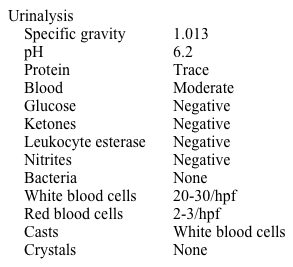 Laboratory studies show serum creatinine level of 2.2 mg/dL and blood urea nitrogen of 34 mg/dL. Which of the following is the most likely cause of this patient's urinary findings?
 (Multiple Choice)
4.8/5 (81)
(81) An 80-year-old woman with multiple medical problems is admitted to the hospital for evaluation of syncope. Her heart rate is found to be 36/min. She was admitted to another hospital recently, then discharged to an acute rehabilitation facility, and then sent to a nursing home. Review of her history shows that the patient is taking high-dose diltiazem, metoprolol, and atenolol. Which of the following medication reconciliation interventions is most likely to result in a decrease in adverse drug events and health care utilization?
(Multiple Choice)
4.9/5 (93)
(93) A 30-year-old man comes to the office due to low back pain and stiffness for 2 months. His pain is worse in the morning and improves with activity. The patient has also had intermittent diarrhea and lower abdominal pain for the past 3 months. He tried ibuprofen, which helped his back pain but made his diarrhea worse. He has not traveled outside the United States. The patient has been sexually active with the same female partner for 2 years. He has no other medical problems and does not use tobacco, alcohol, or recreational drugs. Vital signs are normal. Physical examination shows limited spine flexion and tenderness in the lower back. Laboratory studies show anemia and thrombocytosis. Stool cultures are negative. Plain radiographs reveal sacroiliac joint inflammation. Which of the following is the most likely cause of this patient's symptoms?
(Multiple Choice)
4.8/5 (82)
(82) A 33-year-old man comes to the hospital due to left flank pain. The patient has never had these symptoms previously. He has been told during past physicals that his blood pressure is elevated, but he never followed up. The patient's father died suddenly in his sleep at age 42. Blood pressure is 170/100 mm Hg in both arms, and pulse is 82/min. Cardiopulmonary examination is normal. The abdomen is soft, and mild tenderness is noted in the left flank. Renal ultrasonogram reveals mildly enlarged kidneys containing multiple cysts of varying sizes; echogenic foci compatible with nephrolithiasis are also noted in the left kidney. The patient's pain is well controlled with analgesics. However, his blood pressure remains elevated. Which of the following is the most likely cause of hypertension in this patient?
(Multiple Choice)
4.7/5 (84)
(84) A 64-year-old man comes to the emergency department due to intermittent, burning midline chest pain over the last 2 hours. He has never had similar pain. The patient's medical history includes hypertension and hyperlipidemia. An immediate ECG reveals sinus rhythm with ST-segment elevations in leads II, III, and aVF. Temperature is 37.8 C (99.7 F), blood pressure is 115/70 mm Hg, pulse is 65/min, and respirations are 15/min. He is given sublingual nitroglycerin, and the on-call cardiologist is notified. Several minutes later, the patient reports lightheadedness and extreme weakness. His repeat blood pressure is 75/50 mm Hg and pulse is 85/min. The patient is diaphoretic and his extremities are cold. Jugular venous pulse is elevated in the semirecumbent position. On auscultation, the lungs are clear and no murmurs are heard. Which of the following is the best next step in management of this patient?
(Multiple Choice)
4.8/5 (70)
(70) A 24-year-old woman comes to the office due to headaches that she has had every few months for the past 6-7 years. She describes these as left-sided and throbbing; they are associated with mild nausea, last for 12-18 hours, and improve after she rests in a dark and quiet room or takes ibuprofen. For the past month, she has been waking up almost daily with bifrontal headaches often accompanied by nausea and vomiting. She also has occasional blurry vision. The patient attributes these headaches to increased stress at work after being promoted to a supervisor position. She has had no fevers, focal weakness, or numbness. She has no other medical history and does not use tobacco, alcohol, or recreational drugs. Her mother and sister have migraine headaches. Temperature is 37 C (98.6 F), blood pressure is 120/80 mm Hg, and pulse is 72/min. Bilateral pupils are equal and reactive to light. She has a normal examination of the cranial nerves, motor strength, sensation, and deep tendon reflexes. Which of the following is the most appropriate next step in management of this patient?
(Multiple Choice)
4.9/5 (75)
(75) A 60-year-old man is brought to the emergency department due to progressive lethargy. The patient has a history of alcoholic cirrhosis and was recently seen in his primary care provider's office for increasing abdominal distension and leg swelling. His wife says that the swelling improved slightly after furosemide and spironolactone were started, but for the last 2 days he has been confused and irritable. The patient has slept most of the time and has not eaten. Temperature is 36.7 C (98 F), blood pressure is 96/50 mm Hg, and pulse is 96/min. On examination, the patient appears lethargic but is arousable. He is not very cooperative and at times is agitated. Mucous membranes are dry. His outstretched hands exhibit a flapping tremor. The abdomen is nontender and distended, and shifting dullness is present. Bilateral lower extremity pitting edema is present. Stool occult blood is negative. Laboratory results are as follows: 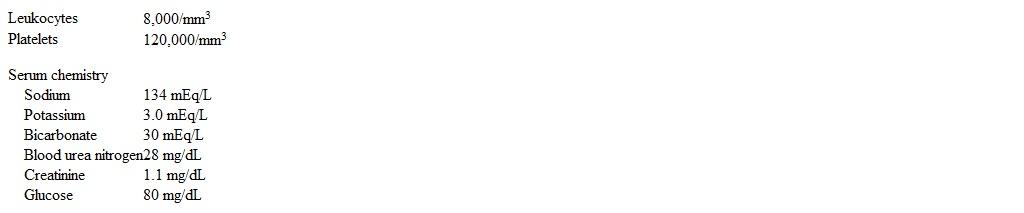 Which of the following is the best initial treatment for this patient?
 (Multiple Choice)
4.9/5 (76)
(76) A 68-year-old woman comes to the emergency department due to epigastric abdominal pain. The pain began suddenly, is severe and unremitting, and radiates to the back. The patient also has nausea and frequent nonbloody emesis. She was seen in the office 3 months ago for hypertension management. Medications include hydrochlorothiazide and amlodipine. She does not use tobacco, alcohol, or illicit drugs. Temperature is 38.1 C (100.6 F), blood pressure is 149/89 mm Hg, pulse is 95/min, and respirations are 18/min. Physical examination reveals anicteric sclera and moist mucous membranes. Heart and lung sounds are unremarkable. The abdomen is tender to palpation diffusely with mild distension but no rebound or guarding. Laboratory results are as follows: 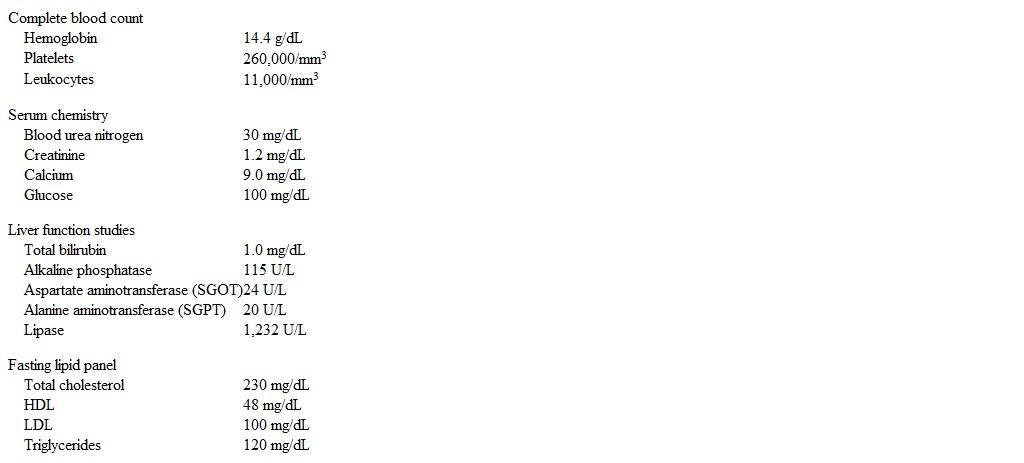 The patient is admitted to the hospital for intravenous fluids and pain control. Ultrasound of the right upper quadrant shows a normal gallbladder without stones; the size of the common bile duct is normal. Which of the following is the best next step in management of this patient?
 (Multiple Choice)
4.8/5 (74)
(74) A 72-year-old man comes to the emergency department due to a 24-hour history of progressive lower abdominal discomfort and difficulty voiding. The patient has never had urinary difficulty in the past. He has a history of hypertension, ischemic stroke with mild left-sided residual weakness, and a recent episode of abdominal shingles. The patient also reports several days of non-productive cough and has been taking over-the-counter diphenhydramine for 2 days. He is a former smoker and does not drink alcohol. Temperature is 36.7 C (98 F), blood pressure is 150/80 mm Hg, and pulse is 105/min. The patient appears restless. Bilateral breath sounds are normal with no added sounds. Cardiac examination reveals regular rhythm. Previous area of shingles on the abdominal wall has no active lesions but the area is hyperesthetic. There is suprapubic fullness and tenderness. A mildly enlarged, nontender prostate is palpated on the rectal examination. Which of the following is the most likely cause of this patient's current condition?
(Multiple Choice)
4.9/5 (80)
(80) A 58-year-old man hospitalized for confusion is evaluated for elevated serum creatinine. He has a history of cirrhosis due to chronic hepatitis C infection, and evaluation at the time of admission revealed hepatic encephalopathy and spontaneous bacterial peritonitis. Since admission, the patient's mental status has gradually improved with lactulose and cefotaxime therapy, but his renal functioning has worsened. At home, he takes furosemide, spironolactone, and nadolol, all of which were stopped at the time of admission. Temperature is 37 C (98.6 F), blood pressure is 98/62 mm Hg, and pulse is 102/min. Physical examination shows jaundice, spider angiomas, ascites, and leg edema. He has no skin rash. Serum creatinine and urine output since admission are shown below.  Urinalysis reveals 1-2 erythrocytes/hpf with no significant casts or protein. Renal ultrasound shows normal-size kidneys with no hydronephrosis. There has been no improvement in renal function with intravenous saline and albumin infusion. Which of the following is the most likely mechanism of this patient's renal dysfunction?
 (Multiple Choice)
5.0/5 (80)
(80) A 38-year-old woman comes to the emergency department with 7 days of fatigue and headache that has worsened in intensity today. She also reports an episode of vomiting. The patient is accompanied by her roommate, who has noted no confusion or personality changes. On physical examination she is awake, alert, and conversant. Her temperature is 38.3 C (101 F) and pulse is 84/min. Her neck is supple. Oropharynx examination shows thrush. Lungs and cardiovascular examination is normal. Neurological examination shows no focal deficits. Ophthalmological examination shows bilateral papilledema. An MRI of the brain is normal. A rapid HIV test is positive. Which of the following is most likely to establish a diagnosis?
(Multiple Choice)
4.9/5 (96)
(96) Showing 1281 - 1300 of 1702
 Prev
- 1
- ...
- 2
- ...
- 3
- ...
- 4
- ...
- 5
- ...
- 6
- ...
- 7
- ...
- 8
- ...
- 9
- ...
- 10
- ...
- 11
- ...
- 12
- ...
- 13
- ...
- 14
- ...
- 15
- ...
- 16
- ...
- 17
- ...
- 18
- ...
- 19
- ...
- 20
- ...
- 21
- ...
- 22
- ...
- 23
- ...
- 24
- ...
- 25
- ...
- 26
- ...
- 27
- ...
- 28
- ...
- 29
- ...
- 30
- ...
- 31
- ...
- 32
- ...
- 33
- ...
- 34
- ...
- 35
- ...
- 36
- ...
- 37
- ...
- 38
- ...
- 39
- ...
- 40
- ...
- 41
- ...
- 42
- ...
- 43
- ...
- 44
- ...
- 45
- ...
- 46
- ...
- 47
- ...
- 48
- ...
- 49
- ...
- 50
- ...
- 51
- ...
- 52
- ...
- 53
- ...
- 54
- ...
- 55
- ...
- 56
- ...
- 57
- ...
- 58
- ...
- 59
- ...
- 60
- ...
- 61
- ...
- 62
- ...
- 63
- ...
- 64
- ...
- 65
- ...
- 66
- ...
- 67
- ...
- 68
- ...
- 69
- ...
- 70
- ...
- 71
- ...
- 72
- ...
- 73
- ...
- 74
- ...
- 75
- ...
- 76
- ...
- 77
- ...
- 78
- ...
- 79
- ...
- 80
- ...
- 81
- ...
- 82
- ...
- 83
- ...
- 84
- ...
- 85
- ...
- 86
- ...
- Next

Filters
- Essay(0)
- Multiple Choice(0)
- Short Answer(0)
- True False(0)
- Matching(0)