


 Chat with AI
Exam 1: Medicine

Exam 1: Medicine2 k Questions
Exam 2: Pediatric723 Questions
Exam 3: Psychiatry336 Questions
Exam 4: Surgery563 Questions
Exam 5: Obstetrics & Gynecology469 Questions
Select questions type


A 62-year-old woman comes to the office due to progressive gait unsteadiness. The patient's legs feel stiff, and she frequently stumbles and has to hold handrails while descending stairs. She also has had tingling and numbness in the hands and an occasional electric shock-like sensation in the spine. She has had no bowel or bladder incontinence. The patient has fibromyalgia and continues to have shoulder and neck pain despite a recent dosage increase in duloxetine. Other medical conditions include depression and hypothyroidism. She does not use tobacco, alcohol, or illicit drugs. Examination of the cranial nerves is normal. Upper extremity muscle strength is decreased, with mild wasting of intrinsic hand muscles. Lower extremity tone and reflexes are increased bilaterally. Sensation is grossly intact. Which of the following is the most likely cause of this patient's current condition?
(Multiple Choice)
5.0/5  (66)
(66) A 36-year-old man comes to the office after experiencing intermittent episodes of rectal bleeding over the past 2 months. Initially, he noted only small streaks of blood on the tissue when wiping, but yesterday he dripped bright red blood after defecating and the stool was coated with blood. He has had no anal or abdominal pain, nausea, vomiting, anorexia, or weight loss. The patient has been having bowel movements every 2 or 3 days, which is unchanged from his previous routine. He has no other medical concerns and takes no medications. The patient's father was diagnosed with colon cancer at age 54. Blood pressure is 130/70 mm Hg, and pulse is 80/min with no orthostatic changes. Physical examination shows a soft and nontender abdomen with no masses or organomegaly. Inspection of the perianal skin shows no abnormalities. No mass or tenderness is palpable on digital rectal examination. Anoscopy reveals purplish mucosal bulges. Which of the following is the best next step in management of this patient?
(Multiple Choice)
4.8/5 (84)
(84) A 45-year-old man comes to the office after experiencing left-sided chest pain for a day. The pain is nonradiating and constant and increases with movement of the left hand. The patient has had no nausea, dyspnea, diaphoresis, lightheadedness, or syncope. He has a 25-pack-year smoking history. Vital signs are within normal limits. On examination, the pain is reproduced with palpation of the left-sided chest wall muscles. ECG reveals no significant ST-segment or T-wave abnormalities. The rhythm strip is shown in the exhibit.  Which of the following is the best approach to this patient's ECG findings?
 (Multiple Choice)
4.9/5 (88)
(88) A 47-year-old man comes to the office due to occasional daytime headaches, dizziness, and nausea. He has not had any chest pain, shortness of breath, or cough. He gets restful sleep and does not snore. The patient has no significant past medical history and takes no medication. He works as a traffic controller in an underground parking garage. He has smoked 2 packs of cigarettes daily for 25 years. Blood pressure is 140/90 mm Hg and pulse is 84/min. Oxygen saturation is 97% on room air. BMI is 24 kg/m2. There is no jugular venous distension or lymphadenopathy. Pulmonary examination is unremarkable. A grade 2/6 apical holosystolic murmur is present. The abdomen is soft and nontender. The liver span is 8 cm, and the spleen is not palpable. The extremities have no cyanosis, clubbing, or edema. Neurologic examination reveals no abnormalities. Laboratory results are as follows: 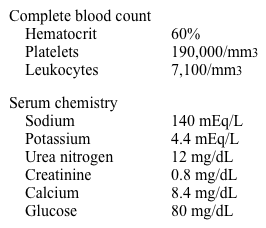 Which of the following is most likely responsible for this patient's current condition?
 (Multiple Choice)
4.9/5 (74)
(74) A 16-year-old girl is brought to the office due to hair loss. Over the last few months, she has developed a few patches of hair loss on the scalp. The lesions are associated with mild itching just before the loss of hair but are otherwise asymptomatic. Medical history is unremarkable; the patient's only current medication is an oral contraceptive. She does not use tobacco, alcohol, or illicit drugs. Vital signs are normal. Scalp examination findings are shown in the exhibit. 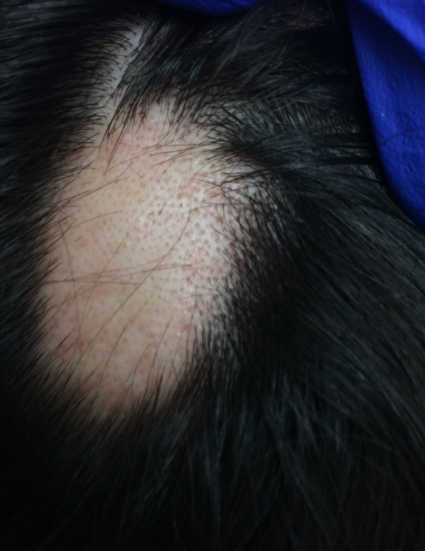 Which of the following is the most appropriate next step for this patient's hair loss?
 (Multiple Choice)
4.9/5 (69)
(69) A 31-year-old man is brought to the emergency department by his friends due to 2 weeks of headaches and progressive confusion. His friends note that he has also been aggressive and inappropriately suspicious, which is not typical for him. The patient is a flight attendant and frequently works on international flights. He has a history of HIV infection and sometimes skips antiretroviral therapy when he travels. His friends are unsure if he takes other prophylactic medications. Temperature is 38.6 C (101.5 F), blood pressure is 118/80 mm Hg, and pulse is 102/min. The patient appears unkempt and is disoriented. Neurologic examination shows ataxia and right-sided hemiparesis. Brain MRI findings are shown in the image below. 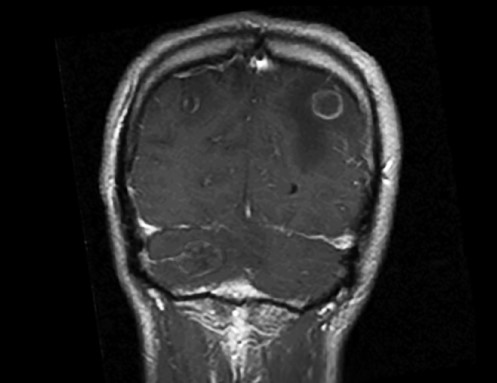 Which of the following would have most likely prevented this patient's condition?
 (Multiple Choice)
4.9/5 (72)
(72) A 34-year-old man is brought to the emergency department due to several hours of confusion. His wife reports that he has had fever, malaise, and cough for the past 2 days. A year ago, the patient required prolonged hospitalization and extensive surgery for multiple gunshot wounds to the abdomen. He takes no medications regularly and has no other medical problems. The patient does not use tobacco, alcohol, or illicit drugs. He has no history of recent travel. Temperature is 40.5 C (104.9 F), blood pressure is 80/50 mm Hg, pulse is 110/min, and respirations are 32/min. Mucous membranes are moist and no cervical lymphadenopathy is present. Dullness to percussion and crackles over the left lower chest are present. Cardiovascular examination reveals normal first and second heart sounds and bounding peripheral pulses. The abdomen has several well-healed surgical scars. Intravenous fluids and broad-spectrum antibiotics are initiated. The next day, blood cultures show gram-positive cocci. Which of the following is the most likely underlying mechanism leading to this patient's clinical presentation?
(Multiple Choice)
4.8/5 (79)
(79) A 65-year-old woman comes to the office due to a 2-month history of fatigue and weight gain. The patient has rheumatoid arthritis, peptic ulcer disease, and hypertension. She takes hydrochlorothiazide and acetaminophen. She does not use tobacco, alcohol, or illicit drugs. The patient's blood pressure is 120/70 mm Hg, pulse is 80/min, and respirations are 14/min. Physical examination shows generalized edema; liver is palpated 5 cm below the costal margin. Urinalysis shows 4+ proteinuria. Ultrasound of the kidneys shows bilateral enlargement. Renal biopsy was performed. Which of the following is the most likely finding on pathological examination?
(Multiple Choice)
4.9/5 (85)
(85) A 42-year-old woman comes to the office in October for a follow-up visit 3 weeks after being hospitalized for abdominal swelling. The patient reports that she has occasional fatigue but is otherwise feeling well. She has been taking lactulose, spironolactone, and furosemide with some improvement in her symptoms. The patient drank 12 beers daily for 15 years but has been sober for the past 3 months. She does not use tobacco or illicit drugs. When asked about her immunization history, the patient recalls receiving all appropriate childhood vaccines and a tetanus-diphtheria toxoids booster following a traumatic injury at age 31; she does not recall receiving any vaccines since then. Physical examination reveals mild jaundice, palmar erythema, a slightly distended abdomen, and spider angiomas. Laboratory results are as follows:  Which of the following immunizations are recommended for this patient?
PPSV23 = 23-valent pneumococcal polysaccharide vaccine
Tdap = tetanus-reduced diphtheria-acellular pertussis vaccine
Which of the following immunizations are recommended for this patient?
PPSV23 = 23-valent pneumococcal polysaccharide vaccine
Tdap = tetanus-reduced diphtheria-acellular pertussis vaccine (Multiple Choice)
4.8/5 (78)
(78) A 74-year-old man comes to the office for follow-up. He was diagnosed with chronic lymphocytic leukemia 2 years ago during evaluation for diffuse lymphadenopathy. The patient has had no other symptoms and has received no treatment for the disease. However, he now has significant fatigue, and laboratory evaluation reveals worsening lymphocytosis and anemia. Treatment with combination chemotherapy is planned. Which of the following therapies is most likely to reduce this patient's risk of developing acute kidney injury during treatment initiation?
(Multiple Choice)
4.8/5 (75)
(75) The patient's initial laboratory results are as follows:
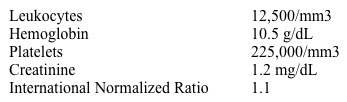 While in the emergency department, the patient has an episode of coughing and shortness of breath. He brings up approximately 600 mL of blood. His blood pressure is 105/61 mm Hg and pulse is 122/min. He is intubated, and fresh blood fills the endotracheal tube. Which of the following is the most appropriate next step in management of this patient?
 (Multiple Choice)
4.9/5 (91)
(91) A 59-year-old woman comes to the office for a routine visit. She reports no symptoms. She has no medical problems and takes no medications. She grew up in the United States and has not traveled outside the country. The patient does not use tobacco, alcohol, or illicit drugs. Her blood pressure is 120/70 mm Hg, pulse is 88/min, and respirations are 14/min. Physical examination shows a firm, nontender mass in the right upper quadrant. The remainder of the examination is within normal limits. Laboratory testing is unremarkable. Abdominal CT scan is shown in the image below. 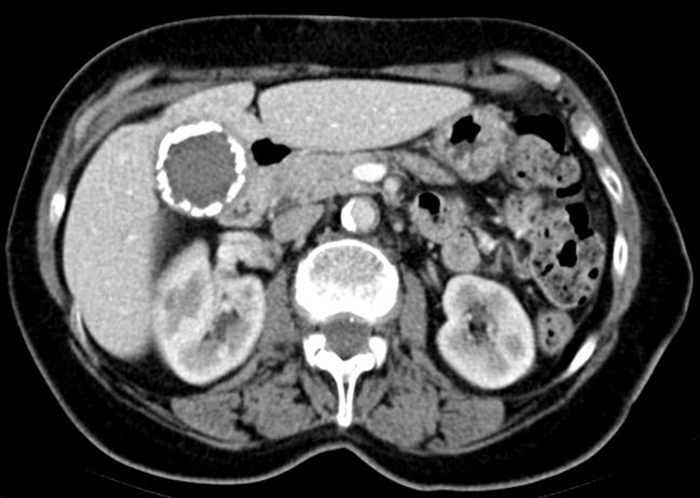 This patient is at greatest risk for which of the following conditions?
 (Multiple Choice)
4.8/5 (96)
(96) A 47-year-old African American farmer from Mississippi has a 3-week history of malaise, nonproductive cough, fatigue, and shortness of breath. He is seeking care as he "sweat right through" his shirt the previous night. He is an active smoker with no recent travel or sick contacts. His temperature is 38.1 C (100.5 F). Cardiopulmonary examination is normal. The patient has several erythematous, tender nodules approximately 2-3 cm in diameter over both shins. Chest x-ray shows bilateral patchy opacities and enlarged mediastinal and hilar lymph nodes. Tuberculin skin testing and HIV testing are negative, and serial sputum samples are negative for acid-fast bacilli. Transbronchial biopsy of one of the lymph nodes shows non-caseating granulomas. No organisms are seen with Gram staining and staining for acid-fast bacilli. The patient is diagnosed with pulmonary sarcoidosis, and high-dose corticosteroids are initiated. However, he deteriorates rapidly over the subsequent 48 hours. He is intubated and mechanically ventilated; a chest x-ray reveals progression of the pulmonary infiltrates. Which of the following is the most likely diagnosis?
(Multiple Choice)
4.8/5 (85)
(85) A 35-year-old man comes to the office due to 2 weeks of abdominal distension. He has been in a drug rehabilitation program for 2 years due to prior heroin abuse. Recent viral hepatitis and HIV profiles were negative. Temperature is 37.1 C (98.7 F), blood pressure is 145/82 mm Hg, pulse is 80/min, and respirations are 14/min. BMI is 40 kg/m2. Examination shows periorbital edema, ascites, and 2+ pitting edema in both legs up to the knees. Breath sounds are decreased at the right lung base. Twenty-four-hour urine shows protein excretion of 7.5 g. Which of the following is most likely to be present on kidney biopsy?
(Multiple Choice)
4.7/5 (92)
(92) A 56-year-old woman comes to the clinic due to a sensation she has had for 3 weeks that her heart is skipping beats. The patient has had no chest pain, dyspnea, or diaphoresis. Medical history includes hypertension and well-controlled type 2 diabetes mellitus. Blood pressure is 155/90 mm Hg. Cardiopulmonary examination shows an irregular heart rate. The ECG is shown in the exhibit. 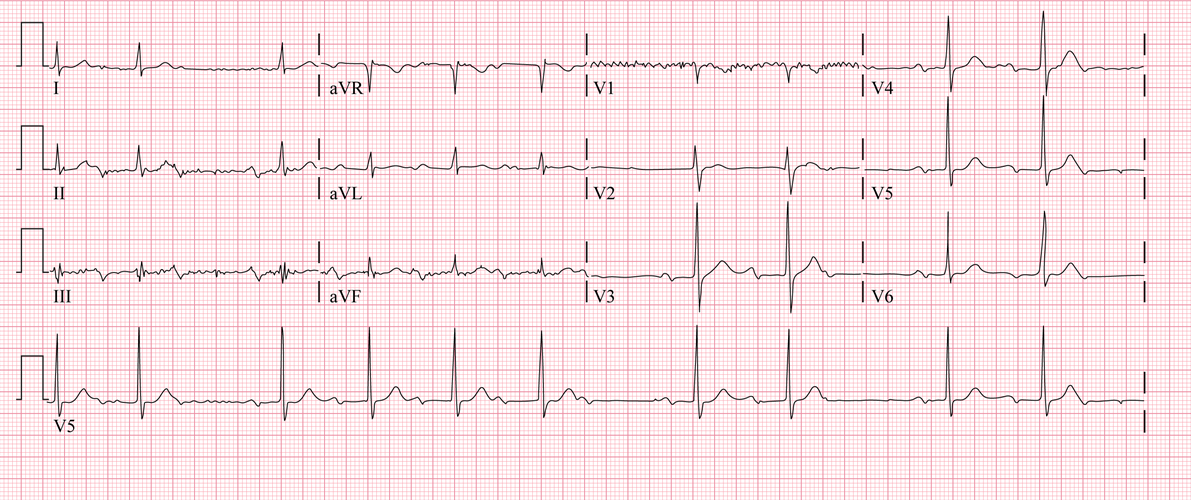 Which of the following is the most likely diagnosis?
 (Multiple Choice)
4.8/5 (84)
(84) A 41-year-old man comes to the office due to worsening fatigue and dyspnea on exertion. Over the past week, he has been feeling short of breath while riding his bike to work, which is unusual for him. He has had no chest pain, palpitations, syncope, or pedal edema. The patient has no prior medical conditions and takes no medications. He occasionally drinks alcohol but does not use tobacco or illicit drugs. Temperature is 37.2 C (99 F), blood pressure is 130/80 mm Hg, pulse is 96/min, and respirations are 18/min. Physical examination shows moist mucous membranes, normal thyroid, clear lungs, and normal heart sounds. The abdomen is soft and nontender with normal bowel sounds. Laboratory results are as follows.  Peripheral blood smear shows numerous atypical leukocytes, some of which contain cytoplasmic inclusions, as shown below.
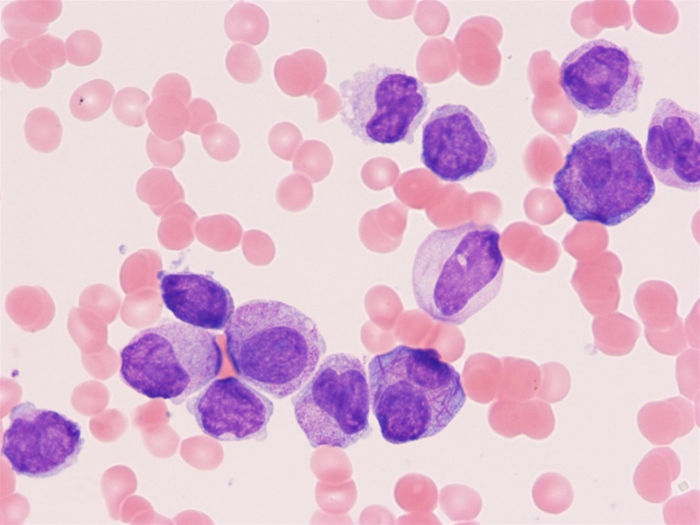 This patient is at greatest risk of which of the following due to his current condition?
Peripheral blood smear shows numerous atypical leukocytes, some of which contain cytoplasmic inclusions, as shown below.
This patient is at greatest risk of which of the following due to his current condition? (Multiple Choice)
4.8/5 (88)
(88) A 47-year-old man comes to the emergency department due to chest pain. He says the pain is sharp and substernal, and it began this morning. Swallowing and deep breathing make the pain worse. The patient reports that 3 days ago he had a sore throat and muscle pains, but these symptoms are currently resolved. His medical history is otherwise unremarkable. The patient does not smoke or consume alcohol. He has no significant history of cardiac disease in his family. Temperature is 37.9 C (100.2 F), blood pressure is 130/80 mm Hg, pulse is 98/min, and respirations are 20/min. There is no tenderness with palpation of the chest wall. During cardiac auscultation, a scratchy sound is heard at the left sternal border just before S1, again between S1 and S2, and then faintly just after S2. The lungs are clear on auscultation. ECG reveals a sinus rhythm with PR segment depression in both precordial and limb leads. Laboratory values are as follows:  Which of the following is the most appropriate next step in management of this patient?
 (Multiple Choice)
4.8/5 (99)
(99) A 62-year-old man comes to the emergency department with severe epigastric pain lasting an hour. He has had postprandial epigastric discomfort for the past several days, but now the pain is severe and constant. The patient also feels nauseated and has vomited once since the pain began. Medical history is significant for hypertension, type 2 diabetes mellitus, hyperlipidemia, and coronary artery disease. He underwent coronary artery stenting 5 months ago. Temperature is 37.6 C (99.7 F), blood pressure is 116/70 mm Hg, pulse is 108/min, and respirations are 24/min. ECG shows Q waves in the inferior leads. Chest x-ray is shown in the image below: 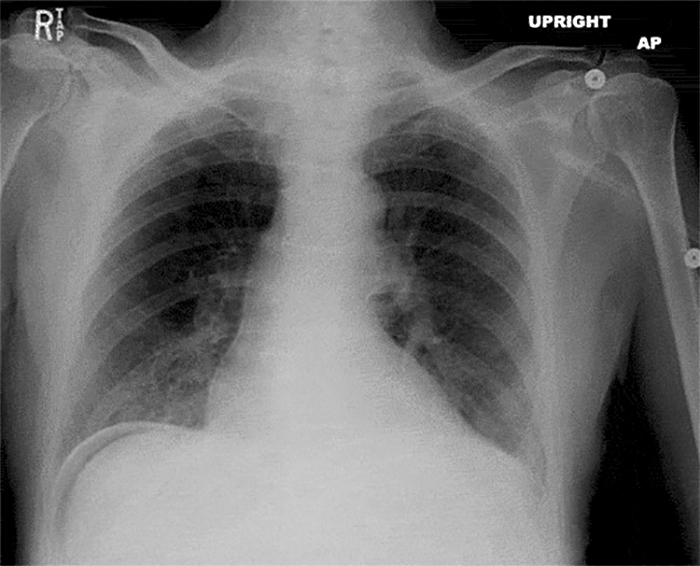 Which of the following is the best next step in management of this patient?
 (Multiple Choice)
4.8/5 (93)
(93) An 82-year-old man comes to the office for evaluation of chronic back pain. On physical examination, he is found to have a blood pressure of 160/85 mm Hg while supine and 135/70 mm Hg while standing. He is otherwise healthy; his only medicine is occasional ibuprofen for back pain. Which of the following age-related changes best explains the observed finding?
(Multiple Choice)
4.8/5 (88)
(88) A 48-year-old man comes to the office due to generalized bone pain. The patient has a history of Crohn disease and underwent extensive small bowel resection several months ago. His current medications are mesalamine and infliximab, and he has not used glucocorticoids recently. The patient has a sedentary lifestyle and spends most of his time watching television. Physical examination shows bony tenderness of the lower spine, pelvis, and lower extremities. There is mild weakness of proximal limb muscles. Radiographs reveal diffuse osteopenia of the spine and pseudofractures in both femoral necks. Which of the following sets of laboratory findings is most consistent with this patient's current condition?
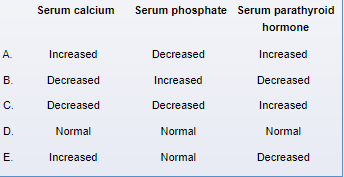
(Multiple Choice)
4.9/5 (75)
(75) Showing 961 - 980 of 1702
 Prev
- 1
- ...
- 2
- ...
- 3
- ...
- 4
- ...
- 5
- ...
- 6
- ...
- 7
- ...
- 8
- ...
- 9
- ...
- 10
- ...
- 11
- ...
- 12
- ...
- 13
- ...
- 14
- ...
- 15
- ...
- 16
- ...
- 17
- ...
- 18
- ...
- 19
- ...
- 20
- ...
- 21
- ...
- 22
- ...
- 23
- ...
- 24
- ...
- 25
- ...
- 26
- ...
- 27
- ...
- 28
- ...
- 29
- ...
- 30
- ...
- 31
- ...
- 32
- ...
- 33
- ...
- 34
- ...
- 35
- ...
- 36
- ...
- 37
- ...
- 38
- ...
- 39
- ...
- 40
- ...
- 41
- ...
- 42
- ...
- 43
- ...
- 44
- ...
- 45
- ...
- 46
- ...
- 47
- ...
- 48
- ...
- 49
- ...
- 50
- ...
- 51
- ...
- 52
- ...
- 53
- ...
- 54
- ...
- 55
- ...
- 56
- ...
- 57
- ...
- 58
- ...
- 59
- ...
- 60
- ...
- 61
- ...
- 62
- ...
- 63
- ...
- 64
- ...
- 65
- ...
- 66
- ...
- 67
- ...
- 68
- ...
- 69
- ...
- 70
- ...
- 71
- ...
- 72
- ...
- 73
- ...
- 74
- ...
- 75
- ...
- 76
- ...
- 77
- ...
- 78
- ...
- 79
- ...
- 80
- ...
- 81
- ...
- 82
- ...
- 83
- ...
- 84
- ...
- 85
- ...
- 86
- ...
- Next

Filters
- Essay(0)
- Multiple Choice(0)
- Short Answer(0)
- True False(0)
- Matching(0)