


 Chat with AI
Exam 1: Medicine

Exam 1: Medicine2 k Questions
Exam 2: Pediatric723 Questions
Exam 3: Psychiatry336 Questions
Exam 4: Surgery563 Questions
Exam 5: Obstetrics & Gynecology469 Questions
Select questions type


A 54-year-old man comes to the office due to 6 months of fatigue, anorexia, and a 7-kg (15.4-lb) unintentional weight loss. The patient has noticed that despite his weight loss, his pants are getting tighter and his socks leave deep imprints on his legs. He has a history of hypertension for which he takes amlodipine. He is unaware of any family history as he was adopted. The patient has smoked 5-6 cigarettes daily for the past 30 years and drinks 1 or 2 cans of beer on weekends. He has a remote history of injection drug use. Blood pressure is 134/82 mm Hg, pulse is 84/min, and BMI is 23 kg/m2. Jugular venous pressure is normal. The patient has bilateral gynecomastia and several spider angiomas on his upper trunk. Cardiac examination reveals normal heart sounds without any murmurs. Breath sounds are decreased at the bases. The abdomen is soft, nontender, and distended with shifting dullness. There is bilateral lower extremity pitting edema. Which of the following is the most likely underlying cause of this patient's condition?
(Multiple Choice)
4.8/5  (65)
(65) A 34-year-old man comes to the office for evaluation of hearing loss. The patient is a military pilot who has flown the past 8 years in noncombat zones. Regular hearing tests administered by the military have been normal until his most recent one. The patient has noticed no change in his hearing and has no ear pain, tinnitus, or vertigo. The results from the remainder of his annual physical, mental, vision, and cardiac tests were normal. The patient has no medical conditions and takes no medications. Aural examination shows clear, intact tympanic membranes bilaterally with no middle ear effusion. Review of the audiometry reveals a mild, bilateral, high-frequency hearing loss. Which of the following is the most likely cause of this patient's hearing impairment?
(Multiple Choice)
4.9/5 (78)
(78) A 35-year-old man comes to the office for follow-up of low back pain. He has aching pain in the left lumbar paraspinal area that is worse at the end of the day and relieved overnight with rest. The pain began 3 months ago with no precipitating trauma. The patient was initially treated with intermittent doses of acetaminophen and naproxen but continues to have moderate residual pain. There is no associated fever, weight loss, radicular pain, lower extremity weakness, or urinary symptoms. Medical history is unremarkable. The patient is employed as a factory line worker, requiring him to lift 5-7 kg (11-15 lb) several times daily. Vital signs are normal. On physical examination, the patient appears comfortable. Cervical and thoracic spine range of motion is normal, but flexion and extension of the lumbar spine elicit pain. Straight-leg raising test is normal. There is mild tenderness in the left lumbar paraspinal tissues but no midline tenderness. Upper and lower extremity strength and deep tendon reflexes are normal. Which of the following is the best recommendation for management of this patient's pain?
(Multiple Choice)
4.9/5 (87)
(87) An 80-year-old woman is brought to the physician by her son due to fatigue. She lives alone and suffers from bilateral knee osteoarthritis, which significantly limits her mobility. Her only other medical problem is hypertension. Her medications include lisinopril, chlorthalidone, and prescription naproxen. She also takes low-dose aspirin because it is "good for the heart." Her blood pressure is 146/92 mm Hg and pulse is 78/min. The patient has conjunctival pallor. Both knees are deformed due to bony overgrowth but there is no significant effusion or erythema. Extension of both knees is limited. Her renal function, assessed 2 months ago, was normal. Which of the following is the most likely cause of pallor in this patient?
(Multiple Choice)
4.9/5 (67)
(67) A 52-year-old man comes to the physician for a regular health check-up. He is a chronic smoker and has consumed 1 to 2 beers 2 to 3 times a week for the past 10 years. He also drinks 6 to 7 cups of coffee daily. The patient was diagnosed with type 2 diabetes mellitus 5 years ago and takes metformin. Blood pressure is 130/80 mm Hg and body mass index is 29 kg/m2. Random blood sugar is 190 mg/dL. His older brother died of pancreatic cancer at age 58, and the patient is worried that he might also develop pancreatic cancer. Which of the following interventions would have the greatest impact on decreasing this patient's risk of pancreatic cancer?
(Multiple Choice)
4.9/5 (76)
(76) A new test is devised to measure the serum level of a specific protein. A sample of blood is taken from a patient, and the new test is performed 3 times with results of 162, 186, and 247 IU/dL. Using the traditional reference test (considered the gold standard), the patient's serum protein level is determined to be 184 IU/dL. A measurement within 5% of the reference test value is considered accurate. Based on these results, the new test most likely has which of the following characteristics?
(Multiple Choice)
4.9/5 (59)
(59) A 46-year-old man comes to the emergency department due to intermittent severe right flank pain over the past few days. He has had decreased urination over the last week but has also noted occasional episodes of high urine output along with a feeling of generalized weakness. The patient has a history of chronic back pain for which he takes oxycodone daily, and he underwent a left total nephrectomy following a motor vehicle accident 25 years ago. He was recently started on low-dose lisinopril for a new diagnosis of hypertension. There is no family history of renal disease. On physical examination, blood pressure is 145/86 mm Hg and heart rate is 86/min. Laboratory results are as follows: 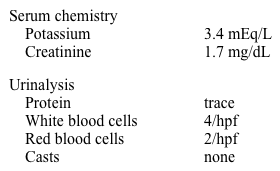 Which of the following is the most likely cause of this patient's symptoms?
 (Multiple Choice)
4.9/5 (78)
(78) A 72-year-old man comes for evaluation of shortness of breath, headache, and fatigue. He has a history of hypertension, lives alone, and is not compliant with his medications. The patient drinks 1 or 2 glasses of wine daily but does not smoke. Blood pressure is 184/128 mm Hg, pulse is 96/min, and oxygen saturation is 90% by pulse oximetry on room air. He has early papilledema on funduscopic examination. Pulmonary examination shows bibasilar coarse crackles. Cardiac examination shows a grade 2/6 systolic ejection murmur along the left sternal border. There is trace pedal edema. Chest x-ray reveals mild pulmonary edema. An ECG is unchanged from prior tracings. Laboratory studies are normal except for serum creatinine of 2.0 mg/dL. The patient is given oxygen and furosemide and is started on a nitroprusside drip. After 36 hours, his blood pressure is 140/80 mm Hg and he is no longer dyspneic; however, he is confused and disoriented and has diffuse hyperreflexia. There are no other focal neurologic findings. Repeat laboratory results are as follows: 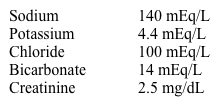 Which of the following is the most likely cause of this patient's current symptoms?
 (Multiple Choice)
4.9/5 (88)
(88) A 46-year-old man comes to the emergency department due to a week of fever, chills, productive cough with yellow-white sputum, and shortness of breath. The patient received an allogenic renal transplantation 6 months ago and currently takes maintenance immunosuppressive therapy. He is a former smoker and works in a post office. Temperature is 39.4 C (102.9 F), blood pressure is 110/65 mm Hg, pulse is 110/min, and respirations are 22/min. Lung auscultation reveals left upper lung crackles and bronchial breath sounds. Chest imaging reveals a left upper lobe nodular density with cavitation and nodular infiltrates in the right lung. Sputum Gram stain and culture are negative. Bronchoalveolar lavage cultures yield light growth of branching, filamentous rods that are partially acid-fast, as shown in the image below. Which of the following is the most likely causative organism of this patient's condition? 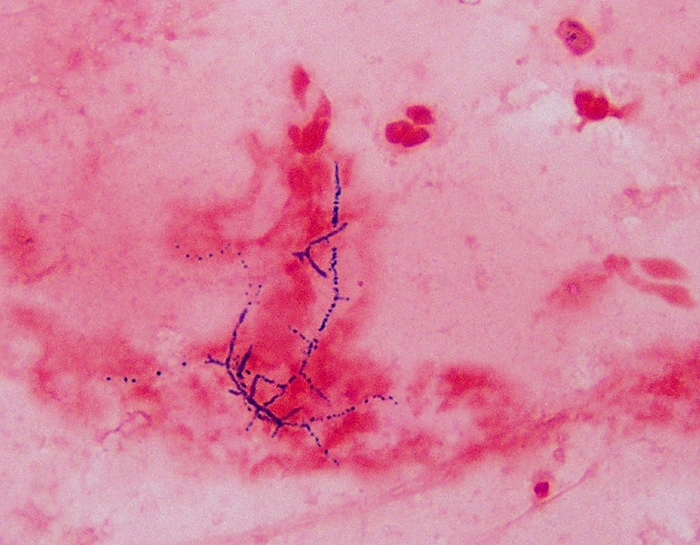
(Multiple Choice)
4.9/5 (69)
(69) A 20-year-old college student comes to the emergency department accompanied by her roommate after an episode of falling to the ground and "shaking all over." Her roommate was able to record part of the episode on her phone, which shows the patient lying on the ground, rhythmically shaking all 4 extremities, and tightly closing her eyes. The roommate is heard asking multiple questions but the patient remains nonresponsive. The episode resolves within 1 minute, when the patient gets up and asks her roommate to take her to the emergency department. The patient has been studying for upcoming final exams, has had minimal sleep, and has consumed multiple cups of coffee a day. She has no other medical problems and takes no medications. The patient shares that one of her close relatives has epilepsy and is concerned that she had a seizure. Vital signs are within normal limits and physical examination shows no abnormalities. Which of the following is the most likely diagnosis in this patient?
(Multiple Choice)
4.8/5 (73)
(73) A 36-year-old woman comes to the office for evaluation of intermittent chest pain and palpitations. The patient describes episodes of pressure in her chest, occurring 2 or 3 times a week, lasting several minutes to an hour, and typically occurring while she is lying in bed. She also has sensations that her heart is fluttering and reports, "Last week, during a work meeting, my heart started racing, and I felt dizzy for a few seconds." Six months ago, the patient was evaluated by her previous physician for similar symptoms and was told, "Nothing is abnormal," but she adds, "They didn't test me when I have symptoms." She has no other medical or psychiatric history. The patient has eliminated all caffeinated beverages and does not use alcohol, tobacco, or illicit drugs. She reports feeling excited about a recent promotion at work but feels "stressed out" because of increased expectations. Blood pressure is 110/60 mm Hg, pulse is 72/min, and respirations are 12/min. Lungs are clear to auscultation and cardiac examination is normal. Complete blood count, comprehensive metabolic panel, TSH level, 12-lead ECG, echocardiography, and 2-week ambulatory rhythm monitoring are normal. Which of the following is the most appropriate statement to address this patient's concerns?
(Multiple Choice)
4.8/5 (85)
(85) A 44-year-old woman comes to the office due to excessive thirst and urination. She has to get up several times during the night to urinate. Two months ago, she was diagnosed with type 2 diabetes mellitus, which she manages with diet and exercise. Blood pressure is 134/78 mm Hg and pulse is 88/min. BMI is 32 kg/m2. The remainder of the physical examination is normal. Laboratory results are as follows: 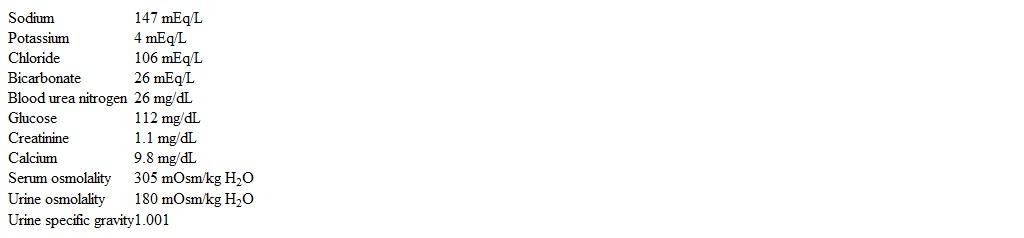 Which of the following is the most likely cause for this patient's excessive thirst and urination?
 (Multiple Choice)
4.9/5 (97)
(97) A 72-year-old man comes to the hospital due to 12 hours of worsened shortness of breath and nonproductive cough. He was in his usual state of health until 3 days ago, when he abruptly developed fever, headache, sore throat, runny nose, anorexia, and severe body aches. The patient has no known sick contacts but spent a long time in a mall shopping for Christmas presents 5 days ago. He has a history of coronary artery disease, hypertension, and diet-controlled type 2 diabetes mellitus. Temperature is 38.9 C (102 F), blood pressure is 140/90 mm Hg, pulse is 102/min, and respirations are 28/min. Oxygen saturation is 91% on 40% supplemental oxygen via mask. Oropharyngeal examination shows mild pharyngeal erythema without exudates. No lymphadenopathy or jugular venous distension is present. Chest auscultation reveals scattered bilateral crackles and a fourth heart sound (S4) but no cardiac murmurs. The abdomen is soft and nontender. There is no peripheral edema. Laboratory results are as follows: 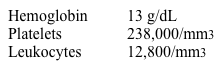 Chest x-ray reveals bilateral, diffuse reticular opacities. Which of the following is the most likely underlying cause of this patient's current condition?
 (Multiple Choice)
4.9/5 (68)
(68) A 46-year-old man is admitted to the hospital for elective cholecystectomy. He is started on intravenous fluids and antibiotics. Just before he is to go to an operating room, the patient complains of a sudden onset of chest tightness and lightheadedness. His medical history is significant for anxiety, and he has had 2 previous visits to the emergency department for panic attacks. His blood pressure is 118/67 mm Hg. His electrocardiogram is shown in exhibit. 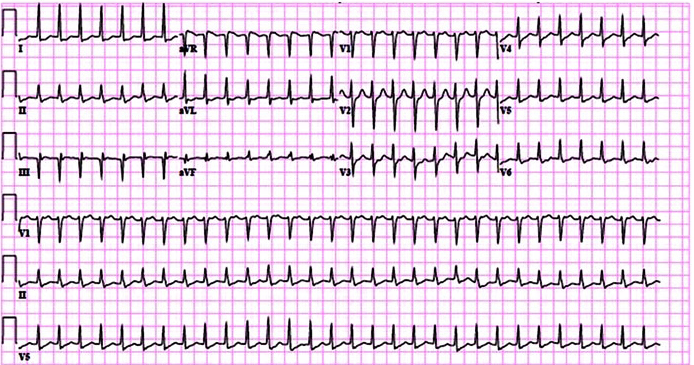 Which of the following is the best initial step in treating this patient?
 (Multiple Choice)
4.9/5 (71)
(71) A 30-year-old family physician moves from Florida to a town in the Colorado mountains to establish a medical practice. On the night of arrival, she experiences headache and has difficulty falling asleep. The next day she develops fatigue, nausea, dizziness, and mild dyspnea on exertion. She has no chronic medical conditions. Temperature is 37.2 C (99 F), blood pressure is 116/68 mm Hg, pulse is 90/min, and respirations are 20/min. Pulse oximetry shows 90% on ambient air. Medication with which of the following effects is most appropriate to improve her symptoms?
(Multiple Choice)
5.0/5 (68)
(68) A 25-year-old woman comes to the physician with a rash on her buttocks. The lesions began 10 days ago and are associated with intense itching and burning. She has attempted treatment with cool compresses and calamine lotion without relief. The patient has had occasional diarrhea and unintentional weight loss over the past few months. Her medical history is otherwise unremarkable. Her temperature is 37.1 C (98.8 F), blood pressure is 117/76 mm Hg, pulse is 82/min, and respirations are 14/min. The skin lesions are shown in the image below. 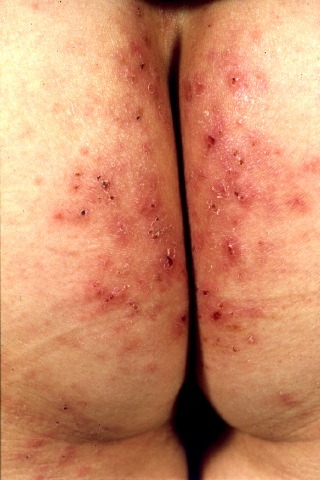 Which of the following is the most likely diagnosis of this patient's rash?
 (Multiple Choice)
4.8/5 (78)
(78) A 69-year-old man is brought to the emergency department due to severe chest pain that started suddenly, approximately 3 hours ago. He describes the pain as sharp and the "worst pain in my life." He feels the pain anteriorly as well as in his neck and between the shoulder blades. The patient has not seen a doctor for the past 20 years and takes no medications. On physical examination he appears very uncomfortable. There is an early diastolic decrescendo murmur at the right upper sternal border. ECG shows sinus tachycardia with nonspecific ST-segment and T-wave changes. Chest x-ray reveals widening of the superior mediastinum. Which of the following is the most likely predisposing condition in this patient?
(Multiple Choice)
4.9/5 (78)
(78) A 56-year-old man comes to the emergency department due to a 1-day history of fever, chills, shortness of breath, and productive cough. The patient has an episode of vomiting while in the emergency department. He has no prior medical conditions and takes no medications. The patient has smoked for several years and occasionally drinks alcohol. Temperature is 38.8 C (101.8 F), blood pressure is 90/60 mm Hg, and pulse is 102/min. Repeat blood pressure measurement after administration of 2 L of normal saline bolus is 120/80 mm Hg. Leukocyte count is 16,000/mm3. Arterial blood gas analysis on room air shows the following:  Which of the following is the most likely acid-base status of this patient?
 (Multiple Choice)
4.8/5 (93)
(93) A 35-year-old man comes to the office with a 5-day history of back pain, which began as he was carrying heavy boxes while moving to a new apartment. Since then, he has had sharp pain in the low back radiating to the posterior aspect of the left calf and foot. The patient has no associated bladder or bowel incontinence. Vital signs are normal. BMI is 38 kg/m2. Examination shows intact motor strength, deep tendon reflexes, and light touch and pinprick sensation in the lower extremities. Anal reflex and perineal sensation are normal. Lifting the left leg to 70 degrees with the knee held straight causes burning pain radiating from the low back to the left foot. Which of the following is the best next step in management?
(Multiple Choice)
4.8/5 (88)
(88) A 31-year-old woman comes to the office for follow up of an abnormal Pap test. Two weeks ago, the patient underwent her annual well-woman examination, and Pap testing revealed a high-grade squamous epithelial lesion. She has no chronic medical conditions and has had no prior surgery. The patient smokes a half pack of cigarettes daily. She has been in a monogamous relationship with a female partner for the past 2 years. The patient has regular monthly menses, and her last menstrual period was a week ago. Vital signs are normal. BMI is 33 kg/m². Colposcopy reveals a nulliparous cervix with no raised or ulcerated lesions. The entire squamocolumnar junction cannot be visualized. Which of the following is the best next step in management of this patient?
(Multiple Choice)
4.9/5 (70)
(70) Showing 1061 - 1080 of 1702
 Prev
- 1
- ...
- 2
- ...
- 3
- ...
- 4
- ...
- 5
- ...
- 6
- ...
- 7
- ...
- 8
- ...
- 9
- ...
- 10
- ...
- 11
- ...
- 12
- ...
- 13
- ...
- 14
- ...
- 15
- ...
- 16
- ...
- 17
- ...
- 18
- ...
- 19
- ...
- 20
- ...
- 21
- ...
- 22
- ...
- 23
- ...
- 24
- ...
- 25
- ...
- 26
- ...
- 27
- ...
- 28
- ...
- 29
- ...
- 30
- ...
- 31
- ...
- 32
- ...
- 33
- ...
- 34
- ...
- 35
- ...
- 36
- ...
- 37
- ...
- 38
- ...
- 39
- ...
- 40
- ...
- 41
- ...
- 42
- ...
- 43
- ...
- 44
- ...
- 45
- ...
- 46
- ...
- 47
- ...
- 48
- ...
- 49
- ...
- 50
- ...
- 51
- ...
- 52
- ...
- 53
- ...
- 54
- ...
- 55
- ...
- 56
- ...
- 57
- ...
- 58
- ...
- 59
- ...
- 60
- ...
- 61
- ...
- 62
- ...
- 63
- ...
- 64
- ...
- 65
- ...
- 66
- ...
- 67
- ...
- 68
- ...
- 69
- ...
- 70
- ...
- 71
- ...
- 72
- ...
- 73
- ...
- 74
- ...
- 75
- ...
- 76
- ...
- 77
- ...
- 78
- ...
- 79
- ...
- 80
- ...
- 81
- ...
- 82
- ...
- 83
- ...
- 84
- ...
- 85
- ...
- 86
- ...
- Next

Filters
- Essay(0)
- Multiple Choice(0)
- Short Answer(0)
- True False(0)
- Matching(0)