


 Chat with AI
Exam 1: Medicine

Exam 1: Medicine2 k Questions
Exam 2: Pediatric723 Questions
Exam 3: Psychiatry336 Questions
Exam 4: Surgery563 Questions
Exam 5: Obstetrics & Gynecology469 Questions
Select questions type


A 26-year-old woman comes to the emergency department with severe shortness of breath. She has a long history of asthma with periodic exacerbations. Her home medications include inhaled albuterol and fluticasone. The patient does not use tobacco, alcohol, or illicit drugs. Her temperature is 37.2 C (99 F), blood pressure is 150/90 mm Hg, pulse is 110/min, and respirations are 24/min. On examination, she has moderate respiratory distress, prolonged expiratory phase, and diffuse wheezing. Complete blood count shows a hemoglobin of 13.8 g/dL and a leukocyte count of 9,200/mm3. Chest x-ray reveals hyperinflated lungs but no infiltrates. The patient is admitted and is given nebulized albuterol, intravenous methylprednisolone, and supplemental oxygen. The next day, her respiratory status is improved. Repeat vital signs show temperature of 37.2 C (99 F), blood pressure of 130/80 mm Hg, pulse of 90/min, and respirations of 20/min. Some scattered bilateral wheezes are heard on lung auscultation. Changes in laboratory results are as follows: 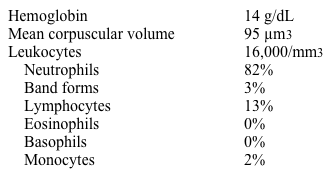 What is the most likely explanation for the abnormal laboratory findings in this patient?
 (Multiple Choice)
4.7/5  (94)
(94) A 34-year-old man comes to the office due to frequent headaches. A year ago, he was diagnosed with migraines and prescribed painkillers without significant relief. Recently, the patient has had high blood pressure on several checks, but he has no other significant medical history. He does not use tobacco, alcohol, or illicit drugs. The patient has no family history of hypertension or cardiovascular disease. Blood pressure is 185/105 mm Hg and pulse is 88/min and regular. A fourth heart sound is heard on cardiac auscultation. A continuous murmur is noted throughout the thorax in multiple areas. The lungs are clear. Which of the following is most likely to be found on chest x-ray?
(Multiple Choice)
4.8/5 (68)
(68) A 41-year-old man comes to the office due to progressive abdominal distension for the past 3 months. He reports that his abdomen feels heavy and although uncomfortable, the feeling has not been severe enough to interfere with activities of daily living. The patient drinks 8-10 beers a day and was previously hospitalized for alcohol-induced hepatitis. Vital signs are within normal limits. There is no jaundice. Heart and lung sounds are unremarkable. The liver edge is nodular and palpable 4 cm below the right costal margin. A right upper quadrant ultrasound demonstrates cirrhosis and the presence of intraperitoneal fluid. Which of the following would most likely lead to a decrease in both liver inflammation and portal pressure?
(Multiple Choice)
4.8/5 (82)
(82) A 42-year-old man comes to the office due to progressive upper abdominal discomfort and nausea over several weeks. He was a farmer in rural Guatemala before immigrating to the United States 5 years ago. Temperature is 36.9 C (98.4 F), blood pressure is 138/82 mm Hg, and pulse is 68/min. Cardiopulmonary examination is normal. Hepatomegaly is present. There is no lower extremity edema. Liver ultrasonography shows a 10-cm, smooth, round cyst with daughter cysts inside. Which of the following is most likely to be associated with this patient's current condition?
(Multiple Choice)
4.8/5 (68)
(68) A 30-year-old Hispanic male presents to the office with complaints of palpitations, tremor, nervousness and headache. His past history is insignificant. His mother has type 2 diabetes, which is well-controlled with medications. His temperature is 37.0° C (98.6° F), pulse is 100/min, blood pressure is 150/80 mm Hg, and respirations are 16/min. He appears anxious, sweaty and shaky. His neurological examination is non-focal, and examination of other systems is unremarkable. His fingerstick blood glucose level is 38 mg/dL. Intravenous administration of a bolus of 50% dextrose leads to the improvement of his symptoms. He is then subjected to supervised prolonged fasting. After an overnight fast, laboratory studies reveal: 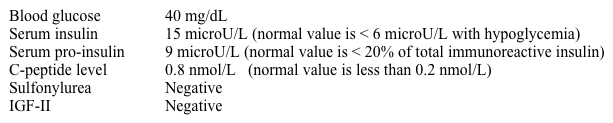 Based on the above information, what is the most likely cause of this patient's hypoglycemia?
 (Multiple Choice)
4.8/5 (88)
(88) A 70-year-old man comes to the office due to early satiety, nausea, and abdominal distension for the past 3 months. These symptoms have increased in frequency and limited the patient's ability to eat a full meal. For the past week, he has been unable to consume any solid food without vomiting afterward. The patient has also experienced a 13.5-kg (29.8-lb) weight loss during this period. He does not have dysphagia, hematochezia, melena, or hematemesis. Current medication is omeprazole, which he takes daily for heartburn. Temperature is 37.5 C (99.5 F), blood pressure is 132/78 mm Hg, pulse is 85/min, and respiratory rate is 12/min. Physical examination is significant for bilateral temporal wasting. Heart and lung sounds are unremarkable, and there is no appreciable lymphadenopathy. The abdomen is distended and tender to palpation in the epigastrium. A succussion splash is elicited during abdominal auscultation. Laboratory results are as follows: 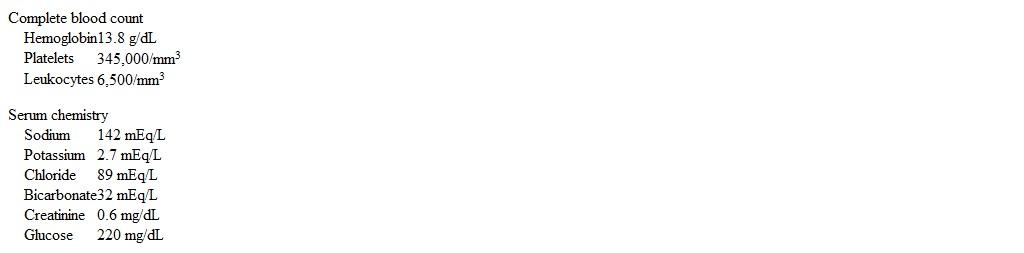 Which of the following most likely explains this patient's presentation?
 (Multiple Choice)
4.8/5 (79)
(79) A 68-year-old man is evaluated for exertional fatigue. He used to play tennis actively but now is having a hard time finishing a set. His only other medical problem is hypertension. He does not use tobacco, alcohol, or illicit drugs. Temperature is 37 C (98.6 F), blood pressure is 126/86 mm Hg, and pulse is 82/min. Mild mucosal pallor is present. There is no lymphadenopathy. Cardiopulmonary examination is normal. There is no splenomegaly or lower extremity edema. Laboratory results are as follows: 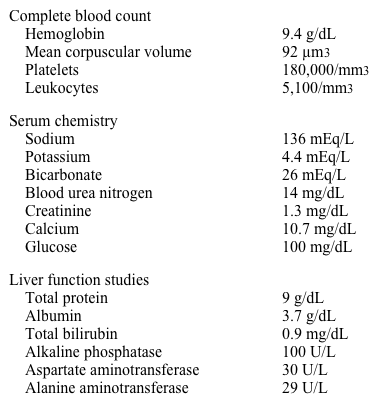 Peripheral blood smear is shown in the exhibit.
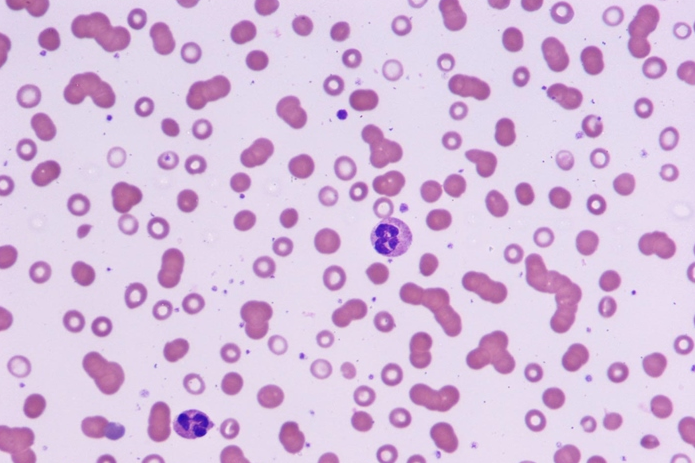 Which of the following is most likely to be found on the patient's bone marrow biopsy?
Peripheral blood smear is shown in the exhibit. Which of the following is most likely to be found on the patient's bone marrow biopsy? (Multiple Choice)
4.8/5 (81)
(81) A long-time patient comes to the office for a routine physical examination accompanied by his wife. He has a history of hypertension, obesity, and osteoarthritis. At the last visit, the physician recommended an exercise and weight loss regimen to improve his condition. The patient subsequently cancelled his next 2 appointments, explaining that things came up at the last minute. At today's visit, the patient reports low energy and pain in his knees, back, and hands. His wife is worried that he is not doing well. Blood pressure is 150/90 mm Hg, pulse is 84/min, and respirations are 18/min. Examination shows a 3.18-kg (7-lb) weight gain and decreased range of motion. During the visit, the patient shows a detailed understanding of his illnesses and readily acknowledges the importance of medication, diet, and exercise. However, he admits that he has a hard time dieting, has not exercised because it hurts his knees, and sometimes forgets to take his antihypertensive medications. Which of the following is the best initial response to address this patient's nonadherence to treatment?
(Multiple Choice)
4.9/5 (70)
(70) A 27-year-old man with sickle cell anemia comes to the emergency department due to increasing dyspnea that started 3 hours ago. The patient was seen in the emergency department 5 days ago for symptomatic anemia, and his hemoglobin level was 6.2 g/dL. He received a blood transfusion, after which his hemoglobin level improved to 8 g/dL, and he was sent home. Temperature is 38.1 C (100.6 F), blood pressure is 105/66 mm Hg, pulse is 112/min, and respirations are 28/min. Oxygen saturation is 97%. The patient appears pale; scleral icterus is present. Lungs are clear. Abdomen is soft and nontender with no hepatosplenomegaly. Laboratory results are as follows:  Which of the following is the most likely cause of his current symptoms?
 (Multiple Choice)
4.8/5 (82)
(82) A 45-year-old man comes to the office due to several months of easy fatigability and exertional dyspnea. The patient had a subtotal gastrectomy for a nonhealing gastric ulcer 5 years ago. He takes daily iron supplementation. Blood pressure is 120/70 mm Hg, pulse is 80/min, and respirations are 16/min. Physical examination shows a shiny tongue and pale palmar creases. No lymphadenopathy, hepatomegaly, or splenomegaly is present. Laboratory results are as follows: 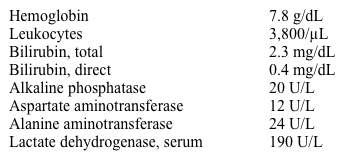 Stool tests for occult blood are repeatedly negative. This patient's condition involves which of the following pathophysiologic mechanisms?
 (Multiple Choice)
4.8/5 (79)
(79) A 64-year-old woman is brought to the emergency department due to sudden-onset double vision for the past few hours. She has had no headache, vertigo, or slurring of speech and no focal weakness or numbness. The patient has a history of hypertension, type 2 diabetes mellitus with poor glycemic control, and chronic kidney disease. She smokes cigarettes but does not use alcohol or illicit drugs. Blood pressure is 140/90 mm Hg and pulse is 82/min. Physical examination shows ptosis of her right eye. The right eyelid is manually elevated, showing the right eye in a "down-and-out" position. Right eye adduction, elevation, and depression movements are significantly impaired. Left extraocular movements are normal in all directions. Bilateral pupils are equal and reactive to light. The remainder of the neurologic examination is normal. Which of the following is the most likely cause of this patient's current condition?
(Multiple Choice)
4.8/5 (84)
(84) A 69-year-old man comes to the office due to 2 days of increasing shortness of breath, cough, and lower-extremity edema. He drinks a half of a bottle of vodka daily and has a 45-pack-year smoking history. There is no past history of hypertension or ischemic heart disease. The patient has a sedentary lifestyle due to disability from a work injury at age 20. He takes no medications and has not seen a physician in 20 years. His blood pressure is 130/90 mm Hg, pulse is 90/min, and oxygen saturation is 90% on room air. Cardiac examination shows faint heart sounds. Jugular venous pressure is 11 cm H2O. Lung auscultation shows decreased breath sounds. The liver span is 18 cm and ascites is present. There is bilateral 3+ lower-extremity pitting edema up to the knees. Chest x-ray reveals enlarged central pulmonary arteries without evidence of vascular congestion. Which of the following is the most likely diagnosis?
(Multiple Choice)
4.7/5 (82)
(82) An 86-year-old woman comes to the office due to difficulty breathing with exertion and nocturia. She has had these symptoms for 6 months and they have been slowly worsening. The patient has had no chest pain, palpitations, or syncope. She has a history of chronic hypertension and takes lisinopril. Blood pressure is 152/78 mm Hg, pulse is 82/min and regular, and respirations are 18/min. Jugular venous pressure is 10 cm H2O. The lungs are clear without crackles. There are no heart murmurs. The abdomen is mildly distended with no tenderness. There is 2+ pitting edema in the patient's legs. Brain natriuretic peptide concentration is 776 pg/mL (N <100 pg/mL). D-dimer is normal. Chest x-ray shows no cardiomegaly, normal interstitial markings, and no pulmonary edema. Urinalysis shows 1+ protein but is otherwise normal. Which of the following is the most likely diagnosis?
(Multiple Choice)
4.8/5 (87)
(87) A 26-year-old man is being evaluated in the intensive care unit 24 hours after he was admitted with acute respiratory distress syndrome due to opioid overdose and aspiration of gastric contents. The patient is intubated, sedated, and receiving mechanical ventilation. The patient had anesthesia-induced hypotension after intubation, but has been hemodynamically stable after receiving 4 L of normal saline. Temperature is 38.1 C (100.6 F), blood pressure is 118/78 mm Hg, pulse is 96/min, respirations are 20/min, and oxygen saturation is 92%. The patient is receiving low tidal volume ventilation at 8 mL/kg ideal body weight, FiO2 is 50%, and positive end-expiratory pressure is 12 cm H2O. The patient-ventilator interaction is synchronous. Arterial blood gas analysis demonstrates pH 7.31, PaCO2 50, and PaO2 64. Chest x-ray shows patchy bilateral opacities consistent with pulmonary edema. Echocardiography shows normal left ventricular function. Which of the following interventions would be most helpful to promote recovery of the patient's respiratory failure?
(Multiple Choice)
4.9/5 (85)
(85) A 27-year-old man comes to the physician because of a 1-day history of fever and joint pains. He is being treated with cephalexin for a skin infection. His urine has turned darker. His temperature is 38.5° C (101.3° F), blood pressure is 125/70 mm Hg, pulse is 90/min, and respirations are 15/min. Examination shows a skin rash; examination otherwise shows no abnormalities. Urinalysis shows: 8 RBCs/HPF, 12 WBCs/HPF with white cell casts, eosinophiluria, and a mild degree of proteinuria. Laboratory studies show a BUN of 40 mg/dl and serum creatinine of 2.2 mg/dl. Which of the following is the most appropriate next step in management?
(Multiple Choice)
4.7/5 (76)
(76) A 43-year-old, previously healthy man is hospitalized due to acute pancreatitis. On day 3, he develops respiratory distress. The patient is transferred to the intensive care unit and intubated. His ideal body weight is 70 kg (154 lb). Initial ventilator settings are as follows:  Ten minutes after the patient is intubated, blood pressure is 110/70 mm Hg and pulse is 90/min. Results from arterial blood gas testing are as follows:
 Which of the following is the best next step in management of this patient?
Ten minutes after the patient is intubated, blood pressure is 110/70 mm Hg and pulse is 90/min. Results from arterial blood gas testing are as follows: Which of the following is the best next step in management of this patient? (Multiple Choice)
4.8/5 (87)
(87) A 34-year-old man comes to the office to reestablish routine healthcare. The patient has a 9-year history of asthma, for which he uses an inhaler containing a combination of both inhaled corticosteroid (ICS) and long-acting beta agonist (LABA) as needed. For the past 2 years, he has been using this combination inhaler about 3 times per week. His asthma symptoms wake him from sleep approximately once every week. The patient has seasonal allergies to ragweed, but he has no other medical conditions and takes no other medications. He demonstrates excellent inhaler technique in the office, with good synchronization and breath holding. The patient does not use tobacco, alcohol, or illicit drugs. Family history is significant for asthma in his grandfather. Vital signs are normal. Lung auscultation indicates normal breath sounds without wheezing. Heart sounds are normal. Which of the following is the most appropriate next step in management of this patient?
(Multiple Choice)
4.8/5 (72)
(72) A 26-year-old woman comes to the emergency department due to back pain and weakness in her legs. Four days ago, she began experiencing pain in her lower back and difficulty moving her feet. Today, she could not stand on her legs due to the weakness. She describes the pain as a sensation of an electrical shock radiating from the buttocks to the feet. She has no difficulty with bowel or bladder function. The patient reports no chronic medical conditions or previous back injury. Two weeks ago, she had an upper respiratory infection that resolved with symptomatic treatment. Temperature is 37 C (98.6 F), blood pressure is 130/82 mm Hg, pulse is 88/min, and respirations are 16/min. On physical examination, motor strength is 3/5 and deep tendon reflexes are absent in bilateral lower extremities. Light touch and pain sensation is normal. There is no tenderness in the spine. Which of the following is the most likely spine MRI finding in this patient?
(Multiple Choice)
4.8/5 (89)
(89) A 65-year-old woman comes to the office due to memory impairment. The patient's memory difficulties began 2 months ago, and she is concerned her symptoms have recently worsened. She often forgets parts of recent conversations and has misplaced her car keys multiple times. The patient sleeps without issue and feels well rested upon awakening. She is a retired accountant and recently moved across the country to care for her parents, preparing meals for them and managing their finances. The patient regularly eats out at restaurants and drinks a glass of wine 3-4 times a week. Medical history includes allergic rhinitis, for which she has been taking over-the-counter medications. Temperature is 36.9 C (98.4 F), blood pressure is 130/82 mm Hg, and pulse is 76/min. The patient is alert and oriented. Physical examination shows no abnormalities. Which of the following is the most appropriate statement?
(Multiple Choice)
4.8/5 (77)
(77) A 61-year-old man is evaluated for progressive exertional dyspnea and decreased exercise tolerance. He has also noticed some ankle swelling. The patient has a 40-pack-year smoking history but no illicit drug use or occupational exposure. Examination shows increased anteroposterior diameter of the chest. Breath sounds are decreased throughout. Heart sounds are distant. The abdomen is soft and nontender. Mild bilateral ankle edema is present. His chest x-ray is shown below. 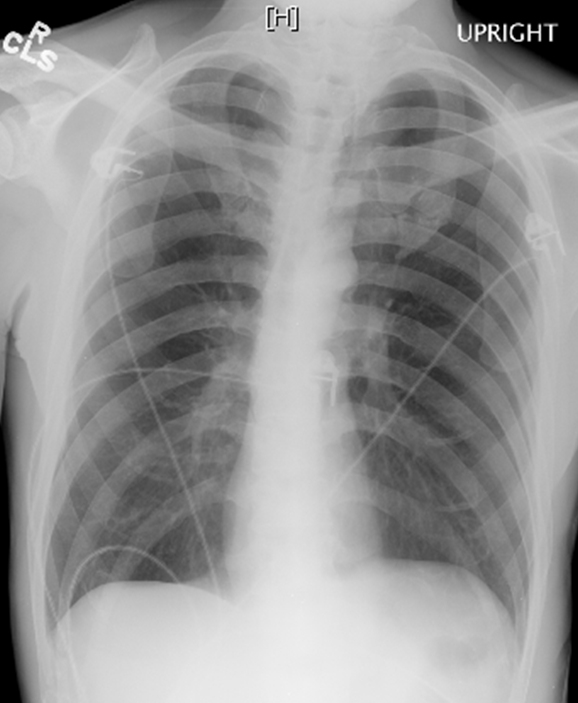 Which of the following is the most likely effect of the abnormal diaphragmatic contour in this patient?
 (Multiple Choice)
4.9/5 (80)
(80) Showing 1381 - 1400 of 1702
 Prev
- 1
- ...
- 2
- ...
- 3
- ...
- 4
- ...
- 5
- ...
- 6
- ...
- 7
- ...
- 8
- ...
- 9
- ...
- 10
- ...
- 11
- ...
- 12
- ...
- 13
- ...
- 14
- ...
- 15
- ...
- 16
- ...
- 17
- ...
- 18
- ...
- 19
- ...
- 20
- ...
- 21
- ...
- 22
- ...
- 23
- ...
- 24
- ...
- 25
- ...
- 26
- ...
- 27
- ...
- 28
- ...
- 29
- ...
- 30
- ...
- 31
- ...
- 32
- ...
- 33
- ...
- 34
- ...
- 35
- ...
- 36
- ...
- 37
- ...
- 38
- ...
- 39
- ...
- 40
- ...
- 41
- ...
- 42
- ...
- 43
- ...
- 44
- ...
- 45
- ...
- 46
- ...
- 47
- ...
- 48
- ...
- 49
- ...
- 50
- ...
- 51
- ...
- 52
- ...
- 53
- ...
- 54
- ...
- 55
- ...
- 56
- ...
- 57
- ...
- 58
- ...
- 59
- ...
- 60
- ...
- 61
- ...
- 62
- ...
- 63
- ...
- 64
- ...
- 65
- ...
- 66
- ...
- 67
- ...
- 68
- ...
- 69
- ...
- 70
- ...
- 71
- ...
- 72
- ...
- 73
- ...
- 74
- ...
- 75
- ...
- 76
- ...
- 77
- ...
- 78
- ...
- 79
- ...
- 80
- ...
- 81
- ...
- 82
- ...
- 83
- ...
- 84
- ...
- 85
- ...
- 86
- ...
- Next

Filters
- Essay(0)
- Multiple Choice(0)
- Short Answer(0)
- True False(0)
- Matching(0)