


 Chat with AI
Exam 1: Medicine

Exam 1: Medicine2 k Questions
Exam 2: Pediatric723 Questions
Exam 3: Psychiatry336 Questions
Exam 4: Surgery563 Questions
Exam 5: Obstetrics & Gynecology469 Questions
Select questions type


A 67-year-old man comes to the hospital with acute-onset upper abdominal pain associated with nausea and vomiting. The patient was discharged 24 hours earlier after he underwent elective coronary angiography and stent placement due to left circumflex artery stenosis. He has been taking his prescribed medications and reports no chest pain, shortness of breath, or flank pain. His other medical problems include type 2 diabetes, hypertension, hypercholesterolemia, and peripheral vascular disease. The patient does not use tobacco, alcohol, or illicit drugs. His temperature is 37.7 C (99.9 F), blood pressure is 134/88 mm Hg, pulse is 92/min, and respirations are 18/min. The abdomen is tender to palpation in the epigastric area. Bowel sounds are decreased. The skin over the lower extremities and toes appears mottled, reddish-blue, and reticulated but blanches on pressure. Laboratory results are as follows: 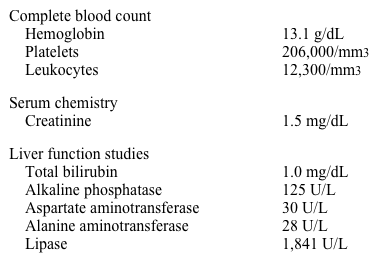 CT scan of the abdomen reveals diffuse enlargement of the pancreas. Abdominal ultrasonogram reveals normal-sized gallbladder and common bile duct without gallstones. The patient's pain is improved with a dose of intravenous morphine. Which of the following is the best therapy for this patient?
 (Multiple Choice)
4.9/5  (99)
(99) A 26-year-old woman is brought to the emergency department due to an episode of near-syncope. The patient's husband states that they were at a buffet 20 minutes ago, when she suddenly experienced severe weakness and dizziness. The patient almost fell, so he helped her sit. She also had nausea, abdominal cramping, and a generalized itching sensation but no chest pain or shortness of breath. The patient has no chronic medical conditions and takes no medications. She is menstruating, and her husband says that she usually has heavy periods. Temperature is 36.7 C (98.1 F), blood pressure is 80/50 mm Hg, pulse is 120/min, and respirations are 20/min. On physical examination, the patient is ill-appearing with flushed skin and warm extremities. The lungs are clear to auscultation, and cardiac examination is normal except for tachycardia. The abdomen is soft with mild, diffuse tenderness, and bowel sounds are normal. ECG reveals sinus tachycardia. In addition to intravenous fluids, which of the following is the most appropriate next step in management of this patient?
(Multiple Choice)
4.8/5 (81)
(81) A 35-year-old man comes to the emergency department with shortness of breath that started 2 days ago and worsened last night. He also has a dry cough. The patient has a history of hypertension, and his medications include chlorthalidone, amlodipine, and labetalol. He ran out of his medications about 3-4 days ago. The patient smokes a pack of cigarettes and drinks 4-5 beers on the weekends. His last drink was 4 days ago. The patient's temperature is 36.7 C (98 F), blood pressure is 220/120 mm Hg, pulse is 105/min, and respirations are 20/min. Oxygen saturation is 96% on 2 liters of oxygen via nasal cannula. Chest auscultation shows bibasilar crackles and fourth heart sound. Funduscopic examination shows normal optic discs and occasional cotton-wool spots. His serum potassium is 5.0 mEq/L, and creatinine is 2.1 mg/dL. The patient is admitted to the coronary care unit and started on intravenous furosemide and nitroprusside infusion with improvement of his symptoms. The next morning, the nurse finds him confused and agitated, and he has a generalized tonic-clonic seizure. His temperature is 36.7 C (98 F), blood pressure is 176/95 mm Hg, and pulse is 102/min. Physical examination shows normal breath sounds bilaterally and no focal muscle weakness. Which of the following is the most likely cause of this patient's new neurologic findings?
(Multiple Choice)
5.0/5 (84)
(84) A 48-year-old woman comes to the office due to a lesion on her neck. The lesion has been present for the past 6 months and is slowly enlarging. Skin findings are shown in the image below. 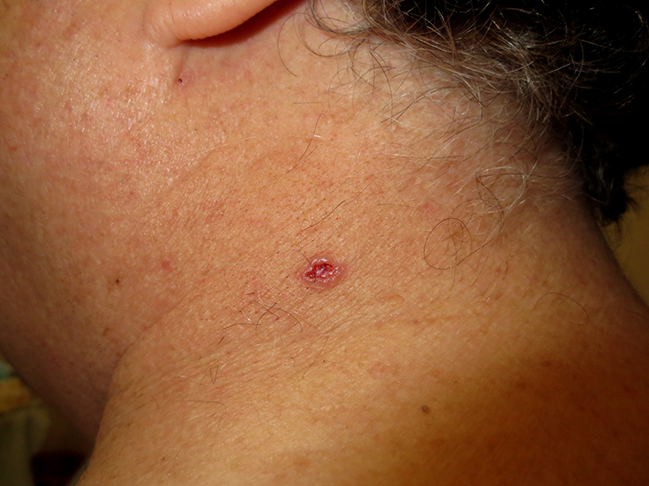 Which of the following is the most likely diagnosis?
 (Multiple Choice)
4.9/5 (86)
(86) A 45-year-old man comes to the office due to several abnormal blood pressure readings over the past year. He also has had fatigue, which he attributes to stress at work. The patient is a carpenter, and his diet consists primarily of fast food several times a day because he is busy with worksite jobs. He wakes up several times at night and occasionally finds it difficult to fall back asleep. He has had no chest pain, shortness of breath, light-headedness, or syncope. Family history is negative for hypertension, stroke, and early-onset coronary artery disease. The patient drinks 2 beers a day on weekends. Blood pressure is 151/90 mm Hg on the right arm and 159/95 mm Hg on the left. Repeat blood pressure on the left arm is 158/94 mm Hg. Pulse is 78/min and regular. BMI is 32 kg/m2. Physical examination is unremarkable. ECG shows normal sinus rhythm with no abnormalities. Serum chemistry panel and TSH are within normal limits. Which of the following is the most likely underlying cause of this patient's hypertension?
(Multiple Choice)
4.9/5 (97)
(97) A 66-year-old man comes to the emergency department due to shortness of breath. The symptoms started a week ago with a dry cough and exertional dyspnea. Medical history includes hypertension and recent stenting for double-vessel coronary artery disease. He was hospitalized 6 months ago for pneumonia. He has a 35-pack-year smoking history. Temperature is 37.2 C (98.9 F), blood pressure is 160/90 mm Hg, and pulse is 90/min and regular. On examination, the patient is in mild respiratory distress, but he can speak in full sentences. Chest auscultation reveals decreased breath sounds at the lung bases, bilateral crackles, and occasional wheezes. His arterial blood gas shows: 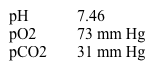 Which of the following is the most likely explanation for this patient's symptoms?
 (Multiple Choice)
4.8/5 (80)
(80) A 2-year-old girl is brought to the clinic for evaluation of left knee pain and fever. The knee pain began 2 months ago. At the time of onset, the patient and several other children at day care had cough and rhinorrhea, but only the patient developed joint pain. Movement is limited by pain in the morning but seems to improve in the afternoon. For the past month, she has had a daily fever and an erythematous macular rash over her chest around bedtime. Temperature is 36.1 C (97 F), blood pressure is 90/60 mm Hg, and pulse is 114/min. Physical examination shows swelling, erythema, and warmth of the left knee, with pain elicited on passive and active movement of the left hip. The patient can walk but has a slight limp. Laboratory results are as follows:  Which of the following is the most likely diagnosis in this patient?
 (Multiple Choice)
4.8/5 (73)
(73) A 60-year-old woman comes to the office due to "balance problems while walking." The patient has had 2 falls over the last 2 months associated with tingling in her feet and dull pains in her back and legs. Medical history is notable for type 2 diabetes mellitus; her most recent hemoglobin A1c was 7.6%. Neurological examination reveals decreased muscle strength in both legs, diminished proprioception peripherally in the feet, decreased pain sensation in the feet and ankles, a hyperactive right knee jerk, and an upgoing plantar reflex on the right side. Which of the following is the most appropriate next step in management of this patient's symptoms?
(Multiple Choice)
4.9/5 (90)
(90) A 65-year-old man comes to the hospital with a 1-day history of increasing shortness of breath and cough. He has been using albuterol occasionally without relief of symptoms. The patient is noncompliant with medications and has not seen a doctor in the past year. He smoked 1 pack of cigarettes daily for 40 years. Temperature is 37.5 C (99.5 F), blood pressure is 110/70 mm Hg, pulse is 98/min, and respirations are 20/min. His pulse oximetry shows 86% on room air. Examination shows jugular venous distension, and lung auscultation reveals diffuse wheezing with no crackles. His heart sounds are distant. Mild hepatomegaly is present, and he has bilateral pitting edema halfway to the knees. Chest x-ray reveals hyperinflated lungs and a flattened diaphragm with no infiltrates. He is started on systemic steroids, bronchodilator nebulization, and furosemide. Laboratory studies at the time of admission and 5 days later show the following: 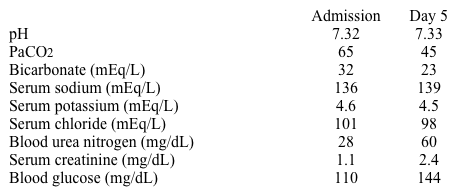 Which of the following is the most likely explanation for the changes in acid-base balance and serum chemistry values between day 1 and day 5 in this patient?
 (Multiple Choice)
4.8/5 (84)
(84) A 68-year-old man comes to the office because of diarrhea for the past 2 months. His stools are postprandial, watery, foul-smelling, and difficult to flush. They never awaken him at night. Prior to this, the patient's stools were always regular and solid. He also has intermittent, epigastric, postprandial abdominal pain that has not improved with a trial of lansoprazole. The patient has no melena, hematochezia, or vomiting, although he has unintentionally lost 7 kg (15.4 lb). Medical history is significant for a prolonged hospitalization 3 years ago for acute necrotizing pancreatitis due to alcohol use. He does not take any medications. The patient smokes a pack of cigarettes daily and occasionally drinks alcohol. Temperature is 37.1 C (98.8 F), blood pressure is 147/82 mm Hg, pulse is 82/min, and respirations are 15/min. Physical examination shows anicteric sclera, moist mucous membranes, and normal heart and lung sounds. The abdomen is mildly tender to palpation in the epigastrium but without distension, rebound, or guarding. Laboratory results are as follows:  Which of the following is most likely to be present in this patient?
 (Multiple Choice)
4.9/5 (94)
(94) A 65-year-old woman comes to the office due to progressively worsening right knee pain. The patient has had the pain for 2 years but never sought medical attention and last saw a physician 5 years ago. The pain, which is worse in the evening, was initially responsive to over-the-counter analgesics, but they gradually lost effectiveness and she stopped taking them. There is no history of trauma to the joint. Medical history is unremarkable. The patient recently retired from her occupation as an elementary school janitor. She does not use tobacco, alcohol, or illicit drugs. Blood pressure is 160/100 mm Hg and pulse is 70/min. BMI is 34 kg/m2. Knee examination shows tenderness over the medial tibial condyle and a small joint effusion. Range of motion of the knee elicits bony crepitus. Which of the following is the most likely diagnosis in this patient?
(Multiple Choice)
4.8/5 (80)
(80) A 43-year-old man comes to the physician due to a 1-month history of worsening frontal headaches, blurred vision, and occasional falls. The blurry vision is provoked when he leans forward. His symptoms are particularly bothersome as they interfere with his sleep. The patient has no history of head trauma or seizure. He says "I occasionally get a head cold at this time of year." He does not take any medications. His mother has a history of glaucoma. He works as a real estate agent and does not use tobacco or alcohol. His vital signs are normal. On physical examination, his pupils are equally round and reactive to light. Which of the following is the most likely cause of this patient's condition?
(Multiple Choice)
4.8/5 (78)
(78) A 78-year-old man is brought to the emergency department after a brief episode of syncope. Since yesterday, he has been fatigued and lightheaded. The patient has no chest pain or palpitations. He has a history of hypertension, stable coronary artery disease, type 2 diabetes mellitus, and hyperlipidemia. The patient's blood pressure is 82/44 mm Hg. He appears mildly lethargic but answers questions appropriately. Lungs are clear on auscultation. The patient's extremities are cold and capillary refill is 3 seconds. ECG is shown in the image. Which of the following is the most appropriate next step in management of this patient?
(Multiple Choice)
5.0/5 (82)
(82) A 46-year-old man comes to the emergency department complaining of severe headache for the past 2 days. He suffers from tension headaches but says that this headache is nothing like those. He feels nauseated and wants to move to a quiet, dark room. His temperature is 36.5° C (97.7° F), blood pressure is 163/90 mm Hg, and pulse is 102/min. Examination shows moderate pain and mild stiffness with neck flexion. There are no cranial nerve deficits or muscle weakness. Noncontrast head computed tomography scan shows subarachnoid hemorrhage. The patient is hospitalized and undergoes endovascular coiling. On the fifth day of hospitalization, he appears to be mildly confused and complains of tingling in his right hand. There is right-sided muscle weakness and mild facial droop. Which of the following is the most likely cause of this patient's current symptoms?
(Multiple Choice)
4.8/5 (76)
(76) A 33-year-old postpartum woman is brought to the emergency department with sudden onset of severe dyspnea and right-sided chest pain that began 3 hours ago when getting up from breastfeeding her child. The patient was discharged from the hospital 4 days ago after an uneventful elective cesarean delivery. She does not use tobacco, alcohol, or illicit drugs. Temperature is 36.7 C (98 F), blood pressure is 100/70 mm Hg, pulse is 128/min, and respirations are 32/min. Pulse oximetry is 84% on room air. BMI is 34 kg/m2. Examination shows a woman in moderate respiratory distress with evidence of accessory muscle use. She is alert and cooperative, without cyanosis or jaundice. Heart sounds are normal. The chest is clear to auscultation. Chest x-ray reveals no infiltrates and heart size is normal. ECG shows sinus tachycardia. Arterial blood gas analysis results are as follows: 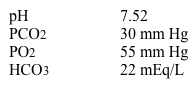 In addition to supplemental oxygen therapy, which of the following is the best initial step in management of this patient?
 (Multiple Choice)
4.8/5 (82)
(82) A 64-year-old man comes to the office because he has had 2 falls within the last month. He states that he loses his balance when he tries to turn or stop suddenly while walking. Recently, it has been taking him quite a while to get himself out of bed. He also has hand tremors that started last year in his left hand, but that now have been affecting both hands. Which of the following is the best tool to confirm his diagnosis?
(Multiple Choice)
4.9/5 (88)
(88) A 73-year-old woman comes to the office due to dry eyes. For the last year, she has had mild burning discomfort associated with a sensation of dust or sand in the eyes. Recently, the patient has had difficulty reading small-print books due to decreased visual acuity. She uses over-the-counter eye drops to relieve the discomfort. Her medical history is notable for hypothyroidism and osteoarthritis of the knees, which are treated with levothyroxine and acetaminophen, respectively. She drinks a glass of wine nightly and does not smoke. Vital signs are normal. On examination, the pupils are symmetrically round and reactive to light. The conjunctivae are normal bilaterally, and funduscopic examination is normal. Oropharyngeal examination shows dry mucosa with mild dental caries. Neurologic examination is unremarkable. Serum chemistry panel, complete blood count, and TSH are normal. Serum antinuclear antibody assay is negative. Which of the following is the most likely cause of this patient's symptoms?
(Multiple Choice)
4.9/5 (80)
(80) A 58-year-old man comes to the physician with a one-year history of diarrhea. The stools are watery and accompanied by abdominal cramps. He has no fever, blood from the rectum, or foul-smelling stools. He has also experienced frequent episodes of dizziness, flushing, wheezing, and a feeling of warmth. The patient has taken herbal medicines, which failed to relieve his symptoms. He is depressed about his illness and feels hopeless about diagnosis and treatment. He appears ill. Cardiac auscultation shows a 2/6 systolic murmur over the left lower sternal border that increases with inspiration. Abdominal examination shows hepatomegaly 3 cm below the right costal margin and no abdominal tenderness. Laboratory results are as follows: 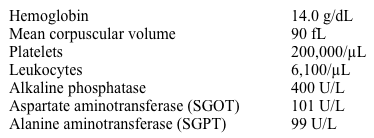 This patient is at risk of developing a deficiency of which of the following vitamins or minerals?
 (Multiple Choice)
4.8/5 (81)
(81) A 45-year-old man comes to the office for the evaluation of excessive wasting of his extremity muscles, which is more apparent on the extensor side. The weakness began distally and asymmetrically. He recently started to have difficulties with swallowing, chewing, and speaking. He feels some movements in his face and tongue. He also has muscle stiffness. His bowel, bladder, cognitive, and sensory functions are intact. The physical examination reveals excessive wasting of his muscles, which is more prominent in the lower extremities. Fasciculations and hyperreflexia are noted. His bulbar reflexes are decreased. What neural pathway is most likely damaged?
(Multiple Choice)
4.8/5 (81)
(81) A 3-year-old girl is brought to the emergency department by ambulance after being found unresponsive in her family's pool. She and her mother had been playing on the back porch until the mother went inside "for less than 1 minute" to answer the phone. When the mother came back outside, she found the girl floating face down in the pool. The mother immediately pulled her out and began rescue breathing, and the neighbor called an ambulance. The emergency medical team arrived 5 minutes later, at which time the patient was awake, alert, and coughing. She is an otherwise healthy girl with no prior hospitalizations. The patient lives at home with her parents and 16-year-old brother. On arrival, temperature is 36.7 C (98 F), blood pressure is 90/50 mm Hg, pulse is 104/min, and respirations are 20/min; pulse oximetry is 99% on room air. Physical examination shows a smiling, alert young girl running around the room. Heart rate and rhythm are regular, and the lungs are clear to auscultation with no adventitious sounds or increased work of breathing. Which of the following complications is this patient at greatest risk of developing?
(Multiple Choice)
5.0/5 (66)
(66) Showing 1661 - 1680 of 1702
 Prev
- 1
- ...
- 2
- ...
- 3
- ...
- 4
- ...
- 5
- ...
- 6
- ...
- 7
- ...
- 8
- ...
- 9
- ...
- 10
- ...
- 11
- ...
- 12
- ...
- 13
- ...
- 14
- ...
- 15
- ...
- 16
- ...
- 17
- ...
- 18
- ...
- 19
- ...
- 20
- ...
- 21
- ...
- 22
- ...
- 23
- ...
- 24
- ...
- 25
- ...
- 26
- ...
- 27
- ...
- 28
- ...
- 29
- ...
- 30
- ...
- 31
- ...
- 32
- ...
- 33
- ...
- 34
- ...
- 35
- ...
- 36
- ...
- 37
- ...
- 38
- ...
- 39
- ...
- 40
- ...
- 41
- ...
- 42
- ...
- 43
- ...
- 44
- ...
- 45
- ...
- 46
- ...
- 47
- ...
- 48
- ...
- 49
- ...
- 50
- ...
- 51
- ...
- 52
- ...
- 53
- ...
- 54
- ...
- 55
- ...
- 56
- ...
- 57
- ...
- 58
- ...
- 59
- ...
- 60
- ...
- 61
- ...
- 62
- ...
- 63
- ...
- 64
- ...
- 65
- ...
- 66
- ...
- 67
- ...
- 68
- ...
- 69
- ...
- 70
- ...
- 71
- ...
- 72
- ...
- 73
- ...
- 74
- ...
- 75
- ...
- 76
- ...
- 77
- ...
- 78
- ...
- 79
- ...
- 80
- ...
- 81
- ...
- 82
- ...
- 83
- ...
- 84
- ...
- 85
- ...
- 86
- ...
- Next

Filters
- Essay(0)
- Multiple Choice(0)
- Short Answer(0)
- True False(0)
- Matching(0)