


 Chat with AI
Exam 1: Medicine

Exam 1: Medicine2 k Questions
Exam 2: Pediatric723 Questions
Exam 3: Psychiatry336 Questions
Exam 4: Surgery563 Questions
Exam 5: Obstetrics & Gynecology469 Questions
Select questions type


A 68-year-old man with chronic obstructive pulmonary disease (COPD) experiences progressive dyspnea, wheezing, and cough over several days despite using inhaled glucocorticoids and bronchodilators. His shortness of breath rapidly worsens and emergency medical services (EMS) is called. The patient becomes unresponsive prior to EMS arrival and is found to have pulseless electrical activity. Cardiopulmonary resuscitation is begun, and he is endotracheally intubated. The patient regains spontaneous circulation on arrival to the emergency department and is found to have a large pneumothorax and exacerbation of COPD. His other medical conditions include hypertension, type 2 diabetes mellitus, and Parkinson disease. A chest tube is inserted, and the patient is admitted to the intensive care unit for further management. Over the next several days, his respiratory status gradually improves, but he remains unresponsive despite not receiving any sedation. The patient is also observed to have recurrent episodes of brief contractions of various muscle groups. Deep tendon reflexes are normal. Serum electrolytes are within normal limits. Which of the following is the most likely cause of the observed findings in this patient?
(Multiple Choice)
4.7/5  (86)
(86) A 65-year-old man comes to the office after noticing blood in his urine. He has had 2 similar episodes of bloody urine over the last month that cleared spontaneously. He has had no abdominal pain, dysuria, or recent illness. The patient has a 30-pack-year smoking history but quit 10 years ago. He has a history of hypertension and has had a transient ischemic attack. Temperature is 36.7 C (98 F), blood pressure is 130/86 mm Hg, pulse is 80/min, and respirations are 16/min. Physical examination, including digital rectal examination, is unremarkable. Laboratory results are as follows:  Which of the following is the most likely cause of this patient's symptoms?
 (Multiple Choice)
4.7/5 (101)
(101) A 55-year-old man comes to the emergency department due to progressively worsening shortness of breath for the past 3 days. He also reports wheezing and productive cough with purulent sputum. The patient's medical history includes chronic bronchitis and benign prostatic hyperplasia. He smokes a pack of cigarettes daily. Temperature is 37.2 C (99 F), blood pressure is 150/90 mm Hg, pulse is 114/min, and respirations are 26/min. The patient's pulse oximetry shows 84% on room air. He is alert and answering questions coherently. Examination shows decreased breath sounds and diffuse wheezing over all lung fields. The patient is admitted to the hospital and started on antibiotics, systemic corticosteroids, and nebulized albuterol and ipratropium. The following day, laboratory results are as follows: 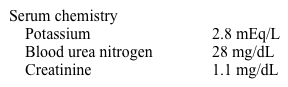 Serum chemistry 2 days ago was normal. Which of the following is the most likely cause of this patient's low serum potassium?
 (Multiple Choice)
4.7/5 (80)
(80) A 43-year-old man comes to the physician reporting acute-onset right knee pain. He was diagnosed with diabetes mellitus a year ago and takes metformin. He does not use tobacco, alcohol, or illicit drugs. The patient is in a monogamous relationship. His father also has diabetes. His temperature is 37 C (98.6 F), blood pressure is 134/86 mm Hg, pulse is 86/min, and respirations are 16/min. BMI is 26 kg/m2. Physical examination shows a slightly swollen and tender right knee and mild hepatomegaly. Right knee x-ray reveals chondrocalcinosis and a moderate effusion. Appropriate analgesic is administered for joint pain. Which of the following is the best next step in management of this patient?
(Multiple Choice)
4.7/5 (82)
(82) A 38-year-old woman is evaluated in the clinic due to swallowing difficulty that began a month ago while eating dinner. Halfway through the meal, she had difficulty chewing her steak and was unable to swallow it. Since then, the patient has had 2 similar episodes associated with food and water regurgitation through her nose. Medical history is significant for gastroesophageal reflux disease. Blood pressure is 138/76 mm Hg and pulse is 82/min. Oropharyngeal examination is unremarkable. Lung auscultation is normal. Heart sounds are normal with no murmurs. The abdomen is soft and nontender with no organomegaly. The patient has no focal weakness or sensory loss, and reflexes are normal. Upper gastrointestinal endoscopy and esophageal manometry are normal. CT scan of the chest is shown in the image below: 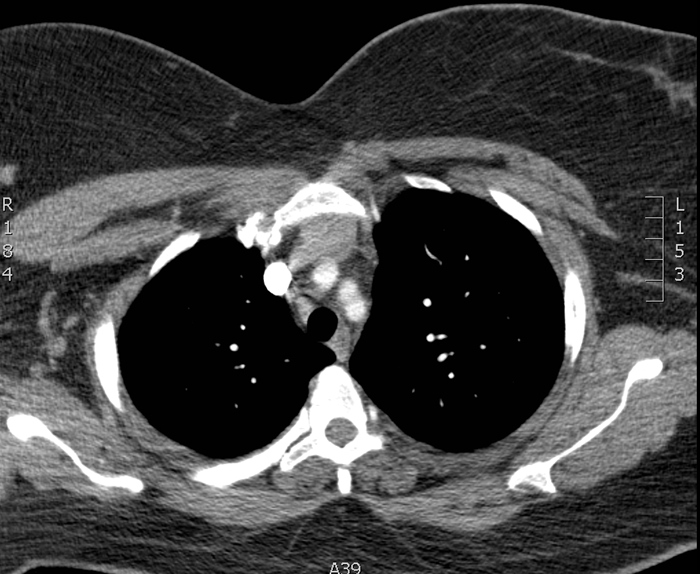 Which of the following is the most likely cause of this patient's symptoms?
 (Multiple Choice)
4.8/5 (90)
(90) A 37-year-old woman comes to the office due to worsening leg swelling for the past 2 months. She has also felt excessively tired and has had achy pain in her hands during this time. The patient reports occasional respiratory illness and minor "aches and pains." She has no chronic medical conditions and takes no medications. She occasionally drinks 1 or 2 glasses of wine during social gatherings but does not use tobacco or illicit drugs. Temperature is 37.3 C (99 F), blood pressure is 156/92 mm Hg, and pulse is 86/min. Physical examination shows normal jugular venous pressure, dullness and decreased breath sounds at the left lung base, normal heart sounds, and no abdominal organomegaly. There is 3+ bilateral lower extremity pitting edema. Bilateral finger joints and wrists are mildly swollen and tender to palpation. Laboratory studies reveal a hemoglobin of 9.1 g/dL, platelet count of 102,000/mm3, and serum creatinine level of 2.1 mg/dL. A peripheral blood smear is normal. Urinalysis is positive for proteinuria and hematuria. Which of the following is most likely involved in the pathogenesis of this patient's renal disease?
(Multiple Choice)
4.8/5 (92)
(92) A 43-year-old woman complains of fatigue and shortness of breath over the last 2 weeks. She has no chest pain, nausea, vomiting, or weight loss. She reports a recent upper respiratory tract infection. The patient does not use tobacco, alcohol, or illicit drugs. Her blood pressure is 98/55 mm Hg and pulse is 105/min. Jugular veins are distended with the patient in the seated position. Lungs are clear to auscultation. Chest x-ray is shown below. 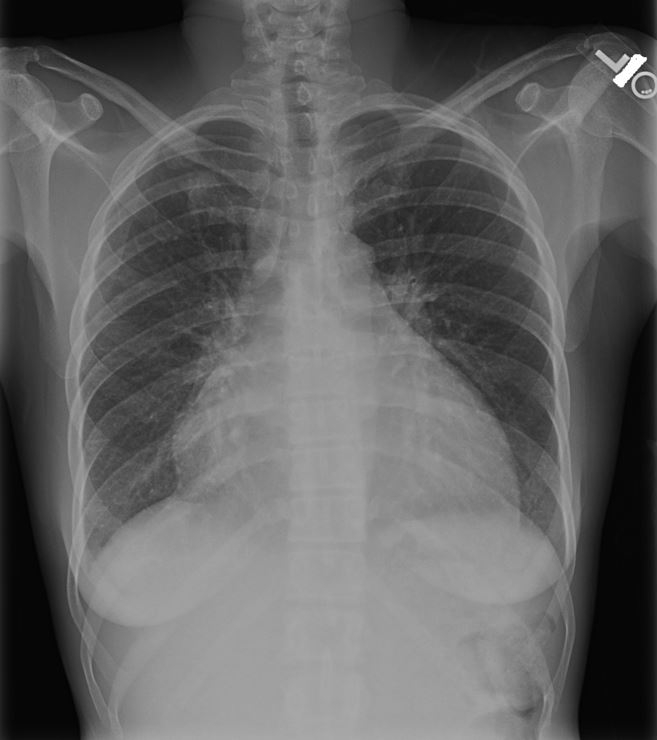 Which of the following is the most likely additional finding in this patient?
 (Multiple Choice)
4.9/5 (71)
(71) A 25-year-old woman with a history of asthma comes to the emergency department due to severe shortness of breath. The patient experienced rapidly worsening dyspnea, wheezing, and chest tightness after she was exposed to some cleaning chemicals at work. On arrival, the patient is in severe respiratory distress with diffuse wheezing and poor air movement. Blood cell counts, serum electrolyte levels, and chest x-ray are normal. Noninvasive ventilation is started, and continuous nebulized albuterol and intravenous methylprednisolone are administered. Several hours later, the patient's respiratory symptoms have significantly improved, but she has muscle weakness; she has difficulty getting out of bed and lifting her arms over her head. Mild hand tremors are noted, and deep tendon reflexes are diffusely decreased. Which of the following is the best next step in the management of this patient?
(Multiple Choice)
4.8/5 (83)
(83) A 20-year-old woman comes to the office due to headache, fatigue, malaise, myalgias, and fever. She has no known sick contacts. The patient recently returned from a summer internship as an arborist at a New Jersey nature preserve. She has a monogamous sexual relationship with her partner. Temperature is 37.9 C (100.2 F), blood pressure is 124/78 mm Hg, and pulse is 98/min. Oropharyngeal examination is normal, and no cervical lymphadenopathy is present. There is a 4-cm, flat, annular lesion on her right lower abdomen with no scaling, raised borders, induration, or purulence. Which of the following is the best next step in management of this patient?
(Multiple Choice)
4.9/5 (89)
(89) A 76-year-old woman is brought to the emergency department by ambulance due to confusion. Her husband says that she has metastatic esophageal cancer and has been unable to eat or drink for the last few days. Yesterday, she became increasingly lethargic, and today, she is hard to arouse. Temperature is 37.1 C (98.8 F), blood pressure is 80/30 mm Hg, pulse is 60/min, and respirations are 30/min. Pulse oximetry is 95% on room air. The patient appears lethargic but opens her eyes to verbal stimuli. Mucous membranes are dry. A peripheral IV is placed, laboratory studies are ordered, and intravenous fluids are started. An ECG tracing is shown in the exhibit. 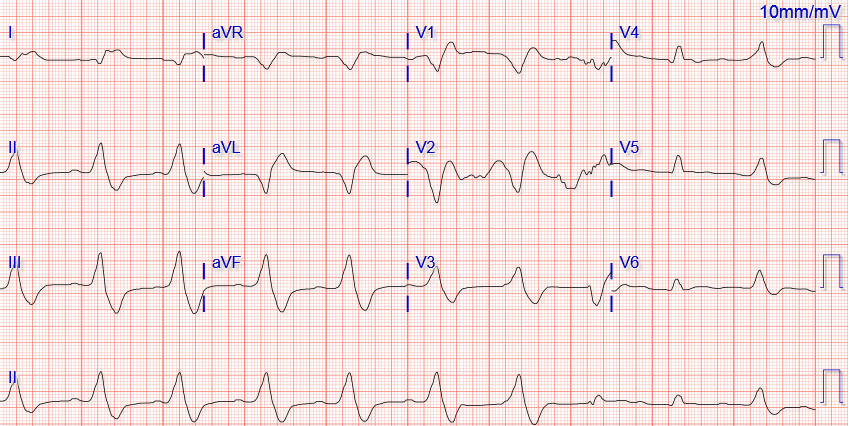 Which of the following is the best next step in management?
 (Multiple Choice)
4.9/5 (77)
(77) A 38-year-old woman, gravida 1 para 0, at 30 weeks gestation comes to the emergency department due to severe epigastric pain that started 6 hours ago. The pain began suddenly, is constant, and radiates to her back. She also has associated nausea and has had multiple episodes of vomiting. The patient has a history of hypertriglyceridemia, and her fibrate medication was discontinued at her initial prenatal visit. Her only current medication is a prenatal vitamin. The patient does not use tobacco, alcohol, or illicit drugs. Temperature is 36.7 C (98.1 F), blood pressure is 134/82 mm Hg, pulse is 92/min, and respirations are 18/min. Fetal heart tones are 155/min. The abdomen is tender over the epigastric region; there is no rebound or guarding. Bowels sounds are normal. The uterus is nontender and has no palpable contractions. Laboratory results are as follows: 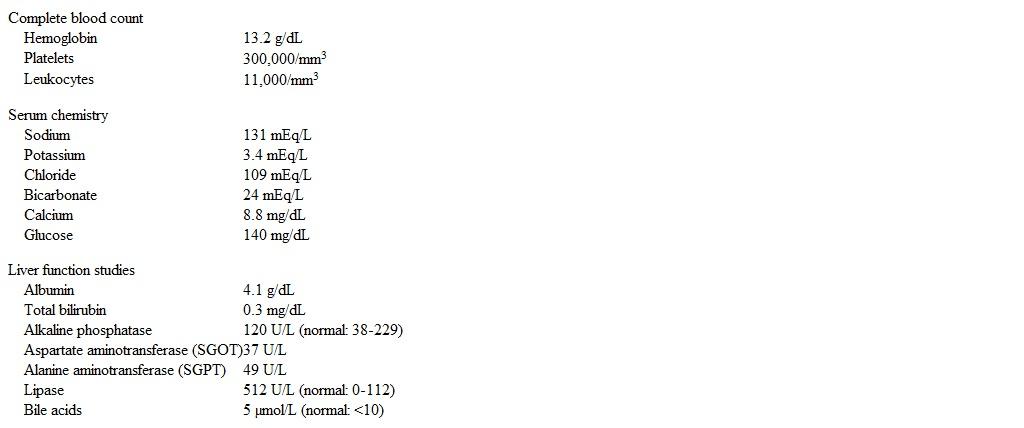 A right upper quadrant ultrasound reveals no biliary sludge or dilation of the biliary tree. Which of the following is the best next step in management of this patient?
 (Multiple Choice)
4.9/5 (78)
(78) A 56-year-old woman comes to the office with her daughter to discuss knee pain, which has been ongoing for several years. The patient has a high tolerance for pain and has previously refused to see a doctor for her condition. Lately, the pain has been affecting the patient's daily activities, and she spends most of the day sitting in a chair. The knee pain and stiffness are more pronounced on the right side and are worse in the morning but gradually improve by the afternoon. She takes no medications. Review of systems is positive for fatigue. Vital signs are within normal limits. BMI is 31 kg/m2. Lower extremity examination shows that both knees are swollen and tender but more so on the right side. The patient is unable to fully flex or extend the right knee. There is mild, bilateral atrophy of the quadriceps. Radiographs of the knees reveal osteopenia of the distal femur, multiple periarticular erosions, and soft tissue swelling. Which of the following is the best long-term management for the most likely diagnosis in this patient?
(Multiple Choice)
4.8/5 (88)
(88) A 12-month-old girl is brought to the office due to 3 days of fever, rhinorrhea, and nasal congestion. The patient completed a course of oral antibiotics for an ear infection 3 weeks ago and was noted to have a persistent middle ear effusion at a well-child visit last week. There is no history of additional infections or medical conditions. She has no allergies. Both parents smoke cigarettes, and both older siblings received tympanostomy tubes as infants. Temperature is 39.4 C (102.9 F). The patient is irritable but easily consoled by her mother. External ear examination is unremarkable, and external ear canals are patent. Otoscopy shows bilateral bulging and pink tympanic membranes with poor mobility on insufflation. The oropharynx appears normal without lesions or sores, and the lungs are clear to auscultation. Which of the following is the most appropriate next step in management of this patient?
(Multiple Choice)
4.8/5 (86)
(86) A 64-year-old woman comes to the emergency department due to headache and nausea over the last 2 days. She has end-stage renal disease due to advanced diabetic nephropathy and recently started hemodialysis. In addition, the patient has anemia due to chronic kidney disease and is receiving treatment with erythropoietin and parenteral iron. Medical history is notable for mild hypertension, osteoporosis, and hypothyroidism. Blood pressure is 210/121 mm Hg and pulse is 76/min. Muscle strength is normal and sensory examination is unremarkable. There are no heart murmurs. Ophthalmoscopic examination shows bilateral retinal hemorrhages. Fingerstick glucose level is 186 mg/dL. Which of the following is the most likely cause of this patient's current condition?
(Multiple Choice)
4.9/5 (89)
(89) A 34-year-old man comes to the office with a 4-week history of diarrhea. He has no blood in the stools. The patient recently returned from a trip to South America, where he developed foul-smelling stools, abdominal cramps, and bloating. A 3-day course of ciprofloxacin did not relieve his symptoms. He has no previous medical problems and has never had similar symptoms. The patient takes no other medication and does not use tobacco, alcohol, or illicit drugs. Temperature is 36.8 C (98.2 F), blood pressure is 126/80 mm Hg, and pulse is 86/min. Examination shows a soft, nontender abdomen with increased bowel sounds. Which of the following is the most appropriate next step in management?
(Multiple Choice)
4.7/5 (89)
(89) A 25-year-old man comes to the clinic due to a 3-month history of right shoulder pain. He also has swelling and pain at his heels. The patient has tried using a topical "arthritis cream" without improvement, although over-the-counter analgesics have provided some relief. Medical history includes influenza pneumonia at age 12, but he has otherwise been healthy and takes no regular medications. The patient does not use tobacco, alcohol, or illicit drugs. His temperature is 37.3 C (99.2 F), blood pressure is 115/75 mm Hg, pulse is 56/min and regular, and respirations are 12/min. On examination, there is pain with resisted abduction at the shoulder and tenderness at the acromioclavicular junction. Palpation over the heels, iliac crests, and tibial tuberosities also elicits tenderness. Which of the following additional findings is most likely in this patient?
(Multiple Choice)
4.7/5 (78)
(78) A 75-year-old man is brought to the office by his daughter due to increasing confusion over the past 3 weeks. His daughter noticed that he has had trouble writing, using a computer, and keeping track of his calendar. The patient's wife died 4 weeks ago and since then, he has not been sleeping well and taking doxylamine at bedtime has not helped much. Other medical conditions include chronic obstructive pulmonary disease and hypertension. The patient takes amlodipine and tiotropium. Temperature is 36.1 C (97 F), blood pressure is 140/90 mm Hg, pulse is 105/min, and respirations are 18/min. The patient is oriented to person but not to time or place. Extraocular movements are normal. Lungs are clear to auscultation bilaterally. Reflexes are 2+ and strength is normal. His gait is ataxic and his speech is dysarthric. Complete blood count, urinalysis, and serum chemistries are normal. CT scan of the head reveals mild cortical atrophy but is otherwise normal. Which of the following is the most appropriate next step in management?
(Multiple Choice)
4.8/5 (83)
(83) A 32-year-old woman comes to the office because of fatigue, progressively worsening shortness of breath, and swelling of her feet. The patient has had these symptoms for the last 4 or 5 days. She denies chest pain. The patient has no other medical conditions except for a cold 2 weeks ago. She takes no medications. Temperature is 36.7 C (98 F), blood pressure is 110/65 mm Hg, pulse is 90/min, and respirations are 20/min. Physical examination shows bilateral basilar crackles, elevated jugular venous pressure, and 2+ bilateral pitting edema extending above the ankles. Complete blood count reveals no abnormalities. Which of the following will most likely be shown on echocardiography?
(Multiple Choice)
4.8/5 (78)
(78) A 17-year-old boy is brought to the office for a routine presports physical evaluation. The patient has no symptoms. He plays competitive soccer for his high school. Blood pressure is 120/80 mm Hg, pulse is 62/min, and respirations are 15/min. BMI is 27 kg/m2. The patient is well built with increased skeletal muscle mass. Physical examination is unremarkable. ECG demonstrates normal sinus rhythm with T-wave inversion in leads V5 and V6. Echocardiography reveals left ventricular hypertrophy with impaired early diastolic filling and mild left atrial enlargement. What is the most likely diagnosis in this patient?
(Multiple Choice)
4.8/5 (84)
(84) An 83-year-old woman comes to the office due to a 1-year history of progressively severe, crampy abdominal pain that occurs immediately after she eats. The pain is diffuse but more pronounced in the epigastric area and is associated with frequent bloating and nausea and occasional diarrhea. The patient has had a 15-kg (33-lb) weight loss over the past year. She has lost her appetite since the pain episodes began. Her other medical problems include hypertension, type 2 diabetes mellitus, hypercholesterolemia, peripheral vascular disease, and coronary artery disease. Three years ago, she suffered an inferior wall myocardial infarction, which was treated with a drug-eluting stent. The patient has a 40-pack-year history of smoking but quit 10 years ago. She occasionally drinks a glass of wine. Temperature is 36.8 C (98.2 F), blood pressure is 140/92 mm Hg, pulse is 80/min, and respirations are 14/min. BMI is 24 kg/m2. Abdomen is soft, nontender, and nondistended. Bowel sounds are present. Abdominal x-rays reveal no abnormalities. Which of the following is the most likely cause of this patient's current presentation?
(Multiple Choice)
5.0/5 (81)
(81) Showing 1521 - 1540 of 1702
 Prev
- 1
- ...
- 2
- ...
- 3
- ...
- 4
- ...
- 5
- ...
- 6
- ...
- 7
- ...
- 8
- ...
- 9
- ...
- 10
- ...
- 11
- ...
- 12
- ...
- 13
- ...
- 14
- ...
- 15
- ...
- 16
- ...
- 17
- ...
- 18
- ...
- 19
- ...
- 20
- ...
- 21
- ...
- 22
- ...
- 23
- ...
- 24
- ...
- 25
- ...
- 26
- ...
- 27
- ...
- 28
- ...
- 29
- ...
- 30
- ...
- 31
- ...
- 32
- ...
- 33
- ...
- 34
- ...
- 35
- ...
- 36
- ...
- 37
- ...
- 38
- ...
- 39
- ...
- 40
- ...
- 41
- ...
- 42
- ...
- 43
- ...
- 44
- ...
- 45
- ...
- 46
- ...
- 47
- ...
- 48
- ...
- 49
- ...
- 50
- ...
- 51
- ...
- 52
- ...
- 53
- ...
- 54
- ...
- 55
- ...
- 56
- ...
- 57
- ...
- 58
- ...
- 59
- ...
- 60
- ...
- 61
- ...
- 62
- ...
- 63
- ...
- 64
- ...
- 65
- ...
- 66
- ...
- 67
- ...
- 68
- ...
- 69
- ...
- 70
- ...
- 71
- ...
- 72
- ...
- 73
- ...
- 74
- ...
- 75
- ...
- 76
- ...
- 77
- ...
- 78
- ...
- 79
- ...
- 80
- ...
- 81
- ...
- 82
- ...
- 83
- ...
- 84
- ...
- 85
- ...
- 86
- ...
- Next

Filters
- Essay(0)
- Multiple Choice(0)
- Short Answer(0)
- True False(0)
- Matching(0)