


 Chat with AI
Exam 1: Medicine

Exam 1: Medicine2 k Questions
Exam 2: Pediatric723 Questions
Exam 3: Psychiatry336 Questions
Exam 4: Surgery563 Questions
Exam 5: Obstetrics & Gynecology469 Questions
Select questions type


A 36-year-old woman comes to the office due to worsening shortness of breath. The patient has a long-standing history of nasal congestion and frontal headaches that partly improved after nasal polyp removal a year ago. Over the past several months, she has experienced increasingly frequent episodes of chest tightness and wheezing. The patient has noted that the symptoms worsen after she takes over-the-counter analgesics. She has no pets, and there have been no changes in her environment. She does not use tobacco or alcohol. Which of the following is the main driver of pathogenesis of this patient's symptoms?
(Multiple Choice)
4.8/5  (83)
(83) A 17-year-old girl is brought to the emergency department by her mother after an episode of loss of consciousness 20 minutes ago. The patient was taking a shower when her mother heard her fall. By the time the mother opened the bathroom door, she was lying on the floor and unresponsive. The patient woke up within a few minutes and was taken to the emergency department by ambulance. During transport, she was drowsy and confused. The mother notes that the patient recently broke up with her boyfriend, has been under significant stress at school, and has been sleeping poorly. In the emergency department, blood pressure is 120/70 mm Hg, pulse is 90/min, and respirations are 13/min. The patient is now alert and answers questions appropriately. Examination of the head shows no obvious injury, step-off, or hematoma. The pupils are symmetric and reactive to light. Fingerstick glucose level is 100 mg/dL. Which of the following is most likely to be seen in this patient?
(Multiple Choice)
4.8/5 (75)
(75) A 45-year-old man comes to the physician due to epigastric pain and diarrhea. Past medical history is significant for peptic ulcer disease. He has a 20-pack-year smoking history but does not use alcohol or illicit drugs. Physical examination shows abdominal tenderness without rebound or rigidity. Endoscopy shows prominent gastric folds, 3 duodenal ulcers, and upper jejunal ulceration. Which of the following is the most appropriate next step in the management of this patient?
(Multiple Choice)
4.9/5 (83)
(83) A 56-year-old woman is brought to the emergency department due to shortness of breath, which she says began suddenly 2 hours ago while she was enjoying her favorite television show. She also reports sharp, left-sided chest pain that worsens with cough. Medical history includes diabetes mellitus for the past 10 years and hypertension for the past 6 years. Family history is significant for heart disease in her father, who died at age 40. The patient has a 30-pack-year smoking history but does not smoke currently. On physical examination, she is in acute distress and diaphoretic. Temperature is 38.1 C (100.5 F), blood pressure is 110/60 mm Hg, pulse is 140/min and irregular, and respiratory rate is 30/min. Oxygen saturation is 84% on room air by pulse oximetry. BMI is 38 kg/m2. Jugular venous pressure is slightly elevated. The lungs are clear to auscultation. Laboratory results are as follows:  Chest x-ray is unremarkable. ECG reveals irregular RR intervals with no definite P waves and narrow QRS complexes. Which of the following is the most likely cause of this patient's current symptoms?
 (Multiple Choice)
4.9/5 (80)
(80) A 51-year-old attorney comes to the office due to sleep difficulties. She is a partner in a law firm and finds her job stressful but enjoyable. The patient goes to bed at 12:00 AM and has trouble initiating sleep. When she cannot sleep, she watches the clock, tosses and turns, and worries about being able to function the next day, eventually falling asleep around 3:00 AM before having to wake up at 7:00 AM for work. She reports feeling "exhausted" by 6:00 PM and takes a 20-minute "power nap." The patient's job requires long hours, and she usually eats dinner at 8:00 PM "when things settle down" at the office. The patient drinks several cups of coffee throughout the day but avoids caffeinated beverages after dinner. She has 1-2 alcoholic drinks when she goes out with colleagues in the evenings once or twice a week. She quit smoking 3 years ago but recently started smoking a pack a day again. She often wonders "what my life is all about" and tries not to dwell on these thoughts. She also has been more irritable lately and feels down at times but attributes this to "sleep deprivation." Which of the following is the most likely cause of the patient's symptoms?
(Multiple Choice)
4.8/5 (79)
(79) A 12-year-old girl is brought to the emergency department due to rash and difficulty breathing. Symptoms started acutely after she was stung by a bee while playing soccer. Her coach says that the patient developed full-body hives, difficulty breathing, and vomiting before the ambulance arrived. She has a history of moderate persistent asthma. Medications include inhaled fluticasone twice daily and inhaled albuterol PRN. On arrival, temperature is 37.2 C (99 F), blood pressure is 110/70 mm Hg, pulse is 114/min, and respirations are 28/min. Pulse oximetry is 91% on room air. Examination shows a thin girl in moderate respiratory distress with hives on the trunk and extremities. Diffuse wheezing is heard on auscultation, and the patient has mild tenderness to abdominal palpation. Intramuscular epinephrine is administered, with resolution of symptoms and normalization of vital signs. However, an hour later, she has worsening hives, mild wheezing, and an additional episode of emesis. Repeat respiratory rate is 18/min and pulse oximetry is 97%. Which of the following is the most appropriate next step in management of this patient?
(Multiple Choice)
4.9/5 (80)
(80) A 32-year-old woman complains of a "nagging" dry cough over the last 8 weeks. The cough is present during the day and awakens her at night. There is no associated shortness of breath, chest pain, or wheezing. The patient's past medical history is significant for chronic rhinorrhea and an occasional itching skin rash. She takes no medications. Chest x-ray shows no abnormalities. One week of treatment with chlorpheniramine significantly improves her symptoms. Decrease in which of the following is most likely responsible for her symptom relief?
(Multiple Choice)
4.8/5 (67)
(67) A 65-year-old man with nonischemic cardiomyopathy treated with furosemide, carvedilol, lisinopril, and digoxin comes to the emergency department with palpitations. His last left ventricular ejection fraction was 35%. His blood pressure is 160/100 mm Hg and pulse is 130/min and irregular. Lungs are clear to auscultation. The abdomen is soft and nondistended. ECG shows atrial fibrillation with rapid ventricular response and nonspecific T-wave changes. Therapy with rivaroxaban and amiodarone is initiated with improvement in symptoms. The patient is discharged home after 2 days, with these new medications added to his initial regimen. Two weeks later, he returns to the emergency department with profound anorexia, nausea, and generalized weakness. Which of the following is the most likely cause of this patient's symptoms?
(Multiple Choice)
4.8/5 (74)
(74) A 19-year-old man is brought to the emergency department due to an eye injury. About an hour ago, the patient was playing racquetball and was hit in the face by the ball. He felt pain immediately in his left eye and placed an ice pack over it. The appearance of the eye on examination is shown in the image below. 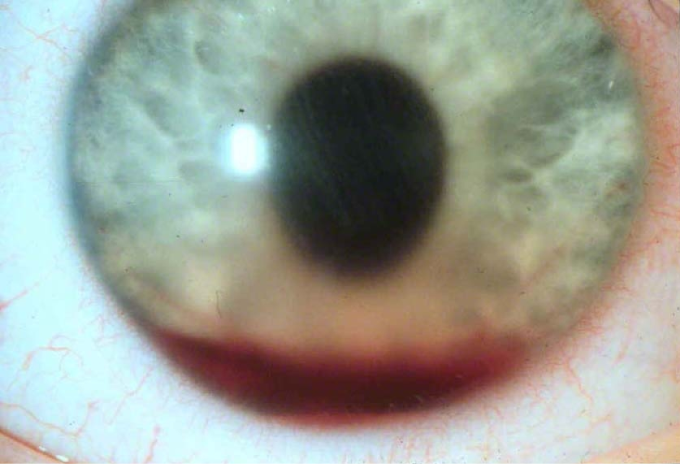 This patient's diagnosis increases the risk of which of the following complications?
 (Multiple Choice)
4.9/5 (77)
(77) A 24-year-old woman is evaluated for a lump in her neck. She discovered the lump a week ago while showering. The patient feels well and has no associated pain, fever, night sweats, or weight changes. Her medical history is unremarkable, although she has had irregular menses for a year since insertion of an intrauterine device. The patient does not use tobacco, alcohol, or illicit drugs. Her mother died during surgery for thyroid cancer. Blood pressure is 133/80 mm Hg and pulse is 78/min. On examination, there is a palpable 2-cm nodule in the right thyroid lobe. The remainder of the examination, including chest, abdomen, extremities, and skin, is normal. Serum TSH and calcium levels are normal and calcitonin is elevated. Ultrasound-guided aspiration biopsy reveals malignant cells. Which of the following tests is the best next step in evaluation of this patient?
(Multiple Choice)
4.9/5 (83)
(83) A 60-year-old woman with a history of locally advanced breast cancer comes to the office for scheduled follow-up. The patient underwent a lumpectomy followed by radiation therapy and completion of chemotherapy 6 months ago. She is currently taking an aromatase inhibitor. The patient feels that the fatigue she experienced during her chemotherapy has not improved. She has been sleeping poorly and recently left her volunteer job at the library because she is "too distracted to sit and alphabetize books." The patient had previously been meeting weekly with friends for lunch but has not replied to recent invitations. Since her last appointment 3 months ago, she has lost 3 kg (6.6 lb); otherwise, vital signs are within normal limits, there are no changes on physical examination, and laboratory and imaging studies are unremarkable. When informed of these normal results, she says, "That's good to hear, but I'm anxious that the cancer is coming back. Why else would I feel so tired all the time?" Which of the following is the most likely explanation of this patient's condition?
(Multiple Choice)
4.8/5 (73)
(73) A 74-year-old woman is brought to the office by her son. He is concerned because his mother had an unprovoked fall a year ago and has since relied on him to coordinate her activities and make decisions about everyday matters. The patient's symptoms seemed to improve until she sustained another significant fall about 6 months ago. She has also become mildly forgetful, experiences occasional mood swings, and now seems sad most of the time. The patient has a long history of hypertension, stress urinary incontinence, and depression. She has a family history of colorectal cancer and Alzheimer disease. Temperature is 36.7 C (98 F), blood pressure is 141/87 mm Hg, pulse is 82/min, and respirations are 14/min. Neurologic examination shows weakness and sensory deficits on the right side. Mental status examination is significant for low volume of speech and flat affect. The remainder of the examination is within normal limits. Neuroimaging would most likely show which of the following?
(Multiple Choice)
4.9/5 (81)
(81) A 54-year-old woman comes to the emergency department due to several hours of severe epigastric abdominal pain. The patient began having mild colicky upper abdominal pain after dinner last night and took acetaminophen before going to bed. In the night, the patient awoke with severe abdominal pain radiating to her back. She has also had nausea and several episodes of vomiting. The patient has a history of occasional upper abdominal pain after eating but has never had such severe symptoms. She has no other medical issues and takes no medications. Temperature is 37.6 C (99.6 F), blood pressure is 110/66 mm Hg, pulse is 118/min, and respirations are 24/min. The patient appears to be in moderate distress. Mucous membranes are dry. The abdomen is distended with marked epigastric tenderness. Bowel sounds are decreased. Laboratory results are as follows:  Which of the following sets of renal findings are most expected in this patient?
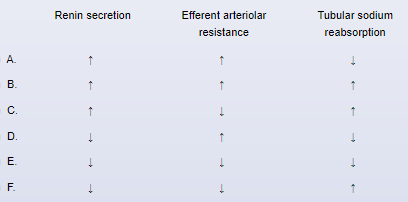
Which of the following sets of renal findings are most expected in this patient?
(Multiple Choice)
4.9/5 (89)
(89) A 58-year-old man comes to the office due to increasing abdominal girth for the past several months. The patient also reports progressive fatigue, weight gain, and nausea but no vomiting. Medical history is significant for gastroesophageal reflux and hypertension. He drinks 12 beers a day but denies smoking or intravenous drug use. Temperature is 37 C (98.6 F), blood pressure is 122/76 mm Hg, pulse is 80/min, and respirations are 18/min. Mental status is normal. Cardiopulmonary examination is unremarkable. The abdomen is grossly distended, and shifting dullness is elicited. There is no asterixis. Chest x-ray is normal. Basic metabolic panel is unremarkable. Abdominal ultrasonogram shows splenomegaly, moderate ascites, and a shrunken liver with no masses. Diagnostic paracentesis reveals straw-colored fluid. In addition to recommending complete abstinence from alcohol use, which of the following is the best next step in management?
(Multiple Choice)
4.7/5 (90)
(90) A 52-year-old man comes to the emergency department with a 24-hour history of pain and swelling of his right knee. He has no fevers, chills, or recent trauma to the knee. In addition, the patient has had constipation, excessive urination, and fatigue for the past several months. His medical history is notable for a kidney stone a year ago that passed with intravenous and oral hydration. The patient does not take any prescription medications, and does not use tobacco, alcohol, or illicit drugs. His temperature is 37.2 C (98.9 F) and blood pressure is 130/76 mm Hg. Examination shows tenderness, erythema, and swelling of the right knee. The remainder of the examination is unremarkable. Laboratory results are as follows: 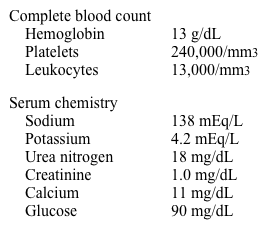 Arthrocentesis is performed. Which of the following is most likely to be found on synovial fluid assessment in this patient?
 (Multiple Choice)
4.9/5 (74)
(74) A 53-year-old woman is brought to the emergency department after she collapsed suddenly while standing and lost consciousness for approximately 3 minutes. She recovered spontaneously but was very weak and dyspneic. She also reports left-sided chest pain. There was no tonic-clonic activity or incontinence. The patient was recently diagnosed with colon cancer on a routine colonoscopy and is scheduled to undergo surgical resection. Her only other medical problem is hypertension, but she has not been compliant with her medications. Her blood pressure is 86/50 mm Hg and pulse is 120/min and regular. Pulse oximetry shows 80% on room air. She is diaphoretic and tachypneic. Jugular venous pressure is 13 cm H2O. Lungs are clear to auscultation. Further workup in this patient would most likely show which of the following?
(Multiple Choice)
4.9/5 (87)
(87) A 55-year-old man comes to the office for an annual visit. Medical history includes hypertension and hypercholesterolemia, for which he takes amlodipine and atorvastatin. He is adherent to his medication regimen. The patient feels well in general, but over the past few months, he has had difficulty achieving and maintaining an erection, despite having a normal libido. He drinks 2 or 3 glasses of wine daily and does not smoke. He works for a lawn care company, frequently driving the grass cutter. Blood pressure is 160/100 mm Hg and pulse is 80/min. BMI is 45 kg/m2. Cardiopulmonary examination is normal. The abdomen is soft and nontender. The liver and spleen are not palpable. Laboratory results are as follows:  Which of the following is most likely responsible for this patient's increased hematocrit?
 (Multiple Choice)
4.9/5 (70)
(70) A 69-year-old woman comes to the office for a routine preventive visit. She has no specific concerns and feels well. The patient lives alone, drinks alcohol socially, and does not smoke. Other than an emergency appendectomy 40 years ago, she has no significant medical history. The patient takes no medications and has no personal or family history of cancer or heart disease. She had a normal mammogram and lipid panel 2 years ago and a normal resting ECG and Pap smear with human papillomavirus cotesting at age 65. A colonoscopy 7 years ago showed no lesions. Which of the following studies is most appropriate at this time?
(Multiple Choice)
4.9/5 (62)
(62) A 42-year-old man comes to the office due to back pain. Yesterday, the patient was moving furniture when he suddenly had sharp, shooting pain in the lower back and buttocks that radiated down the back of the legs. He took acetaminophen and rested, but the pain was persistent. When the patient woke up today, his legs felt numb and weak, and he also had to strain to urinate. He has no chronic medical conditions and takes no medication. Vital signs are within normal limits. Physical examination shows lower lumbar spine tenderness on palpation. Bilateral lower extremity strength is 4/5, and ankle reflexes are absent bilaterally. Sensation to touch is decreased in the perineal region and buttocks. Straight leg raise testing is positive. Which of the following is the most appropriate next step in management of this patient?
(Multiple Choice)
4.9/5 (72)
(72) A 67-year-old man with hypertension comes to the office for follow-up. Despite escalations in his antihypertensive therapy, he has persistently elevated blood pressure readings at home and in the office. The patient has occasional headaches but no chest pain, shortness of breath, or syncope. His other medical conditions include type 2 diabetes mellitus, coronary artery disease, and an ischemic stroke with residual left-sided weakness. The patient underwent coronary artery bypass surgery 7 years ago and carotid endarterectomy 5 years ago. His current antihypertensive regimen includes lisinopril, chlorthalidone, amlodipine, and carvedilol. Blood pressure is 184/120 mm Hg in the left arm and 170/112 mm Hg in the right arm, and pulse is 65/min. Physical examination shows an upper abdominal systolic-diastolic bruit. This finding is best explained by which of the following?
(Multiple Choice)
4.8/5 (72)
(72) Showing 221 - 240 of 1702
 Prev
- 1
- ...
- 2
- ...
- 3
- ...
- 4
- ...
- 5
- ...
- 6
- ...
- 7
- ...
- 8
- ...
- 9
- ...
- 10
- ...
- 11
- ...
- 12
- ...
- 13
- ...
- 14
- ...
- 15
- ...
- 16
- ...
- 17
- ...
- 18
- ...
- 19
- ...
- 20
- ...
- 21
- ...
- 22
- ...
- 23
- ...
- 24
- ...
- 25
- ...
- 26
- ...
- 27
- ...
- 28
- ...
- 29
- ...
- 30
- ...
- 31
- ...
- 32
- ...
- 33
- ...
- 34
- ...
- 35
- ...
- 36
- ...
- 37
- ...
- 38
- ...
- 39
- ...
- 40
- ...
- 41
- ...
- 42
- ...
- 43
- ...
- 44
- ...
- 45
- ...
- 46
- ...
- 47
- ...
- 48
- ...
- 49
- ...
- 50
- ...
- 51
- ...
- 52
- ...
- 53
- ...
- 54
- ...
- 55
- ...
- 56
- ...
- 57
- ...
- 58
- ...
- 59
- ...
- 60
- ...
- 61
- ...
- 62
- ...
- 63
- ...
- 64
- ...
- 65
- ...
- 66
- ...
- 67
- ...
- 68
- ...
- 69
- ...
- 70
- ...
- 71
- ...
- 72
- ...
- 73
- ...
- 74
- ...
- 75
- ...
- 76
- ...
- 77
- ...
- 78
- ...
- 79
- ...
- 80
- ...
- 81
- ...
- 82
- ...
- 83
- ...
- 84
- ...
- 85
- ...
- 86
- ...
- Next

Filters
- Essay(0)
- Multiple Choice(0)
- Short Answer(0)
- True False(0)
- Matching(0)