


 Chat with AI
Exam 1: Medicine

Exam 1: Medicine2 k Questions
Exam 2: Pediatric723 Questions
Exam 3: Psychiatry336 Questions
Exam 4: Surgery563 Questions
Exam 5: Obstetrics & Gynecology469 Questions
Select questions type


A 35-year-old woman is brought to the emergency department after being rescued from inside a burning building by firefighters. She had a brief tonic-clonic seizure en route to the hospital. Her past medical history is unknown. She is confused and mildly agitated. Her temperature is 37 C (98.6 F), blood pressure is 100/60 mm Hg, pulse is 115/min, and respirations are 24/min. Her oxygen saturation is 96% on room air as measured by standard pulse oximetry. Physical examination shows no burns, and her skin color is normal. There are symmetric breath sounds bilaterally with scattered end-expiratory wheezes. Neurologic examination shows no abnormalities apart from confusion. The abdomen is soft and nontender. Which of the following is the best initial treatment for this patient?
(Multiple Choice)
4.9/5  (70)
(70) A 75-year-old man comes to the office for an annual wellness visit. He feels healthy and has no bothersome symptoms. The patient is up to date on vaccines and cancer screening tests. History is notable for hypertension, for which he takes lisinopril and amlodipine, and type 2 diabetes mellitus, for which he takes metformin. The patient does not smoke and drinks alcohol only on social occasions. Blood pressure is 128/82 mm Hg. External ocular examination is normal; funduscopic examination shows an enlarged optic cup with an increased cup/disc ratio. Automated visual field testing reveals decreased peripheral vision in all axes. Which of the following is the most likely diagnosis?
(Multiple Choice)
4.8/5 (97)
(97) A 78-year-old woman is brought to the emergency department by her daughter, who is concerned about the patient's increasing forgetfulness and ability to live on her own. The daughter says, "Over the past month, my mother seems to ask me the same questions over and over. When I visited last week, she seemed slowed down overall and couldn't remember if she had taken a shower that day. She has also stopped shopping for groceries and cooking for herself, although she did eat all the meals that I prepared." The patient takes medications for type 2 diabetes mellitus, hypertension, and urinary incontinence. Over the past several months, she has had difficulty sleeping due to a burning sensation in her feet from diabetic neuropathy. After recently discussing these symptoms with her primary care physician, the patient was prescribed a new medication that provided significant relief. Blood pressure is 138/86 mm Hg and pulse is 84/min and regular. The lungs are clear on auscultation and heart sounds are normal. The abdomen is soft and nontender. The patient's gait is slow, but there are no focal neurologic deficits. Montreal Cognitive Assessment score is 24/30 (normal: ≥26) with deficits in orientation, attention, and recall. Which of the following is the most appropriate next step in management of this patient?
(Multiple Choice)
4.8/5 (68)
(68) A 15-year-old girl is brought to the emergency department after a suicide attempt. The patient has a history of depression, and 12 hours ago she ingested 30 tablets of one of her father's medications. He has a history of hypertension and coronary artery disease. The patient has no other medical conditions and does not use alcohol or illicit drugs. Upon arrival, she has nausea, upper abdominal discomfort, and ringing in the ears. Temperature is 38.1 C (100.5 F), blood pressure is 120/76 mm Hg, pulse is 115/min, and respirations are 26/min. Physical examination is otherwise unremarkable. Which of the following sets of findings are most likely to be observed on arterial blood gas analysis in this patient?

(Multiple Choice)
5.0/5 (66)
(66) A 60-year-old man comes to the office for evaluation of gait imbalance, which he has had for the past 3 days. The patient was hospitalized 2 weeks ago for a complicated enterococcal diabetic infection of the left foot. He was prescribed ampicillin and gentamicin, which he has continued via home intravenous antibiotic therapy. The patient subsequently developed a constant sensation of objects moving around in his visual field when looking in any direction, which has caused him to feel unsteady. He has no associated nausea or vomiting. The patient has a history of poorly controlled type 2 diabetes mellitus and hypertension. His other medications include lisinopril and basal-bolus insulin therapy. Temperature is 36.7 C (98 F), blood pressure is 140/96 mm Hg, pulse is 80/min, and respirations are 16/min. BMI is 34 kg/m2. The left foot wound is healing without discharge or surrounding erythema. Neurologic examination shows 5/5 muscle strength and 2+ reflexes in all extremities. Hearing is decreased in the right ear on whisper test. Rapid head movement away from a fixed target causes eye movement away from the target followed by a horizontal saccade back toward it. Which of the following is the most likely cause of this patient's current symptoms?
(Multiple Choice)
4.9/5 (80)
(80) A 36-year-old man from California who had been skiing at a Colorado ski resort for 3 days developed cough, shortness of breath, headache, and dizziness. The patient has no previous medical problems and takes no medication. He does not use tobacco, alcohol, or illicit drugs. Temperature is 38.3 C (100.9 F), blood pressure is 110/70 mm Hg, and pulse is 102/min. Oxygen saturation is 86% on room air. Examination shows cyanosis, dry mucous membranes, normal jugular venous pressure, and bilateral lung crackles. Heart sounds are normal. There is no peripheral edema. Neurologic examination shows no focal findings. Leukocytes are 13,000/mm3 with 75% neutrophils. The patient is given antibiotics and high-flow oxygen as well as strict bed rest. Six hours later his symptoms markedly improve with a decrease in oxygen requirements. What is the most likely diagnosis?
(Multiple Choice)
4.9/5 (79)
(79) A 38-year-old homeless man is brought to the emergency department due to severe muscle pain and stiffness. He arrived at a homeless shelter 2 days ago, and the manager says that he has been restless and irritable. The patient has a history of alcohol abuse and injection drug use. Temperature is 37.7 C (100 F), blood pressure is 150/90 mm Hg, and pulse is 102/min. Both pupils are normal, equal, and reactive to light. There are marks on the patient's arms from previous injections as well as several abrasions and lacerations on the lower extremities. He is unable to open his mouth completely. Painful spasms of the neck muscles are triggered by physical stimuli. Which of the following is the most likely cause of this patient's current condition?
(Multiple Choice)
4.9/5 (90)
(90) A 50-year-old man comes to the office due to a rash, joint pain, malaise, and fatigue for the past several weeks. Medical history is significant for intravenous drug use with 5 years of abstinence since participating in a methadone treatment program. The patient takes no medications. He does not use alcohol and is a lifetime nonsmoker. Temperature is 37.7 C (99.9 F), blood pressure is 165/90 mm Hg, pulse is 80/min, and respirations are 14/min. Examination shows palpable purpura involving the lower extremities as well as hepatomegaly. Achilles reflexes are absent. Urinalysis reveals hematuria, red blood cell casts, and proteinuria. Laboratory results are as follows:  Which of the following is the most likely diagnosis?
 (Multiple Choice)
4.9/5 (92)
(92) A 34-year-old woman comes to the office to discuss the results of a recent CT scan. The patient was in a motor vehicle collision last week and underwent a CT scan of the abdomen and pelvis for possible intraabdominal trauma. The CT scan showed a markedly enlarged uterus with multiple intramural and pedunculated leiomyomata that did not compress the ureters or surrounding bowel. The patient has a monthly menstrual period with 4 days of light bleeding. She typically has abdominal cramping on the first day of her menstrual period, but usually does not require pain medication. The patient has no urinary frequency, urgency, chronic pelvic pain, or changes in bowel habits. She has no chronic medical conditions and takes no daily medications. The patient is in a monogamous, same-sex relationship and has no pain with intercourse. Vital signs are normal, and BMI is 23 kg/m2. An irregularly enlarged mass is palpated in the lower abdomen, consistent with uterine leiomyomata. Which of the following is the best next step in management of this patient?
(Multiple Choice)
4.8/5 (74)
(74) A 45-year-old woman comes to the office due to progressive weakness for the past several months. The patient has had difficulty lifting her foster children and getting in and out of her car. She also reports difficulty swallowing and has had several episodes of choking while drinking water. She has no medical problems, but there is a history of breast cancer in her mother. The patient does not use tobacco, alcohol, or illicit drugs. Vital signs are within normal limits, and she has normal sensation and deep tendon reflexes. Strength is 4/5 in the deltoid and quadriceps muscle groups, and there is no limitation in range of motion. Physical examination is otherwise unremarkable. Erythrocyte sedimentation rate is 50 mm/hr, and serum creatine kinase is elevated. TSH is normal. Which of the following is the best initial treatment for this patient?
(Multiple Choice)
4.8/5 (77)
(77) A 58-year-old man is brought to the emergency department after an apparent suicide attempt. He was found lethargic by his wife, who also discovered a suicide note. The patient has a history of coronary artery disease and hypertension. His temperature is 37.7 C (100 F), blood pressure is 76/40 mm Hg, pulse is 40/min, and respirations are 12/min. Examination shows diffuse bilateral wheezing. Extremities are cold and clammy. ECG shows profound sinus bradycardia with first-degree atrioventricular block. The patient is given intravenous fluids and atropine; however, his bradycardia and hypotension do not improve. In addition to ensuring adequate oxygenation, which of the following is the most appropriate next step in management?
(Multiple Choice)
4.8/5 (88)
(88) A 21-year-old man comes to the office due to a rash. The rash began several months ago and became more noticeable over the summer. The patient works as a lifeguard at a hotel swimming pool and has had "5 or 6" sexual partners in the last year. Vital signs are normal. Examination shows scattered macules across the shoulders, chest, and upper back, as shown in the exhibit. 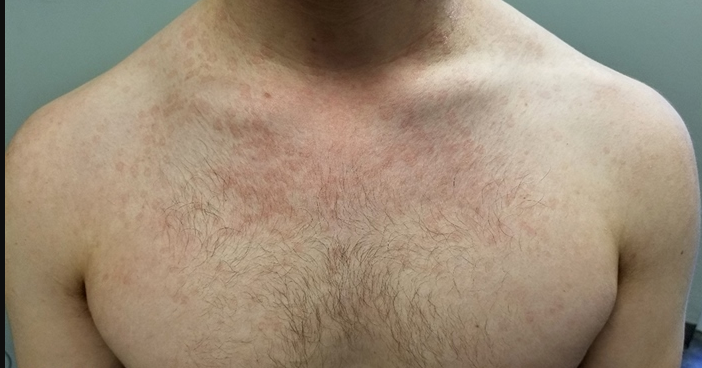 After diagnostic confirmation, which of the following is the most appropriate treatment for this patient's skin condition?
 (Multiple Choice)
4.9/5 (93)
(93) A 20-year-old man from northern Europe comes to the emergency department with a 2-month history of intermittent right upper quadrant pain. The patient's medical history is unremarkable, and he considers himself healthy. His mother had her gallbladder removed at a young age. Abdominal ultrasound reveals cholelithiasis. Laboratory results show a hemoglobin level of 10.2 g/dL. Peripheral blood smear is shown in the image below. 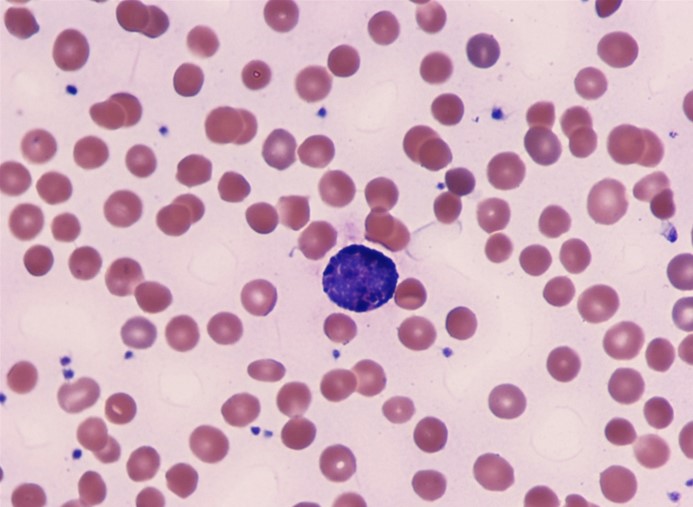 This patient most likely has which of the following additional laboratory findings?
 (Multiple Choice)
4.9/5 (81)
(81) A 78-year-old woman is brought to the hospital due to a 2-day history of confusion and involuntary jerking of the upper extremities. Medical history is significant for heart failure with preserved ejection fraction, type 2 diabetes mellitus, and peripheral neuropathy. Her furosemide and lisinopril dosages were increased 3 weeks ago. Other medications include gabapentin, insulin lispro and glargine, and atorvastatin. Vital signs are normal. Examination shows a slightly confused woman with prominent upper extremity myoclonus and dry mucous membranes. The rest of the physical examination shows no abnormalities. Laboratory results are as follows: Furosemide and lisinopril are held. What is the most appropriate next step in management of this patient's myoclonus?
(Multiple Choice)
4.9/5 (84)
(84) An 80-year-old woman comes to the office due to progressive lower extremity edema over the last 2 months. Her mobility is impaired due to knee osteoarthritis, but recently she has become somewhat tired and short of breath with daily activities. Her stomach feels full and her appetite has been decreased. The patient has had no forgetfulness or mood problems. Blood pressure is 136/75 mm Hg and pulse is 70/min and regular. Jugular veins are distended with the patient in the seated position. There are no heart murmurs. Breath sounds are decreased at the bases bilaterally. The abdomen is distended with flank dullness on percussion. There is 3+ peripheral edema. Laboratory results are as follows: Urine albumin excretion is 1 g/24 hr. Echocardiogram reveals left atrial enlargement, marked concentric left ventricular hypertrophy, and left ventricular ejection fraction of 70%. Which of the following is the most likely cause of this patient's symptoms?
(Multiple Choice)
4.8/5 (86)
(86) A 37-year-old man comes to his primary care physician for the evaluation of slightly pruritic skin lesions on his penis and around his anus. He has no fever, malaise, or anorexia. He is sexually active with multiple male partners and uses condoms occasionally. The patient has never been tested for HIV or other sexually transmitted diseases. He has no drug allergies. Examination shows skin-colored, verrucous, papilliform lesions as shown in the image below. 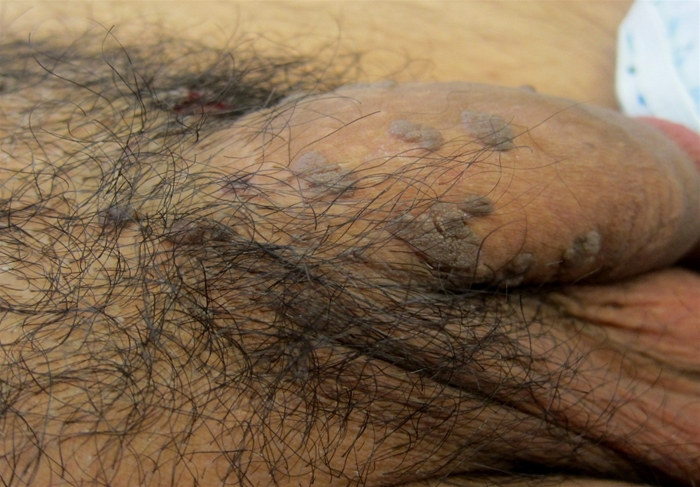 Which of the following is the most likely cause of this patient's skin condition?
 (Multiple Choice)
4.9/5 (66)
(66) A 46-year-old woman comes to the office for evaluation of heavy menstrual bleeding. The patient's menses previously occurred every 29 days and consisted of 4 days of moderate bleeding. However, for the past year her menses have occured every 27 days and have become increasingly heavy, consisting of 5 days of heavy bleeding. During the first 2 days of her menstrual period, the patient changes her tampon every 1-2 hours and often soaks through her clothes. Her menses have also become increasingly painful and unrelieved by ibuprofen, and she now has constant, dull pelvic pain between menses. The patient has had 3 cesarean deliveries and a bilateral tubal ligation. Blood pressure is 110/70 mm Hg and pulse is 92/min. BMI is 28 kg/m2. Bimanual examination reveals a soft, tender, globular uterus that measures 11 weeks in size. Urine pregnancy test is negative. Hemoglobin is 9.8 g/dL and platelets are 180,000/mm3. Which of the following is the most likely cause of this patient's symptoms?
(Multiple Choice)
4.8/5 (65)
(65) A 50-year-old woman comes to the office due to lower extremity edema. The edema started about 6 weeks ago and has slowly progressed . Medical history is significant for hypertension, treated with metoprolol for 3 years. Two months ago, amlodipine was added because of inadequate blood pressure control with metoprolol alone. The patient does not use tobacco or alcohol. She has no known drug allergies. Blood pressure is 130/80 mm Hg and pulse is 64/min. Physical examination reveals bilateral symmetric 3+ pitting edema of both lower extremities, without any skin changes or varicosities. Her neck vein pulsation is normal. The rest of the examination is unremarkable. Laboratory results are as follows:  Urinalysis is within normal limits. What is the most likely cause of the edema in this patient?
 (Multiple Choice)
5.0/5 (79)
(79) A 37-year-old woman comes to the clinic for evaluation of a rash. She has a few small, red rashes on her shoulders and lower back, which have gradually increased in size over the last 2 weeks. The rashes are slightly itchy but not painful. Vital signs are normal. Skin examination findings are shown in the exhibit. 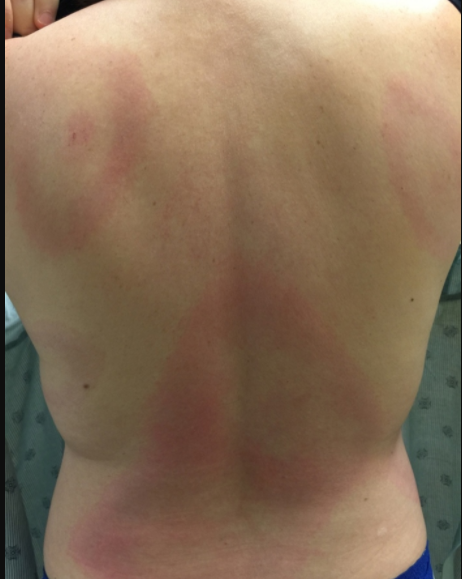 The remainder of the examination is normal. Which of the following is the most appropriate treatment for this patient?
 (Multiple Choice)
4.9/5 (86)
(86) A 32-year-old man comes to the office due to recent insomnia. The patient has experienced stress at his job in the past month because he has had to work extra hours on multiple occasions while several coworkers have been on vacation or sick. Over the past 2 weeks, he has had difficulty falling asleep most nights and has been fatigued throughout the day. Recently, the patient has started drinking 1 or 2 beers at night to help him fall asleep as well as energy drinks throughout the day to stay alert. He describes feeling anxious and irritable and has experienced occasional palpitations and feelings of panic. The patient has a history of depression. He does not use illicit drugs. Blood pressure is 140/90 mm Hg and pulse is 95/min. On examination, the patient is restless and mildly tremulous with a flushed and agitated appearance, irritable mood, and rapid speech. Which of the following is the most likely explanation for this patient's condition?
(Multiple Choice)
4.8/5 (75)
(75) Showing 1321 - 1340 of 1702
 Prev
- 1
- ...
- 2
- ...
- 3
- ...
- 4
- ...
- 5
- ...
- 6
- ...
- 7
- ...
- 8
- ...
- 9
- ...
- 10
- ...
- 11
- ...
- 12
- ...
- 13
- ...
- 14
- ...
- 15
- ...
- 16
- ...
- 17
- ...
- 18
- ...
- 19
- ...
- 20
- ...
- 21
- ...
- 22
- ...
- 23
- ...
- 24
- ...
- 25
- ...
- 26
- ...
- 27
- ...
- 28
- ...
- 29
- ...
- 30
- ...
- 31
- ...
- 32
- ...
- 33
- ...
- 34
- ...
- 35
- ...
- 36
- ...
- 37
- ...
- 38
- ...
- 39
- ...
- 40
- ...
- 41
- ...
- 42
- ...
- 43
- ...
- 44
- ...
- 45
- ...
- 46
- ...
- 47
- ...
- 48
- ...
- 49
- ...
- 50
- ...
- 51
- ...
- 52
- ...
- 53
- ...
- 54
- ...
- 55
- ...
- 56
- ...
- 57
- ...
- 58
- ...
- 59
- ...
- 60
- ...
- 61
- ...
- 62
- ...
- 63
- ...
- 64
- ...
- 65
- ...
- 66
- ...
- 67
- ...
- 68
- ...
- 69
- ...
- 70
- ...
- 71
- ...
- 72
- ...
- 73
- ...
- 74
- ...
- 75
- ...
- 76
- ...
- 77
- ...
- 78
- ...
- 79
- ...
- 80
- ...
- 81
- ...
- 82
- ...
- 83
- ...
- 84
- ...
- 85
- ...
- 86
- ...
- Next

Filters
- Essay(0)
- Multiple Choice(0)
- Short Answer(0)
- True False(0)
- Matching(0)