


 Chat with AI
Exam 1: Medicine

Exam 1: Medicine2 k Questions
Exam 2: Pediatric723 Questions
Exam 3: Psychiatry336 Questions
Exam 4: Surgery563 Questions
Exam 5: Obstetrics & Gynecology469 Questions
Select questions type


A 32-year-old woman is evaluated for cough and shortness of breath while mountain climbing. She has no chronic medical problems and takes no medication. The patient does not use tobacco, alcohol, or illicit drugs. On examination, temperature is 36.5 C (97.7 F), blood pressure is 134/84 mm Hg, pulse is 110/min, and respirations are 20/min. BMI is 25 kg/m2. Oxygen saturation is 84% on ambient air. Perioral cyanosis is present. She is in moderate respiratory distress. Pulmonary examination reveals bilateral inspiratory crackles. Chest x-ray reveals normal heart size and bilateral patchy lung infiltrates. Therapy for this patient would most likely focus on which of the following?
(Multiple Choice)
4.9/5  (82)
(82) A 52-year-old man is brought to the office by his wife. According to her, he repeatedly wakes up at night and seems to be choking but falls back asleep quickly. The patient reports fatigue and often falls asleep while reading books or watching television. He had childhood asthma that required inhalers. Other medical conditions include type 2 diabetes mellitus, hypertension, and hyperlipidemia. Medications include metformin, sitagliptin, atorvastatin, amlodipine, and lisinopril. The patient does not use tobacco and drinks alcohol only on weekends. Blood pressure is 150/88 mm Hg and pulse is 80/min. BMI is 34 kg/m2. There is no jugular venous distension. Lungs are clear to auscultation. A grade II/VI apical holosystolic murmur is present. There is no organomegaly. Mild bilateral pitting edema is present. What is the most likely cause of this patient's symptoms?
(Multiple Choice)
4.7/5 (82)
(82) An 18-year-old woman comes to the office for evaluation of dysuria that began 8 days ago. The patient went to urgent care a week ago and completed a 7-day course of nitrofurantoin with no relief of symptoms. She also has vaginal discharge but no fever, chills, or back pain. The patient is monogamous with a male partner and takes combination estrogen/progestin oral contraceptives. She has no chronic medical conditions or medication allergies. Temperature is 36.7 C (98.1 F), blood pressure is 118/74 mm Hg, and pulse is 68/min. On speculum examination, there is thick, yellow cervical discharge, and the cervix bleeds on contact with a swab. No pain is present on bimanual pelvic examination. The remainder of the examination is normal. Wet mount microscopy shows multiple leukocytes but no clue cells or motile organisms. Urinalysis is positive for leukocyte esterase but negative for nitrites and blood. Urine pregnancy testing is negative. Cervical swabs are obtained for further testing. Which of the following is the best next step in management of this patient?
(Multiple Choice)
4.8/5 (75)
(75) A 36-year-old man comes to the urgent care center due to a 2-day history of a pruritic rash on his hands. It began with small papules and progressed to small blisters with oozing yellow fluid. A few days prior, the patient spent an afternoon clearing bushes around his house but has had no recent travel or change in household products. Medical history is unremarkable. Temperature is 36.6 C (97.9 F), blood pressure is 125/79 mm Hg, and pulse is 76/min. Skin examination shows erythematous plaques with eroded vesicles and small bullae between the fingers of the left hand and on the dorsum of the right hand, as shown in the exhibit. 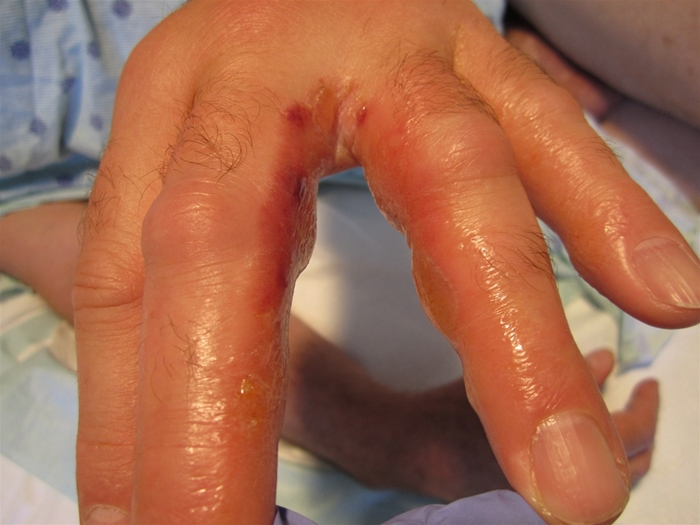 Which of the following is the most likely diagnosis for this patient?
 (Multiple Choice)
5.0/5 (86)
(86) A 65-year-old woman comes to the office due to pain and swelling over the medial aspect of her right eye for the past 2 days. Examination of the eye reveals tenderness, edema, and redness over the medial canthus. Slight pressure over the area causes expression of purulent material. Visual acuity is normal. What is the most likely diagnosis?
(Multiple Choice)
4.7/5 (79)
(79) A 32-year-old woman comes to the emergency department with her boyfriend for evaluation of diarrhea for the past 3 weeks. The patient works as a schoolteacher and says, "There was a stomach bug going around recently, but no one else has had symptoms for this long." She reports voluminous and watery bowel movements that occur 10-12 times a day. She feels fatigued and weak and states that her sleep has been disrupted a few times due to nocturnal bowel movements. The patient has no abdominal pain, melena, hematochezia, vomiting, or unexplained weight changes. Her boyfriend reports that she had a similar episode of diarrhea 2 months ago; laboratory evaluation and colonoscopy showed no abnormalities, and the patient's symptoms resolved a few days later. Temperature is 37 C (98.6 F), blood pressure is 120/80 mm Hg, and pulse is 84/min. There are no orthostatic changes. Mucous membranes are moist, and capillary refill is normal. Abdominal examination shows mild tenderness to palpation in all 4 quadrants, with no rebound tenderness, guarding, or rigidity. Complete blood count, serum chemistry, liver function tests, and urinalysis are normal. HIV testing is negative. Fecal occult blood is negative. Which of the following is the most appropriate next step in management of this patient?
(Multiple Choice)
4.8/5 (67)
(67) A 40-year-old man is found to have severe hypertriglyceridemia on routine evaluation. He has no present complaints. Medical history includes hypertension controlled with hydrochlorothiazide and asymptomatic gallstones. His father had a nonfatal myocardial infarction at age 47. The patient does not smoke or consume alcohol. Blood pressure is 130/75 mm Hg and pulse is 70/min. He is prescribed niacin for his hypertriglyceridemia. The patient returns 1 week later due to intense, generalized pruritus and flushing. What is the most likely cause of his complaint?
(Multiple Choice)
4.8/5 (84)
(84) A 69-year-old man comes to the emergency department due to severe shortness of breath for the past 12 hours. He has used his albuterol inhaler many times without relief. He reports one day of low-grade fever that resolved with acetaminophen. The patient quit smoking 2 years ago but has a 40-pack-year history. His temperature is 37.2 C (99 F), blood pressure is 150/90 mm Hg, pulse is 110/min, and respirations are 22/min. The patient is using accessory muscles of respiration. Lung examination shows prolonged expiration with end-expiratory wheezing bilaterally. Results of arterial blood gas testing performed on room air are as follows:  Noninvasive positive-pressure ventilation is initiated. Which of the following additional therapies is most likely to benefit this patient?
 (Multiple Choice)
4.7/5 (79)
(79) A 34-year-old woman comes to the office after a recent hospitalization. Over the past several months, the patient has had worsening weakness, anorexia, nausea, and abdominal discomfort. Two weeks ago, she had a syncopal episode; evaluation found a low serum cortisol level and subnormal response to ACTH stimulation. The patient was treated in the hospital and was discharged on oral hydrocortisone therapy. Since discharge, she has had intermittent episodes of light-headedness and nausea but reports improvement in other symptoms. Her husband adds that the patient consumes excessive amounts of salty foods. Temperature is 36.9 C (98.4 F), blood pressure is 108/66 mm Hg supine and 98/60 mm Hg upright, and pulse is 88/min supine and 102/min upright. Physical examination reveals hyperpigmentation of the oral mucosa and palmar creases. Cardiopulmonary and abdominal examination shows no abnormalities. Laboratory results are as follows:  Which of the following is the most appropriate next step in management of this patient?
 (Multiple Choice)
4.8/5 (75)
(75) A 43-year-old woman comes to the emergency department due to confusion. She has also had increased thirst and has needed to "use the bathroom more frequently." She has not had any fever, chills, headache, chest pain, shortness of breath, or cough. Her medical history is significant for bipolar disorder that is well-controlled by medication. She does not use tobacco, alcohol, or illicit drugs. Her vital signs are stable, and physical examination is unremarkable. Laboratory results are as follows:  What is the most likely cause of this patient's symptoms and laboratory findings?
 (Multiple Choice)
4.8/5 (70)
(70) A 35-year-old, previously healthy woman comes to the emergency department due to eye injury. She was cleaning her bathroom with industrial-strength bleach 30 minutes ago when some of the chemical splashed into her left eye. The patient immediately washed the eye with tap water for several minutes. She now has a gritty sensation in the eye and difficulty opening it. Physical examination reveals blepharospasm and conjunctival erythema of the left eye. Urgent ophthalmology consultation is requested. Which of the following is the best immediate step in management of this patient?
(Multiple Choice)
4.9/5 (75)
(75) A 54-year-old man comes to the office due to several episodes of coughing up bloody sputum. The patient has also noticed weight loss, anorexia, constipation, increased thirst, and fatigue. He smoked 2 packs of cigarettes daily for 32 years but quit last month. Vital signs are within normal limits. The patient appears slim and pale. Physical examination is otherwise normal. Laboratory results are as follows:  Chest x-ray shows a left-sided hilar mass. Whole-body bone scan is normal. Histopathology of the hilar mass is most likely to reveal which of the following?
 (Multiple Choice)
4.9/5 (86)
(86) A 55-year-old woman comes to the office with a one-week history of pain in multiple joints. She has achy pain and stiffness in both wrists and multiple metacarpophalangeal and proximal interphalangeal joints in both hands. The patient's symptoms are worst in the morning and partially improve over 10-15 minutes of normal activity. There is no associated fever, chills, rash, or weight loss. She works in a day care center and does not use tobacco, alcohol, or illicit drugs. Vital signs are normal. On examination, there is mild swelling with no redness or tenderness of the involved joints. Laboratory studies show normal blood counts and serum chemistries. Erythrocyte sedimentation rate is 12 mm/hr. Which of the following is the most likely diagnosis in this patient?
(Multiple Choice)
4.8/5 (69)
(69) A 70-year-old man is brought to the office by his wife. She reports that he "no longer listens to me" when she speaks and that this has worsened over the past 2 years. The patient has moved his living room chair farther away from her and closer to the TV. He does not like to join her for their weekly dinners with friends anymore. The patient reports he has trouble understanding his wife, especially when the environment is noisy. He says he got tired of asking his friends to repeat themselves and so does not enjoy eating out with them. Medications include hydrochlorothiazide, lisinopril, and aspirin. The patient does not smoke or use alcohol. Which of the following is the most likely cause of his condition?
(Multiple Choice)
4.9/5 (75)
(75) A 55-year-old man comes to the office due to elbow pain. For the past 3 weeks, the patient has had vague, achy pain in the left elbow that radiates to the forearm. It is worse with activity and at the end of the day and is not relieved with acetaminophen. The patient works as an airport baggage handler and has been seen in the office previously for minor occupational injuries. His medical history is otherwise unremarkable. The patient smokes a half pack of cigarettes daily and does not use alcohol or illicit drugs. Vital signs are normal. Inspection of the left elbow shows no erythema or swelling. Range of motion is normal. There is severe pain on palpation at the lateral distal humerus. With the elbow held in extension, terminal passive flexion of the wrist reproduces the pain. Which of the following is the most likely diagnosis in this patient?
(Multiple Choice)
4.8/5 (89)
(89) A 45-year-old man is evaluated in the emergency department for severe right flank pain. He is tossing in the bed from the pain. The patient has a history of hypertension, hyperlipidemia, and diet-controlled type 2 diabetes mellitus. BMI is 43 kg/m2. Abdominal radiographs show no abnormalities, but CT scan shows a 5-mm stone in the right ureter and several smaller stones in both renal pelvises. Urinalysis results are as follows:  The patient subsequently passes a stone, and analysis shows it to be composed of 100% uric acid. Besides high fluid intake, which of the following would be most helpful for this patient to prevent recurrent stones?
 (Multiple Choice)
4.8/5 (69)
(69) A 45-year-old woman is brought to the emergency department due to severe abdominal pain, nausea, and 2 episodes of vomiting over the last 2 hours. After meals for the past several weeks, the patient has had episodic epigastric and right upper quadrant pain associated with nausea. Medical history is significant for mitral valve prolapse, obesity, and migraine headaches relieved by nonsteroidal anti-inflammatory drugs (NSAIDs). Temperature is 38.3 C (100.9 F), blood pressure is 140/92 mm Hg, and pulse is 102/min. Physical examination reveals diffuse abdominal tenderness and guarding over the upper abdomen. Stool guaiac test is positive. Which of the following is the best next step in management of this patient?
(Multiple Choice)
4.9/5 (77)
(77) A 25-year-old woman, gravida 1 para 1, is evaluated for fatigue, palpitation, excessive sweating, and tremor that began 2 weeks ago. Two months before the current visit, she delivered a male child at 39 weeks gestation by an uncomplicated vaginal delivery. The patient has been breastfeeding her infant. She reports no chronic medical conditions. Blood pressure is 140/70 mm Hg and pulse is 110/min. Examination of the thyroid gland shows mild, nontender, diffuse enlargement without an audible bruit. Bilateral lid lag is noted without proptosis or eye redness. A fine tremor of her outstretched hands is present. Deep tendon reflexes are brisk and symmetrical. Laboratory results are as follows:  In addition to propranolol, which of the following is the best therapy for this patient at this time?
 (Multiple Choice)
4.9/5 (70)
(70) A 65-year-old woman comes to the emergency department due to severe pain in her left arm. The patient tripped and fell while working in her yard this morning. To save her head and face from hitting the concrete, she fell on her outstretched left hand. The patient reports no head injury or loss of consciousness. She has no back or neck pain. Vital signs are within normal limits. On examination, the left arm is externally rotated and abducted, and the patient is unable to move her arm without excruciating pain. Distal pulses and sensation are intact. X-ray shows anterior shoulder dislocation and a nondisplaced fracture of humeral neck. The patient is given appropriate analgesics for pain control. What is the best next step in management?
(Multiple Choice)
4.9/5 (76)
(76) A 53-year-old man comes to the emergency department at 6:00 AM due to severe pain in his right great toe for the past 3 hours. His pain began suddenly as a dull ache, and rapidly worsened to severe throbbing that is not relieved by acetaminophen. Medical history is notable for hypertension, type 2 diabetes mellitus, and hypercholesterolemia. The patient has smoked 2 packs of cigarettes daily for 30 years. He drinks 2-3 beers and 3-4 cups of coffee daily, consumes fast food often, and does not exercise regularly. Current medications include metformin, losartan, amlodipine, sitagliptin, and atorvastatin. The patient's temperature is 36.8 C (98.2 F), blood pressure is 160/90 mm Hg, pulse is 88/min, and respirations are 16/min. On examination, the right great toe appears markedly swollen, red, and warm to the touch. Which of the following interventions would be most appropriate to prevent development of further similar episodes in this patient?
(Multiple Choice)
4.9/5 (90)
(90) Showing 1041 - 1060 of 1702
 Prev
- 1
- ...
- 2
- ...
- 3
- ...
- 4
- ...
- 5
- ...
- 6
- ...
- 7
- ...
- 8
- ...
- 9
- ...
- 10
- ...
- 11
- ...
- 12
- ...
- 13
- ...
- 14
- ...
- 15
- ...
- 16
- ...
- 17
- ...
- 18
- ...
- 19
- ...
- 20
- ...
- 21
- ...
- 22
- ...
- 23
- ...
- 24
- ...
- 25
- ...
- 26
- ...
- 27
- ...
- 28
- ...
- 29
- ...
- 30
- ...
- 31
- ...
- 32
- ...
- 33
- ...
- 34
- ...
- 35
- ...
- 36
- ...
- 37
- ...
- 38
- ...
- 39
- ...
- 40
- ...
- 41
- ...
- 42
- ...
- 43
- ...
- 44
- ...
- 45
- ...
- 46
- ...
- 47
- ...
- 48
- ...
- 49
- ...
- 50
- ...
- 51
- ...
- 52
- ...
- 53
- ...
- 54
- ...
- 55
- ...
- 56
- ...
- 57
- ...
- 58
- ...
- 59
- ...
- 60
- ...
- 61
- ...
- 62
- ...
- 63
- ...
- 64
- ...
- 65
- ...
- 66
- ...
- 67
- ...
- 68
- ...
- 69
- ...
- 70
- ...
- 71
- ...
- 72
- ...
- 73
- ...
- 74
- ...
- 75
- ...
- 76
- ...
- 77
- ...
- 78
- ...
- 79
- ...
- 80
- ...
- 81
- ...
- 82
- ...
- 83
- ...
- 84
- ...
- 85
- ...
- 86
- ...
- Next

Filters
- Essay(0)
- Multiple Choice(0)
- Short Answer(0)
- True False(0)
- Matching(0)