


 Chat with AI
Exam 1: Medicine

Exam 1: Medicine2 k Questions
Exam 2: Pediatric723 Questions
Exam 3: Psychiatry336 Questions
Exam 4: Surgery563 Questions
Exam 5: Obstetrics & Gynecology469 Questions
Select questions type


A 72-year-old woman with a past medical history of hypertension, type 2 diabetes mellitus, and coronary artery disease suddenly drops her fork while having dinner with her family. Her speech becomes slurred and she develops right-sided weakness. She then has an episode of vomiting. An hour later, while being evaluated in the hospital, she is stuporous, does not respond to verbal stimuli, and grimaces to pain. Her blood pressure is 185/107 mm Hg and pulse is 55/min. The Babinski reflex is upgoing on the right side. Her fingerstick glucose is 365 mg/dL. Additional laboratory testing and imaging studies are ordered. Which of the following is the most likely cause of this patient's current condition?
(Multiple Choice)
4.9/5  (89)
(89) An 8-year-old boy is brought to the emergency department 45 minutes after falling out of bed. He had been asleep for about 10 minutes when his mother heard a thud and immediately ran to his room. She found him unconscious on the floor with a blue discoloration around his lips that resolved after a few seconds. The patient regained consciousness after a few minutes but seemed excessively sleepy. He has had no fever, vomiting, diarrhea, or change in appetite. The patient has no chronic medical conditions and takes no medication. He was drowsy but responsive on the drive to the hospital and was able to walk in unassisted. Vital signs are normal for age. The patient is now alert and interactive but does not remember anything about the event. Which of the following is the most likely diagnosis?
(Multiple Choice)
4.9/5 (64)
(64) A 15-month-old full-term boy is brought to the clinic for a well-child examination. He has been eating and sleeping well and is meeting all developmental milestones. His day care center had an outbreak of pertussis 6 weeks ago that required it to close for a few days, but the patient has had no cough, nasal congestion, or rhinorrhea. At age 6 months, he had a generalized seizure that lasted approximately 2 minutes within hours of receiving the diphtheria-tetanus-acellular pertussis vaccine. He was taken to the emergency department for observation and discharged later that day. The patient has had no other seizures or medical concerns and takes no medications. His uncle has a history of childhood-onset epilepsy. Vital signs and physical examination are normal. The child is due for the fourth dose of the diphtheria-tetanus-acellular pertussis vaccine. Which of the following is the best next step in management of this patient?
(Multiple Choice)
4.7/5 (80)
(80) A new screening test was devised to detect pancreatic cancer at early stages using a serum marker (CA19-9) of the disease. A study of this new test showed that its use prolongs the survival of patients with pancreatic cancer by several months. The researchers concluded that use of the test improves the prognosis of patients with pancreatic cancer. Which of the following is a potential problem with this conclusion?
(Multiple Choice)
4.8/5 (80)
(80) A 64-year-old man comes to the emergency department with sharp, left-sided chest pain for the last 24 hours. The pain is worsened by deep breathing and relieved with leaning forward. He also complains of decreased appetite, fatigue, and occasional nausea over the last several weeks. He suffered an acute non-ST-elevation myocardial infarction 1 year ago and had stent placement in the right coronary artery. His other medical problems include type 2 diabetes mellitus complicated by retinopathy and peripheral neuropathy, hypertension, hyperlipidemia, hypothyroidism, and chronic kidney disease. His temperature is 36.1° C (97° F), blood pressure is 142/86 mm Hg, pulse is 98/min, and respirations are 16/min. A friction rub is heard at the left lower sternal border. Electrocardiogram shows normal sinus rhythm with asymmetric T-wave inversion in leads V5 and V6. Laboratory results are as follows: 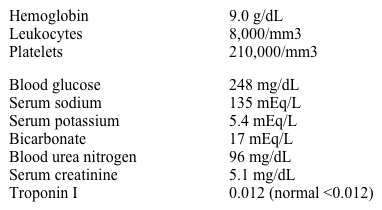 Which of the following is the most appropriate therapy for this patient's chest pain?
 (Multiple Choice)
4.8/5 (97)
(97) A 65-year-old woman comes to the office with a 2-month history of fatigue and dyspnea on exertion. She takes no medications. Her temperature is 36.7 C (98 F), blood pressure is 162/83 mm Hg, pulse is 100/min, and respirations are 21/min. Auscultation shows a 2/6 mid-systolic murmur in the second right intercostal space with normal S2 splitting. No peripheral edema is noted. Rectal examination shows guaiac-negative brown stool. ECG shows sinus tachycardia and nonspecific ST-T changes. Subsequent laboratory results are as follows: 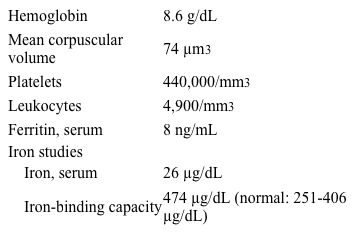 Which of the following is the most appropriate next step in management of this patient?
 (Multiple Choice)
4.8/5 (88)
(88) A 53-year-old woman comes to the urgent care clinic with right-sided abdominal pain that started 2 days ago. She describes the pain as constant, burning, and severe enough to interfere with sleep. There is no associated nausea, vomiting, or diarrhea. The patient tried treating the symptoms with a few doses of over-the-counter antacids and ibuprofen, which brought no relief. Her medical history is significant for breast cancer diagnosed a year ago, for which she underwent a modified radical mastectomy followed by chemotherapy; the last course was completed 3 weeks ago. On physical examination, her temperature is 36.7 C (98 F), blood pressure is 120/70 mm Hg, pulse is 80/min, and respirations are 16/min. Her lung fields are clear to auscultation and her abdomen is soft and nondistended with no rebound, guarding, or rigidity. The liver span is 8 cm and the spleen is not palpable. Bowel sounds are normal. Lightly brushing the skin to the right of the umbilicus elicits intense pain. Which of the following additional features is this patient most likely to develop?
(Multiple Choice)
5.0/5 (81)
(81) A 35-year-old woman comes to the office due to persistent rhinorrhea. The patient has clear drainage from the right side of her nose that increases when she has a bowel movement or bends over to pick something off the floor. On examination, the external nose appears normal, the turbinates are pink, and the septum is straight. There is a small amount of clear fluid from her right nostril. The remainder of the examination is normal. Which of the following additional history is most important for establishing a diagnosis in this patient?
(Multiple Choice)
4.9/5 (81)
(81) A 43-year-old man comes to the office due to a 6-month history of intermittent upper abdominal pain associated with nausea. The patient describes episodes of dull epigastric pain that are usually worse 15-30 minutes after meals and last for a few hours. Pain is not relieved with antacids but improves when leaning forward. He also has had occasional diarrhea. The patient has lost 6.8 kg (15 lb) over the last 12 months. Five years ago, he was hospitalized for 3 days with acute abdominal pain. He has no other medical problems and takes no medications. The patient smokes a pack of cigarettes a day and consumes alcohol almost daily. His family history is significant for diabetes mellitus in his mother and prostate cancer in his father. Which of the following will most likely indicate a diagnosis for this patient's condition?
(Multiple Choice)
4.8/5 (72)
(72) A 48-year-old man comes to the emergency department due to facial drooping. The patient says he had mild left ear discomfort in the morning, and he had difficulty closing the left eye to the sunlight while driving to work. Four hours later, he was unable to sip drinks through a straw, and a colleague remarked that his face appeared droopy. He has had no upper or lower limb weakness or numbness, headache, fever, dizziness, or hearing loss. The patient was recently diagnosed with hypertension and hyperlipidemia, which he is managing with lifestyle modification. He smokes cigarettes and drinks alcohol daily and says he is trying to cut down on both. Temperature is 37 C (98.6 F), blood pressure is 142/86 mm Hg, and pulse is 84/min. On physical examination, there is left facial asymmetry with drooping of the left corner of the mouth and flattening of the nasolabial fold. He is unable to fully close the left eye. Extraocular movements are intact, and pupils are briskly reactive. Bilateral hand grips are equal, and there is no pronator drift. The patient is able to lift his lower extremities against resistance, and gait is normal. Sensation to light touch and pain is intact on the left side of the face. Which of the following is the most appropriate pharmacotherapy for this patient?
(Multiple Choice)
4.9/5 (65)
(65) A 32-year-old woman is brought to the emergency department by her husband due to slurred speech and difficulty walking. The patient has also been uncharacteristically drowsy for the past several hours. She has a history of bipolar disorder, insomnia, migraine headaches, seizures, and hypothyroidism. Temperature is 37 C (98.6 F), blood pressure is 110/70 mm Hg, pulse is 76/min, and respirations are 12/min. The patient is lethargic and falls asleep during the interview and physical examination. Pupils are 3 mm and reactive to light. The neck is supple and the oropharynx is clear. Chest auscultation is unremarkable. The abdomen is soft and nontender; bowel sounds are normal. Limited neurologic examination shows 2+ deep tendon reflexes in all 4 extremities; there is no Babinski sign and strength is 5 on a scale of 0-5 throughout. No nystagmus or hand tremor is present. Blood glucose is 130 mg/dL. Which of the following is the most likely cause of this patient's symptoms?
(Multiple Choice)
4.8/5 (64)
(64) A 56-year-old man with a prolonged history of hypertension and medication nonadherence comes to the emergency department with abrupt-onset, severe, tearing back pain. Blood pressure is 240/130 mm Hg, and CT angiography reveals descending aortic dissection originating at the left subclavian artery takeoff and extending to the iliac arteries. Intravenous infusion of labetalol and nitroprusside are initiated, and the patient is admitted for further management. In the intensive care unit, the patient states that the pain has improved, but he is unable to move the lower extremities. Blood pressure is now 110/60 mm Hg, and pulse is 56/min. Physical examination shows normal heart and lung sounds and a distended urinary bladder. Neurological examination shows normal cranial nerves and upper extremity examination. There is weakness of bilateral lower extremities with decreased deep tendon reflexes. The patient is unable to sense crude touch and pain in the lower extremities, but vibration sensation is intact. Which of the following is the most likely cause of this patient's current neurological findings?
(Multiple Choice)
4.8/5 (102)
(102) A 43-year-old man is brought to the emergency department due to confusion and left-sided weakness. He has been living in a homeless shelter for the past month, and a staff member says that the patient has had progressive memory impairment, difficulty communicating, and left-sided weakness. The patient was diagnosed with HIV infection 4 years ago and had an episode of Pneumocystis pneumonia 6 months ago. He has not been compliant with antiretroviral therapy. Temperature is 37.1 C (98.8 F), blood pressure is 130/80 mm Hg, pulse is 78/min, and respirations are 16/min. Physical examination shows a disheveled and cachectic man with oral thrush. The patient is not oriented to time, place, or person and has expressive aphasia. Left-sided hyperreflexia, hypertonia, and upgoing plantar reflex are present. CD4 count is 30/mm3, and toxoplasma serology is positive. CT scan of the brain with intravenous contrast reveals several asymmetric, hypodense, nonenhancing white matter lesions with no edema. Which of the following is the most likely cause of this patient's current condition?
(Multiple Choice)
5.0/5 (78)
(78) A 45-year-old woman comes to the office due to cough with hemoptysis, night sweats, and subjective fever. A chest radiograph demonstrates right upper lobe cavity that is consistent with a diagnosis of pulmonary tuberculosis. Sputum staining for acid-fast bacteria is positive. She is begun on a regimen that includes isoniazid, rifampin, ethambutol, and pyrazinamide. The patient has a history of alcohol use disorder. She has taken oral contraceptive pills for the past 5 years. Two months later when she returns for follow-up examination, her sputum is clear of acid-fast bacilli. However, she now has fatigue, malaise, and nausea that began approximately 10 days ago. Physical examination reveals icteric sclerae and tender hepatomegaly. Laboratory results are as follows: Liver studies
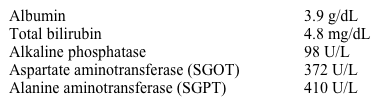 Coagulation studies
 Hepatitis panel
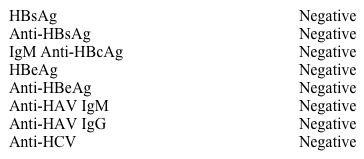 Liver biopsy demonstrates panlobular mononuclear infiltration and hepatic cell necrosis. Which of the following is the most likely diagnosis?
Coagulation studies
Hepatitis panel
Liver biopsy demonstrates panlobular mononuclear infiltration and hepatic cell necrosis. Which of the following is the most likely diagnosis? (Multiple Choice)
4.9/5 (102)
(102) A 29-year-old man comes to the emergency department due to a week of progressive bilateral lower extremity weakness. He has no history of trauma or back pain. The patient had trigeminal neuralgia 3 months ago and a self-limited upper respiratory illness 2 weeks ago. His temperature is 37 C (98.6 F), blood pressure is 122/76 mm Hg, and pulse is 82/min. Physical examination shows increased resistance to passive flexion and extension of the lower limbs. Deep tendon reflexes are 3+ and plantar reflexes are upgoing bilaterally. There is decreased vibratory and positional sensation in his left upper extremity but no other sensory loss. A lumbar puncture is performed. Which of the following is most likely found on the cerebrospinal fluid analysis in this patient?
(Multiple Choice)
4.9/5 (81)
(81) A 17-year-old girl comes to the office for evaluation of irregular menses. The patient reports irregular menses since menarche at age 13, and her menstrual cycle has become increasingly unpredictable. Over the past year, she has had 5 menstrual periods. Her most recent period was 6 weeks ago and it lasted 10 days, with heavy bleeding and large clots. The patient has also gained 10 kg (22 lb) over the last year and has been unable to lose weight despite changes in her diet. She has no medical problems and has had no surgeries. She does not use tobacco, alcohol, or illicit drugs. Blood pressure is 130/80 mm Hg and pulse is 76/min. BMI is 28 kg/m2. Physical examination shows coarse hair along the chin. There is no thyromegaly or palpable neck masses. The abdomen is soft and nontender, with no striae or palpable masses. Deep tendon reflexes of the extremities are normal, and no pedal edema is present. Hemoglobin is 10.2 g/dL. TSH and prolactin levels are normal. A urine pregnancy test is negative. Which of the following is the best next step for addressing this patient's irregular menses?
(Multiple Choice)
4.9/5 (73)
(73) A 45-year-old mildly overweight man recovering from an anterior wall myocardial infarction develops sharp, sudden-onset pain in the left side of his chest. The pain is worse with coughing and improves when sitting up and leaning forward. The patient came to the emergency department 3 days earlier with substernal chest pain and diaphoresis for 10 hours. He underwent coronary angiography with stent placement to the left anterior descending artery. The patient has had no dyspnea, palpitations, or extremity swelling since admission to the hospital. His medical history is significant for diabetes mellitus type 2. Blood pressure is 120/78 mm Hg, and pulse is 60/min. There is no change in blood pressure on deep inspiration. The patient seems mildly restless, especially in the supine position. His breathing is fast and shallow. The lungs are clear on auscultation. ECG is shown in the exhibit. Which of the following is the most likely diagnosis for this patient?
(Multiple Choice)
4.7/5 (75)
(75) A 54-year-old man comes to the office due to several months of increased fatigability. He drinks 2-3 cans of beer on the weekends and rarely eats meat. Physical examination reveals pale conjunctivae and hyperdynamic carotid pulses. Hemoglobin level is 7.7 g/dL, leukocytes are 4,500/mm3, and platelets are 170,000/mm3. Folic acid therapy is initiated. Four weeks later the patient's hemoglobin level is 9.1 mg/dL, but he has new tingling in his toes. Which of the following is a likely cause of this patient's current symptoms?
(Multiple Choice)
4.9/5 (87)
(87) A 45-year-old man is brought to the hospital due to confusion. His family had last seen him at lunch a few hours ago, and he was normal at that time. The patient has a history of schizoaffective disorder, Tourette syndrome, and polysubstance use disorder. Temperature is 38.5 C (101.3 F), blood pressure is 110/70 mm Hg, pulse is 120/min and regular, and respirations are 30/min. Oxygen saturation is 96% on room air. Pupils are 3 mm and reactive to light. Lungs are clear to auscultation. Epigastric tenderness is present, but there is no rebound or rigidity. The patient is not oriented to place or person. Neurologic examination shows no focal deficits. Deep tendon reflexes are normal. Laboratory results are as follows: 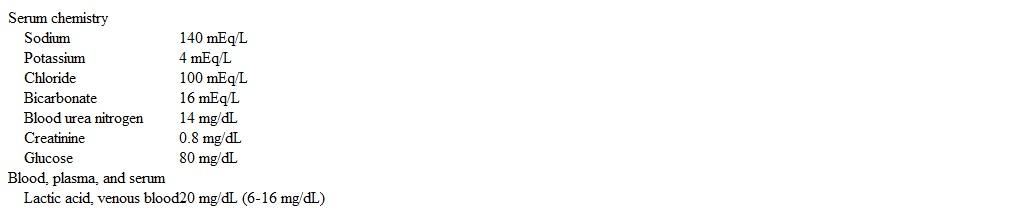 Which of the following is the next best step in the management of this patient?
 (Multiple Choice)
4.8/5 (81)
(81) A 65-year-old woman is brought to the physician due to 6 months of dry cough and worsening dyspnea. Her dyspnea has progressed so that she is now able to walk only a few steps. She has no fever, chest pain, or hemoptysis. Her only medication is hydrochlorothiazide for hypertension. The patient is a retired schoolteacher and does not use tobacco or alcohol. She has no pets and has never traveled abroad. Temperature is 37.2 C (99 F), blood pressure is 140/86 mm Hg, pulse is 84/min, and respirations are 18/min. Chest examination shows dry, late inspiratory crackles and digital clubbing. There is no peripheral edema. Serology is negative for antinuclear antibodies and antineutrophil cytoplasmic antibodies. Chest x-ray shows diffuse reticular opacities. A high-resolution computed tomography scan is shown below. 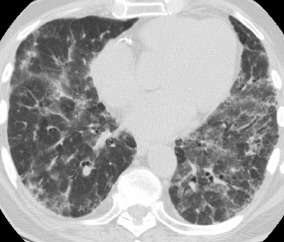 Which of the following abnormalities is most likely to be present in this patient?
 (Multiple Choice)
4.8/5 (71)
(71) Showing 1421 - 1440 of 1702
 Prev
- 1
- ...
- 2
- ...
- 3
- ...
- 4
- ...
- 5
- ...
- 6
- ...
- 7
- ...
- 8
- ...
- 9
- ...
- 10
- ...
- 11
- ...
- 12
- ...
- 13
- ...
- 14
- ...
- 15
- ...
- 16
- ...
- 17
- ...
- 18
- ...
- 19
- ...
- 20
- ...
- 21
- ...
- 22
- ...
- 23
- ...
- 24
- ...
- 25
- ...
- 26
- ...
- 27
- ...
- 28
- ...
- 29
- ...
- 30
- ...
- 31
- ...
- 32
- ...
- 33
- ...
- 34
- ...
- 35
- ...
- 36
- ...
- 37
- ...
- 38
- ...
- 39
- ...
- 40
- ...
- 41
- ...
- 42
- ...
- 43
- ...
- 44
- ...
- 45
- ...
- 46
- ...
- 47
- ...
- 48
- ...
- 49
- ...
- 50
- ...
- 51
- ...
- 52
- ...
- 53
- ...
- 54
- ...
- 55
- ...
- 56
- ...
- 57
- ...
- 58
- ...
- 59
- ...
- 60
- ...
- 61
- ...
- 62
- ...
- 63
- ...
- 64
- ...
- 65
- ...
- 66
- ...
- 67
- ...
- 68
- ...
- 69
- ...
- 70
- ...
- 71
- ...
- 72
- ...
- 73
- ...
- 74
- ...
- 75
- ...
- 76
- ...
- 77
- ...
- 78
- ...
- 79
- ...
- 80
- ...
- 81
- ...
- 82
- ...
- 83
- ...
- 84
- ...
- 85
- ...
- 86
- ...
- Next

Filters
- Essay(0)
- Multiple Choice(0)
- Short Answer(0)
- True False(0)
- Matching(0)