


 Chat with AI
Exam 1: Medicine

Exam 1: Medicine2 k Questions
Exam 2: Pediatric723 Questions
Exam 3: Psychiatry336 Questions
Exam 4: Surgery563 Questions
Exam 5: Obstetrics & Gynecology469 Questions
Select questions type


A 65-year-old woman comes to the clinic due to markedly decreased urine output for the past 24 hours. The patient underwent coronary angiography by the physician's colleague 5 days ago and was discharged the next day in stable condition. Medical conditions include type 2 diabetes mellitus, hypertension, and coronary artery disease. Temperature is 37 C (98.6 F), blood pressure is 140/92 mm Hg, pulse is 88/min, and respirations are 14/min. Laboratory results show creatinine of 3.4 mg/dL and blood urea nitrogen of 40 mg/dL. Acute tubular necrosis secondary to the contrast used during angiography is suspected. Review of the medical chart before and after the procedure reveals that the patient did not receive adequate hydration prior to angiography. The patient is very concerned and asks why she is unable to urinate. Which of the following is the most appropriate response?
(Multiple Choice)
4.9/5  (87)
(87) A 42-year-old man comes to the office for a routine medical evaluation. He has no known medical conditions but has not seen a health care provider in many years. The patient has had an intermittent, nonproductive cough and otherwise feels well. He takes no medications, drinks alcohol occasionally, and does not use tobacco or illicit drugs. Vital signs are within normal limits. Physical examination shows no scleral icterus or mucosal pallor. The lungs are clear on auscultation and heart sounds are normal. The liver edge is palpable 3 cm below the right costal margin, and the spleen tip is palpable below the left costal margin. There is no skin rash or extremity edema. Laboratory results are as follows: 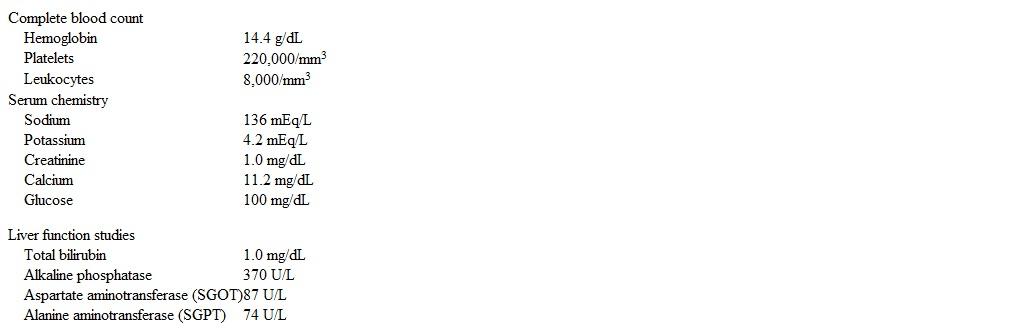 Chest x-ray shows mediastinal fullness and bilateral reticulonodular opacities, mostly involving the upper lungs. Which of the following is the most likely underlying cause of this patient's liver disease?
 (Multiple Choice)
4.9/5 (83)
(83) A 72-year-old man is brought to the office by his niece due to medication nonadherence. The patient has type 2 diabetes mellitus that had been well controlled with a basal-bolus insulin regimen, but recently he has not been taking his insulin regularly and his home glucometer readings have been high. In the past, he self-administered his insulin without difficulty, but now he no longer knows how to draw up his insulin or inject it. The patient's niece says he has been "letting things go" around the house since his wife's death from cancer 3 years ago. He is also reluctant to leave the house after a fall several months prior, and his family has had to help him with grocery shopping and other common errands. On physical examination, the patient appears unkempt and his clothes smell of urine. The lungs are clear on auscultation and heart sounds are normal. The abdomen is soft and nontender. Neurological examination reveals absence of bilateral ankle reflexes, and the patient's gait is slow with a wide base. Brief cognitive assessment shows short-term memory impairment. Hemoglobin A1c is 10.2%. Which of the following is the best next step in the management of this patient?
(Multiple Choice)
4.8/5 (79)
(79) A group of researchers conducted a randomized, double-blind, placebo-controlled trial to study the effectiveness of mercaptopurine and Lactobacillus to prevent recurrence of Crohn disease after surgical resection. Six-hundred patients were randomly assigned to daily mercaptopurine, Lactobacillus, or placebo (ratio: 1:1:1) and followed up for 3 years. Clinical recurrence of Crohn disease was determined based on the Crohn Disease Activity Index (CDAI), with a score >150 indicating recurrence. The primary endpoint was a significant increase in the CDAI (defined as a 100-point increase in score, with CDAI >150) and the need for anti-inflammatory rescue treatment or primary surgical intervention. An excerpt of the study results is shown below.  The researchers decide to focus their attention on the effectiveness of mercaptopurine in preventing clinical recurrence events after surgical resection within 3 years compared with placebo. They estimate the number needed to treat to be 10. Which of the following is the correct interpretation of this value?
 (Multiple Choice)
4.9/5 (89)
(89) A 52-year-old man comes to the emergency department with pain and swelling of his right knee for the last 24 hours. He has not traveled recently and has no recent history of injury or gastrointestinal or genitourinary infection. The patient was diagnosed with pulmonary sarcoidosis 5 years ago when he developed hilar lymphadenopathy and interstitial lung disease. His sarcoidosis responded to treatment with glucocorticoids and went into remission. He has been disease-free for the past 4 years. The patient also has a 10-year history of type 2 diabetes mellitus, hypercholesterolemia, and hypertension. Blood pressure is 140/86 mm Hg and pulse is 90/min. BMI is 34 kg/m2. Physical examination is notable for a moderate-size effusion of the right knee with surrounding erythema and warmth. The knee joint is aspirated. Microscopic examination of the fluid is shown in the image below. 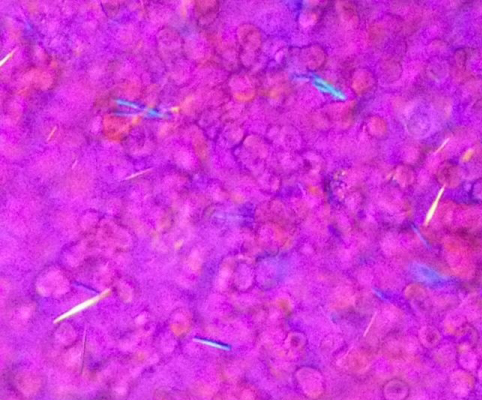 Which of the following is the most likely etiology of this patient's joint effusion?
 (Multiple Choice)
4.8/5 (97)
(97) A 59-year-old man comes to the office for follow-up after a recent acute myocardial infarction. Three months ago, the patient was hospitalized with chest pain and was found to have subtotal occlusion of the mid-left anterior descending artery, which was treated with a drug-eluting stent. He currently has no chest pain, shortness of breath, or palpitations. Medical history is significant for hypertension. His father had a myocardial infarction at age 55. The patient currently takes aspirin, ticagrelor, metoprolol, and lisinopril; he was prescribed high intensity rosuvastatin therapy but stopped taking it a month ago due to muscle aches. Blood pressure is 122/73 mm Hg, and pulse is 65/min and regular. BMI is 28 kg/m2. Physical examination is unremarkable. Lipid panel results are as follows:  Which of the following is the best recommendation for lipid management in this patient?
 (Multiple Choice)
4.8/5 (79)
(79) A 32-year-old woman comes to the office for a regularly scheduled follow-up visit. She has mild fatigue but no other symptoms. Medical history is significant for generalized seizures controlled with chronic phenytoin therapy. Her last seizure was 6 months ago. She does not use tobacco, alcohol, or illicit drugs. She is afebrile and vital signs are within normal limits. Examination shows mild gingival hyperplasia and pallor. There is no jaundice or lymphadenopathy. Cardiopulmonary examination is normal. The abdomen is soft and nontender with no hepatosplenomegaly. Laboratory results are as follows:  Supplementation with which of the following could have prevented this patient's condition?
 (Multiple Choice)
5.0/5 (72)
(72) A 22-year-old man comes to the office due to several small, pruritic skin pustules on his lower extremities. The patient first noticed the lesions a week ago during a trip to New Mexico, where he hiked in the mountains and swam in a heated hotel pool. He was given trimethoprim-sulfamethoxazole at an urgent care center, but the pustules have persisted despite taking the medication as prescribed for 3 days. The patient has no chronic medical conditions and takes no other medications. Temperature is 37.9 C (100.2), blood pressure is 132/68 mm Hg, and pulse is 96/min. Examination shows several small, tender papulopustules on the bilateral lower extremities. Which of the following pathogens is the most likely cause of this patient's symptoms?
(Multiple Choice)
4.9/5 (87)
(87) A 16-year-old boy is brought to the emergency department after loss of consciousness. The patient was riding his bicycle when he lost his balance and fell, hitting his head on the ground. The fall was witnessed by several friends who report that the boy lost consciousness for approximately 1 minute. There were no seizures following the event. The boy vomited twice in the ambulance and has a mild headache. He has no other medical conditions and takes no medications. Blood pressure is 121/67 mm Hg and pulse is 78/min. The patient is awake and alert. Examination shows a small bruise and an abrasion over the right temporal region. Neurological examination shows intact cranial nerves. Strength is 5/5 bilaterally. Sensations are intact and reflexes are equal. Gait examination shows no abnormalities. Romberg test is negative. Which of the following is the most appropriate next step in management of this patient?
(Multiple Choice)
4.9/5 (82)
(82) A 33-year-old woman comes to the office due to blistering on the backs of her hands. She has had occasional blisters in the past, but numerous lesions appeared last week after she spent some time outdoors gardening. The lesions are not painful but are associated with mild itching. The patient says her skin is also fragile and trivial trauma has caused superficial erosions that heal with scarring. She occasionally drinks alcohol but does not use tobacco. The patient used injection drugs in the past but stopped after being diagnosed with hepatitis C infection 8 years ago. She has not yet received treatment for hepatitis, and her only medication is a daily oral contraceptive. Vital signs are within normal limits. Physical examination shows several vesicles and erosions on the dorsum of both hands. Some of the lesions are healing with crusts and scars. Which of the following is the most likely underlying cause of this patient's skin lesions?
(Multiple Choice)
4.7/5 (77)
(77) A 68-year-old woman comes to the office for follow-up after a recent emergency department visit. Two weeks ago, the patient experienced palpitations and mild dizziness; ECG showed atrial fibrillation with rapid ventricular response. The episode resolved spontaneously in 2 hours, and she has had no symptoms since then. The patient has a history of hypertension treated with valsartan and hydrochlorothiazide. She is a lifetime nonsmoker and does not drink alcohol. Her exercise tolerance is good. Blood pressure is 128/72 mm Hg, and pulse is 74/min and regular. Physical examination is unremarkable. TSH is 1.6, creatinine is 1.1 mg/dL, and fasting glucose is 85 mg/dL. Echocardiography shows preserved left ventricular ejection fraction and no significant valvular abnormalities. Which of the following is the best next step in management of this patient?
(Multiple Choice)
4.9/5 (79)
(79) A 38-year-old woman comes to the emergency department due to a 3-day history of left arm and leg numbness. She also reports urinary urgency and incontinence but has no fever or dysuria. The patient was diagnosed with multiple sclerosis 10 years ago after an episode of right eye vision loss. She was taking disease-modifying therapy but stopped after being symptom-free for several years. Temperature is 37 C (98.6 F), blood pressure is 130/80 mm Hg, and pulse is 88/min. Sensation to light touch and pin prick is diminished on the left side. Neuroimaging reveals new areas of demyelination compared to previous MRIs. Which of the following is the most appropriate next step in management of this patient?
(Multiple Choice)
4.8/5 (85)
(85) A 23-year-old man comes to the urgent care center due to a knee injury 2 days ago. He was playing basketball when he was hit on the left side by an opposing player while running. The patient attempted to continue playing, but his left knee felt tight and he had to sit out the rest of the game. Over the last 2 days, the pain has been persistent and only partially relieved with ice and ibuprofen. He also has been using a knee brace for improved stability. Examination shows mild soft-tissue swelling of the left knee without a significant joint effusion. There is tenderness at the medial joint line but no locking or catching. Range of motion of the knee is near normal. Abduction (valgus) stress test shows some left knee laxity but is limited by pain. X-ray of the knee is normal. Which of the following is the most likely diagnosis in this patient?
(Multiple Choice)
4.9/5 (86)
(86) A 69-year-old man comes to the emergency department due to severe occipital headache, nausea, and vomiting for the last 3 hours. He has never had a headache like this before and has otherwise been in good physical condition. The patient was told several years ago that he has high blood pressure, but he has not been taking any medications or seen any health care providers. He has smoked half a pack of cigarettes daily for 40 years and drinks 1 or 2 cans of beer every evening. Both of his parents died of natural causes. Blood pressure is 160/90 mm Hg and pulse is 86/min and regular. His noncontrast head CT scan is shown in the image below. 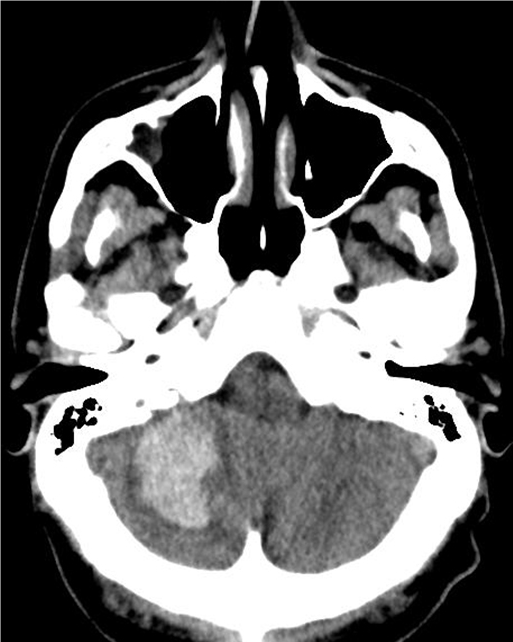 Which of the following physical examination findings is most likely to be seen in this patient?
 (Multiple Choice)
4.8/5 (93)
(93) A 52-year-old woman comes to the clinic with gradual-onset weakness of the leg muscles. For several months, she has had increasing difficulty climbing stairs and rising from a chair. The patient initially attributed her symptoms to being "out of shape." She has no problem chewing food, changes in bowel or bladder function, morning stiffness, or joint pain. Medications include lisinopril and amlodipine for hypertension. She does not use tobacco, alcohol, or illicit drugs. Vital signs are normal. Examination shows 4/5 strength in the thigh muscles of both legs, and distal muscle strength is 5/5. Repeated muscle contractions do not alter the weakness. Mild tenderness is noted in the proximal thigh muscles. Deep tendon reflexes and sensory examination are normal, and Babinski sign is absent. Which of the following would establish a diagnosis in this patient?
(Multiple Choice)
4.9/5 (93)
(93) A 54-year-old man comes to the office due to left foot pain. The patient has had progressively worsening pain for the last month since starting a walking program to help lose weight. He has been walking 2-3 miles each morning and has pain and a stabbing sensation in the sole of his left foot at the end of the walks. The pain usually improves with rest and typically does not recur during normal activity. The patient has used ibuprofen and ice for pain relief. He has type 2 diabetes mellitus; his most recent hemoglobin A1c was 7.9%. Medical history is also notable for appendectomy, cholecystectomy, and bilateral carpal tunnel release. Vital signs are normal. BMI is 36 kg/m2. The left foot has a normal arch. When the toes are dorsiflexed, there is tenderness to palpation between the heel and forefoot. There is no pain with firm palpation along the back or sides of the heel. Sensation and range of motion are normal. Which of the following is the most likely cause of this patient's pain?
(Multiple Choice)
4.8/5 (67)
(67) A 35-year-old woman comes to the office due to a weeklong history of rash in the bilateral axilla. The rash is not painful and does not itch. Two weeks ago, the patient fractured her right ankle while jogging and has since ambulated with crutches. Medical history includes prediabetes. She smokes a pack of cigarettes a day. Her only medication is acetaminophen with codeine as needed for ankle pain. BMI is 33 kg/m2. Vital signs are normal. On examination, many red papules and pustules are present in both axillae. There is no axillary lymphadenopathy or mass. The remainder of the skin examination is normal. Which of the following most likely contributed to this patient's skin condition?
(Multiple Choice)
4.8/5 (88)
(88) A 60-year-old woman comes to the emergency department due to a sudden onset of severe pain in her left eye with blurred vision, nausea, and vomiting. The symptoms began a few minutes ago, while she was watching a movie in a nearby theater. Her temperature is 36.8C (98.4F), blood pressure is 140/90 mm Hg, pulse is 82/min, and respirations are 14/min. Examination reveals decreased visual acuity. Her left eye appears red, with a hazy cornea, shallow anterior chamber, and dilated, fixed pupil. Her left eye is stony hard to touch. What is the most likely diagnosis?
(Multiple Choice)
4.9/5 (67)
(67) A 29-year-old woman comes to the office due to a 6-month history of numbness and pain in her arms. The pain is worse on the left and is exacerbated by lifting or other activities. Associated symptoms include fatigue, fleeting joint pains, and a 5-kg (11-lb) weight loss. Medical history is unremarkable, and the patient does not use tobacco or illicit drugs. She emigrated from Vietnam 5 years ago and works in a furniture repair shop. Blood pressure is 140/90 mm Hg in the right arm and 90/55 mm Hg in the left; pulse is 78/min and regular. Conjunctival and oral mucosae are moist and without lesions. Cardiopulmonary examination shows clear lung fields and no heart murmurs; however, a bruit is heard in the left supraclavicular fossa, and the left radial and brachial pulses are decreased. Abdominal examination is unremarkable. No skin lesions are present. Complete blood count, electrolytes, urinalysis, and renal function are normal. Erythrocyte sedimentation rate is 80 mm/hr. Which of the following is the most likely diagnosis for this patient?
(Multiple Choice)
4.9/5 (75)
(75) A 38-year-old woman is brought to the emergency department after a witnessed seizure. Earlier that day, she participated in a high-altitude marathon. She had no symptoms before the race, but toward the end she began to feel severely nauseated. Following the race, she vomited twice and then had a generalized tonic-clonic seizure. She reported no headache. The patient has no significant medical history. Her trainer insists that she had hydrated aggressively before, during, and after the race. He is quite certain that the only medicine she had taken in the past 24 hours was ibuprofen for aches and pains. In the emergency department, she is afebrile, blood pressure is 110/70 mm Hg, pulse is 100/min, and respirations are 18/min. Pulse oximetry is 98% on room air. Pupils are equal and reactive to light. The neck is supple. The patient is quite confused and does not fully cooperate with a neurological examination, but withdraws all 4 extremities to noxious stimuli. Laboratory results are as follows: Which of the following is the most likely cause of this patient's current condition?
(Multiple Choice)
4.9/5 (75)
(75) Showing 61 - 80 of 1702
 Prev
- 1
- ...
- 2
- ...
- 3
- ...
- 4
- ...
- 5
- ...
- 6
- ...
- 7
- ...
- 8
- ...
- 9
- ...
- 10
- ...
- 11
- ...
- 12
- ...
- 13
- ...
- 14
- ...
- 15
- ...
- 16
- ...
- 17
- ...
- 18
- ...
- 19
- ...
- 20
- ...
- 21
- ...
- 22
- ...
- 23
- ...
- 24
- ...
- 25
- ...
- 26
- ...
- 27
- ...
- 28
- ...
- 29
- ...
- 30
- ...
- 31
- ...
- 32
- ...
- 33
- ...
- 34
- ...
- 35
- ...
- 36
- ...
- 37
- ...
- 38
- ...
- 39
- ...
- 40
- ...
- 41
- ...
- 42
- ...
- 43
- ...
- 44
- ...
- 45
- ...
- 46
- ...
- 47
- ...
- 48
- ...
- 49
- ...
- 50
- ...
- 51
- ...
- 52
- ...
- 53
- ...
- 54
- ...
- 55
- ...
- 56
- ...
- 57
- ...
- 58
- ...
- 59
- ...
- 60
- ...
- 61
- ...
- 62
- ...
- 63
- ...
- 64
- ...
- 65
- ...
- 66
- ...
- 67
- ...
- 68
- ...
- 69
- ...
- 70
- ...
- 71
- ...
- 72
- ...
- 73
- ...
- 74
- ...
- 75
- ...
- 76
- ...
- 77
- ...
- 78
- ...
- 79
- ...
- 80
- ...
- 81
- ...
- 82
- ...
- 83
- ...
- 84
- ...
- 85
- ...
- 86
- ...
- Next

Filters
- Essay(0)
- Multiple Choice(0)
- Short Answer(0)
- True False(0)
- Matching(0)