


 Chat with AI
Exam 1: Medicine

Exam 1: Medicine2 k Questions
Exam 2: Pediatric723 Questions
Exam 3: Psychiatry336 Questions
Exam 4: Surgery563 Questions
Exam 5: Obstetrics & Gynecology469 Questions
Select questions type


A 67-year-old woman comes to the office due to progressive fatigue and anorexia over the last 6 months. She has lost 4 kg (8.8 lb), which she attributes to early satiety. She has had no abdominal pain, night sweats, or fevers. The patient's past medical history is significant for hypothyroidism, hypertension, and gout. She does not use tobacco, alcohol, or illicit drugs and is compliant with her medications. Temperature is 37.3 C (99.2 F), blood pressure is 128/82 mm Hg, and pulse is 88/min. The patient is slightly thin but well nourished. Mild mucosal pallor is present. There is no lymphadenopathy in the cervical or supraclavicular chains. Cardiopulmonary examination is normal. A spleen tip is palpable with deep exhalation. Laboratory results are as follows: 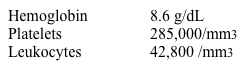 Florescence in situ hybridization reveals an abnormality in chromosome 22. Which of the following is the most important target in treating this patient's disease?
 (Multiple Choice)
4.8/5  (68)
(68) A 55-year-old man comes to the emergency department due to 2 days of fever, chills, and productive cough. Over the past 4 months, he has had 2 episodes of pneumonia, both of which resolved completely with antibiotics. He smoked a pack of cigarettes per day for 30 years but quit following the second bout of pneumonia. The patient's only other medical problem is hypertension. Temperature is 38.9 C (102 F), blood pressure is 130/86 mm Hg, pulse is 98/min, and respirations are 18/min. Oxygen saturation is 94% on room air. Crackles and increased breath sounds are present over the right lower lung field. Leukocyte count is 14,200/mm3 and blood urea nitrogen is 12 mg/dL. Chest x-ray reveals right lower lobe consolidation. Antibiotics are administered. On follow-up 5 days later, the patient describes improvement in his cough and fever. Crackles are still present at the right lung base. Review of chest x-rays obtained during the previous episodes of pneumonia reveals a consolidation in the right lower lung segment, same as found in the current episode. Which of the following is the most appropriate next step in management of this patient?
(Multiple Choice)
4.9/5 (72)
(72) Showing 1701 - 1702 of 1702
 Prev
- 1
- ...
- 2
- ...
- 3
- ...
- 4
- ...
- 5
- ...
- 6
- ...
- 7
- ...
- 8
- ...
- 9
- ...
- 10
- ...
- 11
- ...
- 12
- ...
- 13
- ...
- 14
- ...
- 15
- ...
- 16
- ...
- 17
- ...
- 18
- ...
- 19
- ...
- 20
- ...
- 21
- ...
- 22
- ...
- 23
- ...
- 24
- ...
- 25
- ...
- 26
- ...
- 27
- ...
- 28
- ...
- 29
- ...
- 30
- ...
- 31
- ...
- 32
- ...
- 33
- ...
- 34
- ...
- 35
- ...
- 36
- ...
- 37
- ...
- 38
- ...
- 39
- ...
- 40
- ...
- 41
- ...
- 42
- ...
- 43
- ...
- 44
- ...
- 45
- ...
- 46
- ...
- 47
- ...
- 48
- ...
- 49
- ...
- 50
- ...
- 51
- ...
- 52
- ...
- 53
- ...
- 54
- ...
- 55
- ...
- 56
- ...
- 57
- ...
- 58
- ...
- 59
- ...
- 60
- ...
- 61
- ...
- 62
- ...
- 63
- ...
- 64
- ...
- 65
- ...
- 66
- ...
- 67
- ...
- 68
- ...
- 69
- ...
- 70
- ...
- 71
- ...
- 72
- ...
- 73
- ...
- 74
- ...
- 75
- ...
- 76
- ...
- 77
- ...
- 78
- ...
- 79
- ...
- 80
- ...
- 81
- ...
- 82
- ...
- 83
- ...
- 84
- ...
- 85
- ...
- 86
- ...
- Next

Filters
- Essay(0)
- Multiple Choice(0)
- Short Answer(0)
- True False(0)
- Matching(0)