


 Chat with AI
Exam 1: Medicine

Exam 1: Medicine2 k Questions
Exam 2: Pediatric723 Questions
Exam 3: Psychiatry336 Questions
Exam 4: Surgery563 Questions
Exam 5: Obstetrics & Gynecology469 Questions
Select questions type


A 74-year-old woman is brought to the office by her daughter due to behavioral changes. Over the past month, the patient has become more withdrawn. She no longer watches her favorite television shows and seems less interested in her family. The daughter has noticed increasing forgetfulness over the past 3 years but assumed it "comes with aging." Over the past year, the patient has stopped doing the daily crossword, has had difficulty remembering to eat and clean herself, and has occasionally failed to recognize her grandchildren. Montreal Cognitive Assessment is 22/30 (normal: ≥26). Serum TSH and vitamin B12 levels are normal. Which of the following is the most appropriate next step in management of this patient?
(Multiple Choice)
4.9/5  (85)
(85) A 65-year-old woman is brought to the emergency department due to altered mental status. Her family notes that she awoke in the morning with a headache and became progressively incoherent over the course of the day. The day before, she had nausea and vomited several times during the day. Three weeks ago, the patient was diagnosed with depression and started on sertraline. Her only other medical problem is rheumatoid arthritis, which was diagnosed a year ago and is well controlled with adalimumab. She takes no other medications, supplements, or herbs. She is afebrile. Blood pressure is 110/70 mm Hg without an orthostatic drop, pulse is 75/min, and respirations are 15/min. She is disoriented and irritable. Neck is supple. Neurologic examination is otherwise unremarkable. There is no papilledema. Mucous membranes are moist. There is no jugular venous distension. Lungs are clear to auscultation. Abdomen is soft, nontender, and nondistended. There is no peripheral edema. Laboratory results are as follows:  Serum osmolality is 260 mOsm/kg H2O, urine osmolality is 500 mOsm/kg H2O, and urine sodium is 56 mmol/L. What is the most likely cause of this patient's hyponatremia?
 (Multiple Choice)
4.8/5 (88)
(88) A 24-year-old man is brought to the office by his parents due to hand shaking and involuntary movements, which have progressively worsened over the last 6 months. A year ago, he was diagnosed with depression and treated with fluoxetine for 5 months but stopped the medication and did not follow up with his psychiatrist. His medical history is otherwise unremarkable. The patient has smoked cigarettes intermittently in the past but does not drink alcohol or use illicit drugs. He dropped out of college and has worked as a delivery man for the last several years. Blood pressure is 122/82 mm Hg supine and 120/84 mm Hg standing. Physical examination reveals clear breath sounds and no cardiac murmurs. The liver is enlarged, firm, and nontender, and the spleen is not palpable. There is tremor of both hands that increases with activity. Occasional rapid, jerky contractions of the distal extremities are also seen. Laboratory results are as follows:  Viral hepatitis panel is negative. Which of the following is the most likely diagnosis?
 (Multiple Choice)
4.7/5 (81)
(81) A 65-year-old man comes to the office with a 1-year history of erectile dysfunction and decreased libido. He has hypertension that was diagnosed 5 years ago and is controlled with diet. The patient has no history of cardiac problems, unexpected weight loss, visual changes, or symptoms of neuropathy. Family history is unremarkable. On examination, there is minimal bilateral gynecomastia without galactorrhea. Genitourinary examination shows decreased testicular size. The remainder of the physical examination, including visual fields on confrontation, is unremarkable. Laboratory results are as follows: 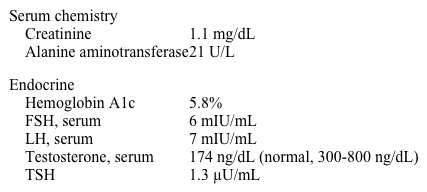 Repeat early-morning testosterone level is 162 ng/dL. Which of the following is the best next step in management of this patient?
 (Multiple Choice)
4.8/5 (87)
(87) A 28-year-old nulliparous woman comes to the office due to malodorous vaginal discharge for the last month. The patient has tried various over-the-counter vaginal douche products with no improvement. Her last menstrual period was 2 weeks ago, and she noticed no change in her symptoms during that time. In addition to the discharge, the patient has had intermittent, crampy abdominal pain and sometimes feels like gas is passing through her vagina. The patient has had no surgeries. Vital signs are normal. Speculum examination shows a malodorous, tan vaginal discharge and a patch of erythema on the posterior vaginal wall. The cervix is nulliparous and has no visible lesions or areas of friability. A sinus with purulent drainage is also present in the perianal skin. Which of the following is the most likely underlying cause of this patient's presentation?
(Multiple Choice)
4.7/5 (101)
(101) A 35-year-old man comes to the emergency department after stepping on a nail that punctured his right sole while jogging at a park. He brought the nail, which is about 4 cm long and rusty, with him. The patient's medical history is unremarkable and he takes no medications. He received a 3-dose primary tetanus vaccination series in childhood but has not received any booster doses since then. Vital signs are within normal limits. Physical examination shows a puncture wound at the middle of the right plantar area with some dry blood and tenderness. There is no surrounding erythema. Radiographs of the right foot reveal no bony injury or foreign body. The wound is cleaned with iodine solution. Which of the following additional interventions for tetanus prevention is most appropriate in this patient?
(Multiple Choice)
4.8/5 (78)
(78) A 23-year-old man comes to the emergency department due to sudden-onset fatigue and dark urine. The patient was recently diagnosed with dermatitis herpetiformis. He began treatment with dapsone and a gluten-free diet 3 days ago. This morning, the patient felt weak and had difficulty getting out of bed. His urine also appeared dark. Temperature is 36.8 C (98.2 F), blood pressure is 130/76 mm Hg, pulse is 88/min, and respirations are 14/min. The patient appears tired. Examination shows scleral icterus and pale lips. There is a papular rash along the scalp, elbows, and knees with overlying excoriation. Laboratory evaluation reveals the following:  Which of the following is the most likely mechanism for this patient's urinary findings?
 (Multiple Choice)
4.9/5 (61)
(61) A 57-year-old man comes to the physician for 2 episodes of blood in his urine. He also complains of fatigue and fever for the last 4 weeks. He has no other medical problems and takes no medications. The patient has a 50-pack-year smoking history but does not use alcohol or illicit drugs. His father died from a blood disorder, but the patient is unsure of the specific name. Vital signs are within normal limits. Examination shows a left-sided varicocele that fails to empty when the patient is recumbent. The remainder of the examination shows no abnormalities. Laboratory results are as follows:
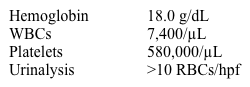 Which of the following is the most appropriate diagnostic procedure?
 (Multiple Choice)
4.8/5 (81)
(81) Which of the following is the primary cause of this patient's acid-base disturbance?
(Multiple Choice)
4.7/5 (78)
(78) A new test has been devised to detect lung carcinoma. The levels of the enzyme corresponding to diseased states are being determined. A random number of smokers are sorted (ie, with and without lung carcinoma) and the corresponding enzyme levels are determined. 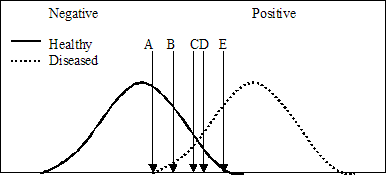 At what cut-off value (ie, enzyme level) will the number of false negatives be the highest?
 (Multiple Choice)
4.8/5 (79)
(79) A 64-year-old man comes to the office for evaluation of persistent cough and worsening dyspnea over the last 6 months. The cough is dry, nagging, and present throughout the day. He reports mild dyspnea with exertion, which has become increasingly bothersome. The patient has no chest pain, syncope, orthopnea, or paroxysmal nocturnal dyspnea. He had an inferior wall myocardial infarction due to right coronary artery occlusion 5 years ago and was treated with a drug-eluting stent. The patient's other medical concerns include a hiatal hernia and hypertension. Medications include aspirin, losartan, atorvastatin, and ranitidine. Temperature is 36.8 C (98.2 F), blood pressure is 130/78 mm Hg, pulse is 82/min, and respirations are 15/min. Pulse oximetry is 97% on room air. Head and neck examination is normal. Jugular venous pressure is normal. There are no murmurs, extra sounds, or gallops. Fine, dry inspiratory crackles are heard in the lower lung zones. Diaphragm excursion is normal and symmetric. There is no peripheral edema. Chest x-ray is normal. What is the most appropriate next step in immediate management?
(Multiple Choice)
4.9/5 (88)
(88) A 66-year-old man comes to the office due to increasing pain in his left arm. The patient works as a furniture transporter and initially attributed the pain to a muscular strain, but it has slowly worsened and stopped responding to over-the-counter pain medications. The pain started 3 months ago and is mainly near the left elbow. He also notes back pain. He has not had fever or chills. His other medical problems include hypertension and hypercholesterolemia. The patient has never smoked. Temperature is 36.8 C (98.2 F), blood pressure is 132/86 mm Hg, pulse is 88/min, and respirations are 14/min. He appears comfortable. His mucous membranes are pale. There is no lymphadenopathy. Cardiopulmonary examination is normal. The abdomen is soft without organomegaly. The prostate is smooth, nontender, and moderately enlarged. Neurologic examination is unremarkable. Laboratory results are as follows:  X-ray of the left arm is shown in the exhibit.
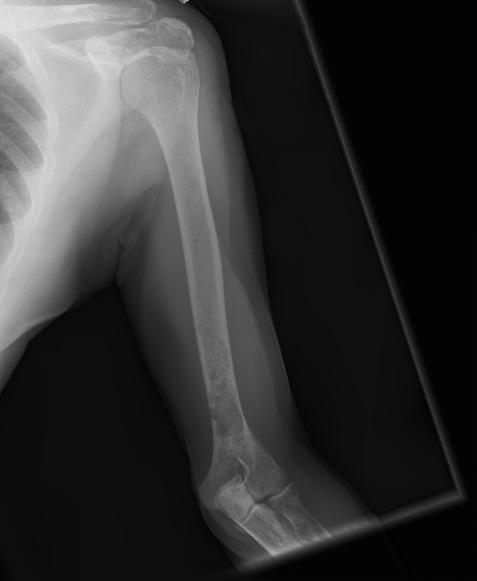 Which of the following tests would be the most useful next step in the management of this patient?
X-ray of the left arm is shown in the exhibit.
Which of the following tests would be the most useful next step in the management of this patient? (Multiple Choice)
4.9/5 (74)
(74) A 43-year-old man comes to the office due to frequent epigastric burning not relieved by antacids for the past 4 months. The sensation is typically brought on by heavy lifting at work and takes 10-15 minutes to go away. The patient has had no associated arm or neck pain, cough, shortness of breath, or difficulty swallowing. His medical history is significant for systemic lupus erythematosus diagnosed 5 years ago, for which he takes low-dose prednisone and hydroxychloroquine. He is a lifetime nonsmoker. A year ago, the patient's wife was diagnosed with peptic ulcer disease that required treatment with antibiotics. On physical examination, blood pressure is 140/90 mm Hg and pulse is 80/min and regular. Breath sounds are equal on both sides. No wheezes or crackles are heard. First and second heart sounds are present. No heart murmurs or rubs are noted. The abdomen is soft and nontender to deep palpation. There is no skin rash or peripheral edema. ECG is normal. Which of the following is the best next step in management of this patient?
(Multiple Choice)
4.9/5 (82)
(82) A 35-year-old woman comes to the office for follow-up on genetic testing for Lynch syndrome. She has no symptoms or medical problems and has never had surgery. A Papanicolaou test was normal last month. The patient takes a daily multivitamin and no other medications. She does not use contraception as she has not been sexually active since separating from her husband last year. The patient's mother, age 54, is receiving chemotherapy for colon carcinoma. Her maternal uncle was diagnosed with colon cancer at age 49, but it is in remission; her first cousin died of colon cancer at age 36. In addition to colon cancer, the patient is at greatest risk for which of the following conditions?
(Multiple Choice)
4.9/5 (86)
(86) A 20-year-old woman comes to the office for a routine employment physical examination. She reports no symptoms, and her medical history includes no significant conditions. The patient has good exercise tolerance and does not take any medications or use illicit drugs. Her blood pressure is 125/65 mm Hg and pulse is 80/min. Cardiac auscultation reveals an early diastolic murmur at the left sternal border that is best heard with expiration. Carotid pulses are normal bilaterally, and there are no bruits. ECG shows normal sinus rhythm without any significant abnormalities. What is the best next step in management of this patient?
(Multiple Choice)
4.9/5 (97)
(97) A 62-year-old man is brought to the emergency department due to left-sided weakness, numbness, and difficulty speaking. He was walking his dog about an hour ago when he developed sudden-onset weakness of the left arm. The patient did not lose consciousness. He has hypertension and type 2 diabetes mellitus but no other medical or surgical history. Blood pressure is 170/96 mm Hg, and pulse is 76/min and regular. On examination, his speech is dysarthric and he has left facial droop. The patient's left upper extremity muscle strength is 2/5 and left lower extremity strength is 5/5. Left hemisensory loss is present. He has impaired attention and lack of awareness for stimuli on the left side of space. Finger-stick glucose level is 270 g/dL, and noncontrast CT scan of the head reveals no abnormalities. Recent laboratory studies performed at his primary care provider's office show serum LDL of 152 mg/dL and hemoglobin A1c of 7.9%. Which of the following therapies is the best next step in management of this patient?
(Multiple Choice)
4.9/5 (82)
(82) A 36-year-old woman, gravida 0 para 0, comes to the office with frequent headaches and amenorrhea for the last 2 months. The patient has also had weight loss, intermittent palpitations, and vague visual disturbances. Her medical history is unremarkable, and she takes no medications. The patient experienced menarche at age 12 and has had normal menstrual cycles all her life. She does not smoke cigarettes or drink alcohol. Blood pressure is 130/60 mm Hg, and pulse is 103/min and regular. Weight is 69 kg (152 lb); a year ago it was 76 kg (168 lb). Examination shows a symmetrically enlarged, nontender thyroid gland. Auscultation of the chest shows tachycardia with regular heart rhythm. A fine hand tremor is noted. The remainder of the physical examination is unremarkable. Laboratory results are as follows: Which of the following is the most likely diagnosis for this patient?
(Multiple Choice)
5.0/5 (77)
(77) A 42-year-old man is admitted to the hospital due to fever and shortness of breath. He has chronic hepatitis C, HIV, and alcohol-induced cardiomyopathy. Temperature is 38.6 C (101.5 F). Thrush is present in the oropharynx. Chest x-ray reveals right lower lobe consolidation. He is started on fluconazole and moxifloxacin. The patient's pneumonia and thrush improve over the next 2 days. However, he develops palpitations on the third day of hospitalization. His ECG strip is shown in the exhibit. Which of the following is the most appropriate next step in the management of this patient?
(Multiple Choice)
4.9/5 (72)
(72) A 62-year-old man with a past medical history of bladder cancer and recurrent hematuria comes to the emergency department after "passing out." The patient was standing up to urinate shortly after waking when he felt dizzy. He was able to return to his bed before losing consciousness for several minutes. The patient's electrocardiogram (ECG) at the time of admission is shown in the Exhibit. 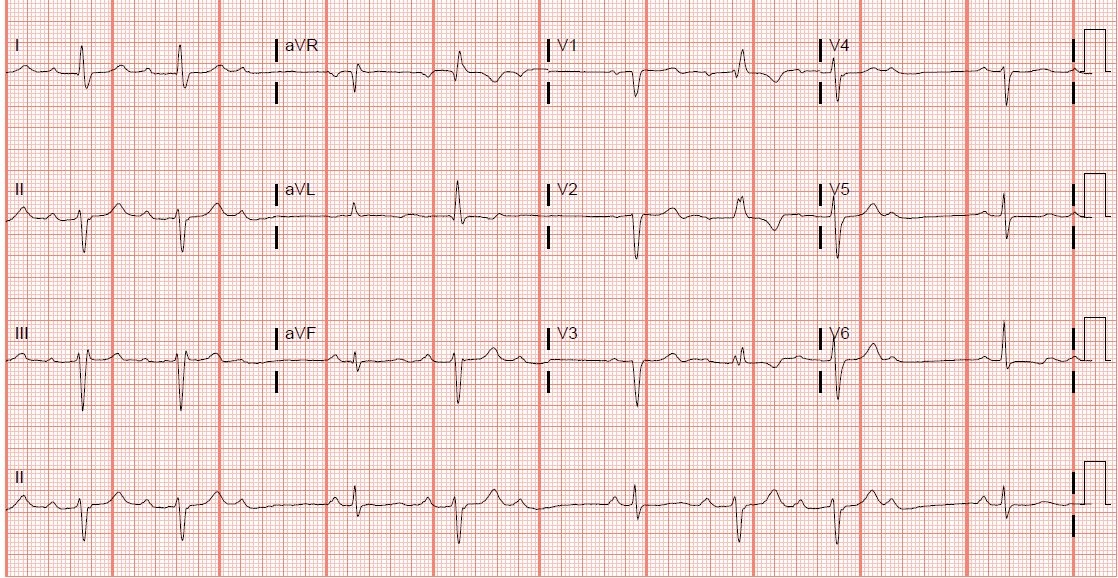 Which of the following most likely accounts for the observed ECG changes?
 (Multiple Choice)
4.9/5 (63)
(63) A 79-year-old woman comes to the office for her yearly checkup. She reports feeling well physically but mentions some sleep issues. The patient used to sleep 8-9 hours a night. Now, she wakes up in the middle of the night and arises an hour earlier than she used to, around 5:30 AM. She has little difficulty falling asleep and does so most evenings while sitting and watching television. She gets a total of 6½ to 7 hours of sleep and often awakens 1 or 2 times to go to the bathroom, returning to sleep within 10-15 minutes. The patient's husband says that she snores softly but reports no breathing pauses, gasping, or choking. During daytime hours, the patient has energy in the morning but often takes a 30- to 45-minute nap in the afternoon. She reports no persistent anxiety or depression. She has a good appetite and is able to follow television programs, concentrate on crossword puzzles, and likes to go out with friends in the morning. Medical conditions include osteoporosis and arthritis. Medications include alendronate and ibuprofen as needed. The patient does not use alcohol or illicit drugs. Blood pressure is 124/82 mm Hg, pulse is 66/min, and respirations are 14/min. BMI is 27 kg/m2. In addition to sleep hygiene education, which of the following is the next best step regarding this patient's sleep?
(Multiple Choice)
4.9/5 (76)
(76) Showing 581 - 600 of 1702
 Prev
- 1
- ...
- 2
- ...
- 3
- ...
- 4
- ...
- 5
- ...
- 6
- ...
- 7
- ...
- 8
- ...
- 9
- ...
- 10
- ...
- 11
- ...
- 12
- ...
- 13
- ...
- 14
- ...
- 15
- ...
- 16
- ...
- 17
- ...
- 18
- ...
- 19
- ...
- 20
- ...
- 21
- ...
- 22
- ...
- 23
- ...
- 24
- ...
- 25
- ...
- 26
- ...
- 27
- ...
- 28
- ...
- 29
- ...
- 30
- ...
- 31
- ...
- 32
- ...
- 33
- ...
- 34
- ...
- 35
- ...
- 36
- ...
- 37
- ...
- 38
- ...
- 39
- ...
- 40
- ...
- 41
- ...
- 42
- ...
- 43
- ...
- 44
- ...
- 45
- ...
- 46
- ...
- 47
- ...
- 48
- ...
- 49
- ...
- 50
- ...
- 51
- ...
- 52
- ...
- 53
- ...
- 54
- ...
- 55
- ...
- 56
- ...
- 57
- ...
- 58
- ...
- 59
- ...
- 60
- ...
- 61
- ...
- 62
- ...
- 63
- ...
- 64
- ...
- 65
- ...
- 66
- ...
- 67
- ...
- 68
- ...
- 69
- ...
- 70
- ...
- 71
- ...
- 72
- ...
- 73
- ...
- 74
- ...
- 75
- ...
- 76
- ...
- 77
- ...
- 78
- ...
- 79
- ...
- 80
- ...
- 81
- ...
- 82
- ...
- 83
- ...
- 84
- ...
- 85
- ...
- 86
- ...
- Next

Filters
- Essay(0)
- Multiple Choice(0)
- Short Answer(0)
- True False(0)
- Matching(0)