


 Chat with AI
Exam 1: Medicine

Exam 1: Medicine2 k Questions
Exam 2: Pediatric723 Questions
Exam 3: Psychiatry336 Questions
Exam 4: Surgery563 Questions
Exam 5: Obstetrics & Gynecology469 Questions
Select questions type


A 42-year-old man is found unconscious in a subway station. He is brought to the emergency department where cardiopulmonary resuscitation is performed and intravenous glucose and thiamine are administered. His laboratory profile shows: 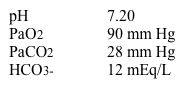 Which of the following is the best next step in the diagnosis of this patient's acid-base status?
 (Multiple Choice)
4.8/5  (85)
(85) A 56-year-old man is evaluated in the preoperative clinic 4 weeks prior to an elective right knee replacement for severe osteoarthritis. Medical history is notable for hypertension and chronic obstructive pulmonary disease. The patient uses inhaled bronchodilators, inhaled corticosteroids, and amlodipine. He has never required hospitalization for respiratory-related issues. The patient is able to perform all basic activities of daily living without dyspnea and was playing golf once a week prior to the knee pain limiting his activity. He previously smoked a pack of cigarettes daily beginning at age of 21 but has cut down to 3 or 4 cigarettes per day over the last 2 years. Vital signs are within normal limits. Oxygen saturation is 92% on room air. Lung auscultation shows slightly diminished breath sounds with prolonged expiration but no wheezes or crackles. Heart sounds are normal. The abdomen is soft and nontender with no organomegaly. There is no extremity edema. The right knee has crepitus and decreased range of motion. Blood cell counts and serum chemistry studies are within normal limits. Which of the following interventions is most appropriate to decrease the risk of postoperative pulmonary complications in this patient?
(Multiple Choice)
4.9/5 (90)
(90) A 13-year-old boy is brought to the emergency department due to refusal to bear weight on the right leg. He has had vague right knee pain for the last 4 days that is now localized to his proximal thigh. Today, the pain has worsened and he is unable to bear weight. The boy has also had a decreased appetite and high fever for the last 3 days. He has had no recent trauma. The patient has no known medical conditions and has had no surgeries. Weight is >95th percentile, height is at the 25th percentile, and BMI is >95th percentile. Palpation over the anterior femur elicits point tenderness. Bilateral hips have full range of motion. The skin overlying the right proximal femur is slightly swollen and erythematous. The remainder of the examination is normal. Which of the following best describes the pathogenesis of this patient's current condition?
(Multiple Choice)
4.8/5 (89)
(89) A 26-year-old woman comes to the office due to a flulike illness with low-grade fever, malaise, nausea, and anorexia. She came back from a trip to Honduras a week ago, and her symptoms started 2 days prior to her return. The patient has no significant medical history and takes no medications. She occasionally smokes marijuana and has used injection drugs in the past. She has had several sexual partners and currently lives with her boyfriend. Temperature is 37.9 C (100.2 F), blood pressure is 121/78 mm Hg, and pulse is 86/min. The patient has scleral icterus. Cardiopulmonary examination is unremarkable. The liver edge, palpated 4 cm below the right costal margin, is smooth and tender. Laboratory results are as follows: 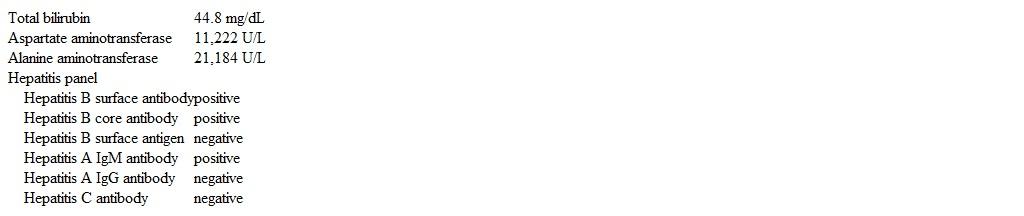 After discussing the findings, the patient says she is worried that she may transmit the disease to her boyfriend. Which of the following interventions for the boyfriend is most likely to decrease his risk of disease acquisition?
 (Multiple Choice)
4.8/5 (77)
(77) A 24-year-old man comes to the office due to nonproductive cough for the past 2 months. He has used over-the-counter cough syrups without improvement. The patient has no fever, chest pain, or dyspnea but recently began having dull back pain. He has no chronic medical issues and takes no other medications. Vital signs are within normal limits. Pulmonary auscultation reveals normal breath sounds. Back examination shows no deformity or tenderness, and a straight leg raise does not elicit pain. Bilateral lower extremity motor strength and sensations are equal, symmetric, and normal. Imaging studies reveal several pulmonary nodules and retroperitoneal lymphadenopathy. Which of the following would most likely establish the primary source of this patient's current findings?
(Multiple Choice)
4.9/5 (80)
(80) A 75-year-old man is brought to the emergency department due to 3 days of confusion, cough, and fever. He has not been eating or drinking well. Medical history is significant for giant cell arteritis, mild aortic stenosis, and hypertension. He takes prednisone and lisinopril. Temperature is 38.5 C (101.3 F), blood pressure is 110/70 mm Hg, pulse is 120/min, and respirations are 20/min. Pulse oximetry shows 94% on room air. The patient is oriented to place and person but not time. Neck is supple. Mucous membranes are dry. Crackles are present over the right lower lobe. A 2/6 systolic ejection murmur is present over the right subclavicular area. The abdomen is soft and nontender. There are no focal neurologic deficits. Chest x-ray reveals no abnormalities. Urinalysis is normal. What is the best next diagnostic step in management of this patient?
(Multiple Choice)
4.9/5 (79)
(79) A 65-year-old woman comes to the office due to gastrointestinal bleeding. She has had 3 or 4 episodes of dark maroon-colored stools in the last 2 weeks, with normal intervening bowel movements. The patient has no associated abdominal or rectal pain, nausea, or vomiting. She has a history of hypertension, type 2 diabetes mellitus, and hypercholesterolemia. Her temperature is 36.7 C (98 F), blood pressure is 140/80 mm Hg, pulse is 95/min, and respirations are 16/min. Physical examination reveals a 3/6 systolic ejection murmur in the right second intercostal space. Carotid pulses are delayed on palpation bilaterally. Abdominal and rectal examinations are benign. Laboratory results are as follows: 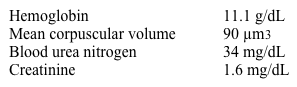 Colonoscopy 6 months earlier was unremarkable but was somewhat limited in the ascending colon due to suboptimal bowel preparation. Which of the following is the most likely cause of this patient's symptoms?
 (Multiple Choice)
4.8/5 (76)
(76) A 45-year-old woman comes to the physician due to several months of progressively worsening watery diarrhea. She has cramps in her leg muscles and feels very dehydrated. She also has mild abdominal discomfort and describes her stools as tea colored. The patient has episodic flushing in her face. She follows a normal diet and has no fever or weight loss. There has been no recent travel to unusual places. The patient smokes 1-2 cigarettes a day and drinks socially. Her temperature is 36.8 C (98.1 F), blood pressure is 108/64 mm Hg, pulse is 118/min, and respirations are 18/min. Abdominal examination shows a nontender abdomen with normoactive bowel sounds. Laboratory results are as follows. 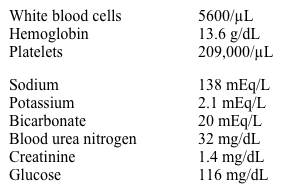 A CT scan of the abdomen shows a 3-cm mass in the pancreatic tail. Which of the following is the most likely diagnosis?
 (Multiple Choice)
4.8/5 (78)
(78) An 85-year-old man comes to the emergency department due to acute-onset shortness of breath associated with coughing spells for 24 hours. He has no chest pain, fevers, or chills. He has had no recent upper respiratory infection symptoms. The patient has a medical history significant for chronic obstructive pulmonary disease (COPD) and has had previous hospitalizations for COPD exacerbation. His other medical problems include persistent atrial fibrillation, hypothyroidism, rheumatoid arthritis, and hypertension. He is an ex-smoker with a 40-pack-year history. Temperature is 36.9 C (98.4 F), blood pressure is 140/90 mm Hg, pulse is 110/min and irregular, and respirations are 22/min. Physical examination shows bilateral decrease in breath sounds with prolonged expiration and wheezing in both lung fields. There is no jugular venous distension or peripheral edema. X-ray of the chest reveals hyperinflation of both lungs. The patient is admitted to the hospital and treated with bronchodilators and systemic corticosteroids. After 3 days of hospitalization, he is ready for discharge and is being considered for home oxygen therapy. Which of the following is an indication for initiating long-term home oxygen therapy in such patients?
(Multiple Choice)
4.8/5 (83)
(83) A 38-year-old woman comes to the office due to a dry cough and malaise for the past 2 months. She has no prior medical issues and takes no medications. The patient reports no allergies and does not smoke. Vital signs are normal. Examination shows no abnormalities. Her chest x-ray is shown below. 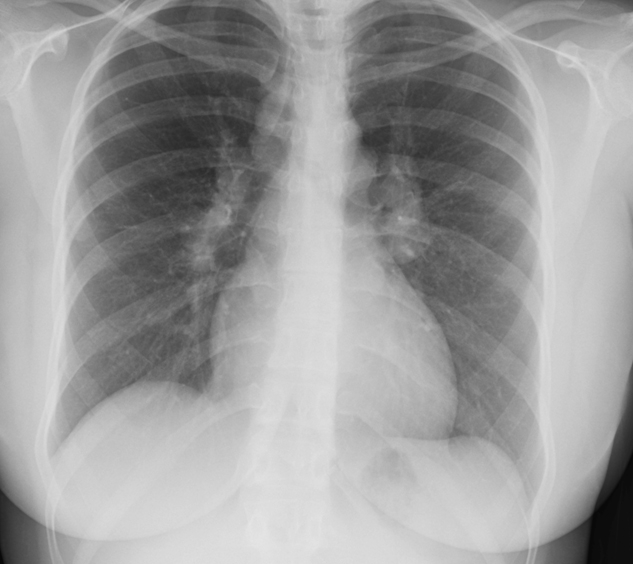 Which of the following is the most likely pathophysiology of this patient's condition?
 (Multiple Choice)
4.9/5 (65)
(65) A 33-year-old African American woman comes to the office due to skin lesions and pain in her ankles for a week. She has had no cough, sore throat, shortness of breath, abdominal pain, or bowel symptoms. She reports no recent travel or illness. The patient has no other significant medical history and takes no medications. She does not use tobacco, alcohol, or illicit drugs. She has no history of sexually transmitted diseases and has been married to a monogamous partner for the past 8 years. Her mother was diagnosed with ovarian cancer at age 65. Temperature is 37.2 C (98.9 F) and blood pressure is 126/76 mm Hg. On examination, the patient has multiple tender pink to reddish nodules below the knee, as shown in the exhibit. 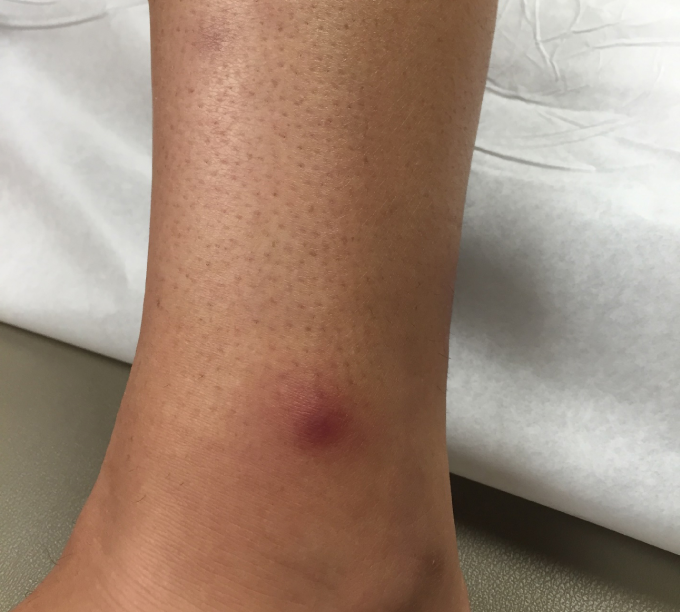 Which of the following is the most appropriate next step in management?
 (Multiple Choice)
4.8/5 (65)
(65) A 70-year-old man comes to the physician complaining of 4-6 months of almost continuous urinary dribbling. It occurs during the day and at night and is progressively worsening. He has no dysuria or hematuria. The patient has a 20-year history of type 2 diabetes, hypertension, alcoholic hepatitis, and coronary artery disease. He had a gastric emptying study done a few weeks ago due to continuous nausea and early satiety. He had laser photocoagulation of both eyes for diabetic retinopathy. The patient has a 50-pack-year smoking history and drinks 4-6 beers daily. His medications include insulin glargine, lispro insulin, metformin, aspirin, metoprolol, lisinopril, and erythromycin. Physical examination shows a normal-size prostate, decreased sensation in both legs below the knees, and absent Achilles tendon and knee reflexes bilaterally. Postvoid residual volume is 550 mL. Urinalysis results are as follows:
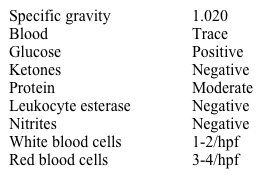 Which of the following is the most likely cause of this patient's incontinence?
 (Multiple Choice)
4.9/5 (86)
(86) A 62-year-old woman comes to the emergency department due to a week of progressive shortness of breath and nonproductive cough. Since this morning, the patient has become more symptomatic as she is now unable to complete full sentences and says that she "can't breathe," especially when lying down. The patient was recently diagnosed with left breast cancer that was treated with a mastectomy followed by radiation and chemotherapy. She has no known history of heart or lung disease. Temperature is 37.2 C (99 F), blood pressure is 160/100 mm Hg, pulse is 130/min and irregular, and respirations are 30/min. The patient is sitting up at the edge of the bed, appears restless, and is using accessory muscles of respiration. Cardiac examination reveals an irregularly irregular tachycardia with normal heart sounds. Neck veins are distended. Bilateral crackles are heard on chest auscultation. This patient is most likely to benefit from which of the following interventions?
(Multiple Choice)
4.9/5 (86)
(86) A 19-year-old man comes to the office due to a week of persistent dry cough that disturbs his sleep. He has also had a sore throat, headaches, and fatigue. Yesterday, he noticed a rash on his arms and legs. The patient has no known medical problems and takes no medications. He has not had any sick contacts. Temperature is 37.8 C (100 F), blood pressure is 115/78 mm Hg, pulse is 86/min, and respirations are 16/min. Mild pharyngeal erythema is present. There is no cervical lymphadenopathy. Cardiopulmonary examination is normal. A faint macular rash is present on the extremities. Chest x-ray reveals increased interstitial markings and a small right-sided pleural effusion. Which of the following organisms is most likely causing this patient's condition?
(Multiple Choice)
4.9/5 (77)
(77) A 3-year-old girl is brought to the emergency department with lethargy and fever. She had diarrhea for several days, and her parents say that "she suddenly took a turn for the worse". The girl has refused liquids for the past 12 hours and has not urinated today. She has no allergies and takes no medications. Her temperature is 39.7 C (103.5 F), blood pressure is 60/28 mm Hg, and pulse is 145/min. On examination, she is lethargic and has poor skin turgor. Her capillary refill time is 5 seconds centrally. Despite numerous attempts, it is not possible to start a peripheral intravenous line, and the child's condition continues to deteriorate. Which of the following is the best next step in management of this patient?
(Multiple Choice)
4.8/5 (72)
(72) A 24-year-old primigravid woman at 10 weeks gestation comes to the emergency department with severe nausea and vomiting. During the past 3 weeks, the patient has had nausea lasting most of the day with occasional emesis, but over the past day her vomiting has become so severe that she has been unable to keep down any fluids. Her medical history includes obesity and appendectomy. Temperature is 36.7 C (98 F), blood pressure is 90/50 mm Hg, pulse is 116/min, and respirations are 16/min. The patient is clutching an emesis basin, into which she frequently spits. On physical examination, mucous membranes are dry and skin turgor is decreased. Heart and breath sounds are normal, and the abdomen is soft and nontender. Transvaginal ultrasound shows a viable, intrauterine twin pregnancy. She is admitted to the hospital for intravenous fluids and antiemetics. Although her emesis subsides, 4 hours later she reports worsening chest discomfort that radiates to her back. Blood pressure is 102/66 mm Hg, and pulse is 112/min. Breath sounds are equal, and a retrosternal crunching sound is heard with each heartbeat. The abdomen is soft but mildly tender in the epigastrium. Which of the following is the most likely diagnosis in this patient?
(Multiple Choice)
4.9/5 (76)
(76) A 34-year-old woman comes to the office due to fatigue for the last several months. She becomes tired easily after walking short distances. She also has difficulty combing her hair due to problems holding her hands over her head for long periods. The patient reports anxiety, irritability, and an unintentional weight loss of 3.6 kg (8 lb) over the last 2 months. She has no fever or loss of appetite. The patient does not use tobacco or alcohol. Her father died of a stroke at age 54 and her mother has diabetes mellitus. On examination, the patient is afebrile with a pulse of 115/min. Cardiac examination reveals regular tachycardia with no murmur. The lungs are clear to auscultation. The patient's gait is normal, but she awkwardly drops into the chair when asked to slowly sit. The patient appears to have decreased muscle mass in her shoulders, but her muscles are nontender. Deep tendon reflexes are normal. Which of the following is the most likely cause of this patient's symptoms?
(Multiple Choice)
4.9/5 (71)
(71) A 56-year-old woman comes to the office due to left lower extremity pain and swelling. One year ago, the patient had a provoked left femoropopliteal deep venous thrombosis and completed 6 months of antithrombotic therapy. Over the past 3 months, she has had slowly worsening intermittent pain, fatigue, and swelling of the left leg, especially toward the end of the day. Medical history is significant for obesity and tobacco use. Temperature is 36.6 C (97.9 F), blood pressure is 122/74 mm Hg, pulse is 83/min, and respirations are 14/min. Oxygen saturation is 98% on room air. Mild pitting edema is noted on left lower extremity examination. There are scattered dilated superficial veins, but no skin erythema or calf tenderness is present. The right lower extremity has no abnormalities. Lower extremity venous ultrasonography is negative for thrombus. Which of the following is the most appropriate next step in management of this patient?
(Multiple Choice)
4.8/5 (79)
(79) A 60-year-old man comes to the office due to erectile dysfunction that has progressed slowly over the last year. He finds it difficult to attain an erection and has noted a decrease in nocturnal erections. Medical history is significant for type 2 diabetes mellitus and benign prostatic hyperplasia. Ophthalmologic evaluation 6 months ago revealed diabetic retinopathy that was treated with photocoagulation. The patient also had a negative treadmill cardiac stress test 4 months ago after presenting with atypical chest discomfort. Current medications include metformin, sitagliptin, rosuvastatin, and doxazosin. Blood pressure is 122/70 mm Hg and pulse is 76/min. Cardiopulmonary examination is unremarkable except for mildly decreased pedal pulses on the right. There is decreased vibration sensation in both feet. Hemoglobin A1c measured 2 weeks ago was 8%. The patient requests a prescription for sildenafil. Which of the following is the most important concern in prescribing sildenafil to this patient?
(Multiple Choice)
4.9/5 (74)
(74) A 23-year-old woman comes to the physician with right foot pain that started 5 weeks ago and is sharp and localized to the forefoot. She recalls no trauma or other inciting event. The patient is an avid runner and is currently training for a long-distance race. The pain has been worsening over the past week and prevents her from doing her daily running activities. She takes no medications. She does not use tobacco, alcohol, or illicit drugs. She is not sexually active, and her last menstrual period was 8 weeks ago. Her temperature is 37 C (98.6 F), blood pressure is 100/60 mm Hg, pulse is 68/min, and respirations are 12/min. Her body mass index is 15 kg/m2. Examination shows normal range of motion, no erythema or bruising, and tenderness to palpation along the second metatarsal bone on the dorsal surface of the right foot. Which of the following is the most likely diagnosis?
(Multiple Choice)
4.9/5 (79)
(79) Showing 461 - 480 of 1702
 Prev
- 1
- ...
- 2
- ...
- 3
- ...
- 4
- ...
- 5
- ...
- 6
- ...
- 7
- ...
- 8
- ...
- 9
- ...
- 10
- ...
- 11
- ...
- 12
- ...
- 13
- ...
- 14
- ...
- 15
- ...
- 16
- ...
- 17
- ...
- 18
- ...
- 19
- ...
- 20
- ...
- 21
- ...
- 22
- ...
- 23
- ...
- 24
- ...
- 25
- ...
- 26
- ...
- 27
- ...
- 28
- ...
- 29
- ...
- 30
- ...
- 31
- ...
- 32
- ...
- 33
- ...
- 34
- ...
- 35
- ...
- 36
- ...
- 37
- ...
- 38
- ...
- 39
- ...
- 40
- ...
- 41
- ...
- 42
- ...
- 43
- ...
- 44
- ...
- 45
- ...
- 46
- ...
- 47
- ...
- 48
- ...
- 49
- ...
- 50
- ...
- 51
- ...
- 52
- ...
- 53
- ...
- 54
- ...
- 55
- ...
- 56
- ...
- 57
- ...
- 58
- ...
- 59
- ...
- 60
- ...
- 61
- ...
- 62
- ...
- 63
- ...
- 64
- ...
- 65
- ...
- 66
- ...
- 67
- ...
- 68
- ...
- 69
- ...
- 70
- ...
- 71
- ...
- 72
- ...
- 73
- ...
- 74
- ...
- 75
- ...
- 76
- ...
- 77
- ...
- 78
- ...
- 79
- ...
- 80
- ...
- 81
- ...
- 82
- ...
- 83
- ...
- 84
- ...
- 85
- ...
- 86
- ...
- Next

Filters
- Essay(0)
- Multiple Choice(0)
- Short Answer(0)
- True False(0)
- Matching(0)