


 Chat with AI
Exam 1: Medicine

Exam 1: Medicine2 k Questions
Exam 2: Pediatric723 Questions
Exam 3: Psychiatry336 Questions
Exam 4: Surgery563 Questions
Exam 5: Obstetrics & Gynecology469 Questions
Select questions type


A case-control study was conducted to evaluate the association between alcohol consumption and cancer of the oral cavity. The crude analysis showed a strong association between the exposure and outcome: odds ratio = 4.5, 95% confidence interval 3.4-5.6. Smoking was considered as a potential confounder of the association. Which of the following properties of smoking is necessary in order for it to be considered as a confounder?
(Multiple Choice)
4.8/5  (75)
(75) A 28-year-old man comes to the office due to abnormal movements of his arm and face over the last week. The patient has had 1- to 2-minute episodes of jerking and twitching of the left arm and left side of the face. He has also had daily headaches for a few weeks that are often associated with nausea. The patient was recently diagnosed with HIV and started antiretroviral therapy 2 months ago. At that time, his CD4 count was 46/mm3. He has a history of intravenous heroin use but recently started a methadone program. Temperature is 37.8 C (100 F), blood pressure is 124/82 mm Hg, and pulse is 76/min. Cardiopulmonary examination is normal with no murmur. Left arm motor strength is 4/5, and deep tendon reflexes are 3+. An MRI of the brain reveals several ring-enhancing lesions at the gray-white matter junction and basal ganglia. Which of the following is the most appropriate treatment for this patient?
(Multiple Choice)
5.0/5 (81)
(81) A 20-year-old man is found to have an elevated calcium level on pre-employment screening blood tests. He feels well and has no polyuria, polydipsia, or constipation. His medical history is unremarkable. He takes no prescription medications, although he has been consuming "protein shakes and vitamin supplements" in preparation for running a marathon. The patient does not use tobacco, alcohol, or illicit drugs. Temperature is 37 C (98.6 F), blood pressure is 110/70 mm Hg, and pulse is 82/min. Physical examination is unremarkable. Laboratory results are as follows: 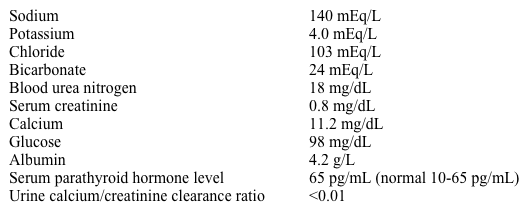 Which of the following conditions is most consistent with this patient's findings?
 (Multiple Choice)
4.8/5 (72)
(72) A 54-year-old man comes to the emergency department after 2 weeks of shortness of breath. The patient gets out of breath easily when walking short distances and has felt more fatigued recently. He has a dry nighttime cough, which he attributes to a respiratory infection. He has not had any chest pain or pressure, palpitations, lightheadedness, or syncope. The patient was diagnosed with hypertension 3 years ago but does not take any medications. He has never smoked and drinks alcohol only socially. He has no family history of heart disease. Blood pressure is 162/90 mm Hg, and pulse is 98/min and regular. Which of the following would have the greatest sensitivity for diagnosing heart failure in this patient?
(Multiple Choice)
4.9/5 (70)
(70) A 55-year-old woman is brought to the emergency department after being found unconscious in her apartment. En route to the hospital, the patient had a seizure and was urgently intubated for airway protection. Medical history is significant for treatment-resistant major depression, hypertension, and hyperlipidemia. The patient takes imipramine, atorvastatin, and lisinopril. Temperature is 38.2 C (100.7 F), blood pressure is 90/50 mm Hg, pulse is 120/min, and respirations are 14/min. Oxygen saturation is 98% on 40% fraction of inspired oxygen. Examination shows bilateral dilated pupils that are minimally reactive to light. The skin appears flushed. Cardiopulmonary examination reveals clear lungs and normal heart sounds. The abdomen is slightly distended with decreased bowel sounds. Muscle tone and reflexes are normal. Sodium bicarbonate therapy is administered. Sodium bicarbonate is indicated in this patient primarily to treat which of the following?
(Multiple Choice)
4.8/5 (91)
(91) A 56-year-old man is admitted to the hospital with severe nausea and vomiting. He has also had fatigue, poor appetite, polyuria, polydipsia, and constipation for several weeks. The patient has a history of hypertension and type 2 diabetes mellitus. His home medications include metformin, lisinopril, and hydrochlorothiazide. He has a 40-pack-year smoking history and drinks alcohol occasionally. Temperature is 36.7 C (98 F), blood pressure is 110/70 mm Hg, pulse is 102/min, and respirations are 16/min. His mucous membranes are dry. The rest of the physical examination is unremarkable. Laboratory results are as follows: 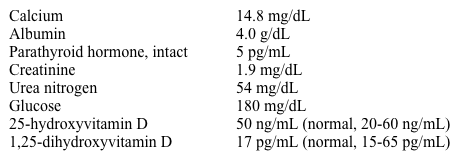 Which of the following is the most likely cause of this patient's hypercalcemia?
 (Multiple Choice)
4.9/5 (86)
(86) A 32-year-old man is brought to the emergency department due to difficulty walking and frequent falls. One week ago he had numbness in his toes and fingertips that progressed to lower-extremity weakness. He had an upper respiratory tract infection 4 weeks ago that resolved spontaneously. The patient has no bowel or bladder complaints. His past medical history is unremarkable. His temperature is 36.9° C (98.5° F), blood pressure is 130/70 mm Hg supine and 100/62 mm Hg standing, pulse is 102/min, and respirations are 18/min. Physical examination shows muscle weakness in both lower extremities and absent knee and ankle reflexes bilaterally. The sensory examination is unremarkable. Lumbar puncture is performed and cerebrospinal fluid analysis results are as follows: 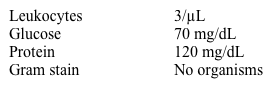 What is the most appropriate next step in management of this patient?
 (Multiple Choice)
4.7/5 (67)
(67) A 16-year-old boy is injured during a high school football game in a helmet-to-helmet collision. When the team physician reaches him, the patient is unconscious and lying prone on the field. He is breathing spontaneously, and respirations are 12/min. A radial pulse is palpable and pulse is 82/min. Emergency medical personnel arrive to transport the patient to the nearest emergency department. Which of the following is the best next step in management of this patient?
(Multiple Choice)
4.7/5 (74)
(74) A 68-year-old woman comes to the emergency department due to sudden-onset chest pain associated with 2 episodes of vomiting. Medical history includes hypertension and chronic obstructive pulmonary disease. The patient smoked a pack of cigarettes per day for 30 years and quit 5 years ago. Blood pressure is 80/50 mm Hg, pulse is 60/min, and respirations are 14/min. Examination shows diaphoresis and elevated jugular venous pressure. S1 and S2 are normal. A grade 2/6 lower left parasternal systolic murmur is heard and increases with inspiration but does not radiate. The lungs are clear to auscultation. ECG reveals 2-mm ST-segment elevation in leads II, III and aVF and 1-mm ST-segment depression in leads I and aVL. Which of the following is the most likely cause of this patient's hypotension?
(Multiple Choice)
4.9/5 (69)
(69) A 22-year-old woman, gravida 1 para 0, at 12 weeks gestation comes to the office due to 3 days of rash, fever, and malaise. The rash seems to be getting larger but does not hurt or itch. Two weeks ago, the patient went camping in northern Massachusetts and had a tick bite while walking through the woods. She has no known drug allergies. Temperature is 38.3 C (101 F), blood pressure is 110/80 mm Hg, pulse is 88/min, and respirations are 16/min. The rash is shown in the image below. 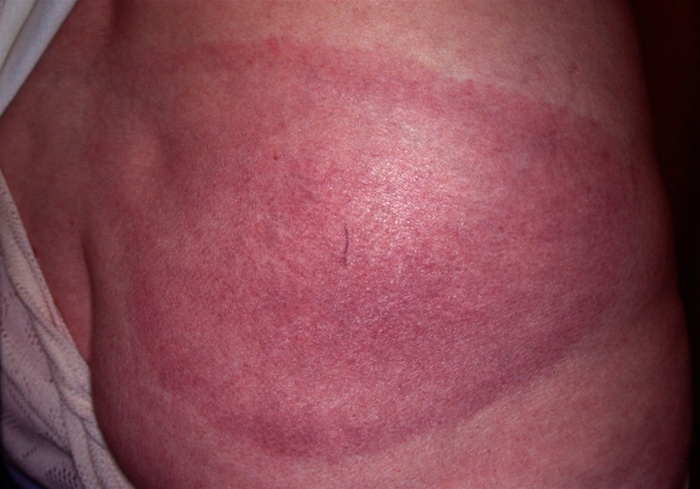 The remainder of the examination is normal. Which of the following is the most appropriate next step in the management of this patient?
 (Multiple Choice)
4.7/5 (70)
(70) A 51-year-old woman comes to the office due to 2 months of pain and numbness of her right index and middle fingers. Her fingers turn white when subjected to cold, and they hurt until she thoroughly warms them. The patient has no problems with her left fingers or toes. Medical history is significant for chronic cough, lower back pain, and acid reflux disease. She has a 28-pack-year smoking history. On examination, there are 2 small ulcers on the tip of her right index finger. Which of the following is the best next step in management of this patient?
(Multiple Choice)
4.9/5 (82)
(82) A 45-year-old woman comes to the emergency department due to 3 days of fever, malaise, progressive dyspnea on exertion, dry cough, abdominal pain, and watery diarrhea. Her loose stools this morning were accompanied by bright red blood. The patient underwent allogeneic renal transplantation 6 months ago and is currently taking tacrolimus, mycophenolate, and prednisone. Two months ago, she developed severe leukopenia, which resolved after discontinuing trimethoprim-sulfamethoxazole and valganciclovir. She does not use tobacco, alcohol, or illicit drugs. Temperature is 38.9 C (102 F), blood pressure is 110/70 mm Hg, pulse is 114/min, and respirations are 22/min. Physical examination shows bilateral lung crackles and diffuse abdominal tenderness. Gross blood is seen on rectal examination. Laboratory results are as follows: 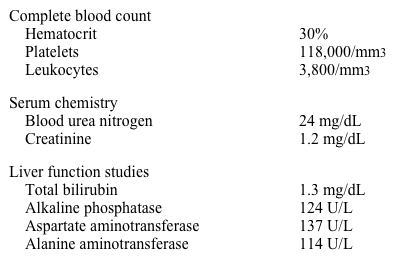 Urinalysis is normal. Chest x-ray reveals bilateral interstitial infiltrates. Which of the following is the most likely cause of this patient's current condition?
 (Multiple Choice)
4.9/5 (91)
(91) A 35-year-old, previously healthy woman comes to the office due to 3 days of fever and malaise. The patient's symptoms started after she returned from a 2-week vacation in the Caribbean islands. For the past day, she has also had marked pain in her hand and wrist joints. The patient does not use tobacco, alcohol, or illicit drugs and is in a monogamous relationship with her fiancé. Temperature is 39.4 C (103 F), blood pressure is 110/70 mm Hg, and pulse is 98/min. Examination reveals clear lung fields, normal heart sounds, and no murmurs. The abdomen is soft and nontender with no hepatosplenomegaly. She has a macular skin rash on her trunk and extremities and mild cervical lymphadenopathy. There are no oral ulcers. Musculoskeletal examination is notable for swelling and tenderness of bilateral hand, wrist, and ankle joints. Laboratory results are as follows:  Which of the following is the most likely diagnosis?
 (Multiple Choice)
4.9/5 (90)
(90) A 49-year-old woman comes to the office due to difficulty swallowing solid food. The patient's symptoms are worse with breads and crackers, but she has no difficulty with liquids, and she uses sips of water to help with swallowing. She thinks that she may have lost weight. The patient's medical history is significant for hypertension and hypothyroidism treated with amlodipine and levothyroxine, respectively. She also uses over-the-counter saline eye drops for eye dryness. The patient has never used tobacco or alcohol. Family history is negative for cancer. She has been monogamous with her husband for 15 years. Blood pressure is 140/90 mm Hg and pulse is 60/min. BMI is 19 kg/m2. Physical examination shows oral thrush, prominent dental caries, and bilateral, firm submandibular nodules. There is no lymphadenopathy. Cardiopulmonary examination shows no abnormalities. Abdomen is soft and nontender with no organomegaly. There is no peripheral edema. Which of the following is the best next step to confirm this patient's diagnosis?
(Multiple Choice)
5.0/5 (82)
(82) A 51-year-old woman comes to the office for a follow-up visit. The patient was initially evaluated 3 weeks ago for bilateral wrist and hand pain that had been occurring for 2 months. She was prescribed ibuprofen and now reports satisfactory improvement in the symptoms. Medical history includes obesity, hyperlipidemia, and major depressive disorder. She is postmenopausal. The patient occasionally drinks alcohol but does not use tobacco or illicit drugs. Vital signs are within normal limits. Physical examination shows decreased swelling and tenderness of bilateral wrists and metacarpophalangeal and proximal interphalangeal joints compared to 3 weeks ago. Laboratory studies show that the erythrocyte sedimentation rate is 52 mm/h, and anticitrullinated peptide antibodies are positive. Low-dose methotrexate therapy is planned. Obtaining which of the following is most appropriate prior to starting this therapy in this patient?
(Multiple Choice)
4.7/5 (71)
(71) A 26-year-old man comes to the emergency department for evaluation of right ankle pain. The patient was playing basketball when he jumped in the air and landed on his friend's foot. The patient rolled his foot in medially and immediately fell to the ground. He tried to walk off the basketball court by himself but was unable to take steps or bear weight on the foot. Blood pressure is 110/80 mm Hg and pulse is 76/min. BMI is 20 kg/m2. The lateral aspect of the right ankle has significant swelling and tenderness to palpation over the lateral malleolus. There is no bruising and no tenderness to palpation over the anterior aspect of the foot. The patient can plantar flex and dorsiflex the ankle. Sensation is normal. Which of the following is the best next step in management of this patient?
(Multiple Choice)
4.7/5 (77)
(77) A 30-year-old woman comes to the physician complaining of a significant increase in her daily urinary volume and intense thirst. The symptoms started a few weeks ago, and she has to get up frequently at night to urinate and drink fluids. She has no other medical problems. The patient does not use tobacco, alcohol, or illicit drugs and has no known drug allergies. Her mother developed diabetes mellitus as an adolescent. Temperature is 36.7 C (98 F), blood pressure is 110/70 mm Hg, pulse is 75/min, and respirations are 15/min. Fasting serum laboratory results are as follows: 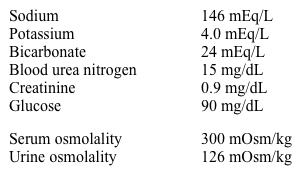 After 6 hours of water deprivation, laboratory results are as follows:
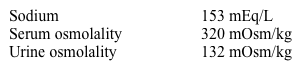 One hour after the subcutaneous administration of arginine vasopressin, the urine osmolality is 395 mOsm/kg. Which of the following is the most appropriate treatment for this patient?
After 6 hours of water deprivation, laboratory results are as follows:
One hour after the subcutaneous administration of arginine vasopressin, the urine osmolality is 395 mOsm/kg. Which of the following is the most appropriate treatment for this patient? (Multiple Choice)
5.0/5 (72)
(72) A 65-year-old man comes to the clinic complaining of progressively worsening dyspnea over the last 2 months. His past medical history is significant for hypertension, type 2 diabetes mellitus, and myocardial infarction 2 years ago. His temperature is 36.7 C (98 F), blood pressure is 156/96 mm Hg, pulse is 65/min, and respirations are 18/min. Physical examination shows bilateral 2+ pitting edema in the lower extremities up to the knees. Hepatojugular reflux is present. The point of maximal impulse is displaced downward and to the left. There is a 2/6 soft and blowing systolic murmur at the apex. Breath sounds are diminished at the right base. Serum protein level is 6.5 g/dL and serum lactate dehydrogenase is 320 U/L. After taking a chest radiograph, the physician suspects pleural effusion on the right and decides to perform diagnostic thoracocentesis. Which of the following findings on pleural fluid analysis would be most consistent with this patient's condition?
(Multiple Choice)
4.9/5 (73)
(73) A 19-year-old woman is brought to the emergency department following a motor vehicle collision. According to the accident report, she hit a temporary guardrail erected to redirect traffic due to construction. On arrival, the patient appears anxious and confused. She has no apparent head, neck, or body injuries. When her parents arrive, they report that she has no other medical problems but that a physician prescribed something for anxiety and insomnia during a stressful period last year. Last month, the patient had her wisdom teeth extracted and experienced a lot of postoperative pain that has since resolved. She occasionally drinks alcohol and smokes half a pack of cigarettes daily. Temperature is 37.2 C (99 F), blood pressure is 128/75 mm Hg, pulse is 110/min, and respirations are 22/min. Examination shows a thin woman with dry mouth and conjunctival injection; the pupils are equal and reactive to light and accommodation. She is oriented to person and place but not time and recalls 1 of 3 objects in 5 minutes. Which of the following substances is most likely contributing to this patient's presentation?
(Multiple Choice)
4.9/5 (78)
(78) A 72-year-old man comes to the emergency department due to severe left lower leg pain that began as a tingling sensation several hours ago but has since become increasingly painful. Medical history is significant for hypertension, type 2 diabetes mellitus, paroxysmal atrial fibrillation, and osteoarthritis. The patient has a 45-pack-year smoking history. Blood pressure is 142/80 mm Hg, and pulse is 112/min and irregular. On physical examination, the left lower extremity skin appears mottled and is cool to the touch. The distal pulses of the left leg are not palpable. There is a right carotid bruit. Which of the following medications could have best prevented this patient's acute condition?
(Multiple Choice)
4.9/5 (82)
(82) Showing 681 - 700 of 1702
 Prev
- 1
- ...
- 2
- ...
- 3
- ...
- 4
- ...
- 5
- ...
- 6
- ...
- 7
- ...
- 8
- ...
- 9
- ...
- 10
- ...
- 11
- ...
- 12
- ...
- 13
- ...
- 14
- ...
- 15
- ...
- 16
- ...
- 17
- ...
- 18
- ...
- 19
- ...
- 20
- ...
- 21
- ...
- 22
- ...
- 23
- ...
- 24
- ...
- 25
- ...
- 26
- ...
- 27
- ...
- 28
- ...
- 29
- ...
- 30
- ...
- 31
- ...
- 32
- ...
- 33
- ...
- 34
- ...
- 35
- ...
- 36
- ...
- 37
- ...
- 38
- ...
- 39
- ...
- 40
- ...
- 41
- ...
- 42
- ...
- 43
- ...
- 44
- ...
- 45
- ...
- 46
- ...
- 47
- ...
- 48
- ...
- 49
- ...
- 50
- ...
- 51
- ...
- 52
- ...
- 53
- ...
- 54
- ...
- 55
- ...
- 56
- ...
- 57
- ...
- 58
- ...
- 59
- ...
- 60
- ...
- 61
- ...
- 62
- ...
- 63
- ...
- 64
- ...
- 65
- ...
- 66
- ...
- 67
- ...
- 68
- ...
- 69
- ...
- 70
- ...
- 71
- ...
- 72
- ...
- 73
- ...
- 74
- ...
- 75
- ...
- 76
- ...
- 77
- ...
- 78
- ...
- 79
- ...
- 80
- ...
- 81
- ...
- 82
- ...
- 83
- ...
- 84
- ...
- 85
- ...
- 86
- ...
- Next

Filters
- Essay(0)
- Multiple Choice(0)
- Short Answer(0)
- True False(0)
- Matching(0)