


 Chat with AI
Exam 1: Medicine

Exam 1: Medicine2 k Questions
Exam 2: Pediatric723 Questions
Exam 3: Psychiatry336 Questions
Exam 4: Surgery563 Questions
Exam 5: Obstetrics & Gynecology469 Questions
Select questions type


A 34-year-old woman who recently immigrated to the United States from China has laboratory tests performed prior to entering nursing school. The patient has no known past medical history and takes no medications. She is currently in a monogamous relationship and does not use illicit drugs. The patient believes she is up-to-date with all of her immunizations. She brings the following report with her to the clinic.  Which of the following is the appropriate interpretation of these serological test results?
 (Multiple Choice)
4.9/5  (66)
(66) A 68-year-old woman comes to the emergency department due to severe generalized weakness and dizziness. She has not fallen or lost consciousness. The patient reports no chest pain, dyspnea, cough, or diarrhea; however, she has had worsening fatigue, nausea, and anorexia for the past 3 weeks. The patient has a history of breast cancer treated with surgery and chemotherapy 5 years ago but was found to have a vertebral metastatic lesion during evaluation of back pain a month ago. Radiation therapy and systemic chemotherapy are planned, but she has not received treatment yet. The patient has no other medical conditions, and the only prescribed medication is opioid analgesic as needed. Temperature is 37.5 C (99.5 F), blood pressure is 108/66 mm Hg, and pulse is 102/min. Orthostatic changes are present and oral mucosa are dry. The lungs are clear on auscultation and heart sounds are normal. The abdomen is soft with mild generalized tenderness, and no lower extremity edema is present. There is focal tenderness of the mid thoracic vertebrae with no focal neurologic deficit. Laboratory results are as follows: 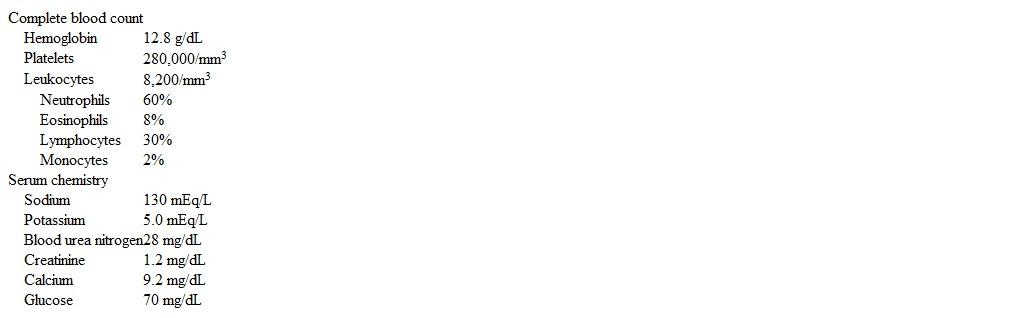 In addition to intravenous fluids, which of the following is the most appropriate management of this patient?
 (Multiple Choice)
4.7/5 (82)
(82) A 24-year-old man comes to the urgent care clinic due to blood in his urine. He has a 1-day history of mild midline back discomfort, associated with a single episode of red urine. The hematuria subsequently resolved and his urine is now a normal yellow color. The patient also has had a sore throat for the past 4 days, for which he took 3 tablets of over-the-counter acetaminophen. He has had no fever, abdominal pain, or burning during urination. He has smoked 1 pack of cigarettes daily for 5 years. Physical examination is unremarkable. Urinalysis shows: 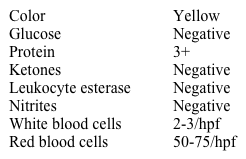 Which of the following is the most likely source of this patient's urinary complaints?
 (Multiple Choice)
4.9/5 (82)
(82) A 55-year-old man comes to the office due to several months of worsening cramping in his left leg that he has noted during morning exercise. The patient has no chest discomfort, shortness of breath, palpitations, or syncope. Medical history is unremarkable, and he takes no medications. He is an ex-smoker with a 20-pack-year history. The patient does not use alcohol or illicit drugs. He exercises twice a week and follows a low-fat diet. His father had a myocardial infarction at age 60 and died from a second myocardial infarction at age 65. Blood pressure is 145/95 mm Hg and pulse is 85/min. Cardiac, pulmonary, and abdominal examinations are within normal limits. Peripheral pulses are decreased in the left leg. Ankle-brachial index is 0.65 in the left and 1.1 in the right. ECG is within normal limits. Fasting laboratory results are as follows:  Which of the following is the most appropriate next step in management of this patient?
 (Multiple Choice)
4.7/5 (79)
(79) A 36-year-old woman comes to the office due to weight loss. She has lost 5 kg (11 lb) over the last 3 months associated with palpitations, heat intolerance, persistent tremors, and excessive sweating. Past medical and family histories are unremarkable, and the patient does not use tobacco, alcohol, or illicit drugs. She is married and has a child. Blood pressure is 140/70 mm Hg and pulse is 104/min and regular. Physical examination shows a 2x2 cm nodule in the left thyroid lobe. The rest of the thyroid gland is normal, and there is no associated cervical lymphadenopathy. Eye examination shows minimal lid lag, but no proptosis or chemosis. There is a fine tremor in both upper extremities. Thyroid function test results are as follows: 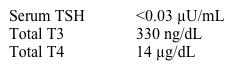 Radioactive iodine scan shows uptake only in the nodule. The patient wishes to have additional children and is concerned that she will not be able to get pregnant if she is treated for her current condition. If left untreated, this patient is at greatest risk for developing which of the following complications?
 (Multiple Choice)
4.8/5 (86)
(86) A 33-year-old man comes to the office for HIV testing after his partner was found to be HIV positive. The patient is asymptomatic and has no history of sexually transmitted infections. He has never had a previous HIV test. The patient has had several male and female partners in his lifetime and uses condoms inconsistently. He does not use tobacco, alcohol, or illicit drugs. Vital signs are within normal limits and physical examination is normal. A fourth-generation HIV test is positive, and subsequent laboratory results are as follows: 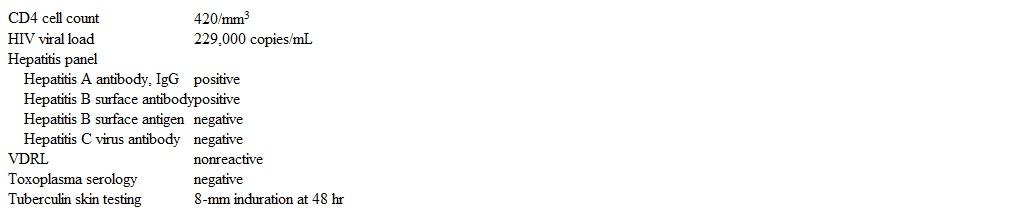 Complete blood count and liver aminotransferase levels are normal. Chest x-ray is unremarkable. In addition to starting antiretroviral therapy, which of the following interventions is most appropriate for this patient?
 (Multiple Choice)
4.8/5 (79)
(79) A 27-year-old woman comes to the office due to a 2-month history of dark hair growth on her cheeks, chin, and upper lip. Her last menstrual period was 12 weeks ago, but she did not seek medical care because a home pregnancy test was negative. The patient is gravida 0 para 0; her menstrual cycles began at age 11 and have previously been regular. She has no associated weight changes, visual disturbances, skin striae, headaches, or proximal muscle weakness. She takes no medications, including over-the-counter medications. Family history is unremarkable. Physical examination shows a BMI of 24 kg/m2. Her skin is oily with acne on the forehead and cheeks. Dark terminal hairs are noted on the upper lip, cheeks, chin, chest, and lower abdomen. Examination of the genitals shows clitoromegaly. Abdominal examination is normal. Pelvic ultrasound reveals a normal uterus and ovaries. CT scan of the abdomen reveals a left adrenal mass. Which of the following patterns of plasma hormone levels is likely to be present in this patient?
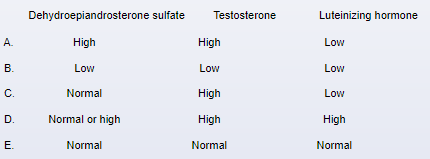
(Multiple Choice)
4.9/5 (68)
(68) A 64-year-old man comes to the office due to a month of dyspnea on exertion, nonproductive cough, and right-sided pleuritic chest pain. The patient's medical history is significant for hypertension, type 2 diabetes, chronic kidney disease (baseline creatinine of 2 mg/dL), and chronic obstructive pulmonary disease. He smoked cigarettes for 40 years and quit 4 years ago. Temperature is 38.2 C (100.8 F), blood pressure is 128/72 mm Hg, pulse is 92/min, and respirations are 18/min. Chest x-ray shows a moderate right-sided pleural effusion. Pleural fluid results are as follows: 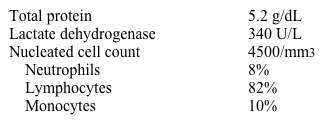 Serum total protein is 6.0 g/dL, and serum lactate dehydrogenase is 120 U/L. Which of the following is the most likely mechanism underlying the development of this pleural effusion?
 (Multiple Choice)
4.9/5 (94)
(94) A 32-year-old woman is brought to the emergency department by her husband after having an episode of generalized tonic-clonic seizure 30 minutes ago. The patient was watching television when she suddenly started convulsing. The seizure stopped spontaneously after a minute, but she has been lethargic and confused since then. She has no prior history of seizures. According to her husband, the patient has had headaches, fatigue, and irritability for the past 2-3 weeks. She has also had several episodes of pain in her hand joints and wrists, which she attributed to an increased workload as a restaurant chef. The patient has no significant medical history, recent travel, or sick contacts. The only medication she takes is an oral contraceptive. Temperature is 38.1 C (100.5 F), blood pressure is 130/80 mm Hg, pulse is 89/min, and respirations are 12/min. The patient is lethargic but follows instructions. She has an erythematous rash involving both cheeks. There is no tongue laceration, but small oral mucosal ulcers are present. The neck is supple, and other signs of meningeal irritation are negative. Neurological examination shows normal muscle strength and deep tendon reflexes. There is mild swelling and tenderness of the hand joints. Laboratory results are as follows: 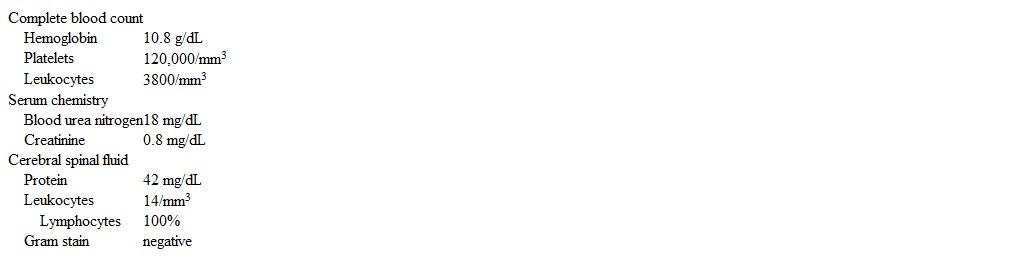 A noncontrast CT scan of the head is unremarkable. Which of the following is the most likely diagnosis for this patient?
 (Multiple Choice)
4.8/5 (87)
(87) A 68-year-old man comes to the office due to 2 weeks of worsening fatigue and exertional dyspnea. The patient was diagnosed with early-stage leukemia a year ago but has not required treatment because he has not had significant symptoms. Vital signs are within normal limits. Physical examination shows generalized lymphadenopathy and hepatosplenomegaly. Laboratory results are as follows:  Which of the following is the most likely underlying cause of this patient's anemia?
 (Multiple Choice)
4.8/5 (75)
(75) A 65-year-old woman comes to the office due to 2 months of lethargy. She is a reporter for the local newspaper and notes severe fatigue in the afternoons and evenings that has required her to reduce her workload. The patient has not had any fevers, night sweats, or weight changes. She does not use tobacco or illicit drugs but drinks a glass of red wine nightly. She is current on her health maintenance and does yoga 3 times a week. Temperature is 37.1 C (98.8 F), blood pressure is 112/72 mm Hg, and pulse is 88/min. The patient is thin but well nourished. There are large, firm, mobile lymph nodes in her bilateral cervical and supraclavicular chains. Cardiopulmonary and abdominal examinations are normal. Laboratory results are as follows: 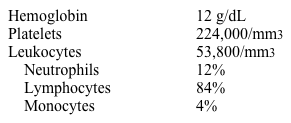 Peripheral blood smear reveals lymphocytosis with small, mature lymphocytes. Which of the following is the most likely diagnosis?
 (Multiple Choice)
4.9/5 (78)
(78) A 71-year-old man is brought to the ER after a witnessed tonic-clonic seizure. He is somnolent and intermittently combative on exam. No past medical history is available. His arterial blood gas (ABG) at room air is given below.
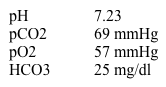 Which of the following best explains the acid-base disturbances in this patient?
 (Multiple Choice)
4.8/5 (96)
(96) A 40-year-old man comes to the office due to progressively worsening shortness of breath and nonproductive cough over the last 3 weeks. He also notes 2 months of fatigue, intermittent fever, and decreased appetite. He has lost 6 kg (13.2 lb) during this period. He has no other medical problems. He has a history of intravenous drug use and a 20-pack-year smoking history. The patient was released from a 2 year incarceration 6 months ago. Temperature is 38.3 C (100.9 F), blood pressure is 110/70 mm Hg, pulse is 90/min, and respirations are 18/min. The patient is in no distress but has mild temporal wasting. Crackles are present throughout the lung fields. Heart sounds are normal. There is mild hepatomegaly. Chest x-ray is shown below. 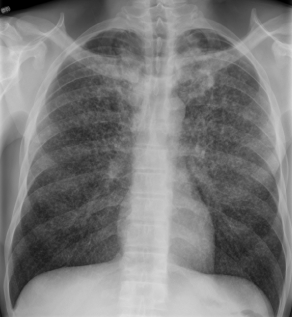 What is the most likely diagnosis?
 (Multiple Choice)
4.8/5 (77)
(77) A 19-year-old woman comes to the office due to 2 days of worsened fatigue and exertional dyspnea. Four days ago, she was diagnosed with otitis media and was prescribed amoxicillin. The patient has no other significant medical history. Physical examination shows a soft and nontender abdomen with mild splenomegaly. Scleral icterus is present. The remainder of the physical examination is unremarkable. Laboratory results are as follows:  Which of the following is the best next step in management of this patient?
 (Multiple Choice)
4.8/5 (77)
(77) A 64-year-old man comes to the office due to persistent upper abdominal pain and nausea. He experienced epigastric discomfort after taking ibuprofen for an ankle injury several months ago. He stopped taking ibuprofen and took omeprazole for 2 weeks, which provided some relief. However, when he stopped omeprazole his pain started again and has progressively worsened. The patient also has occasional nausea and loss of appetite. He has a remote history of tobacco use but no other medical problems. He immigrated to the United States from Laos 20 years ago. Physical examination reveals minimal epigastric tenderness. Upper gastrointestinal endoscopy demonstrates mild gastric erythema and a 4-cm mass in the body of the stomach along the greater curvature. Several biopsies are obtained and histopathology is consistent with low-grade lymphoma arising from the mucosa-associated lymphoid tissue (MALT). Imaging studies reveal no lymphadenopathy or metastatic disease. Which of the following is most likely involved in the pathogenesis of this patient's current condition?
(Multiple Choice)
4.9/5 (82)
(82) A 36-year-old man has been hospitalized for the past 3 days for alcoholic hepatitis. His condition is slowly improving and his prognosis is favorable. However, this is his third absence from his job in the past 6 months due to health-related issues. The patient notified his employer that he is presently hospitalized and was informed that he needs to provide the employer with proof of hospitalization or he could lose his job. In accordance with hospital policy, the patient provides verbal consent for the physician to speak with his employer and disclose his health status. The employer proceeds to contact the physician directly by phone, requesting an update on the patient and his likelihood of returning to work. Which of the following is the most appropriate response by the physician to the employer?
(Multiple Choice)
4.8/5 (82)
(82) A 68-year-old man with myasthenia gravis is evaluated for progressive weakness while hospitalized. The patient was admitted 2 days prior due to fever, productive cough, and pleuritic chest pain. Chest x-ray demonstrated a right lower lobe consolidation for which the patient has been receiving intravenous ceftriaxone and azithromycin. He also has been receiving his outpatient dose of pyridostigmine. In the past several hours, he has experienced progressive generalized weakness and an inability to cough out sputum. His temperature is 37.6 C (99.8 F), blood pressure is 130/70 mm Hg, pulse is 110/min, and respiratory rate is 25/min. Oxygen saturation is 89% on 4 L/min oxygen by nasal cannula. The patient appears to be in distress, and his breathing pattern is rapid and shallow with occasional gurgling sounds. Lung auscultation reveals coarse crackles throughout. There is mild weakness of the extremities, but deep tendon reflexes are normal. His vital capacity is now 1.0 L compared to 1.5 L at the time of admission, and arterial blood gas shows pH 7.27, pCO2 55 mm Hg, and pO2 60 mm Hg. The patient is intubated and moved to the intensive care unit. Which of the following is the best next step in management of this patient?
(Multiple Choice)
5.0/5 (66)
(66) A 23-year-old man comes to the office due to a genital lesion. Two weeks ago, he noticed a small bump on the shaft of his penis that grew before ulcerating. The lesion is nonpainful, and the patient has had no fever or other skin lesions. He has never had similar symptoms. The patient has no chronic medical conditions. He recently began a new sexual relationship, and his use of condoms has been inconsistent. Vital signs are within normal limits. Genital examination shows a 2-cm ulcer on the midshaft of the penis with raised, indurated margins and a smooth base. Palpation does not elicit pain, and no exudate is present. No additional skin lesions are found, and oral examination is normal. Mild, bilateral, nontender inguinal lymphadenopathy is present. Testing for serum VDRL and HIV is negative. Which of the following is most likely to yield a diagnosis in this patient?
(Multiple Choice)
4.8/5 (85)
(85) A 48-year-old man comes to the office due to nasal congestion and rhinorrhea. Three months ago, the patient developed symptoms of nasal congestion, rhinorrhea, cough, fatigue, and fever. He began using over-the-counter acetaminophen and nasal decongestant spray. The fever resolved and symptoms initially improved, but since then, the patient has had worsening nasal congestion and a decreased sense of smell despite continued medication use. He has no other chronic medical problems. He works at a print shop. He does not use tobacco or illicit drugs. Vital signs are within normal limits. The tympanic membranes are clear with no middle ear effusion. Nasal examination shows swollen, beefy-red nasal turbinates obstructing the nasal airway. The oral cavity is clear; the tonsils are small and not inflamed. There is no cervical adenopathy. Which of the following is the most appropriate next step in management of this patient's current condition?
(Multiple Choice)
4.8/5 (78)
(78) A 23-year-old woman is brought to the emergency department after a seizure episode. The seizure occurred at work and was not preceded by any prodromal symptoms or aura. The patient's coworkers reported that she became unresponsive with generalized tonic-clonic movements lasting 1-2 minutes followed by several minutes of confusion. She experienced urinary incontinence but no tongue biting. The patient has no medical problems and takes no prescription medications. She has no prior head trauma and no family history of epilepsy. Vital signs and neurologic examination are normal. Serum electrolytes, glucose, calcium, magnesium, complete blood count, renal function tests, and liver function tests are unremarkable. A non-contrast head CT scan is normal. Which of the following is the most appropriate next step in management?
(Multiple Choice)
4.9/5 (70)
(70) Showing 1161 - 1180 of 1702
 Prev
- 1
- ...
- 2
- ...
- 3
- ...
- 4
- ...
- 5
- ...
- 6
- ...
- 7
- ...
- 8
- ...
- 9
- ...
- 10
- ...
- 11
- ...
- 12
- ...
- 13
- ...
- 14
- ...
- 15
- ...
- 16
- ...
- 17
- ...
- 18
- ...
- 19
- ...
- 20
- ...
- 21
- ...
- 22
- ...
- 23
- ...
- 24
- ...
- 25
- ...
- 26
- ...
- 27
- ...
- 28
- ...
- 29
- ...
- 30
- ...
- 31
- ...
- 32
- ...
- 33
- ...
- 34
- ...
- 35
- ...
- 36
- ...
- 37
- ...
- 38
- ...
- 39
- ...
- 40
- ...
- 41
- ...
- 42
- ...
- 43
- ...
- 44
- ...
- 45
- ...
- 46
- ...
- 47
- ...
- 48
- ...
- 49
- ...
- 50
- ...
- 51
- ...
- 52
- ...
- 53
- ...
- 54
- ...
- 55
- ...
- 56
- ...
- 57
- ...
- 58
- ...
- 59
- ...
- 60
- ...
- 61
- ...
- 62
- ...
- 63
- ...
- 64
- ...
- 65
- ...
- 66
- ...
- 67
- ...
- 68
- ...
- 69
- ...
- 70
- ...
- 71
- ...
- 72
- ...
- 73
- ...
- 74
- ...
- 75
- ...
- 76
- ...
- 77
- ...
- 78
- ...
- 79
- ...
- 80
- ...
- 81
- ...
- 82
- ...
- 83
- ...
- 84
- ...
- 85
- ...
- 86
- ...
- Next

Filters
- Essay(0)
- Multiple Choice(0)
- Short Answer(0)
- True False(0)
- Matching(0)