


 Chat with AI
Exam 1: Medicine

Exam 1: Medicine2 k Questions
Exam 2: Pediatric723 Questions
Exam 3: Psychiatry336 Questions
Exam 4: Surgery563 Questions
Exam 5: Obstetrics & Gynecology469 Questions
Select questions type


A 33-year-old man comes to the physician reporting mild exertional shortness of breath and a "pounding" heart over the last 5 months. He is uncomfortably aware of his heartbeat while lying on his left side. Vital signs include blood pressure of 150/45 mm Hg and pulse of 73/min. Which of the following is most likely responsible for his symptoms?
(Multiple Choice)
4.9/5  (86)
(86) A 17-year-old boy comes to the office due to fatigue. For the past 6 weeks, the patient has had difficulty attending evening soccer practice due to excessive tiredness and feverishness. He has also had generalized itching but no rash. The patient has no nasal congestion, sore throat, cough, dyspnea, abdominal pain, or diarrhea. He has no significant medical history and takes no medications. Temperature is 38 C (100.4 F), blood pressure is 118/66 mm Hg, and pulse is 86/min. Physical examination shows no scleral icterus or conjunctival pallor. There are several enlarged, nontender, and firm cervical and supraclavicular lymph nodes. Oropharyngeal mucosa and tonsils are normal. The lungs are clear on auscultation, and heart sounds are normal. The abdomen is soft and nontender with no organomegaly. There is no extremity edema or skin rash. Which of the following is most appropriate to establish a diagnosis for this patient?
(Multiple Choice)
4.9/5 (85)
(85) A 3-year-old boy is brought to the emergency department by his pregnant mother after developing severe abdominal pain within the past hour and having several episodes of vomiting. The patient's vomit is black and red in color. Blood pressure is 80/50 mm Hg, pulse is 140/min, and respirations are 30/min. On physical examination, he is irritable and lethargic. Examination shows a normal oropharynx. Cardiopulmonary examination is normal. The abdomen is soft and mildly tender at the epigastrium; there is no hepatosplenomegaly. The extremities are cool to the touch. Laboratory results are as follows: 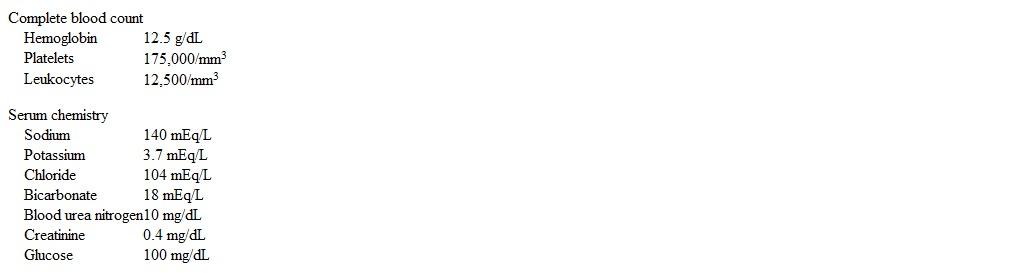 Chest x-ray is normal. Abdominal imaging shows several radiopaque tablets in the stomach. Intravenous normal saline is started. Which of the following is the best next step in management of this patient?
 (Multiple Choice)
4.8/5 (81)
(81) A 67-year-old man comes to the office due to worsening urinary frequency, hesitancy, and nocturia for the past year. He wakes up 2 or 3 times a night to void. The patient also says that the force of his urinary stream is decreased and he feels that his bladder is not completely evacuated after voiding. He has a history of hypertension and osteoarthritis. The patient has a 35-pack-year smoking history but stopped smoking 10 years ago. Temperature is 37.1 C (98.8 F), blood pressure is 130/80 mm Hg, and pulse is 78/min. Physical examination shows a soft and nontender abdomen. Rectal examination reveals an enlarged, smooth prostate with no nodules and normal rectal sphincter tone. Postvoid bladder scan shows 75 mL of urine (normal, <12 mL). Serum creatinine and urinalysis are normal. Serum prostate-specific antigen is 2.8 ng/mL (age-adjusted reference value <4.5 ng/mL). Which of the following is the best next step in management of this patient?
(Multiple Choice)
4.8/5 (85)
(85) A 36-year-old woman comes to the office for a routine annual visit. The patient feels well and has no health concerns. She has regular monthly menses with mild breast tenderness a day before bleeding starts. The patient had a copper-containing intrauterine device (IUD) placed 2 years ago and uses condoms consistently. She is in a monogamous relationship with a male partner, and they are getting married next year. Pap testing was normal 2 years ago. The patient has smoked a pack of cigarettes daily for the past 20 years, but she does not use alcohol or illicit drugs. Blood pressure is 120/78 mm Hg. BMI is 24 kg/m2. Clinical breast examination shows no palpable masses or skin changes. The abdomen is nontender with no palpable masses or hernias. Pelvic examination shows 2-cm IUD strings visible at the cervix and scant physiologic vaginal discharge. The remainder of the physical examination is unremarkable. Which of the following is recommended for this patient at this visit?
(Multiple Choice)
4.9/5 (76)
(76) A 23-year-old woman, gravida 1 para 0, at 12 weeks gestation comes to the emergency department for vaginal bleeding after intercourse. The patient had intercourse 12 hours ago and has since noticed blood in the toilet after urination and bright red blood on the toilet paper. She has no medical history and takes no medications. The patient reports occasional alcohol use prior to pregnancy but no history of tobacco or illicit drug use. Blood pressure is 120/70 mm Hg and pulse is 65/min. Fetal heart rate is normal by Doppler ultrasound. Pelvic examination shows normal external genitalia and a thick, yellow malodorous discharge in the vagina that is tinged with blood. The cervix is closed and bleeds after being touched with a cotton applicator; no masses are noted. Bimanual examination shows an enlarged uterus but no cervical motion tenderness, adnexal masses, or tenderness. Which of the following is the most likely diagnosis in this patient?
(Multiple Choice)
4.8/5 (85)
(85) A 40-year-old man comes to the physician because of a two-week history of fatigue, lower extremity edema, and dark urine. He has no history of serious illnesses. He takes no medications. He does not use tobacco, alcohol, or drugs. His blood pressure is 132/83 mm Hg and pulse is 84/min. Physical examination shows symmetric pitting edema of lower extremities. Laboratory studies show a serum creatinine level of 1.1 mg/dL. Urinalysis shows 4+ proteinuria and microhematuria. Electron microscopy of the specimen obtained from kidney biopsy shows dense deposits within glomerular basement membrane. Immunofluorescence microscopy is positive for C3, not immunoglobulins. Which of the following is the most likely pathophysiologic mechanism that explains this patient's condition?
(Multiple Choice)
4.9/5 (54)
(54) A 21-year-old man comes to the urgent care center due to 3 days of dysuria. The patient also reports a burning sensation at the urethral meatus but has had no fever, urinary urgency, or abdominal or scrotal pain. He has no chronic medical conditions and takes no medications. The patient has had 2 recent female sexual partners and does not use condoms. Vital signs are within normal limits. Physical examination shows mucopurulent penile discharge. No genital ulcers or rash is noted. The scrotum is nontender, and there is no inguinal lymphadenopathy. Rectal examination shows a normal-sized prostate with no tenderness. Urine dipstick is positive for leukocytes but negative for nitrites. Urine microscopy and nucleic acid amplification testing for Neisseria gonorrhoeae and Chlamydia trachomatis are sent. Which of the following is the best next step in management of this patient?
(Multiple Choice)
4.7/5 (83)
(83) A 52-year-old woman comes to the clinic for follow-up of type 2 diabetes mellitus that was diagnosed 6 months ago after she was hospitalized for cellulitis of the right lower leg. The patient's diabetes is managed with insulin in addition to diet and exercise. Her only other medical condition is hypertension, for which she takes antihypertensive medication. The patient's mother had systemic lupus erythematosus and died at age 60. Serum creatinine is 1.7 mg/dL. Urine albumin/creatinine ratio is elevated at 190 mg/g and was also elevated 3 months ago. Which of the following additional findings would most strongly support a diagnosis of diabetic nephropathy in this patient?
(Multiple Choice)
4.8/5 (81)
(81) A 44-year-old car mechanic comes to the office due to a 4-week history of right elbow pain. The pain is worse when grasping tools with the right hand and is not relieved by over-the-counter nonsteroidal anti-inflammatory drugs. He has had no acute trauma to the elbow. On examination, the elbow is not swollen and has full range of motion. There is tenderness on palpation around the lateral distal humerus. Pain is reproduced when testing grip strength and with resisted wrist extension. Which of the following is the best next step in management?
(Multiple Choice)
4.9/5 (80)
(80) A 21-year-old woman comes to the office due to painful blisters on her palms that began after she started taking golf lessons. The patient frequently develops foot blisters during hiking or competitive sports but has never had symptoms on the hands. She has a remote history of failure to thrive during infancy due to frequent oral ulcers and poor feeding but is otherwise healthy. Vital signs are normal. Examination shows bullae and erosions on both palms. The skin of the soles is moderately thickened. Which of the following is the most likely diagnosis of this patient's skin condition?
(Multiple Choice)
4.8/5 (91)
(91) A 54-year-old man comes to the office due to worsening low back pain. The pain started 3 weeks ago and is worse at night but continues through the day. It does not improve with rest or over-the-counter ibuprofen. The patient has no other symptoms. Medical history is notable for non-small cell carcinoma of the lung treated with surgical resection a year ago. At that time, preoperative positron emission tomography scanning did not reveal evidence of metastasis. The patient has smoked a pack of cigarettes a day for 30 years and quit a year ago. Vital signs are within normal limits. Examination shows local spinal tenderness at the L4-L5 level. Muscle strength is 5/5, and deep tendon reflexes are within normal limits. Sensory examination shows no abnormalities. What is the most likely cause of this patient's back pain?
(Multiple Choice)
4.9/5 (65)
(65) A 53-year-old man comes to the office due to 4 months of progressively worsening dyspnea. He has also had decreased appetite, weight loss, and nagging epigastric discomfort. The patient has a history of peptic ulcer disease treated with over-the-counter antacids. He has a 20-pack-year smoking history and has worked as a plumber for the past 30 years. Vital signs are within normal limits. Physical examination shows fingernail clubbing and bibasilar end-inspiratory crackles on lung auscultation. Chest x-ray shows atelectasis and bilateral pleural plaques over the diaphragm. Chest CT shows reticular opacities of the lower lung fields, multiple pleural plaques, and a round 6-cm cavitary mass in the right lower lung field. CT-guided biopsy of the mass is planned. Which of the following is the most likely finding on biopsy?
(Multiple Choice)
4.9/5 (67)
(67) A 25-year-old woman, gravida 2 para 1, at 10 weeks gestation is brought to the emergency department by her boyfriend, who found her lying on the bed in a pool of blood. Her previous pregnancy was uncomplicated and resulted in a normal term vaginal delivery. She has no chronic medical problems. The patient takes a daily prenatal vitamin and does not smoke or drink alcohol. Temperature is 36.7 C (98 F), pulse is 120/min, and respirations are 20/min. Pelvic examinations shows blood clots throughout the vagina. The cervix is dilated, and there is a large amount of blood from the cervical os. On neurologic examination, she is somnolent but responsive to verbal stimuli and has 2+ deep tendon reflexes. Weak posterior tibial and dorsalis pedis pulses are palpable bilaterally. Which set of parameters is most likely to be seen in this patient?
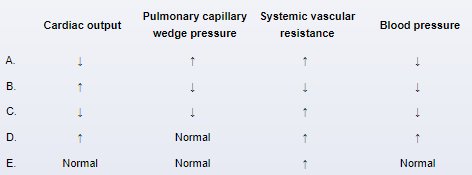
(Multiple Choice)
4.8/5 (90)
(90) A new test is devised to detect HIV. It has a sensitivity of 90% and specificity of 85% compared to the gold standard. The test is used in 2 populations: a population in Africa with a 20% prevalence of HIV, and a population in Asia with a 1% prevalence of HIV. Which of the following is the most accurate statement concerning the new test?
(Multiple Choice)
4.9/5 (68)
(68) A 22-year-old man comes to the office due to yellow eyes lasting a day. Over the past 3 days, the patient has had fever, fatigue, nasal discharge, and sore throat. He has no chronic medical conditions. His only medication is acetaminophen as needed for current symptoms. The patient drinks 4 or 5 alcoholic beverages a week, and the last drink was 3 days ago. Temperature is 38 C (100.4 F), blood pressure is 120/78 mm Hg, pulse is 80/min, and respirations are 16/min. Examination shows scleral icterus; the oropharynx is erythematous without exudates. There is no pallor or lymphadenopathy. Liver span is 11 cm, and a firm, nontender liver edge is palpable. There is no splenomegaly. Laboratory results are as follows: 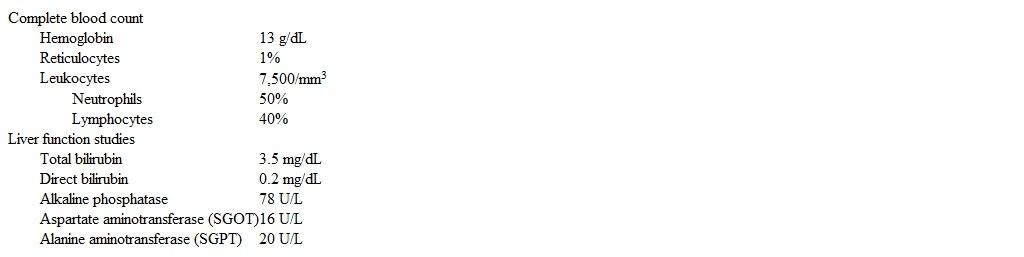 What is the most likely cause of jaundice in this patient?
 (Multiple Choice)
4.7/5 (74)
(74) A 54-year-old man comes to the office due to a day of fever, chills, malaise, and low back pain. This morning, he also noticed urinary frequency and urgency. The patient has had no urethral discharge and is not sexually active. Medical history is significant for type 2 diabetes mellitus and hypertension. The patient does not use tobacco, alcohol, or illicit drugs. Temperature is 38.9 C (102 F), blood pressure is 130/78 mm Hg, and pulse is 90/min. The patient appears acutely ill. Cardiopulmonary examination is normal. Abdomen is soft and nontender. There is no tenderness over the costovertebral angle or spine. The lower extremities have no edema or rash. Digital rectal examination reveals marked anterior tenderness. Which of the following is the most likely diagnosis of this patient?
(Multiple Choice)
4.8/5 (69)
(69) A 47-year-old woman is brought to the emergency department after being found unresponsive in her garage. The patient has a history of chronic pain, depression, and prior suicide attempts. Temperature is 35 C (95 F), blood pressure is 106/64 mm Hg, pulse is 108/min, and respirations are 22/min. Pulse oximetry is 96% on room air. The patient withdraws all extremities to painful stimuli but does not follow commands. Bilateral pupils are equal and reactive, and funduscopy shows no papilledema. Lung auscultation shows occasional wheezes. No heart murmurs are present. The abdomen is soft and nontender with decreased bowel sounds. There is no extremity edema. Laboratory results are as follows:  Endotracheal intubation followed by mechanical ventilation and other supportive measures are begun. A brain MRI obtained several days later is shown in the exhibit.
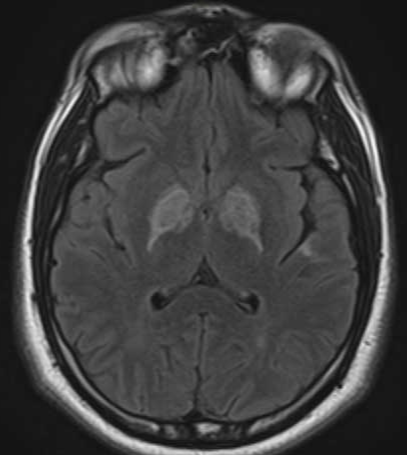 Which of the following is the most likely cause of this patient's current condition?
Endotracheal intubation followed by mechanical ventilation and other supportive measures are begun. A brain MRI obtained several days later is shown in the exhibit. Which of the following is the most likely cause of this patient's current condition? (Multiple Choice)
4.8/5 (88)
(88) A 32-year-old woman comes to the office due to lightheadedness. She had an uncomplicated vaginal delivery 6 weeks ago with minimal blood loss. The patient had mild fatigue and backache during the last trimester of pregnancy, but the fatigue has worsened since the delivery. She has also been having intermittent generalized abdominal pain, loss of appetite, and weakness. She says her skin is tanning even though she has spent only minimal time outdoors. Yesterday, the patient felt like she was "going to pass out" and experienced several episodes of lightheadedness accompanied by nausea and abdominal discomfort. She has no chest pain, shortness of breath, or bleeding. The patient has a history of hypothyroidism and takes levothyroxine. Her temperature is 36.1 C (97 F), blood pressure is 110/60 mm Hg supine and 85/45 mm Hg standing, and pulse is 104/min. Skin shows generalized hyperpigmentation. Lungs are clear, and her heart rate is tachycardic but regular with no gallops or murmurs. Abdominal examination shows mild, diffuse tenderness without guarding and normal bowel sounds. Laboratory results are as follows: 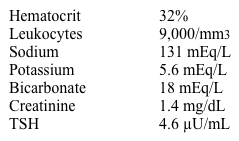 Which of the following is the most likely diagnosis?
 (Multiple Choice)
4.8/5 (74)
(74) A 34-year-old man is brought to the emergency department due to confusion. The patient recently lost his job and moved in with his parents yesterday because he could no longer afford housing. Today, his mother found him disoriented and unsteady. He has no known chronic medical conditions and takes no medications. Temperature is 38.5 C (101.3 F), blood pressure is 164/90 mm Hg, pulse is 108/min, and respirations are 22/min. The patient appears restless and is constantly picking at the bed linens, yelling, "Get these bugs off me." The lungs are clear on auscultation, and cardiac examination is unremarkable with the exception of regular tachycardia. The abdomen is soft and nontender. No extremity edema is present. Laboratory results are as follows: 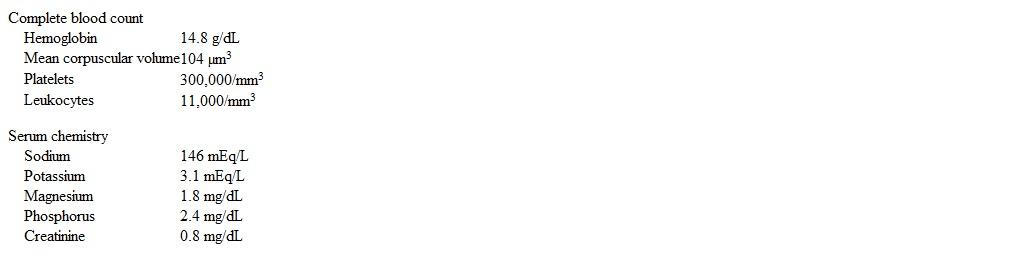 Which of the following would be most helpful to improve this patient's current condition?
 (Multiple Choice)
4.8/5 (82)
(82) Showing 1001 - 1020 of 1702
 Prev
- 1
- ...
- 2
- ...
- 3
- ...
- 4
- ...
- 5
- ...
- 6
- ...
- 7
- ...
- 8
- ...
- 9
- ...
- 10
- ...
- 11
- ...
- 12
- ...
- 13
- ...
- 14
- ...
- 15
- ...
- 16
- ...
- 17
- ...
- 18
- ...
- 19
- ...
- 20
- ...
- 21
- ...
- 22
- ...
- 23
- ...
- 24
- ...
- 25
- ...
- 26
- ...
- 27
- ...
- 28
- ...
- 29
- ...
- 30
- ...
- 31
- ...
- 32
- ...
- 33
- ...
- 34
- ...
- 35
- ...
- 36
- ...
- 37
- ...
- 38
- ...
- 39
- ...
- 40
- ...
- 41
- ...
- 42
- ...
- 43
- ...
- 44
- ...
- 45
- ...
- 46
- ...
- 47
- ...
- 48
- ...
- 49
- ...
- 50
- ...
- 51
- ...
- 52
- ...
- 53
- ...
- 54
- ...
- 55
- ...
- 56
- ...
- 57
- ...
- 58
- ...
- 59
- ...
- 60
- ...
- 61
- ...
- 62
- ...
- 63
- ...
- 64
- ...
- 65
- ...
- 66
- ...
- 67
- ...
- 68
- ...
- 69
- ...
- 70
- ...
- 71
- ...
- 72
- ...
- 73
- ...
- 74
- ...
- 75
- ...
- 76
- ...
- 77
- ...
- 78
- ...
- 79
- ...
- 80
- ...
- 81
- ...
- 82
- ...
- 83
- ...
- 84
- ...
- 85
- ...
- 86
- ...
- Next

Filters
- Essay(0)
- Multiple Choice(0)
- Short Answer(0)
- True False(0)
- Matching(0)