


 Chat with AI
Exam 1: Medicine

Exam 1: Medicine2 k Questions
Exam 2: Pediatric723 Questions
Exam 3: Psychiatry336 Questions
Exam 4: Surgery563 Questions
Exam 5: Obstetrics & Gynecology469 Questions
Select questions type


A 65-year-old man comes to the emergency department due to a sudden loss of vision in his right eye. He has had diabetes, and has been treated with metformin and glyburide for the past 10 years. Visual acuity is reduced to light perception in his right eye, and normal in his left. His vital signs are normal. Ophthalmoscopy reveals loss of fundus details, floating debris and a dark red glow. What is the most likely diagnosis?
(Multiple Choice)
4.9/5  (84)
(84) A 50-year-old man comes to the office for a follow-up visit. He has essential hypertension that was diagnosed a year ago. Laboratory results at that time for complete blood cell count, chemistry panel, and urinalysis were normal. At his last office visit 4 weeks ago, the patient's blood pressure was 144/92 mm Hg. He exercises regularly and has been compliant with a low-salt diet. Current medications include a thiazide diuretic and an ACE inhibitor. He quit smoking 2 years ago after a 25-pack-year history. The patient drinks 3 or 4 glasses of wine every day and 6-8 beers on weekend nights with his friends. He does not use illicit drugs. His father died following a stroke at age 60. Today, the patient's blood pressure is 143/88 mm Hg, and pulse is 76/min. The rest of his physical examination is normal. Which of the following is the most appropriate next step in management of this patient's hypertension?
(Multiple Choice)
4.7/5 (82)
(82) A 40-year-old man comes to the office due to a 2-day history of retrosternal chest pain, pain with swallowing, and epigastric burning. The pain is severe and the patient is afraid to swallow food. He has never had similar symptoms before. The patient has no associated shortness of breath, vomiting, melena, or blood in the stool. Past medical history is notable for nonischemic cardiomyopathy, for which he takes furosemide, carvedilol, spironolactone, lisinopril, and potassium chloride. Temperature is 37.2 C (99 F), blood pressure is 110/65 mm Hg, and pulse is 67/min. Examination shows a soft holosystolic murmur at the cardiac apex, similar to that in prior examinations. The rest of the examination shows no abnormalities. The patient's ECG shows sinus rhythm with no acute ischemic changes. Endoscopy reveals circumferential deep ulceration with relatively normal surrounding mucosa at the middle third of the esophagus. Which of the following is most likely diagnosis?
(Multiple Choice)
4.9/5 (67)
(67) A 34-year-old woman comes to the emergency department after noticing hemoptysis. Yesterday, the patient developed sudden-onset right-side chest pain and mild dyspnea while getting out of bed. For the last 4 days, she has had diarrhea as well as nausea and vomiting after eating in a new restaurant. The patient feels weak and thought her respiratory symptoms were due to being in bed and inactive. Her chest pain increases with deep breathing. Her other medical problems include HIV, heroin use, and a prior episode of cellulitis on the right arm. The patient's last CD4+ cell count 2 months ago was 350/mm3, and PPD at that time showed 2 mm of induration. She has a 15-pack-year smoking history. Temperature is 38.1 C (100.6 F), blood pressure is 110/70 mm Hg, and pulse is 112/min. Mucous membranes are dry. Breath sounds are diminished at the right lung base. Chest CT scan is shown below. 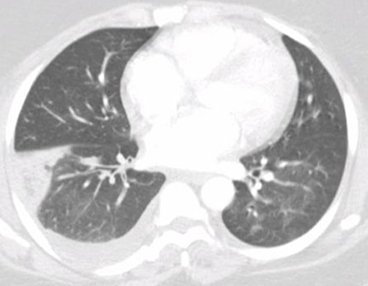 Which of the following is the most likely diagnosis?
 (Multiple Choice)
4.7/5 (72)
(72) A 19-year-old man is brought to the emergency department after being stabbed in the back. Vital signs are normal. He is alert and oriented, with a Glasgow Coma Score of 15. Neurologic examination demonstrates the absence of motor activity in all muscle groups of the right lower extremity, as well as decreased muscle tone. Left leg motor function is normal. Right patellar reflex, Achilles reflex, and Babinski sign are absent. There is loss of light touch and proprioception below the right costal margin. Pinprick sensation is absent on the left side at the level of the umbilicus and below. Which of the following is the most likely location of this patient's injury?
(Multiple Choice)
4.9/5 (78)
(78) A 23-year-old man comes to the office due to right wrist pain. Earlier today, while running to home plate during a baseball game, he landed forcefully on his outstretched right hand with the palm facing down. Since then, the patient has had right wrist pain and swelling. He has had partial relief with acetaminophen and local application of ice packs, but the pain still limits his activities. The patient's medical history is unremarkable. Vital signs are normal. Physical examination shows mild swelling at the dorsum of the right wrist. There is maximal tenderness proximal to the base of the first metacarpal, and the pain worsens with radial deviation of the wrist. Radiographs of the wrist in multiple views reveal no fracture or dislocation. Which of the following is the most appropriate next step in management of this patient?
(Multiple Choice)
4.8/5 (73)
(73) A 42-year-old woman comes to the office for evaluation of weight management. The patient notes that she has not been able to lose any weight despite making dietary changes and exercising 3 times a week for the past 6 months. She is planning to start taking ephedra, an herbal supplement containing ephedrine, that she purchased online to assist with weight loss. The risks of ephedra are discussed, and the patient is advised not to take the supplement. Prescription weight loss medications are reviewed, but the patient declines, stating that she would like to first try ephedra because many of her friends have had sustained weight loss with the supplement. Medical history is otherwise noncontributory. Vital signs are normal. BMI is 36 kg/m2. Physical examination shows obese habitus but is otherwise normal. Which of the following is the most appropriate statement?
(Multiple Choice)
4.8/5 (88)
(88) A 21-year-old man comes to the clinic for painless vision loss in the right eye and headaches. Blood pressure is 190/100 mm Hg and pulse is 96/min. Further evaluation reveals retinal and cerebellar hemangioblastomas. The patient's father had very high blood pressure and significant hearing impairment and died of an intracranial hemorrhage at age 48. Which of the following is the most likely cause of this patient's elevated blood pressure?
(Multiple Choice)
4.8/5 (72)
(72) A 73-year-old man comes to the emergency department saying, "I can't pee!" The patient has not been able to produce any urine over the past 24 hours and has had lower abdominal discomfort. He reports that his urine flow has been weak for the past year. He has had no fever, weakness, numbness, dysuria, back pain, or hematuria. The patient's other medical conditions include myelodysplastic syndrome, hypertension, and lumbar strain. He does not use tobacco, alcohol, or illicit drugs. Temperature is 36.9 C (98.4 F), blood pressure is 150/110 mm Hg, pulse is 94/min, and respirations are 16/min. The abdomen is soft with lower abdominal tenderness and dullness to percussion. Neurologic examination shows absent Achilles tendon reflexes bilaterally but is otherwise unremarkable. Straight catheterization of the bladder produces 800 mL of urine. Which of the following is most likely responsible for this patient's current condition?
(Multiple Choice)
4.8/5 (82)
(82) A 29-year-old woman comes to the emergency department due to worsening generalized weakness and lightheadedness, causing her difficulty ambulating. The patient has had fatigue, nausea, diffuse abdominal pain, and a 10-kg (22-lb) weight loss over the past 3 months. She has a history of hypothyroidism and takes levothyroxine. The patient works as a flight attendant. Temperature is 37.4 C (99.3 F), blood pressure is 80/50 mm Hg, and pulse is 110/min. Orthostatic changes are present. BMI is 19 kg/m2. Physical examination shows dry and pigmented buccal mucous membranes. Lungs are clear to auscultation and heart sounds are normal. The abdomen is soft with mild generalized tenderness. Laboratory results are as follows: 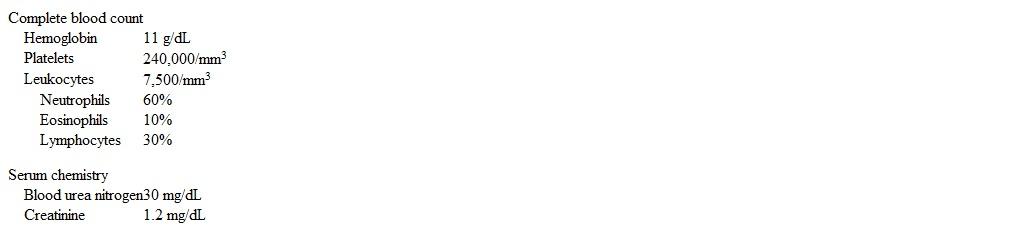 Which of the following is the most likely cause of this patient's current condition?
 (Multiple Choice)
4.9/5 (62)
(62) A 32-year-old man comes to the physician with a 2-day history of fever, headache, malaise, and myalgias. Family members say that he seems slightly confused. He recalls getting a tick bite 2 weeks ago while walking through the woods in Arkansas. His temperature is 39 C (102 F), blood pressure is 125/80 mm Hg, and pulse is 100/min. His neck is supple and there is no lymphadenopathy. The oropharynx is clear. Cardiovascular examination is unremarkable. The abdomen is soft and nontender. There is no rash. There are no focal neurologic deficits. Laboratory results are as follows: 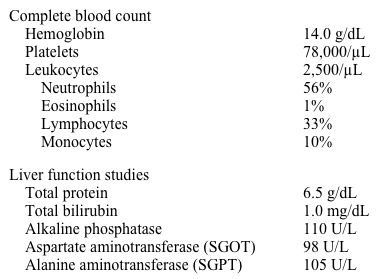 What is the most appropriate next step in management of this patient?
 (Multiple Choice)
4.8/5 (85)
(85) A 68-year-old man comes to the office due to worsening nocturia for the past several months. Lately, he has been waking up every 3-4 hours at night to urinate, which is severely disrupting his sleep. The patient also has increased urinary urgency and frequency during the day but no pain or burning sensation. He has a history of hypertension and takes lisinopril. The patient has a remote history of smoking and does not use alcohol or illicit drugs. Blood pressure is 130/80 mm Hg and pulse is 82/min. The abdomen is soft and nontender. There is no costovertebral angle tenderness. Rectal examination shows a diffusely enlarged and nontender prostate with a smooth surface. Which of the following is the best next step in evaluation of this patient?
(Multiple Choice)
4.9/5 (80)
(80) A 43-year-old man comes to the hospital with chest pain described as dull and nonradiating. The patient has never had chest pain before but has had occasional episodes of dyspnea and coughing in the past. His medical history is significant for diet-controlled diabetes, allergic rhinitis, and childhood eczema. The patient's family history is significant for prostate cancer in his father and rheumatoid arthritis in his mother. He currently takes no medications and does not smoke or consume alcohol. Initial ECG shows ST depression in lateral leads, but cardiac markers show no evidence of acute myocardial infarction. The patient is admitted for further evaluation and is treated with aspirin, clopidogrel, low-molecular-weight heparin, metoprolol, and lisinopril. The next morning, he has shortness of breath and a dry cough but no chest pain. His temperature is 37.2 C (99 F), blood pressure is 122/70 mm Hg, pulse is 63/min, and respirations are 22/min. Oxygen saturation is 95% on room air. Physical examination shows prolonged expiration with bilateral wheezes. There are no crackles. Cardiac examination is normal, and jugular venous pressure is normal. Which of the following is most likely responsible for this patient's current respiratory symptoms?
(Multiple Choice)
4.9/5 (62)
(62) A 35-year-old woman comes to the office due to a 2-day history of weakness in her right hand. She has no other symptoms but reports a transient episode of lower extremity numbness that resolved spontaneously. The patient has a history of herpes labialis and she takes valacyclovir as needed. She recently began taking a vitamin D supplement after she was found to have low serum vitamin D levels. Other medications include oral contraceptive pills; she has also received annual influenza vaccines. The patient does not use tobacco, alcohol, or illicit drugs. Family history is significant for type 2 diabetes mellitus in her mother and hypertension in her father. BMI is 28 kg/m2. Examination shows mild spasticity in her right hand. MRI of the brain shows the findings seen below. 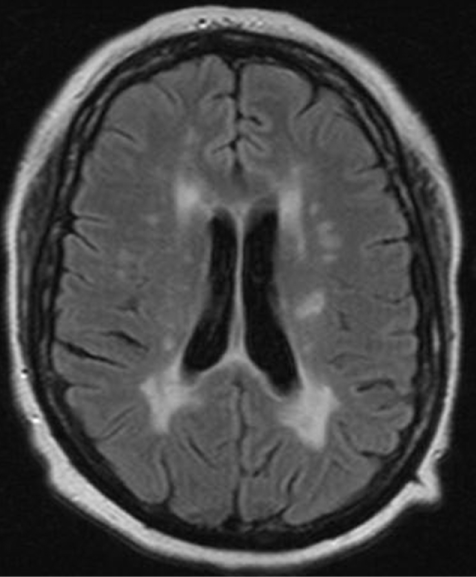 Which of the following is most strongly associated with this patient's current condition?
 (Multiple Choice)
4.8/5 (88)
(88) A 46-year-old man comes to the urgent care clinic due to genital lesions. Three days ago, the patient noticed a papule on the shaft of his penis, which has since evolved into an ulcer. Two similar lesions have developed on the glans penis in the last 24 hours. The patient has had multiple female sexual partners in the last 3 months and uses condoms inconsistently. He has no other symptoms. Examination reveals a 2-cm, nonpainful, ulcerated lesion on the shaft of the penis with indurated borders and no purulent drainage. There are 2 smaller, similar lesions on the glans penis. Mild, bilateral, nontender inguinal lymphadenopathy is present. Which of the following is the most likely diagnosis?
(Multiple Choice)
4.9/5 (80)
(80) A 33-year-old woman comes to the office due to sensory loss in both upper extremities. She recently burned both of her hands while cooking but did not feel any pain. The patient has no history of trauma, headache, or neck pain. She also has no lower extremity weakness or abnormalities of bowel or bladder function. Examination shows diminished strength in the upper limbs. There is loss of pain and temperature sensation on the posterior neck, both shoulders, and both upper extremities. Vibratory and proprioceptive sensation are preserved. Which of the following is the most likely cause of this patient's symptoms?
(Multiple Choice)
4.9/5 (81)
(81) A 64-year-old woman is brought to the emergency department due to sudden-onset headache associated with nausea, vomiting, and a sensation that the "room is spinning." The patient first noticed the symptoms yesterday when she awoke, and they have not improved. She has had no ear pain, hearing loss, fever, or chills. She was recently prescribed hydrochlorothiazide and lisinopril for hypertension. Medical history also includes type 2 diabetes mellitus and hyperlipidemia. The patient does not use tobacco or alcohol. Blood pressure is 124/76 mm Hg and pulse is 86/min. Neurologic examination with the patient lying still shows pure rotatory nystagmus but no extremity weakness or sensory loss. Walking causes worsening of symptoms, and the patient falls toward the left side. Finger-stick glucose is 145 mg/dL. Complete blood count and serum electrolytes are within normal limits. Which of the following is the best next step in management of this patient?
(Multiple Choice)
4.8/5 (86)
(86) A 36-year-old woman comes to the office due to headaches. Over the past 3 months the patient has had constant, bilateral headaches almost every day shortly after awakening. She has had intermittent episodes of migraines since adolescence, but her current headaches are more frequent though milder. The patient has been taking over-the-counter analgesics several times a day. She has had no focal weakness, numbness, or vision changes. The patient has no other medical conditions and does not use tobacco, alcohol, or illicit drugs. Vital signs are within normal limits. BMI is 24 kg/m2. Physical examination, including funduscopy and neurological examination, shows no abnormalities. Blood cell counts and serum chemistry studies are within normal limits. Which of the following is the most appropriate next step in management of this patient?
(Multiple Choice)
4.9/5 (98)
(98) A 62-year-old man comes to the emergency department for evaluation of weakness. Five hours ago, he experienced abrupt-onset weakness in his left arm and leg. The symptoms improved over the next 30 minutes and he had no associated blurry vision, slurred speech, or facial drooping. However, the patient states he is still not "back to normal." He has never experienced similar symptoms. Medical history is significant for hypertension, hyperlipidemia, and osteoarthritis. The patient takes no medications. He has a 25-pack-year history but quit smoking 5 years ago. Blood pressure is 160/96 mm Hg and pulse is 69/min and regular. There are no carotid bruits. Neurologic examination shows mild, left-sided pronator drift. The remainder of the neurologic examination is normal. CT scan of the head without contrast shows no hemorrhage or evidence of acute ischemic infarction. CT angiography of the head and neck does not demonstrate a large vessel occlusion. ECG shows sinus rhythm. Which of the following is the best next step in management of this patient?
(Multiple Choice)
4.9/5 (94)
(94) A 45-year-old woman comes to the emergency department with left leg pain and swelling that has worsened over the last 2 days. The patient has no fevers, chills, dyspnea, or chest pain and has had no trauma to the left leg. Her medical history includes rheumatoid arthritis and gastroesophageal reflux disease, for which she takes low-dose methotrexate, folic acid, and omeprazole. The patient has smoked a pack of cigarettes daily for 10 years and does not consume alcohol. Temperature is 37 C (98.6 F), blood pressure is 140/80 mm Hg, pulse is 70/min, and respirations are 14/min. BMI is 30 kg/m2. The left leg is swollen (>4 cm) compared to the right and is warm and tender on palpation. Pitting edema is present. Her legs are shown in the image below. 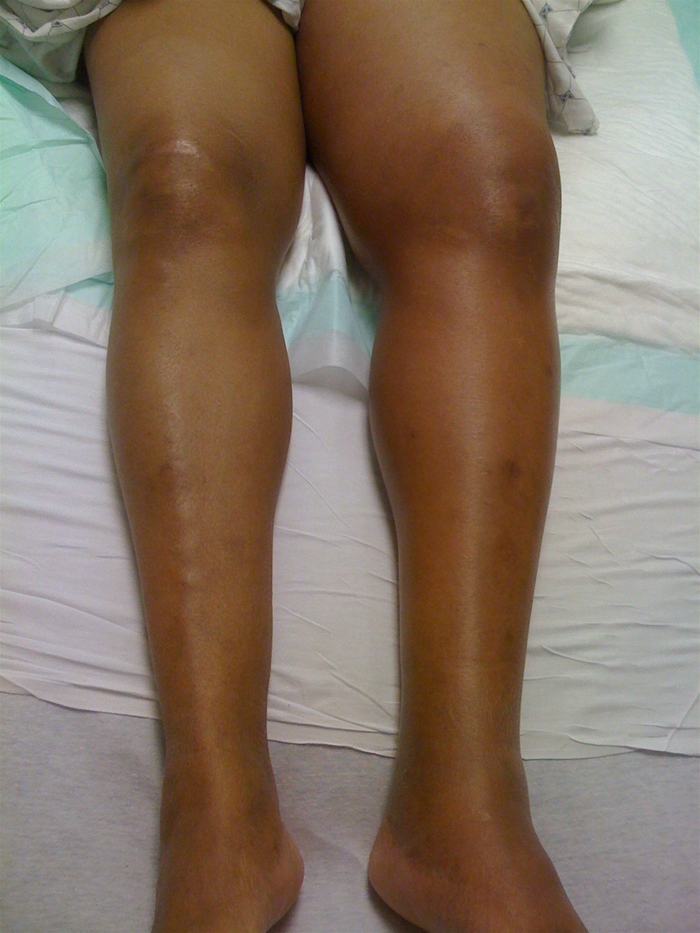 Which of the following is the most appropriate next step in management of this patient?
 (Multiple Choice)
4.8/5 (80)
(80) Showing 441 - 460 of 1702
 Prev
- 1
- ...
- 2
- ...
- 3
- ...
- 4
- ...
- 5
- ...
- 6
- ...
- 7
- ...
- 8
- ...
- 9
- ...
- 10
- ...
- 11
- ...
- 12
- ...
- 13
- ...
- 14
- ...
- 15
- ...
- 16
- ...
- 17
- ...
- 18
- ...
- 19
- ...
- 20
- ...
- 21
- ...
- 22
- ...
- 23
- ...
- 24
- ...
- 25
- ...
- 26
- ...
- 27
- ...
- 28
- ...
- 29
- ...
- 30
- ...
- 31
- ...
- 32
- ...
- 33
- ...
- 34
- ...
- 35
- ...
- 36
- ...
- 37
- ...
- 38
- ...
- 39
- ...
- 40
- ...
- 41
- ...
- 42
- ...
- 43
- ...
- 44
- ...
- 45
- ...
- 46
- ...
- 47
- ...
- 48
- ...
- 49
- ...
- 50
- ...
- 51
- ...
- 52
- ...
- 53
- ...
- 54
- ...
- 55
- ...
- 56
- ...
- 57
- ...
- 58
- ...
- 59
- ...
- 60
- ...
- 61
- ...
- 62
- ...
- 63
- ...
- 64
- ...
- 65
- ...
- 66
- ...
- 67
- ...
- 68
- ...
- 69
- ...
- 70
- ...
- 71
- ...
- 72
- ...
- 73
- ...
- 74
- ...
- 75
- ...
- 76
- ...
- 77
- ...
- 78
- ...
- 79
- ...
- 80
- ...
- 81
- ...
- 82
- ...
- 83
- ...
- 84
- ...
- 85
- ...
- 86
- ...
- Next

Filters
- Essay(0)
- Multiple Choice(0)
- Short Answer(0)
- True False(0)
- Matching(0)